The First Holy Communion invitation is more than a simple notice to gather friends and family. It is the first official proclamation of a child’s entry into a sacred milestone within the Catholic faith. Whether you call it a First Communion invitation, a First Holy Communion invite, or a holy communion invitation, the core purpose remains the same: to share the date, time, and meaning of a child’s public reception of the Eucharist, and to invite loved ones to join in that holy moment. As with any meaningful rite, the invitation should reflect reverence and warmth while giving guests clear information about expectations, attire, and RSVP details.
In this article, you will find a comprehensive guide to creating communion invitation designs, wording options, templates, and practical tips. We cover everything from choosing the right tone for different audiences to balancing tradition with modern aesthetics. By exploring invitations for the first communion in various styles—classic, contemporary, religious, and bilingual—you can tailor a message that resonates with your family’s faith, culture, and personality.
Understanding the Audience and Tone
A thoughtful First Holy Communion invitation speaks to the guest’s relationship with the family and the child. Knowing your audience helps you select the most appropriate tone, whether you’re inviting close relatives, godparents, church members, school friends, or a broader circle of family and neighbors.
Who to Invite
The standard guest list for a First Communion invitation typically includes:
Parents and siblings of the child
Godparents and their spouses
Grandparents and aunts/uncles
Church members who attended catechism classes or the preparation program
Family friends and neighbors who have played a special role in the child’s faith journey
Teachers, coaches, and mentors who supported the child’s spiritual formation
For some families, a smaller, intimate ceremony is preferred, followed by a reception. In other cases, a more expansive guest list may be appropriate, especially if you are inviting extended family across distances. Regardless of size, the invitation should clearly convey the core details: the child’s name, the date and time of the ceremony, the venue, and how to RSVP.
Choosing the Right Tone
The tone of a communion invitation depends on your family’s personality and the level of formality you wish to convey. Consider these common tones:
Traditional and formal: emphasizes liturgical language and reverence, often using full names, titles, and slightly ceremonial phrasing.
Warm and personal: highlights the child’s journey and the family’s love, with a friendly, inviting voice.
Religious and blessed: centers on the sacred meaning of the sacrament, including short Bible verse or prayer quotes.
Modern and casual: uses simple wording, relaxed formatting, and contemporary fonts while preserving the sacred context.
Regardless of style, aim for clarity. Guests should be able to read the invitation at a glance and understand the key details from the moment they look at it.
Design and Format Considerations
A well-designed invitation communicates as much through aesthetics as through text. The right combination of color, imagery, typography, and layout makes a memorable impression while ensuring readability and accessibility.
Color Schemes and Imagery
Color psychology can subtly influence how guests perceive the event. For a First Communion invitation, you might choose:
Soft whites and creams with accents of pale gold or champagne for a classic, timeless look
Pastels like lavender, baby blue, or blush pink for a gentle, child-friendly aesthetic
Rich, regal tones like royal blue, emerald, or burgundy paired with gold for a formal feel
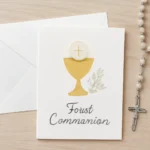
Symbolic imagery such as a cross, a dove, a host, or a modest olive branch to emphasize spirituality
When using imagery, ensure that it supports the text rather than overpowering it. Subtle watermarks or a small emblem placed in a corner can add elegance without distracting from the essential information.
Typography and Readability
Typography affects readability and the overall mood of the invitation. Consider these guidelines:
Choose a primary font for headings (serif or elegant script is common in formal designs) and a readable sans-serif or serif for body text
Maintain a clear hierarchy with consistent font sizes: larger for the name and date, smaller for venue and RSVP
Avoid overcrowding the page. Adequate white space improves legibility and gives a refined look
For digital invitations, ensure the design scales well on mobile devices. For printed invitations, test print on your chosen paper to verify color accuracy and readability.
Print vs Digital
There are advantages to both formats. A printed First Communion invitation has a tangible, keepsake quality and can be displayed or stored as a memory. A digital invitation provides convenience, eco-friendliness, and easy RSVP tracking. Some families opt for a hybrid approach: print a few cards for close relatives and send a digital invite to others.
If you choose digital, you can use e-card platforms, email, or messaging apps that support rich formatting. If you print, consider a high-quality card stock, standardized sizes (for example, 5×7 inches or A7), and professional printing for best results.
Wording and Messaging for Invitations
One of the most critical aspects of the invitation is the wording. You want a message that is precise, meaningful, and respectful of the sacred event. Below are structured approaches to crafting holy communion invitation wording, with variations for different tastes.
Classic Religious Wording
Traditional language often embraces formal phrasing and scriptural or liturgical elements. Consider wording like:
“Together with their families, [Child’s Name] joyfully invites you to share in the Holy Sacrament of First Holy Communion on [Date] at [Time] at [Church Name]. Reception to follow.”
“With grateful hearts, we invite you to witness [Child’s Name] receive First Holy Communion on [Date] at [Time]. Please join us for the celebration in the parish hall.”
“Dear friends and family, you are invited to praise God with us as [Child’s Name] makes their First Communion on [Date] at [Time] at [Church Name].”
If you include a religious verse, select one that aligns with your tradition. For example:
“Let the little children come to me, and do not hinder them, for the kingdom of heaven belongs to such as these.”
“Taste and see that the Lord is good.”
Modern and Casual Wording
For families seeking a lighter, approachable tone, consider wording like:
“Join us as [Child’s Name] takes a big step in their faith journey with their First Holy Communion on [Date] at [Time].”
“We can’t wait to celebrate with you when [Child’s Name] receives their First Communion on [Date]. Ceremony at [Church Name], followed by a reception.”
“Please save the date for a special day as [Child’s Name] shares their First Communion on [Date].”
Bilingual and Multicultural Options
If your family speaks more than one language or your community is multilingual, consider bilingual wording. For example:
English: “We invite you to share in the First Holy Communion of [Child’s Name] on [Date] at [Time].”
Spanish: “Les invitamos a compartir la primera comunión de [Child’s Name] el [Date] a las [Time] en [Church Name].”
Bilingual invitations can alternate language blocks or present side-by-side translations to honor both linguistic communities.
Templates and Samples
Below are practical templates and samples to jump-start your design. Each template emphasizes First Holy Communion invitations in different styles. Replace placeholders like [Child’s Name], [Date], [Time], and [Church Name] with your specific details.
Template 1: Classic Formal
Mr. and Mrs. [Family Name] request the pleasure of your company as their child [Child’s Full Name] receives their First Holy Communion on [Date] at [Time].
RSVP by [RSVP Date] to [Contact Name] at [Phone/Email].
Template 2: Warm and Personal
We are delighted to invite you to celebrate a milestone with our family. [Child’s Name]
will receive their First Holy Communion on [Date] at [Time]
at [Church Name].
Join us for light refreshments in the parish hall afterward. Your presence will bless this day.
RSVP to [Contact Name] by [RSVP Date].
Template 3: Religious Verse Included
“Taste and see that the Lord is good.” Please join us as [Child’s Name] receives their First Holy Communion on [Date] at [Time] in [Church Name].
Reception to follow. RSVP to [Contact Name] at [Phone/Email].
You’re invited to celebrate with us as [Child’s Name] takes their First Holy Communion
on [Date] at [Time] at [Church Name].
Reception to follow. Please RSVP by [RSVP Date] to [Contact].
Template 6: Digital-First Invite
[Child’s Name] is excited to share that they will receive their First Holy Communion on [Date]. Please RSVP online at [RSVP Link]. Ceremony at [Church Name] (address: [Address]).
Template 7: Bilingual Invite
English: You are invited to join [Child’s Name] for their First Holy Communion on [Date] at [Time] at [Church Name].
Español: Les invitamos a celebrar la Primera Comunión de [Child’s Name] el [Date] a las [Time] en [Church Name].
RSVP: [Contact] by [RSVP Date].
Template 8: Family Milestone Card
[Family Name] family invites you to share in the joy as [Child’s Name] makes their First Holy Communion on [Date] at [Time].
Location: [Church Name]. Reception to follow at [Venue].
Practical Checklist and Timeline
Planning a First Communion invitation involves more than formatting text. A practical timeline helps ensure every detail is covered without last-minute stress.
6–8 weeks before: Decide on the guest list, design concept, and whether you’ll print or send digitally.
5–6 weeks before: Finalize the date, time, venue, and RSVP instructions. Prepare address lists for mailing or contact information for digital distribution.
4 weeks before: Create or order the invitations. Begin drafting the wording in the chosen tone (formal, warm, religious, or modern).
3 weeks before: Confirm printing proofs or finalize digital versions. Plan accompanying details such as reception information, dress code, and directions.
2 weeks before: Mail printed invitations or send digital invites. Track RSVPs and follow up with non-responders if necessary.
1 week before: Confirm headcounts with the venue and arrange seating or reception logistics. Prepare any emergency contact details or accessibility needs.
A well-timed invitation process yields a smoother event. Remember to leave room for personal notes to the recipient; a brief handwritten line can add a charming touch to a printed card or a digital message.
What to Include on Every Invitation
The child’s full name and the sacramental event: First Holy Communion
Date, time, and location of the ceremony
Church name, address, and a brief note about the reception
RSVP information and deadline
Dress code (if any) and special instructions (e.g., arrival time, parking)
If you are making a bilingual invitation, you should include all essential information in both languages. Consistency in formatting helps guests quickly locate the details they need.
Invitations don’t have to be expensive to be meaningful. There are plenty of do-it-yourself strategies that blend personalization with cost savings while preserving the sanctity of the occasion.
Look for printable templates from reputable craft sites, religious organizations, or local parish resources. Many offer PDF or editable Word files you can customize with your child’s name and event details. When using printable templates, buy a small pack of high-quality card stock to ensure a professional look.
Use a consistent print size (e.g., 5×7 inches) to simplify mailing and framing.
Choose a design with ample white space so your text remains legible.
Print a few test copies to ensure the colors look correct on different papers.
Customizations on a Budget
You can keep costs down while achieving a polished result by:
Designing invitations in word processing software and printing at a local print shop
Using simple fonts and a single accent color to reduce ink usage
Incorporating a personal photo of the child for a heartfelt, keepsake quality
Pairing printed invitations with a small, meaningful keepsake card (a prayer card, a keepsake cross, or a rosary) to enhance value
Family-Centered Craft Ideas
If your family enjoys hands-on projects, try these:
Handmade seal or stamp with a cross or dove to emboss envelopes
Calligraphy for names or a short blessing on the card
Ribbon accents or satin bow ties to add a festive touch
Remember that the most meaningful aspect is the message and the love it conveys. The aesthetic should support, not overshadow, the message of faith and community.
Etiquette and Practicalities
Etiquette for First Communion invitations varies by culture and family tradition, but certain guidelines are widely accepted and help ensure grace and inclusivity.
Send invitations in a timely manner, typically 4–6 weeks ahead for local guests and 6–8 weeks for out-of-town friends or relatives.
Be inclusive in the guest list, recognizing the child’s relationships with their community, school, church, and extended family.
Provide a clear RSVP deadline and a straightforward method for responses. If you’re using digital invitations, ensure that the RSVP link is easy to access.
Respect dietary and accessibility needs for any post-ceremony reception, especially if you host a meal or refreshments.
For families who wish to honor tradition, you can include a note about attire (e.g., “formal dress” or “dress code: smart casual”) and any expectations about photography or video during the ceremony.
Common Mistakes to Avoid
Even well-intentioned invitations can miss the mark if certain pitfalls are not avoided. Here are common mistakes and how to prevent them:
Unclear details: Always include date, time, venue, and RSVP instructions in a prominent place. If the ceremony has a separate reception, mention that too.
Inconsistent information: Double-check addresses, hours, and names to avoid confusion or missed guests.
Overly long text: Keep the message concise. Use bullet points or separate lines for readability.
Forgetting accessibility needs: If you have guests with mobility or dietary considerations, note arrangements or contact information for accommodations.
Ignoring digital accessibility: If sending digital invitations, ensure font sizes are legible and that the RSVP process is straightforward on mobile devices.
Conclusion: Celebrating a Sacred Milestone with Thoughtful Invitations
The First Holy Communion invitation sets the stage for a meaningful spiritual celebration. By balancing reverence with warmth, and tradition with a modern sensibility, you can craft an invitation that honors the sacred moment while inviting friends and family to participate in the joy of this sacramental milestone.
Whether you choose a classic formal invitation, a modern and casual card, a bilingual design, or a digital invitation, the heart of the message remains the same: a community of faith comes together to witness and support a child as they receive the Eucharist for the first time. As you tailor wording, choose visuals, and plan accompanying celebrations, remember that the most enduring keepsakes are the memories created and the prayers shared on this blessed day.