Psalm 74 Destruction Meaning: Interpreting the Psalm’s Imagery of Ruin and Hope
Psalm 74 Destruction Meaning: Interpreting the Psalm’s Imagery of Ruin and Hope
Psalm 74 stands as one of the most striking expressions of collective lament in the biblical canon. When readers encounter the line-by-line portrait of ruin, the question often emerges: what does destruction mean in this psalm, and how can it be read as both ruin and a doorway to hope? The phrase psalm 74 destruction meaning often surfaces in contemporary study as a way to frame the psalm’s imagery—ruined sanctuaries, desecrated altars, and a cosmos destabilized—as a language through which the faith community processes catastrophe while holding fast to trust in the God who remembers and acts. In what follows, we explore the destruction imagery of Psalm 74, articulate its varied interpretations, and show how the psalm moves from the memory of ruin toward the possibility of deliverance and renewed covenant life.
To grasp the destruction meaning in Psalm 74, it helps to place the text within its historical and literary frame. The psalm is traditionally labeled as a maskil (a thoughtful or instructive piece) of Asaph, a figure associated with temple worship and liturgy in ancient Israel. The opening cry—“O God, why have you cast us off forever?”—invites readers into a public lament that is not merely personal grief but communal distress. The central event invoked is the destruction of the temple and the desecration of the sanctuary, a disaster that shook national memory and religious life. In historical terms, many scholars connect the psalm to the period surrounding the fall of Jerusalem and the burning of the First Temple by the Babylonians in 586 BCE, though some argue that echoes of later crises in Judea (including later sieges) inform its imagery as well.
Literarily, Psalm 74 deploys a range of symbolic devices to translate political catastrophe into sacred language. Its opening plea shifts into a catalog of acts attributed to enemies, followed by a long appeal to divine memory—“Remember this, how the enemy has mocked your name.” The destruction imagery is not incidental decoration; it functions as a vehicle for communal identity, theological critique, and the longing for judgment turned toward mercy. The engagement with ruin thus becomes theological work: a way to name, interpret, and ultimately reframe catastrophe in terms of faithfulness and fidelity to the covenant.
The Core Images of Destruction in Psalm 74
The psalm offers a mosaic of ruin that ranges from the tactile to the cosmic. The following elements repeatedly surface as anchor points for readers trying to translate the destruction meaning into present understanding:
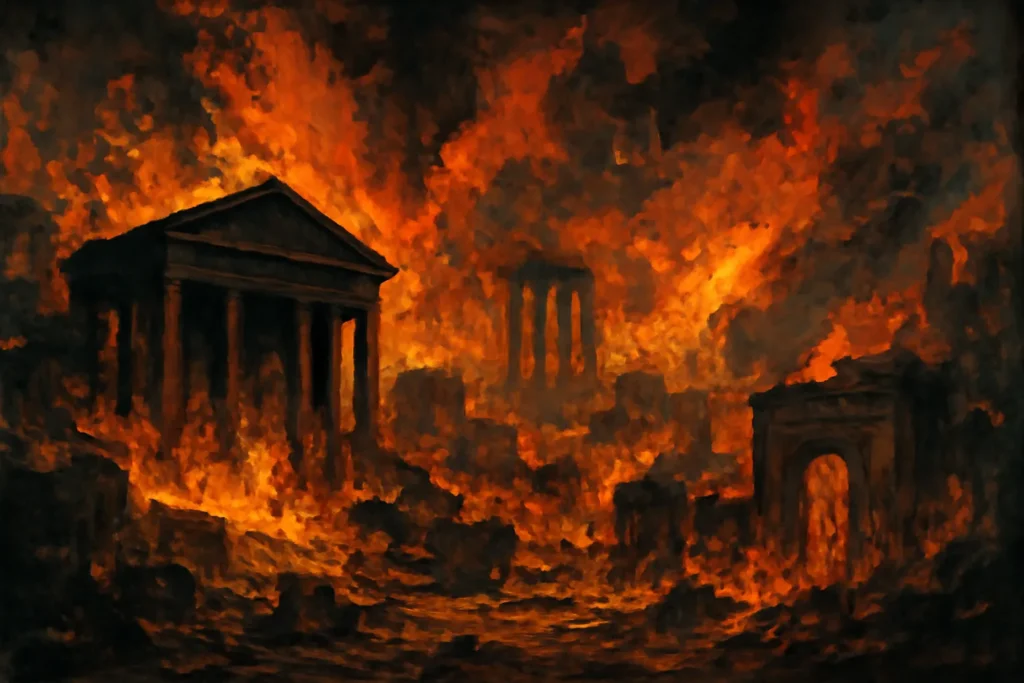
The desecration of the sanctuary: The attackers are described as storming the temple precincts, tearing down its ritual structures, and profaning the dwelling place of God’s Name. The temple in this scene is not merely a building but the locus where heaven and earth meet in worship; its ruin signals a rupture in divine-human relationship.
The burning and defilement of holy spaces: The imagery of fire consuming the cedars, gates, and altars conveys total destruction, not as a mere failure of architecture but as a desecration of sacred order. The sanctuary becomes a scorched memory, and memory itself becomes a battleground for faith.
The roar of enemies and the tearing of sacred adornments: The psalm paints the invaders as loud, aggressive forces who challenge the integrity of worship. This is not only a political crisis but a spiritual assault on the people’s sense of divine presence.
Cosmic disturbances: The heavens are invoked, the earth trembles, and natural phenomena become signs of a disrupted order. This cosmic language links political ruin with universal consequences, inviting readers to read personal or national catastrophe within a larger, instructive frame.
Memory as a counter-image: Interwoven with the destruction is a call to remember past acts of salvation—God’s deeds on behalf of the people—and a petition for those acts to be renewed in the present crisis.
Destruction and the Sanctified Space
One of the most persistent images is the destruction of the sanctuary. It is easy to read this as mere vandalism; a more nuanced reading sees it as an assault on the center of Israelite worship and identity. The psalmist suggests that when a sacred space is toppled, the entire community feels disoriented, their sense of purpose and vocation called into question. Yet within this disruption there is an invitation to reframe what worship means: not only the rites performed within walls but the remembrance of a God who is present in history, even when the building is gone or unusable for the moment.
Most readers who study Psalm 74 are drawn to a paradox: ruin is not the end of the story. The destruction meaning in this psalm often hinges on how the author threads through lament to petition, how crisis opens space for divine intervention, and how memory becomes a seed of hope.
Destruction as a catalyst for prayer: The imagery of ruin intensifies the cry to God to act. The very repetition of the declamatory, almost liturgical, questions—“Why do you sleep, O Lord?” or “Do not forget the afflicted forever?”—serves as a discipline of faith, training the community to approach God with honesty about pain and fear.
Ruin as a test of fidelity: The crisis tested the people’s trust in God’s promised presence. The psalmist argues that fidelity persists even in the face of destruction, turning the ruin into a testing ground for whether the community remains faithful to its covenantal memory and to the expectation that God will act.
The possibility of divine action: The cry for God to stretch out a “strong hand” or to remember and redress the offense against the sanctuary reveals the conviction that destruction is not a sealed fate but a situation that can be redirected by God’s intervention.
Hope grounded in memory: Even as walls burn, the memory of God’s past salvations becomes the soil in which new expectancy grows. The psalmist does not pretend ruin does not hurt; instead, ruin is a historical marker that God has acted in the past and can act again.
Memory as a Bridge from Ruin to Restoration
In Psalm 74, memory is not nostalgia; it is a theological device that binds believers to their covenantal identity. By recalling God’s prior acts, the community reframes their present crisis in light of a track record of divine faithfulness. The guilt of past unfaithfulness, the persistence of enemies, and the hope for deliverance are woven together in a way that keeps faith alive. The phrase destruction meaning here includes the sense that ruin is not meaningless; it is a stage in the ongoing drama of God’s redemptive plan.
Thematic Threads: Memory, Covenant, and Community Identity
Beyond the immediate images of ruin, Psalm 74 engages with larger themes that help interpret the destruction meaning for readers across generations. Three threads stand out: memory and covenant, communal identity in crisis, and the goal of justice grounded in divine action.
Memory and covenant: The psalmist appeals to the people’s recollection of God’s deeds—not as an ancient museum piece but as a living argument for present trust. Remembering past deliverances becomes a way to claim future deliverance. The juxtaposition of ruin with remembrance fosters a robust sense that God’s faithfulness is not contingent on a single moment of existence but a continuous pattern in history.
Communal identity under pressure: The destruction of sacred space is a communal wound. The poem recognizes that a shared sense of belonging—tied to the temple’s presence and to the people’s worship life—constitutes a core element of identity. When that is threatened, the community must articulate who they are in relation to God and in relation to one another, even as they plead for mercy.
Justice as divine initiative: The psalm’s rhetoric sustains the claim that God is not distant or indifferent. Instead, God is perceived as the one who can judge the oppressors and restore rightful order. The destruction meaning here is ultimately inseparable from a hope anchored in divine justice and fidelity to the covenant.
Historical vs. Theological Readings
Scholars often frame Psalm 74 in two overlapping, not mutually exclusive, ways. The historical lens reads the psalm as a record of a concrete catastrophe—the destruction of a temple and the political subjugation of the people. A theological lens sees the same text as a meditation on the problem of suffering, the presence (or absence) of God, and the possibility of renewal through divine intervention. The destruction meaning in each reading informs the other: history provides the concrete stage on which faith is tested; theology animates the interpretation of that scene so that it remains usable for worship and ethical reflection in future crises.
How these readings inform preaching and teaching
For communities today, approaching Psalm 74 through both lenses offers a robust approach to preaching and teaching. It validates the pain of disaster while still naming hope as a legitimate response to ruin. It encourages people to address urgent questions—where is God in suffering, what counts as deliverance, how should memory shape present worship—without reducing faith to optimistic slogans. When readers hold both dimensions together, the destruction meaning becomes a language that can be spoken aloud in sorrow and hope alike.
How to Read Psalm 74 Today
Modern readers may approach Psalm 74 as a guide for navigating crises—personal, communal, or societal. The following practices illuminate how the destruction imagery can become a resource rather than a barrier to faith:
Name the ruin honestly: A first act of fidelity is to describe the damage plainly—what has been lost, what has been broken, what has been profaned. This honesty mirrors the psalmist’s own lament and avoids spiritual bypassing.
Invite divine remembrance: Following the psalm’s pattern, invite God to recall old acts of salvation and covenant faithfulness. This invitation keeps the structure of prayer oriented toward action rather than resignation.
Distinguish between destruction and divine absence: The psalm’s pain is real, but the cry does not conflate catastrophe with God’s presence. Holding the tension between ruin and the possibility of intervention prevents a collapse into cynicism or fatalism.
Remember the community dimension: Read the ruin as a shared experience that calls for communal repair, solidarity, and ritual renewal. Destruction becomes a moment for strengthened bonds and reoriented worship life.
Seek concrete steps toward justice and restoration: The psalm ends with a posture of petition that includes a desire for tangible deliverance—reinstating order, restoring sanctuary, and reestablishing the possibility of communal worship.
Poetic Devices and Structural Considerations
The psalm’s powerful imagery is reinforced by its poetic craft. A closer look at structure and devices helps illuminate the destruction meaning and how it is conveyed with artistic force:
Parallelism: The Hebrew poetry of the psalms often relies on parallel lines that reinforce a point by presenting two motifs in balance or contrast. In Psalm 74, this technique intensifies both the lament and the petition, creating a rhythmic heartbeat between ruin and plea.
Chiasmus: The text sometimes positions ideas in a mirrored order, guiding readers through a circuit from catastrophe to petition to anticipated mercy, and then back to a renewed sense of covenant.
Imagery of cosmic disruption: The references to the heavens, the earth, and the fire in the sanctuary elevate the disaster beyond local politics, portraying it as a disruption in the whole order of creation. This zooms the destruction from the immediate to the universal, inviting readers to see suffering as part of a larger divine pedagogy.
Rhetorical questions: The psalm uses questions to compel engagement, demanding that listeners examine their assumptions, fears, and hopes. The questions are not merely rhetorical; they function as a spiritual exercise designed to awaken faith to act in alignment with truth and justice.
Practical Takeaways for Faith Communities
What can congregations, families, and individuals carry away from Psalm 74’s destruction meaning for modern life? Several practical strands emerge:
Worship that speaks honestly: Music, prayers, and sermons that name pain while maintaining trust reflect the psalmist’s integrity. Lament becomes a doorway to renewal rather than a dead-end.
Ritual memory as renewal: Remembering God’s deeds in the past can become a catalyst for present commitment—service, justice advocacy, and communal healing follow remembrance.
Theology of hope in crisis: The psalm teaches that hope does not erase suffering but reframes it within a narrative of divine faithfulness and anticipated restoration.
Justice-centered interpretation: In reading ruin, communities are urged to discern ways to pursue justice, address oppression, and repair harm—especially where sacred trust has been violated.
Pastoral care rooted in lament: When individuals or groups experience catastrophe, leaders can use the psalm’s framework to validate pain, invite prayer, and guide toward constructive steps for collective healing.
Translation Variants and How They Shape Meaning
Different Bible translations render Psalm 74 with slight nuance, and those choices can affect how readers perceive destruction meaning. Some renditions emphasize the destruction of the sanctuary more pointedly, while others foreground the cry for divine action or the cosmic dimensions of ruin. For readers, it is helpful to compare a few versions to see how wording can shift emphasis—from the brutality of destruction to the confidence that God is not finished with the people. This multiplicity of readings invites interpretive humility and deepens engagement with the text’s core questions: Where is God in catastrophe? How can memory sustain faith? What would it mean for God to act now?
While Psalm 74 is rooted in a specific biblical context, its central tension—ruin that provokes prayer and hope that invites divine action—speaks across faith traditions. Communities that have faced destruction, exile, or institutional collapse often find in this psalm a sympathetic voice. The imagery of a temple desecrated or a sacred space laid waste appears in many religious literatures, yet Psalm 74 offers a particularly poignant meditation on how sacred memory can sustain a people when ritual spaces and political powers fail. For interfaith dialogue, the psalm can function as a comparative study in how different traditions articulate loss, collective memory, and the longing for justice and renewal in the face of ruin.
Although the word destruction dominates Psalm 74’s first half, the latter portion ushers in a resolute longing for restoration. The psalmist’s insistence that God has acted in the past becomes a charge to believe in future intervention, even when present circumstances appear most bleak. The combination of lament, memory, and hope constitutes a durable spiritual toolkit for those who must navigate devastation without surrender. In this sense, psalm 74 destruction meaning can be translated from a literal description of damage into a spiritual program: to lament honestly, remember faithfully, and expectantly await a renewed act of divine mercy and mercy’s outward expression in justice and communal healing.
Destruction in Psalm 74 is multi-layered—physical ruin of temple and ritual space, as well as a crisis of memory, identity, and divine presence.
The imagery is intentional: it links the collapse of sacred places to cosmic signs, inviting readers to interpret suffering within a larger cosmic framework.
Hope emerges not by denying pain but by invoking memory of God’s past acts and by praying for renewed intervention and justice.
Reading Psalm 74 in today’s context can help communities articulate loss while articulating pathways toward healing, reform, and renewed worship.
In all its stages—from lament to plea to hopeful expectation—Psalm 74 models a disciplined way to encounter destruction without surrendering to despair. Its destruction meaning is not merely a record of what happened; it is a living invitation to engage with suffering in a way that can lead to deeper trust, communal solidarity, and a renewed sense of vocation in light of divine faithfulness.








Leave a Reply