When a child prepares to receive their First Communion, one of the most meaningful rituals is the act of inviting family and friends to share in the celebration. 1st Communion cards and their printable counterparts offer a tangible way to announce the moment, set the tone for the day, and create a keepsake that families can treasure for years. This article explores everything you need to know about designing, purchasing, and using First Holy Communion invitations—whether you plan to print them at home, work with a local printer, or opt for a fully digital solution.
In the category of Communion invitations, you will encounter a wide range of styles, from traditional religious motifs to modern minimalist designs. The keyword here is versatility: a well-made printable invitation can honor the child’s faith journey while reflecting the personality of the family and the tone of the celebration. Throughout this guide, you will see different terms used interchangeably—First Communion cards, First Holy Communion invitations, eucharist invitations, Holy Communion cards—because the core purpose remains the same: to share a sacred moment with loved ones in a format that is both beautiful and practical.
What makes printable invitations for a first communion special?
Printable First Communion invitations have several distinct advantages. They are:
Cost-effective compared to custom-printed one-off designs, especially when you need multiple copies for a large guest list.
Highly customizable, allowing you to tailor text, imagery, color schemes, and typography to match the child’s personality and the family’s faith tradition.
Environmentally friendly when you reuse templates or print on recycled paper, reducing waste and minimizing trips to a print shop.
Flexible in format, offering options for single-panel cards, folded designs, and multi-panel layouts with space for RSVP details, directions, and extras like a response card or insert note.
Easy to distribute digitally for those who cannot attend in person, while still preserving the tactile charm of a physical card for others.
Because there are so many possible directions—religious symbolism, color palettes, and printable formats—parents and guardians can craft an invitation that honors both faith and family. The resulting First Holy Communion invitations become a thoughtful preview of the celebration, helping guests plan, anticipate, and participate with joy.
Design considerations for 1st Communion cards
Designing communion cards requires balancing tradition with personal taste. Here are key design considerations to guide your process.
Symbolism and imagery
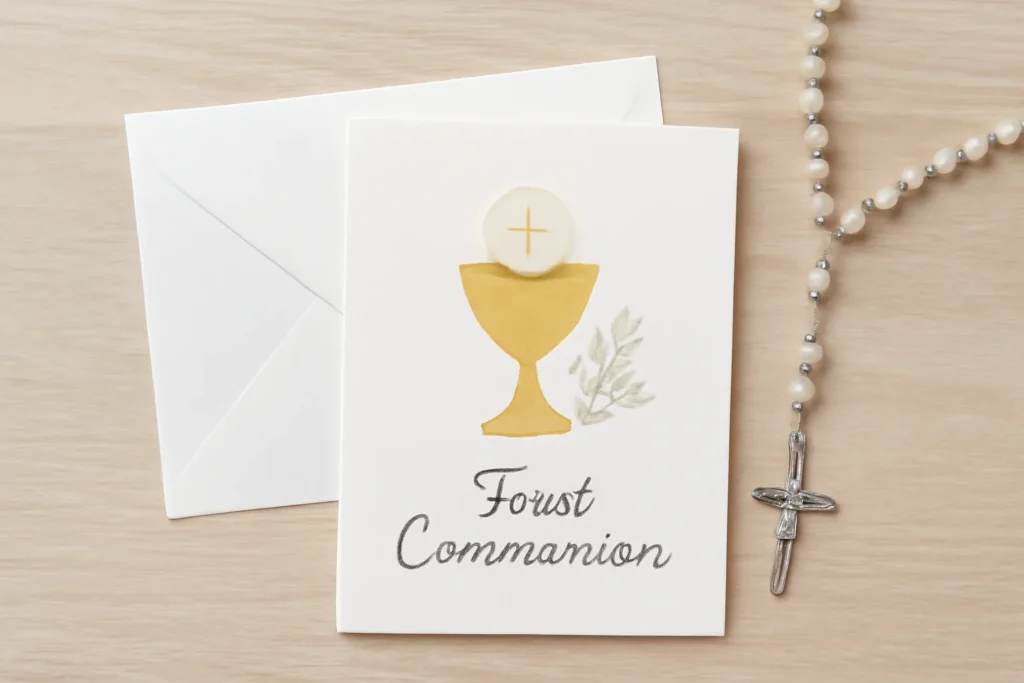
Many families choose imagery that directly references the sacrament. Common motifs include the host (the consecrated bread), the chalice, a dove symbolizing the Holy Spirit, and sacred rosaries. Other popular elements are angels, crosses, lilies, and stained-glass-inspired patterns. Beyond strictly religious symbols, some designs incorporate nature scenes such as sunrises or gentle waves to signify new beginnings and spiritual renewal.
When selecting imagery, consider how it resonates with the child’s faith journey. For families with a more traditional Catholic background, a card featuring a simple cross, a chalice, and a host might be appropriate. For more contemporary families, clean lines, soft gradients, and abstract shapes can convey reverence without feeling overly ceremonial. The central goal is clarity and beauty that elevates the moment rather than overwhelming it.
Color palettes and typography
Color plays a crucial role in setting the mood of the invitation. Pastel tones—soft blues, blush pinks, muted sage greens, and lavender—often work well for girls’ and boys’ celebrations alike, because they feel gentle and celebratory without being garish. Rich, jewel-tone palettes (deep blues, emerald greens, maroon, gold accents) can lend a classic, formal feel appropriate for a traditional ceremony.
Typography is equally important. A good printable invitation relies on legible type paired with a style that suits the occasion. For example:
Serif fonts (such as Garamond, Times New Roman, or Caslon) convey tradition and formality.
Sans-serif fonts (such as Helvetica, Futura, or Avenir) lend a modern, clean look.
A script font (like Great Vibes or Pacifico) can add a touch of elegance when used sparingly for names or headings.
A practical approach is to pair a readable sans-serif body text with a subtle script or serif for the name or headline. Always ensure there is high contrast between text and background to maximize readability, especially for guests who will read the invitation from a distance or on a mobile screen.
Traditional single-panel cards with a front image and a back panel or space for a short message.
Folded cards that create a small, elegant booklet feel and offer extra space for more details (directions, dress code, RSVP information).
Multi-panel designs that unfold into a larger message or reveal a personal photo.
Minimalist designs with generous white space, a single emblem, and restrained typography for a modern effect.
In terms of printing considerations, you’ll want to decide early whether you’ll print at home, use a local print shop, or work with an online vendor. Each path has its own best practices for file formats, bleed, margins, and color management.
Formats, sizes, and printing specs for 1st Communion cards
Understanding printable specs is essential to ensure your First Communion invitations come out correctly. Here are practical guidelines.
Common card sizes
5x7 inches (approximately 12.7 x 17.8 cm) – a classic size that fits most frames and standard envelopes.
4x6 inches (approximately 10.2 x 15.2 cm) – a compact, economical option; often works well for RSVP cards or inserts.
A6 (4.5 x 6.25 inches) – a popular European size that suits folded designs.
Bleed, margins, and safe zones
If you are designing the card yourself, you should design with a bleed of 1/8 inch (0.125 in) on all sides. This ensures that, when trimmed, there are no white edges. Keep important text and graphics within a safe zone of at least 1/4 inch (0.25 in) from the edge to prevent cropping.
Print settings vary by software and printer, but a common approach is to export a print-ready PDF with embedded fonts and a 300 dpi (dots per inch) resolution for crisp text and images.
Printing methods: home vs professional
Home printing is ideal for small runs, last-minute needs, or fully DIY projects. Use good-quality white or color stock, appropriate ink (pigment-based inks tend to last longer), and a reliable home printer that can handle heavier cardstock.
Professional printing offers superior color accuracy, higher-quality finishes (matte, gloss, soft-touch), and options like double-thick stock, die-cut shapes, foil stamping, or letterpress. This is often a good choice for formal celebrations or when a larger guest list demands a polished look.
Finish and paper types
Paper choice can dramatically affect the card’s appearance and durability. Common options include:
Smooth cardstock for clean text and modern aesthetics.
Textured stock (e.g., linen, felt) for a tactile, traditional feel.
Coated papers for vibrant photos and sharper details.
Recycled papers for an eco-friendly option that still looks sophisticated.
If you plan to add special effects—such as foil accents, embossing, or spot UV coating—consult with your printer about compatibility and minimum order quantities.
Guidelines for wording and etiquette
The wording on First Holy Communion invitations sets expectations for the event and informs guests about details like date, time, venue, and RSVP. Etiquette can vary by tradition, but many families value clarity, warmth, and a respectful tone.
A well-crafted invitation often includes:
The name of the child receiving the sacrament
The date and time of the ceremony
The location/address of the church
Formal or casual dress code, if applicable
RSVP instructions and contact details
A brief message or sentiment from the family (optional)
The following are wording samples you can adapt to suit your style. They demonstrate the balance of reverence and warmth that many families aim for.
as our child Alexandra Marie
receives her First Communion.
Saturday, the fifteenth of June, two thousand twenty-six
at four o’clock in the afternoon
Saint Joseph Church
123 Faith Lane, Hometown, USA
Reception to follow
Sample wording for a more contemporary invitation
Please join us as Alexandra Marie
takes her First Communion.
Saturday, June 15, 2:00 PM
Saint Joseph Church
123 Faith Lane, Hometown
RSVP and practical details
Including RSVP information is essential to help the family plan for seating, refreshments, and accommodations. You may want to offer multiple RSVP methods (phone, email, or online form) and specify a deadline. If you send digital invitations, consider adding a clickable RSVP link or a QR code for easy access.
Step-by-step guide to creating printable 1st Communion invitations
Whether you are a DIY enthusiast or a first-timer, this step-by-step guide will help you create beautiful printable invitations that feel personal and thoughtful.
Define the tone — Decide whether the invitation should be formal, semi-formal, or casual, and choose imagery and typography accordingly.
Choose a format — Single-panel, folded, or multi-panel. Consider how much text you need to include, and whether you want to include an RSVP card or insert.
Pick a color palette — Align with the liturgical season (e.g., white and gold for a solemn, festive feel) and with the child’s personality.
Select imagery — Choose 1–2 focal motifs (host, cross, dove, lily) and use them consistently across the card.
Set typography — Choose 1–2 typefaces and assign roles (headline vs. body text) to maintain readability.
Prepare the copy — Write the essential details and optional sentiments, then proofread for accuracy and tone.
Create the design — Using a design tool (Canva, Illustrator, InDesign, or a word processor), assemble the elements with proper margins and bleed.
Test print — Print a test copy on similar stock to the final card to check colors, alignment, and readability.
Print and trim — Print the full run, trim carefully, and finish with any extra touches (envelopes, wax seals, ribbons).
Package and mail — Bundle with return address labels or a small note, then mail with appropriate postage and timing.
Where to find templates and templates variations
In the realm of first communion invitations, templates are a valuable starting point. They save time and provide professional structure while offering ample room for customization. You can find a broad range of options:
Free templates that cover classic and modern aesthetics, ideal for quick projects and families on a budget.
Premium templates with higher-quality graphics, more typography options, and professional layouts suitable for formal gatherings.
Printable kits that include invitation cards, RSVP cards, direction cards, and thank-you notes in coordinated styles.
DIY templates designed for tools like Canva, Adobe Express, or Microsoft Word, which provide user-friendly customization with drag-and-drop elements.
When choosing a template, look for compatibility with printing methods (home printing, professional printing, or online printing) and confirm that the file format accommodates your software. Commonly available formats include PDF, PNG, and JPG. If you plan to print at home, ensure the template has an embedded bleed or a clearly marked bleed area; if you plan to print professionally, export the design as a high-resolution PDF with fonts embedded.
Etiquette, inclusivity, and guest considerations
Modern families increasingly emphasize inclusivity and accessibility in their invitations. Consider the following approaches:
Inclusive language that welcomes all family and friends, including godparents, mentors, or sponsors who will participate in the ceremony.
Accessibility options such as larger fonts, high-contrast color combinations, and simple layout for easier readability by older guests and those with visual impairments.
Clear information on venue, timing, dress code (if any), and RSVP so guests can plan accordingly and feel respected.
If you want to honor a variety of traditions within a family or parish, you can tailor wording to reflect both the religious significance and the cultural aspects of the celebration. The key is to maintain a respectful tone while ensuring the message remains clear and welcoming.
Budgeting and planning considerations
A thoughtful approach to budgeting can help you avoid surprises. Here are practical budgeting considerations for printable 1st Communion invitations.
Estimate the guest count early, as it impacts the number of cards you’ll need and the size of your print run.
Account for extra pieces such as RSVP cards, direction cards, and thank-you notes, if you plan a coordinated suite.
Choose between DIY and professional printing based on budget, timeline, and desired finish. DIY may save money but require more hands-on time; professional printing offers refined results but at a higher cost per card.
Consider finishes like matte, gloss, or soft-touch coatings. Each adds a different tactile feel and can affect price.
If you’re aiming for an elegant, timeless look, a coordinated suite with matching envelopes and seals can be surprisingly affordable, especially when buying templates in bulk or using standard card sizes that fit widely available envelopes.
Envelopes, presentation, and finishing touches
The envelope is the first tactile touch guests experience, so it should complement the card. Consider these finishing touches to elevate the presentation:
Coordinated envelopes with liners in a color that mirrors the invitation design.
Return address printing to streamline mailing and add a professional touch.
Wax seals, ribbon tied bows, or embellished corners for a celebratory feel without overdoing it.
Canada/Postage or international stamps that match the tone of the invitation and are appropriate for international guests if needed.
If your guest list includes a mix of in-person and remote attendees, you might also consider sending a digital version by email or messaging apps, preserving the option to print locally. A well-crafted digital version can include an RSVP link, an online map, and a short note about the event, while still serving as a legacy keepsake.
Supporting sources of inspiration for 1st Communion cards
For families seeking design inspiration, consider a few reliable sources of ideas:
Religious art and iconography from trusted sources within your faith tradition to inform symbolism and layout.
Parish resources that offer guidelines or preferred formats for sacramental invitations.
Design portfolios from printers and template marketplaces featuring examples of First Holy Communion invitations in various styles.
DIY design communities where fellow crafters share tips on typography pairing, color theory, and printable layouts.
Keepsakes, memory-making, and aftercare
A First Communion invitation can become a cherished keepsake when paired with a thoughtful presentation. Many families store a copy of the invitation in a memory box alongside a photo from the ceremony, a program, or a note about the day. In addition, you can create thank-you notes that reference the invitation and incorporate the same design elements for a cohesive look.
Complementary keepsake ideas
Framed mini prints of the invitation design for the child’s room or a family album.
A digital photo page or digital album version of the invitation with the ceremony’s photographs.
A small insert card with a blessing or personal reflection from the child about their faith journey.
When the day passes, the printable invitation can serve as a doorway to memory: a reminder of the community that supported the child on their spiritual path and a marker of growth over time.
Timeline planning for a seamless rollout
Planning ahead ensures that First Communion invitations arrive in plenty of time for guests to respond and for the family to prepare. Here is a practical timeline you can adapt.
6–8 weeks before: finalize the guest list, choose a design, and decide on the printing method.
4–6 weeks before: complete the layout, proofread the text, and place an order or prepare files for printing.
3–4 weeks before: begin printing or sending digital invitations; monitor RSVPs and adjust seating or reception plans as needed.
1–2 weeks before: assemble envelopes, seals, and any inserts; confirm accommodations for guests with access needs.
Day of the event: prepare a guest sign-in or memory book that complements the invitation suite and offers a space for well-wishes and reflections.
Variations on the theme: different phrasing and styles
Because language and presentation matter, it’s useful to consider variations of the same concept. Here are different angles and phrasing ideas you can adapt for your First Communion cards or related invitations.
Traditional invocation with a formal tone and classic typography.
Modern minimalism with clean lines, ample white space, and a restrained color palette.
Photo-centered designs that showcase the child’s celebration with a portrait or symbolic imagery.
Blessing-and-prayer focus that highlights a short reading or favorite verse from scripture.
Family story style that includes a brief sentence about the child’s spiritual journey and hopes for the day.
Each variation can be paired with a distinct color scheme, font pairing, and image style to express the family’s identity. The key is to maintain readability and respect for the sacred nature of the event while giving guests a sense of welcome and anticipation.
Practical tips for success with 1st Communion invitations
To wrap up, here are practical recommendations to help you achieve a successful, beautiful outcome with your printable 1st Communion cards.
Start with a clear brief describing your desired style, color palette, and inclusivity goals.
Choose a single consistent design language (color, typography, imagery) that can be applied to all related pieces (invitation, RSVP card, directions, thank-you card).
Keep the copy concise but informative. Guests should know what to expect and how to respond without confusion.
Proofread carefully and consider having a trusted friend or family member review for tone, accuracy, and typos.
Test print with the same stock you intend to use and verify that colors, alignment, and text size are comfortable to read.
With thoughtful planning and attention to detail, your 1st Communion cards will not only announce the day but also reflect the faith, love, and culture of the family. They can become treasured mementos that preserve the memory of a child’s important milestone and the community that supported them on their spiritual journey.
Conclusion: making the invitation meaningful
In the end, the beauty of First Communion invitations lies in their ability to convey meaning, warmth, and anticipation. Whether you are drawn to a traditional or a contemporary approach—or a combination of both—your printable cards can be a thoughtful reflection of faith and family. When you plan with care, you create more than just a card; you create a bridge between the sacred moment of the sacrament and the joy of shared fellowship with those who care for your child.










Leave a Reply