In many Christian communities, the First Holy Communion marks a sacred milestone in a child’s spiritual journey. The accompanying invitation cards are more than just a note about a date and place; they set the tone for the ceremony, reflect family values, and provide guests with essential details in a respectful and graceful way. When chosen thoughtfully, 1st Holy Communion invitation cards become keepsakes—mementos that families may treasure for years to come. This article explores templates and printables that help you craft invitations that are both meaningful and practical, with guidance on design, wording, printing, and personalization.
What are 1st Holy Communion invitation cards?
At their core, First Holy Communion invitations announce a religious rite of passage. They inform guests about the date, time, location, dress code, and reception plans while communicating reverence and joy. A well-designed invitation does more than convey logistics; it invites recipients to participate in a solemn act and celebrate a child’s spiritual step forward.
The spectrum of First Communion invitation designs ranges from traditional to contemporary, from minimalist to ornate, and from fully printed cards to digital formats. The terminology you’ll encounter includes:
1st Holy Communion invitation cards
First Holy Communion invitations
First Communion invitation templates
Holy Communion invitation printables
First Communion RSVP cards
Regardless of the style you choose, the essential components remain consistent: the child’s name, the date and time, the church or venue, the address, and an optional reception or after-ceremony gathering detail. Additionally, many families include a brief religious verse or a memorable blessing to set a reverent tone.
Template categories: templates and printables for every vibe
When selecting templates for 1st Holy Communion invitation cards, you’ll encounter several broad categories. Each category can be customized to reflect family values, cultural traditions, and church affiliation. Below are common template options and what makes them suitable for different audiences.
Traditional and classic templates
These cards honor longstanding church traditions with formal typography, delicate borders, and symbolic imagery such as crosses, doves, or wheat. They often use neutral color palettes—ivory, cream, pale blues, soft pinks—and print on high-quality cardstock.
Modern and minimalist designs
Clean lines, ample white space, and restrained color schemes characterize modern First Communion invitations. Minimalist templates emphasize readability and a contemporary aesthetic that fits urban or secular-influenced styling while preserving a sacred tone.
Elegant and luxurious options
For families seeking a more upscale look, these templates feature luxe materials (like metallic foils, embossing, or velvet ribbon accents) and refined typography. They can be printed on high-end stock and supplemented with optional add-ons, such as vellum overlays or custom monograms.
Rustic and charming designs
A rustic approach uses textured cardstock, warm color palettes, and natural motifs (woodgrain patterns, burlap textures, floral simplifications) that evoke a country-church vibe or garden setting.
Religious symbolism-focused templates
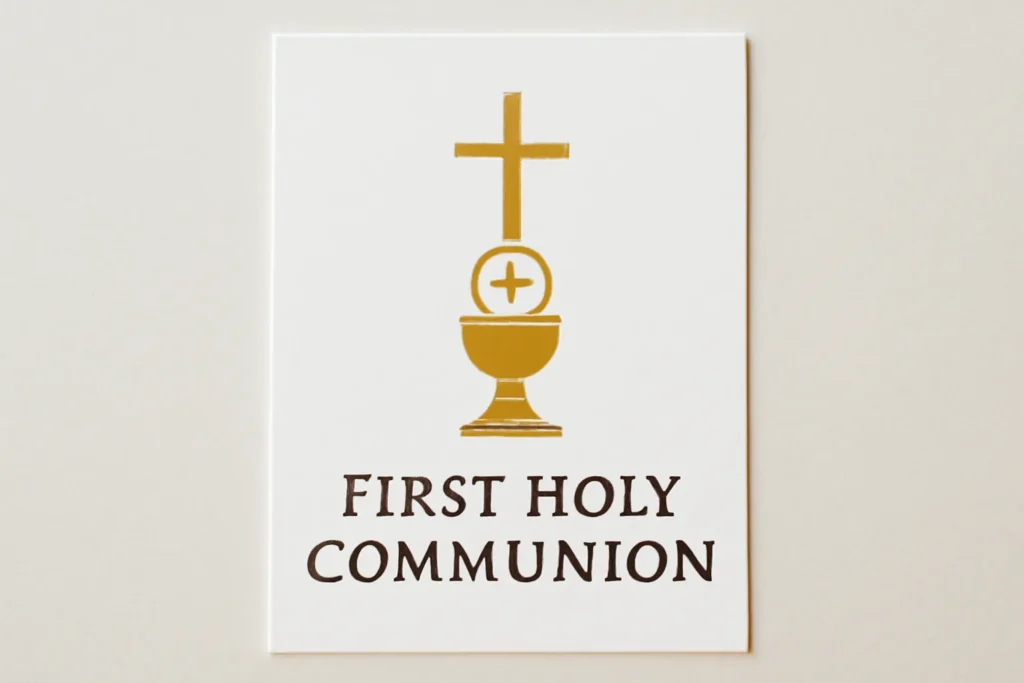
Some families prefer templates that foreground explicit religious symbolism, including crucifixes, chalices, angels, or loaves and fishes. These can be integrated subtly or become the centerpiece of the card, depending on the family’s preference.
DIY and printable templates
For hands-on crafters or budget-conscious households, printable templates allow you to print invites at home or through a local print shop. They are often offered as downloadable PDFs or editable formats (such as AI, PSD, or InDesign templates) to modify names, dates, and other details.
Photo-based and personalized templates
Including a photo of the child is a popular option that adds a personal touch. Photo-based templates can range from casual snapshots to professional portraits, paired with meaningful captions or verses.
Regardless of category, a strong template will balance aesthetic appeal with legibility and ease of use. It should also respect the preferences of the child’s church or parish—some communities have guidelines about imagery, symbols, or languages used in invitations.
Printables and digital versions: formats that fit your needs
Printables and digital versions of invitation templates provide flexible options. They allow families to print at home, work with a local print shop, or distribute invitations via email or social media. Here are common formats and their uses:
Printable PDFs: Flat or folded cards that you print and cut. Ideal for DIY printing at home or at a local shop.
Editable templates: Formats that let you customize text and imagery before printing (often offered in .AI, .PSD, .EPS, or .INDD formats).
Digital invites: Email-ready or social media-friendly templates. Good for recipients who prefer online access or are far away.
Monochrome or color options: Variants designed to reduce printing costs while keeping a polished look.
When choosing between printables and digital options, consider your guest list, delivery method, and your preferred level of personalization. Digital invites can be eco-friendly and convenient, but physical cards often have a tangible impact and can be kept as keepsakes. The best approach may be to offer both—a primary physical invitation with a supplementary digital version for friends and relatives who are far away.
Key design elements for effective 1st Holy Communion invitations
Designing First Holy Communion invitation cards that are both beautiful and legible requires attention to several design elements. Below is a guide to the most important aspects to consider.
Color palettes
Colors can convey tone as much as imagery does. Traditional palettes often rely on ivory, white, gold, and pastel hues. Contemporary palettes may experiment with muted teals, blush pinks, or charcoal accents. Consider the church’s color symbolism and family preferences when selecting a palette.
Typography
Font choices influence readability and mood. Serif fonts (e.g., Garamond, Baskerville) project formality, while sans-serif fonts (e.g., Open Sans, Lato) offer a modern feel. For headings, you might pair an elegant script with a clean sans-serif for body text. Always ensure that the text contrast is strong enough to be read easily—especially for seniors and visually impaired guests.
Imagery and symbols
Iconography such as a cross, chalice, host, dove, or olive branch can communicate the religious significance without overpowering the layout. When using imagery, ensure it aligns with the child’s church's doctrine and avoids over-commercialization. Subtle borders, filigree, or watercolors can add a touch of sanctity without distraction.
Layout and hierarchy
A clear visual hierarchy helps guests quickly locate essential information. Typically, the child’s name appears prominently, followed by the date, time, and location. A secondary line can present RSVP details or a note about the reception. Use alignment, margins, and spacing to create a calm, organized appearance.
Wording and tone
The language should reflect reverence while remaining warm and welcoming. If the sender prefers a formal tone, opt for traditional phrasing. If a more casual environment suits the family, a friendly and heartfelt tone is appropriate. Remember to include both religious context and practical instructions in concise form.
Wording considerations: sample language and templates
Crafting the perfect wording for 1st Holy Communion invitations requires balancing tradition with personal voice. Below are wording templates you can adapt. Each example includes the essential details and a suggested closing line.
Traditional tone
Together with their families, Jamie A. Smith invites you to share in the joy of their First Holy Communion on Saturday, May 15, 2027 at 10:30 AM at St. Michael Parish, 123 Church Street, Anytown, USA. A reception will follow in the parish hall. Kindly RSVP by April 30 to jamie@example.com or (555) 123-4567.
Warm, modern tone
You’re invited! Join us as Ella Marie Carter receives her First Holy Communion on June 6, 2027 at 9:00 AM at Holy Trinity Church, 45 Christ Way, Hometown. Light refreshments will be served afterward. Please RSVP by May 20 to ella@example.com.
With gratitude to God, we invite you to share in the blessing of Sarah Grace Nguyen’sFirst Holy Communion on Sunday, May 2, 2027 at 11:00 AM at Saint Mary’s Cathedral, 77 Faith Lane, Cityville. A reception will follow in the parish center. Kindly RSVP by April 25 to nguyen.family@example.com.
Inclusive and approachable
We invite you to celebrate with us as Daniel/Riya Khan experiences their First Holy Communion on April 18, 2027 at 2:00 PM at Grace Church, 12 Church Street, Townsville. A light reception will be held afterward. Please RSVP by April 5 to family@example.com.
Tips for wording:
Include all vital details: who, what, when, where, and RSVP.
Be mindful of gender and name order; verify how the child wishes to be addressed.
Consider including a brief blessing or a short Bible verse (e.g., John 1:12 or Matthew 19:14).
Provide optional reception details if applicable.
Practical guidance: printing, stock, and production considerations
The production process for 1st Holy Communion invitation cards involves material choices, print methods, and finishing touches. Here is a framework to help you choose the right options for your budget and timeline.
Stock and finish
Cardstock weight is measured in pounds (lb) or grams per square meter (gsm). Typical high-quality invitation stock ranges from 80–120 lb (120–320 gsm). Heavier stock feels substantial and tends to photograph well. Finishes may include:
Matte or satin finishes for a classic look and easy readability
Glossy finishes for bright, vibrant colors
Pearlescent or vellum overlays for a luminous effect
Embossing, debossing, or foil accents for a luxurious touch
Print methods
Common printing methods include:
Offset printing for large quantities and sharp images
Digital printing for short runs, customization, and cost efficiency
Letterpress for a tactile, timeless appeal
Laser cutting or die-cut shapes for unique card silhouettes
Enclosures and embellishments
Optional additions can elevate the presentation:
Enclosure cards with RSVP instructions
Envelope liners in coordinating colors
Ribbon or string ties for a touch of elegance
Wax seals or stickers for a personal seal
Envelopes and addressing
Proper addressing conveys respect and care. Consider self-adhesive or traditional return-address labels. If you’re sending internationally or to a diverse group, include clear postal instructions and consider bilingual wording if appropriate.
Personalization and customization ideas
Personalization makes 1st Holy Communion invitations more meaningful. You can tailor templates to reflect a child’s personality, family history, and cultural traditions. Here are ideas to personalize without compromising readability or reverence.
Monograms or family crests to honor lineage and faith.
Personal photos from a recent portrait session or a candid moment.
Verse or blessing aligned with the child’s favorite scripture.
Ceremony-specific notes about communion attire or modest dress code expectations.
Parental or sponsor acknowledgments on the back of the card or in a separate insert.
When adding personalization, ensure typography remains legible and that images are high-resolution to avoid pixelation when printed. If you use a photo, select a high-contrast background and an image where the child’s face is clearly visible.
Etiquette and cultural considerations
Invitations to a religious ceremony carry etiquette expectations. Being mindful of these considerations helps ensure that your invitations are received with warmth and respect.
Timeliness: Send invitations with ample lead time, typically 4–6 weeks before the ceremony. For out-of-town guests or international attendees, consider mailing even earlier.
Respect for church guidelines: Some parishes have guidelines about imagery, language, or dress codes on invitations. When in doubt, consult the church office or priest.
RSVP etiquette: RSVP requests should be clear and provide a deadline. Consider including a phone number, email, or online RSVP option.
Inclusivity: If your community is diverse, provide language options or translations as appropriate. A bilingual card can be helpful for families with relatives who speak different languages.
Dress code clarity: If a guideline is in place (e.g., formal attire), state it briefly on the invitation or on a separate insert.
Delivery formats: how to distribute invitations
Beyond the physical card, there are several ways to distribute invitations while maintaining decorum and accessibility.
Print-and-send: Traditional method—print cards and mail them to guests.
Hand-delivered invitations: For close family and friends, hand-delivery can be a personal touch.
Digital distribution: Email or messaging apps for distant relatives; consider sending a PDF or image file.
Combination approach: Use physical cards for local guests and a digital version for those who live far away.
DIY guide: how to create your own 1st Holy Communion invitations
If you enjoy hands-on crafting or want to maximize control over the final product, a DIY approach to First Holy Communion invitations may be ideal. Here is a practical guide to a successful DIY project.
Choose a template that aligns with your church’s aesthetics and your family’s preferences. Look for templates that include editable fields for name, date, time, and location.
Gather materials: high-quality cardstock, envelopes, a ruler, scissors/craft knife, glue or double-sided tape, and optional embellishments such as ribbons, wax seals, or foil accents.
Prepare the design: customize the chosen template with the child’s name, event details, and any personalization elements. Ensure the layout remains balanced and legible.
Proofread: double-check spelling, dates, and addresses. Have a second person review for clarity and accuracy.
Print tests: print a test card on the same stock you plan to use to ensure color and alignment are correct.
Print and finish: print all cards, trim to size, and add any embellishments or inserts. Package with matching envelopes.
DIY invitations can be a wonderful family project, especially when children participate by adding a drawing, a personal blessing, or a small handwriting note to guests.
Budget-conscious planning: cost considerations for 1st Holy Communion invites
Planning invitations for a large guest list requires budgeting. Here are practical tips to control costs without sacrificing style or meaning.
Guest list sizing: The number of invites influences cost more than any other factor. Decide whether to send one invitation per household or per guest, and consider whether children count toward the invite tally.
Print run: Small-run digital printing is cost-effective for 50–100 invites, while offset printing becomes economical for larger quantities.
Stock choice: Heavier stock and specialty finishes increase cost. A simple matte stock with a clean design often provides the best value.
Template access: Some designers offer free templates; others charge a one-time fee. For DIYers, editable templates may reduce time and error costs.
DIY vs professional: Weigh the value of your time against potential savings. A professional print shop might deliver a more polished result with less effort, which can justify higher costs for some families.
A thoughtful approach to budgeting helps ensure you can produce meaningful 1st Holy Communion invitations that reflect your family’s values without causing financial stress.
Where to find templates and printables for 1st Holy Communion invitations
If you’re looking for ready-made templates and printables for First Holy Communion invitations, several sources provide legitimate options. When selecting templates, verify licensing terms to ensure you have the right to print for personal use and to customize text.
Official church or parish resources: Some churches publish templates aligned with their liturgical season and guidelines.
Design marketplaces: Reputable marketplaces offer a range of templates, including editable formats for personal customization.
Graphic designers: Many designers offer bespoke or semi-custom templates tailored to your event, often including a customizing service.
DIY-friendly blogs and tutorials: Some authors share printable templates or step-by-step guides for creating invitations at home.
When using external templates, make sure that the religious imagery and wording align with your beliefs and with any guidelines from your church. If you have questions about appropriateness, consult your parish office or a trusted clergy member.
Printing checklist: ensuring a smooth production process
Before you print, run through a concise checklist to minimize errors and ensure that you achieve a professional result.
Finalize the layout: Confirm margins, spacing, and alignment across all pages or card panels.
Check color accuracy: Do a color Proof on your chosen stock to ensure the final product matches your expectations.
Verify text accuracy: Confirm spellings of names, dates, church address, and RSVP details.
Test print: Print a single sample card to verify readability and overall appearance.
Order or print in batches: If printing at a shop, order in batches to avoid delays and ensure consistency.
Delivery and storage: preserving the memory
After you’ve produced the 1st Holy Communion invitation cards, consider how you’ll deliver and store them as cherished keepsakes.
Envelope presentation: Use matching envelopes and consider adding a return address label or a decorative seal for a refined presentation.
Safe storage: Store unused cards in a cool, dry place away from direct sunlight to prevent fading or warping.
Keepsake packaging: Some families place invitations in a keepsake box with other mementos from the ceremony, such as a program or a photograph.
Variations in tone: matching wording to different religious communities
Different Christian communities might have distinct expectations for invitation language and formality. The following notes help tailor invitations to a range of contexts:
Catholic tradition: It is common to include a formal invitation language, a quote from Scripture, and clear liturgical details about the Mass or service.
Anglican/Episcopal traditions: Invitations may emphasize liturgical structure and the participation of the parish community, with a respectful yet approachable tone.
Protestant denominations: Wording can range from formal to contemporary, with emphasis on community welcome and the sacredness of the day.
Interfaith or multi-denomination families: Consider neutral or inclusive language that honors diverse beliefs while preserving the sacred nature of the rite.
In all cases, ensure that the invitations reflect the family’s beliefs and respect the hosting church’s guidelines. If you’re unsure, consult the parish administrator or a clergy member for guidance.
Conclusion: the enduring value of well-crafted 1st Holy Communion invitations
The 1st Holy Communion invitation cards you choose or design represent more than a date and location. They embody a moment of faith, a sense of family heritage, and a warm invitation to share in a sacred blessing. Whether you opt for a traditional template or a modern design, a photo-based template or a printable format, the right card communicates reverence, joy, and community. By carefully selecting your templates and printables, you can ensure that your invitation not only informs guests but also blesses them with a memory they will treasure long after the ceremony.
As you move forward, consider documenting the process—saving your digital files, notes about the design decisions, and photos of the finished invitations. These records can serve as a family keepsake and a reference for future milestones. Ultimately, the best First Holy Communion invitation is one that reflects your family’s faith, your sense of hospitality, and your commitment to honoring this sacred moment with care and beauty.










Leave a Reply