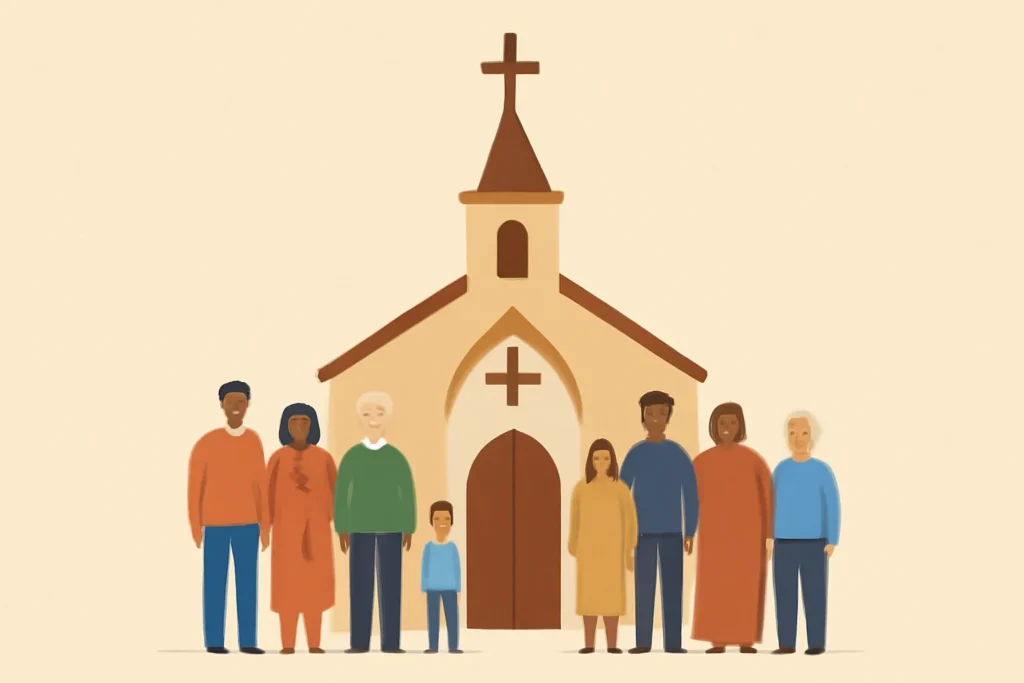
The phrase universal church is used in different ways across Christian traditions, and its meaning can shift depending on historical context, theological emphasis, and denominational vocabulary. At its core, the idea points to a body of believers that transcends a single local gathering, a single congregation, or a single denomination. It aspires to describe the whole of Christ’s people gathered across time, geography, language, and culture. In some traditions, the term emphasizes a wide, even global, scope; in others, it carries a more aspirational or theological sense of communion that binds all who belong to Christ. Because of these varying emphases, the universal church can be described in several synonymous terms and with different nuances: ecclesia universalis (Latin for “universal church”), the catholic church (with a lowercase c meaning “universal”), the Body of Christ, or the notion of an invisible versus visible church depending on the tradition in question.
Definitions in Roman Catholic Theology
In Roman Catholicism, the term universal church is deeply connected to the doctrinal claim that the Church has a unique, divinely established continuity through apostolic succession, entrusted with the means of grace. The Catholic understanding often frames the Church as one, holy, catholic (universal), and apostolic, existing as a single, visible, structured communion governed by the bishops in communion with the successor of Peter, the Pope. Within this frame, the universal church is not simply a metaphor for a large crowd; it is the institutional, sacramental, and doctrinal fullness that accompanies the Church’s mission in the world. Sacraments, apostolic succession, the magisterium, and the church’s unity in faith and discipline are frequently highlighted as distinctive marks of the universal dimension of the Church in Catholic thought.
Definitions in Eastern Orthodoxy
Similarly, the Eastern Orthodox Church speaks of the universal church as the one, holy, catholic, and apostolic body that spans diverse cultures and local churches. Orthodoxy emphasizes that the true Church is visible in tangible worship, sacraments, and continuity with the apostolic tradition, yet it also retains a sense of universality that cannot be confined to a single national church or jurisdiction. In Orthodox theology, the universal church is often described as the fullness of the Body of Christ expressed through its many autocephalous (self-governing) churches, united by apostolic succession, shared faith, and common worship—while inviting ecumenical relations with other Christian traditions under the banner of shared Christian truth.
Definitions in Protestant and Evangelical Thought
Within many Protestant and Evangelical streams, the term universal church can have a slightly different emphasis. Some theologians stress the distinction between the invisible church (the total number of true believers across all times and places, known only to God) and the visible church (the local, organized communities of faith seen in history). In this usage, the universal church refers to all believers in Christ gathered by faith, regardless of denomination or local church boundaries. Others prefer to speak of the universal church as the aggregate of those who profess faith in Jesus Christ, while acknowledging the value of local congregations as concrete expressions of that faith. Across Protestant traditions, the universal church is often linked to the Great Commission—going into all nations and making disciples—along with a strong local-church emphasis on discipleship, worship, and mission within particular communities.
Beliefs and Doctrines Associated with the Universal Church
The concept of a universal church carries a cluster of beliefs that different traditions might phrase in distinct terms, yet share common ground about the scope, purpose, and unity of Christ’s people. The following points highlight elements frequently associated with the universal church across major Christian traditions:
Unity in the Body of Christ: The church is one spiritual organism with Christ as the head. Though there are many local assemblies, there is a fundamental unity that binds all believers across time and space.
Holiness and Sanctification: The universal church is called to pursue holiness in moral life, worship, and love, reflecting the character of God through the sanctifying work of the Holy Spirit.
Catholicity (Universality): The church claims a universal reach and scope, not limited to one culture, nation, or language, but intended to include all peoples and generations.
Apostolicity: The continuity of faith and practice traces back to the apostles. This continuity is often expressed through apostolic succession (in some traditions) and the apostolic teaching that guides doctrine and life.
Authority and Tradition: In traditions that honor both Scripture and tradition, the universal church bears witness to the full deposit of faith handed down through generations, interpreted in a manner consistent with the historic creeds and confessions.
Sacramental or Ordinance Life: Most traditions tied to the historic churches affirm that certain rites (such as baptism and the Eucharist or the Lord’s Supper) anchor the life of the universal church and connect believers to the grace of God through time.
Mission and Witness: The universal church is commissioned to preach the gospel, make disciples, Baptize, and teach all nations, embodying the Great Commission in all corners of the world.
Inclusion and Diversity: While united in core beliefs, the universal church includes a wide diversity of cultures, languages, and expressions of worship that reflect God’s creative and saving work across humanity.
Visible and Invisible Dimensions (where applicable): Some traditions distinguish between the visible church (the concrete, organized communities) and the invisible church (the true believers whom only God fully knows), recognizing that outward affiliation does not always guarantee inward faith.
Eschatological Dimension: The universal church looks forward to the consummation of all things in God’s kingdom, when unity among believers is perfectly realized in the renewed creation.
Key Distinctions Between the Universal and Local Church
To appreciate how the universal church relates to daily Christian life, it helps to map out several important distinctions that are frequently discussed in theology and ecclesiology. The terms universal church and local church describe different scopes, functions, and theological emphases. Keep in mind that different traditions may emphasize different aspects, but the following distinctions capture common patterns:
Scope: The local church refers to a specific congregation or assembly in a particular place and time (for example, a church community in a city or neighborhood). The universal church refers to all believers across time and space who belong to Christ, possibly described as the “whole Church” rather than a single local gathering.
Visibility: In some traditions, the visible church denotes those who visibly gather for worship, mission, and discipline. In those same traditions, the invisible church refers to the true believers known to God. The universal church often sits at the intersection of these concepts, representing the broad, global communion of every believer—whether or not every individual is publicly identifiable as a member of a particular local body.
Authority and Governance: The local church has its own governance structure, leadership, and discipline within a given locale. The universal church speaks to a broader, often more theological or doctrinal unity that transcends local governance, sometimes anchored in apostolic succession or creedal confessions depending on tradition.
Worship and Communion: The local church assembles for regular worship, baptism, and the Lord’s Supper according to its own schedule and practice. The universal church shares in the same faith and sacraments through a broad framework of shared doctrine, but the specific liturgical patterns vary by tradition and culture.
Mission and Outreach: Local churches typically engage in local mission and community life, while the universal church emphasizes a global mission and solidarity with Christians everywhere, often expressed through ecumenical partnership and interchurch cooperation.
Historical Continuity: The local church exists in a particular historical moment and place, whereas the universal church is understood as continuing the apostolic witness across generations and civilizations.
Two Perspectives on Visibility
Within this domain, two complementary perspectives illuminate how believers and communities understand the universal church in practice. The visible/universal approach emphasizes that the church is seen and recognized by outward membership, liturgy, and institutional structure. The invisible or spiritual approach stresses that the essential reality of the church lies in the inner faith of believers, which may outpace or transcend public visibility. Both readings highlight a central point: the church is not simply a human organization, but a divine assembly called to bear witness to Christ in a broken world. Recognizing both dimensions helps believers navigate ecumenical relations, church discipline, and interdenominational cooperation without collapsing the distinct identities of local communities.
Historical Development and Terminology
The idea of a universal church has deep roots in Christian history, and its language has evolved as Christians have engaged questions about unity, doctrine, and practice. Three developments are especially influential for understanding the term today:
Early Christian Usage: In the New Testament and early patristic writings, the term ekklesia (Greek for “assembly” or “church”) is used to describe the People of God gathered in faith. As the church grew from a small, persecuted movement to a global network, writers began to speak of a Church that transcends one city or region—the universal or catholic church in the sense of breadth and continuity.
Medieval Theological Language: By the medieval period, the concept of “ecclesia universalis” gained traction as theologians wrestled with questions of papal authority, apostolic succession, and the universality of the faith. In this era, the universal church often carried institutional weight, visible in the unity claimed by the Western Church under the papacy and by the Eastern churches under their own authorities.
Reformation and Modern Ecumenism: The Protestant Reformation reoriented the language of unity by foregrounding the invisible church (the community of true believers) and by recombining the concept of universality with local autonomy. The modern ecumenical movement further reframed the universal church as a shared aspiration toward visible unity among diverse Christian traditions, while preserving doctrinal distinctives and local expression.
In contemporary usage, the term often reflects a synthesis of these historical strands. For some, the universal church denotes a single, unified institution with worldwide governance and sacramental life. For others, it is a broader, more theological concept that identifies all true believers and all who are united to Christ by faith, regardless of formal communion. Each of these readings has implications for church governance, ecumenical dialogue, and how believers understand their own life within the body of Christ.
Practical Implications for Believers
Understanding what counts as the universal church has practical consequences for how Christians live, worship, and engage with others. Here are several implications that can shape daily faith and long-term church life:
Ecumenical sensibility: Recognizing the universal scope of the Church encourages cooperation across denominational lines for common witness, relief efforts, and humanitarian work, while still honoring the distinctive calls of local communities.
Affirmation of diversity: The universal church invites appreciation for diverse cultures, languages, and forms of worship, all animated by shared faith in Christ. This fosters humility, mutual respect, and a commitment to learn from one another.
Discerning unity and truth: Believers are called to pursue unity in essential doctrines while preserving a respectful, charitable posture toward legitimate differences in nonessentials.
Mission continuity: The universal church upholds the Great Commission as a perpetual mandate, encouraging believers to engage in local evangelism and global missions as connected parts of a single mission.
Accountability and discipline: The idea of a shared church body implies shared standards and accountability, whether through local church governance or broader theological norms recognized across communities.
Sacramental and liturgical life (where applicable): For traditions that preserve a robust sacramental life, the universal church reframes sacraments as lines of continuity that connect local worship to the wider body of believers.
Hope for perfect unity: Eschatological hope—the day when all believers are perfectly unified in truth and love—gives shape to how Christians pursue reconciliation and healing in a fractured world.
Common Myths and Clarifications
Several misunderstandings about the universal church recur across cultural and doctrinal lines. Clarifying these can prevent confusion and promote healthier dialogue among Christians and with people of other faiths. Here are some frequent myths accompanied by clarifying notes:
Myth: The universal church is identical to the Roman Catholic Church.
Clarification: In Catholic theology, the universal church has a particular institutional form and teaching authority within the Roman Catholic communion. In other traditions, the term can refer to a broader communion of believers or to the spiritual unity of all who belong to Christ, outside of any single denominational frame.
Myth: The universal church exists only among Protestants or only among Catholics.
Clarification: The concept has multiple strands—Catholic, Orthodox, and Protestant thinkers all speak of universality, but they emphasize different mechanisms (apostolic succession, creeds, shared faith, or a combination of Scripture and tradition) for maintaining unity and truth.
Myth: The universal church has no tangible reality and is merely an abstract idea.
Clarification: While some expressions emphasize the spiritual or invisible dimension, many traditions also speak of the universal church as a real, lived community—visible in worship, mission, and the cooperation of local churches across borders.
Myth: The universal church dissolves local identity and autonomy.
Clarification: The universal church and local churches are often viewed as complementary: local communities express the church in a specific place and time, while the universal church points to a broader unity and purpose that informs local life.
Glossary of Key Terms and Concepts
To navigate discussions about the universal church, it helps to be familiar with a few recurring terms. Here is a concise glossary that captures the essential ideas:
Ecclesia universalis (Latin)
A traditional phrase meaning the universal church, used to describe the church’s global scope and unity across cultures.
Ekklesia (Greek)
Originally meaning “assembly,” the biblical word that undergirds the concept of the church as the gathered people of God.
Visible church
The portion of the church that is publicly identifiable through worship, governance, and membership in a particular locale.
Invisible church
The theological idea that the true people of God are known fully only by God, regardless of outward affiliation or membership.
Apostolic succession
The view that church authority and doctrinal continuity are transmitted through a chain of bishops traced back to the apostles, especially in Catholic and Orthodox traditions.
Creeds
Brief, shared statements of faith that articulate core beliefs believed to bind the church in unity across time and space.
Putting It All Together: How Different Traditions Express the Universal Church
Different Christian traditions articulate the universality of the Church in ways that reflect their history, theology, and ecclesial practice. Some key distinctions include the following:
Catholic and Orthodox expressions tend to emphasize a continuity of faith and sacramental life safeguarded by apostolic succession and ecumenical councils. The universal church is often linked to a structured, visible ecclesial order that transcends national boundaries and unites diverse people in a shared faith and worship life.
Protestant and Evangelical expressions frequently stress the unity of believers in Christ and the idea that the true church includes all who trust in Jesus, regardless of denomination. Some Protestants reserve the term universal church for the invisible dimension—the fellowship of genuine believers—while still acknowledging the importance of local churches for teaching, fellowship, worship, and mission.
Ecumenical perspectives pursue visible unity and cooperation among church bodies while acknowledging doctrinal differences. In ecumenical dialogue, the universal church serves as a frame for common witness and shared commitments to peace, justice, and humanitarian work, even as distinct traditions preserve their own identities.
Encounters with the Universal Church in Practice
Beyond theology, the concept of a universal church shapes many practical aspects of Christian life. Here are some real-world manifestations of how believers and communities relate to the idea of universality:
Worship and liturgy: Across traditions, there is a longing to honor the faith handed down through generations, sometimes expressed in memorable creeds, confessional statements, or classic liturgical forms that attempt to speak to believers in many places at once.
Education and formation: The universal scope of the church informs catechetical efforts, theological education, and the transmission of doctrinal values to new generations and to new geographic contexts.
Missional collaboration: Mission organizations, denominational partnerships, and local churches often coordinate across borders to address needs, share resources, and advance gospel proclamation in places where the church is growing or facing challenges.
Social witness: The universality of the church underwrites a commitment to human dignity, justice, and charitable service, reflecting the belief that Christ’s lordship extends to all corners of society.
Pastoral care and discipline: The idea of a global church informs how communities think about accountability, discipline, and pastoral care in a way that respects local circumstances while seeking to maintain doctrinal integrity.
Variations in Language and Emphasis: A Brief Survey
Because Christian history features rich diversity, many people encounter the universal church under various labels. A few notable phrases reflect different emphases:
One Church (often used as a shorthand for the belief that there is a single Church of Christ despite many local expressions).
Catholic Church with a lowercase c (noting universality as a trait of the Church rather than a specific denomination).
Visible Church vs. Invisible Church (a dichotomy especially prominent in Protestant theology about the nature of true faith).
Ecclesia universalis (Latin, used in Catholic and Orthodox contexts to denote the worldwide church).
Body of Christ (a biblical metaphor that emphasizes unity, diversity, and mutual belonging among all followers of Jesus).
Historical Milestones and Their Impact on the Concept
Several historical milestones have shaped how people think about the universal church today. Understanding these helps readers see why the term means different things to different Christians:
Patristic era: Early church fathers articulate a vision of the Church as a unified body spanning multiple communities, solidified through apostolic teaching and shared worship.
Schisms and councils: The Great Schism (1054) and subsequent ecumenical councils underscored the tension between unity and diversity, influencing how the universal church is imagined—sometimes emphasizing unity in essentials and diversity in nonessentials.
Reformation: The Reformation reframed the discussion by foregrounding the authority of Scripture, the priesthood of all believers, and the notion that universal fellowship is rooted in faith in Christ rather than in a single institutional framework.
Modern ecumenism: The 20th and 21st centuries saw an intentional move toward dialogue, shared social witness, and cooperative mission among different churches, shaping contemporary understandings of how the universal church acts in a pluralistic world.
Questions Christians Often Ask About the Universal Church
People frequently seek clarifications about how the universal church relates to their own life and faith. Here are common questions and concise answers that reflect current thinking across traditions:
What is the universal church in the simplest sense?
In its simplest sense, it is God’s people gathered in faith in Jesus Christ across all ages and places, encompassing both those who belong to particular local churches and those who belong to a larger, global communion of faith.
Is the universal church the same as a single denomination?
No. While a single denomination can claim to express the universal church in a limited sense, the universal church is broader, extending beyond any one denomination to include all who profess faith in Christ, across diverse traditions and communities.
How does the universal church relate to local church life?
The universal church provides a framework for unity, shared belief, and mission that informs local churches. Local congregations carry out worship, community life, and pastoral care within their context, while remaining part of the larger body of Christ.
What role do creeds play in understanding the universal church?
Creeds articulate core, time-tested beliefs that help believers across different communities maintain doctrinal continuity. They serve as a common reference point for affirming what binds the universal church in faith and practice.
How should Christians engage with believers from other traditions about the universal church?
Engagement should be characterized by humility, curiosity, and charity. Recognizing shared beliefs and common mission while acknowledging legitimate differences can foster constructive dialogue, practical cooperation, and mutual respect.
As you explore the concept of the universal church, you may notice that the core idea—believing in a single, global body of Christ—remains a unifying thread. Yet the way that unity is conceived, safeguarded, and lived out varies with theological traditions, historical experiences, and cultural contexts. The result is a richly plural landscape in which the universal church is both a theological ideal and a practical reality experienced in worship, mission, and fellowship around the world.
For readers new to this subject, a useful approach is to distinguish between the idea of universality (a broad, inclusive sense of belonging to Christ’s worldwide people) and the practice of unity (the concrete ways communities strive to live in fellowship, teach sound doctrine, and work together across boundaries). Taken together, these dimensions offer a nuanced and robust picture of what many Christians mean when they speak about the universal church.







Leave a Reply