Garden of Gethsemane in the Bible: Meaning, Significance, and Key Passages
Garden of Gethsemane in the Bible: Meaning, Significance, and Key Passages
Among the pivotal moments in the Christian narratives, the scene in the Garden of Gethsemane stands out as a deeply human moment embedded within a divine plan. This garden, a quiet place on the Mount of Olives just outside the old city walls of Jerusalem, becomes the stage where Jesus faces the immediate darkness of the hour ahead, wrestling with fear, sorrow, and surrender. The setting is not merely a backdrop; it is a symbolic space where the boundaries between human vulnerability and divine mission are tested and transfigured. In biblical terms, the episode that unfolds in the olive grove—often described by readers with a variety of names and descriptors—shapes the trajectory of the Passion, illuminates the nature of prayer, and offers a model for trust under trial. The language around this site varies in the Bible, offering semantic breadth to the reader: some call it the garden by the olive press, others simply the olive garden, and a common shorthand is the Gethsemane garden or the garden at Gethsemane.
The Setting: Where the Garden of Gethsemane Is Located
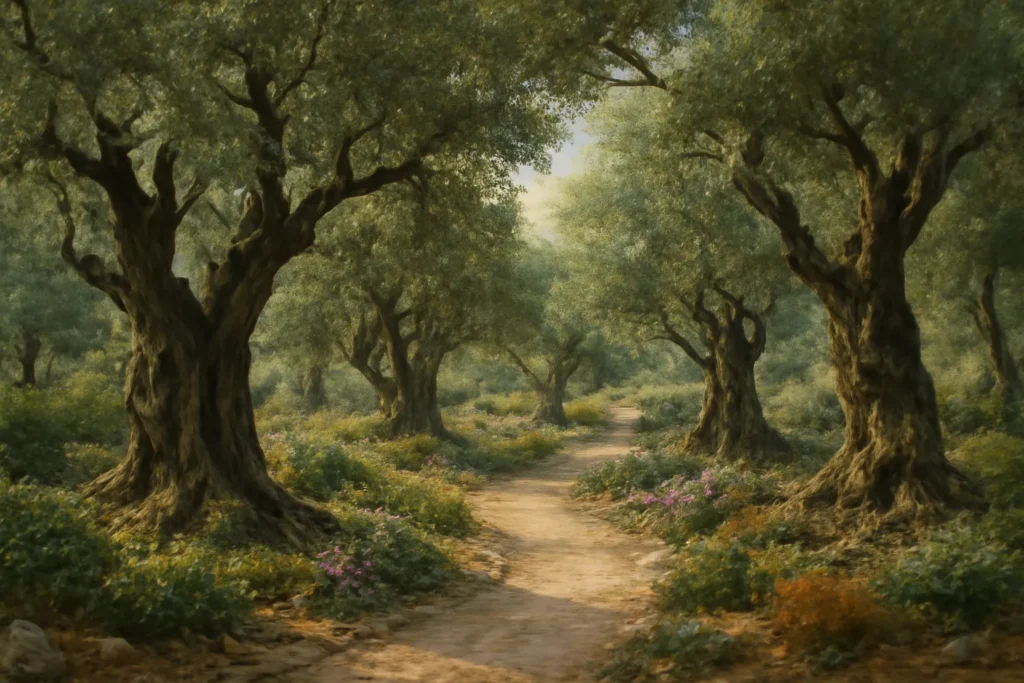
The Garden of Gethsemane is described in the Gospel accounts as a private, cultivated space near the city of Jerusalem, tucked along the Kidron Valley and adjacent to the Mount of Olives. The name Gethsemane itself derives from a Hebrew/Aramaic origin meaning “the place of the oil press” — an evocative image that connects the garden to the olive trees that would have grown there and the ancient agricultural life of the region. In the Gospel narrative, this is not a public park or a grand temple precinct; it is a garden-like refuge, a place where Jesus often went with his closest followers to pray and to be with his Father in a moment of sober preparation for what was to come.
In the narrative, the garden’s geographical setting matters. It sits on the edge of the urban environment, within a landscape shaped by the hills and the valley. The emotional geography is parallel to the physical geography: the walk from the city into this garden mirrors the transition from ordinary life into the realm of vocation and sacrifice. The name variations—such as the garden near the Mount of Olives, the olive-press garden, or simply the garden called Gethsemane—are not mere synonyms; they underscore a place where the ordinary rhythms of life give way to a moment when heaven and earth converge in prayer, petition, and obedience.
Location: on the Mount of Olives, near Jerusalem, along the path away from the city’s bustle
Historical feature: olive trees and ancient cultivation; symbolic link to press and suffering
Purpose in the narrative: a setting for intense prayer, testing, and the arrest that follows
The Meaning: Theological Resonance of the Garden Encounter
The Garden of Gethsemane is widely read as a key scene for understanding the nature of Jesus’ suffering, the purpose of his mission, and the character of his obedience. Several threads converge here, offering a depth that scholars and readers have explored for centuries.
The cup is the primary symbolic motif in this scene. In the Gospels, Jesus speaks of a cup he must drink, a metaphor for bearing the weight of human sin, judgment, and the consequences of broken relationship with God. The verbs and phrases used in the accounts—requests to have the cup pass, followed by immediate surrender to the Father’s will—illustrate a tension between desire for relief and commitment to divine plan. The phrase “Let this cup pass from me” captures the human side of Jesus’ prayer, while “not what I want, but what you want” expresses the ultimate theological truth of the event: obedience unto death.
Another layer concerns agony and sorrow. Luke’s account, in particular, emphasizes the intensity of Jesus’ distress as his sweat became like great drops of blood—a moment often cited as the deepest human sharing in pain with the world he came to redeem. This is not merely emotional turmoil; it is a moment of existential decision where Jesus moves from fear toward fidelity. The garden becomes the arena where the human will and the divine purpose are brought into alignment through disciplined prayer and fellowship with the Father.
Beyond the individual dimension, the disciples’ weakness and sleep in the face of crisis also carries meaning. The contrast between Jesus’ vigil in prayer and the disciples’ fatigue underscores a spiritual truth about reliance on God versus human strength. The lesson is not to condemn those who falter in fear, but to invite readers into a posture of ongoing dependence on God’s grace when exposed to impending danger and uncertain outcomes.
Submission emerges as a central virtue in this narrative. The garden moment reframes obedience not as passive resignation but as a courageous alignment with the Father’s will, even when the path ahead is painful and uncertain. In this sense, the garden scene shapes the theological understanding of what it means to trust the divine plan when the cost is high, and it offers a model for believers facing their own “cups” in prayer and life.
Key Passages and Their Significance
Matthew’s account: the weight of the hour in the olive grove
In Matthew 26:36-46, the narrative centers on Jesus taking his disciples to a place called Gethsemane, asking them to keep watch with him, and then retreating to pray. The crucial moment comes when Jesus prays deeply, expressing distress and a desire for a different outcome, yet yielding to the Father’s will. The passage culminates in the kiss of betrayal and the arrival of the crowd as Judas arrives with soldiers. The act of asking for companionship, and then facing the inevitable alone-ness of the moment, is central to Matthew’s portrayal of fidelity under pressure.
Key ideas to notice in this account include the disciples’ sleep, the awareness of danger that Jesus communicates, and the recurrent phrase that hints at the human vulnerability of the Son. The narrative also foregrounds the arrest as a decisive turning point in the Gospel story, where the garden scene transitions into the Passion narrative that follows.
Mark’s succinct, urgent version: watchfulness and the Son’s readiness
Mark 14:32-42 presents a compact and vivid telling of the same event. The emphasis is on the watch and pray” motif, the temptation to abandon the path of suffering, and the instruction to the disciples to remain alert. Mark’s account highlights the duality of human fear and divine resolve, underscoring the sense that Jesus has already made up his mind to undertake what lies ahead, even as he prays that the Father’s will be done. The repetition—three times Jesus returns to find his companions sleeping—emphasizes the gravity of the moment and the necessity of vigilance in spiritual life.
Luke’s portrait of blood-drenched supplication and divine accompaniment
Luke 22:39-46 adds a striking sensory detail: Jesus’ sweat becomes like great drops of blood, a vivid image of anguish. Luke, more than the other Gospel writers, foregrounds the human condition and the emotional intensity of the moment. The angel who strengthens Jesus in the garden is a significant element in Luke’s account, hinting at divine consolation even as the path of suffering remains on course. This passage invites readers to reflect on how God sustains the faithful in the hour of greatest trial and how heavenly support accompanies earthly pain.
John’s concise proximity to Jesus’ arrest and the broader context
John 18:1-2 places the garden scene in the broader chronology, noting that Jesus went out, passed through the Kidron Valley, and crossed into the garden with his disciples. John's gospel, while sparing some of the pastoral details found in the synoptic accounts, echoes the sense that the garden is a hinge moment—an access point where the public revelation of Jesus’ mission edges toward the climactic events of the Passion. The reference to the garden in John contributes to a holistic picture of Jesus’ obedience that encompasses both private prayer and public truth-telling.
Across these four Gospel narratives, the variations in emphasis—Jesus’ distress, the disciples’ failure to stay awake, the repeated petitions for relief, and the eventual surrender—work together to present a multidimensional portrait of the garden encounter. Taken together, they form a composite image of a moment in which God’s redemptive plan is advanced through the travail of the Son and the fragile support of human companionship.
Historical Context: What the Garden Meant in Its Time
To appreciate the Garden of Gethsemane fully, it helps to acknowledge its historical and cultural backdrop. Gardens in Second Temple Judaism were places of rest, teaching, and symbolic meaning, often attached to vineyards or olive groves. The presence of olive trees in particular would have carried cultural resonance for a society that depended on olives for sustenance, light, and economic life. The oil press imagery embedded in the name evokes both physical labor and the concept of pressing sorrow and sin under divine judgment. The garden setting also situates Jesus within a daily rhythm of prayer that was characteristic of his ministry—time set apart from crowds, a deliberate withdrawal that allowed for intimate conversation with the Father.
Another layer comes from the political and religious tension of the era. The Mount of Olives was a boundary space between Jerusalem’s familiar way of life and the volatile future that would unfold over the next days. In this sense, the garden scene is not only about personal suffering; it is about a watershed moment in Jewish and early Christian history, where the Messiah’s path intersects with human violence, political power, and the divine invitation to lay down one’s life for others.
Gethsemane, as a term and as a place, thus functions on multiple levels: it is a literal site, a linguistic symbol, and a theological hinge that points readers toward the crucifixion and resurrection. The variations in naming—“the olive grove near the city,” “the garden at the place of the oil press,” or simply “the garden called Gethsemane”—echo the layers of meaning attached to the event and invite readers to contemplate both its historical reality and its lasting spiritual significance.
Theological Themes Across the Garden Narrative
Prayer under pressure: a model for persistent prayer even when outcomes are uncertain.
Human fear and divine sovereignty: the image of Jesus naming his fear while submitting to the Father’s plan.
Vulnerability and fidelity: Jesus shares the burden of suffering while inviting others into solidarity through prayer.
Obedience as central virtue: the ultimate obedience of the Son is presented as the path to redemption.
Companionship and loneliness: the contrast between Jesus’ solitude in prayer and the disciples’ inability to stay awake.
These themes have resonated through centuries of Christian meditation and teaching. The garden narrative has been read as a practical guide for personal prayer life, a lens for understanding temptation and moral choice, and a call to stand with others in their times of crisis. The tension between asking for relief and choosing submission offers a nuanced approach to spiritual discernment—one that acknowledges human frailty while entrusting outcomes to God’s good purposes.
The Garden in Art, Music, and Tradition
Beyond the biblical text, the Garden of Gethsemane has richly influenced Christian art, music, drama, and devotional literature. In art, the olive groves often appear as a quiet, intimate backdrop for a moment of extraordinary significance. In music, motifs of surrender, humility, and prayer surface in hymns that reflect on the Passion and the weight of the cup. In liturgy and devotional practice, the garden scene is invoked as a setting for contemplation on obedience and the cost of discipleship. The legacy of Gethsemane endures in sermons that invite believers to “watch and pray” with Jesus, especially in times of fear, illness, or moral challenge.
Scholars and theologians frequently use the garden as a pedagogical metaphor: it helps people understand how a moment of intense struggle can become the hinge point for a broader narrative of salvation. The durability of the image across centuries—from early church father writings to modern Christian reflections—speaks to its powerful resonance about trust, courage, and the mystery of divine love at work in human history.
Prayer as discipline: if Jesus sought oneness with the Father in a moment of extreme distress, modern readers can learn to bring their fears to God with honesty, perseverance, and humility.
Affirming God’s will over personal comfort: the garden teaches that fidelity can involve pain, but it also leads to a broader good within the divine plan.
Community support and accountability: the disciples’ failure to stay awake invites believers to cultivate reliable companionship for prayer and discernment in times of trial.
Hope in the midst of sorrow: even in agony, the narrative points to purpose, and the path toward Easter’s triumph.
Holistic spirituality: the garden experience blends body, mind, and spirit—embracing fear, longing, and surrender in a holistic spiritual life.
For readers today, engaging with the Gethsemane narrative means recognizing that faith is not a rejection of fear but a courageous movement through fear toward trust. It invites individuals to identify their own “cups,” articulate their requests to God, and listen for the divine response that may differ from their expectations yet remains grounded in love and redemption.
What does the cup of suffering symbolize in your own life, and how can the garden’s example of prayer guide your response?
How do you understand obedience vs. comfort in moments of moral pressure?
In what ways does the contrast between Jesus’ vigilance and the disciples’ sleep speak to your own spiritual discipline and accountability to community?
What might the angelic strengthening in Luke’s account suggest about God’s presence in our moments of weakness?
How can the Garden of Gethsemane influence how you approach difficult conversations, decisions, or personal trials?
Across Bible translations and scholarly discussions, the Garden of Gethsemane is referred to using several related expressions. Some versions emphasize the olive press imagery in the original language, while others highlight the place name component. The following variants help readers recognize the breadth of meaning carried by the garden scene:
Garden of Gethsemane (most common English phrasing)
Gethsemane Garden (flipped order sometimes found in translations)
Olive grove at Gethsemane or the olive garden (emphasizing the trees and cultivation)
The place called Gethsemane (emphasizing the proper name as a location)
The garden by the Mount of Olives (geographical descriptor)
The oil-press garden or the place of the oil press (etymological and symbolic emphasis)
Each variant offers a different rhetorical and interpretive emphasis, but all point to the same pivotal scene in the Passion narratives. Readers who encounter these variants can appreciate how the garden’s identity is shaped by language, culture, and the broader story’s needs.
While the word “conclusion” is not used as a heading in this article, it is appropriate to acknowledge that the Garden of Gethsemane functions as a threshold moment—between the public ministry and the suffering that culminates in the crucifixion, and between human fear and divine purpose. In this quiet olive grove, a son-prays-with-anguish-prayer and ultimately submits to the Father’s will. The scene teaches that fidelity can be costly, yet it is also transformative, setting in motion a redemptive arc that Christians celebrate in the Passion narratives and the Easter story.
By exploring the Garden of Gethsemane through the four Gospels, readers gain a composite portrait of a profound spiritual reality: that prayer, when faced with fear and uncertainty, can become a place of encounter where the deepest parts of the human heart meet the deepest strands of God’s plan. The Garden of Gethsemane remains a living place in the imagination of faith—an ancient scene that continues to speak to the courage, vulnerability, and obedience that define the journey of discipleship.











Leave a Reply