Overview of the Four Horsemen in the Book of Revelation
The Four Horsemen are among the most enduring and debated symbols in the Book of Revelation. They appear as a quartet of riders who emerge as the first four seals are opened in Revelation 6, signaling a sequence of catastrophic events that many scholars read as a depiction of divine judgment and the trials of humanity. This article surveys the meaning, historical background, and prophetic facets of the topic known in scholarly and popular discourse as the four horsemen of the apocalypse, the four riders of Revelation, or simply the Horsemen of the Apocalypse. Throughout, we will use variations of the phrase to reflect the breadth of usage and interpretation that have accumulated over two millennia.
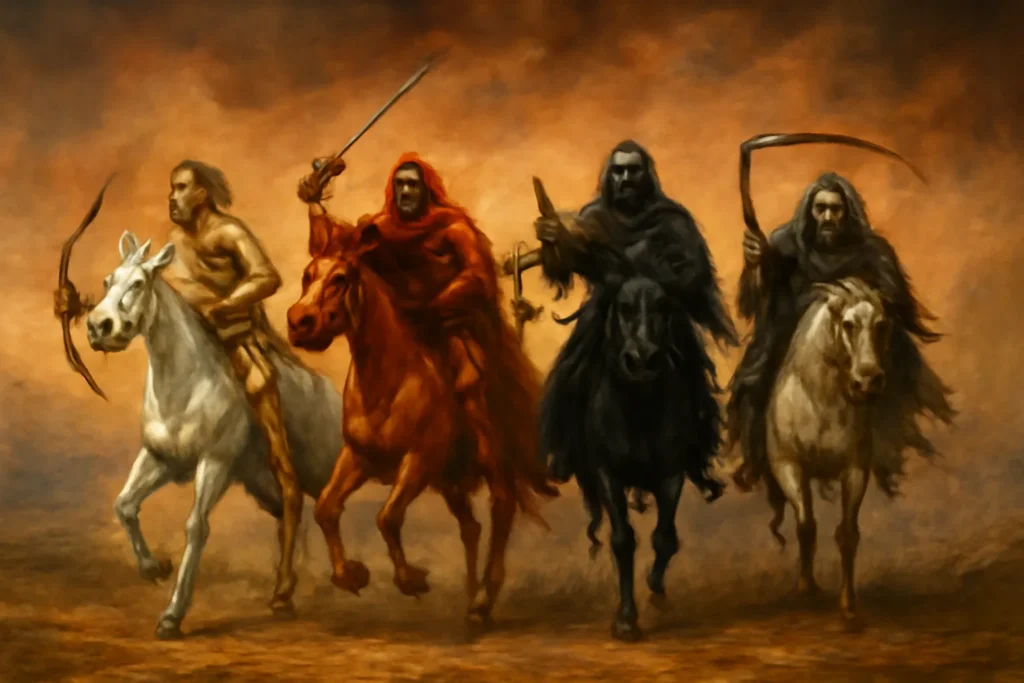
Conquest (often depicted on a white horse)
War (on a red horse)
Famine (on a black horse)
Death (on a pale/ashen horse, with Hades following)
The riders and their mounts function as symbols within a larger apocalyptic framework. They are not meant merely as mythic caricatures of disaster; they encode theological meanings about judgment, human responsibility, and the fragility of worldly order. To readers and listeners across centuries, the four horsemen have become a shorthand for approaching crisis—whether political, social, environmental, or spiritual—and for exploring how civilizations endure, resist, or transform under pressure.
Textual placement and core imagery
In the canonical text, the riders appear after the opening of the first six seals, a moment that situates them within a tightly structured prophetic vision. The imagery is highly symbolic and densely allusive. The first rider carries a crown and goes forth to conquer on a white horse; the second fighter is red, given a great sword and the power to take peace from the earth; the third rides a black horse and bears a pair of scales, signaling famine and economic distress; the fourth is pale, named Death, with Hades following close behind. The precise identifications and meanings have been negotiated in Christian theology for centuries, but the sequence consistently underlines the vulnerability of human life in times of upheaval.
Across interpreters, the text is read not merely as a forecast of a single epoch but as a template for understanding cycles of judgment and mercy. The color choices—white, red, black, and pale—serve as archetypal hues in the ancient world: victory and sovereignty, bloodshed, scarcity and inflation of needs, and the chill of mortality that accompanies catastrophe. The riders’ actions are not the end in themselves but signs pointing to broader confrontations between divine purposes and human choices.
Meanings and interpretations
Traditional readings
Historically, theologians have often linked the four horsemen to concrete phenomena in the Roman world and beyond. Conquest has been read as a symbol of imperial ambition or a broader sense of coercive power that can appear under many banners. War is tied to the tearing apart of political orders and the disruption of peaceful life. Famine speaks to scarcity, price inflation, and the social consequences of war and misrule. Death completes the quartet as the ultimate consequence of widespread crisis, sometimes accompanied by pestilence, famine, or political collapse. In this approach, the horsemen are not merely future portents but timeless pictures of how violence, hunger, and mortality punctuate human history.
Four interpretive frameworks
Preterist interpretation: Sees much of Revelation as fulfilled in the first centuries of the church, with the horsemen reflecting Rome, persecution, and local upheavals around that era rather than distant future events.
Futurist interpretation: Reads the horsemen as events that will occur in a future, end-times sequence, often associated with a tribulation period preceding a final judgment.
Historist interpretation: Considers the horsemen as symbolic representations of broad spans of church history, with each rider highlighting recurring patterns of crisis through the centuries.
Idealist (spiritual or symbolic) interpretation: Emphasizes timeless motifs and archetypes in Revelation, treating the horsemen as enduring symbols of cosmic struggle between good and evil rather than as a linear forecast.
Each framework offers distinct advantages for readers seeking meaning in current events or historical patterns. Critics of each approach stress the interpretive lens as a lens—inevitably shaping what counts as a “fulfillment” or a “symbol.” The Forty-First century reader may find value in cross-reading, comparing how different readers have understood the Horsemen across time and culture.
Historical background and origins
The Book of Revelation itself is a work of late antiquity, traditionally attributed to John of Patmos, who is described as receiving a divine revelation while exiled on the island of Patmos. The historical context of Revelation is complex: many scholars situate its composition in the late first century CE, amid persecution and tension within the Roman Empire. The imagery of plagues, judgments, and cosmic warfare resonates with Jewish apocalyptic traditions and with Greco-Roman symbolic language about power, fate, and the moral order of the world.
Early Christian writers engaged this text with a variety of interpretive tools. Some of the earliest patristic commentators, such as Irenaeus and Tertullian, treated Revelation as a prophetic panorama of ongoing spiritual conflicts and the ultimate triumph of God. The horsemen, in this tradition, appeared as emblematic forces at play through ages, rather than as precise, one-time events. Others, like Origen and Augustine, used allegorical readings that stressed moral and spiritual lessons—for instance, the perseverance of faith under pressure, the sovereignty of divine justice, and the hope of renewal after catastrophe.
Throughout the medieval and later periods, the Four Horsemen migrated from scriptural commentary into broader culture. They appear in illuminated manuscripts, medieval drama, and the iconography of churches and public art. In modern times, the horsemen have become a staple of literature, film, music, and political rhetoric, where the name is invoked to describe environmental collapse, warfare, pandemics, or societal upheaval. The continuity of these symbols across epochs illustrates how the ancient text continues to speak to new generations with fresh urgency and new metaphorical freight.
The symbolism of each rider
The first horseman’s white horse, crowned and moving to conquer, raises questions about the nature of conquest itself: is it a just authority under divine mandate, or a dangerous ambition that imposes itself on others? The second rider’s red horse, bearing a great sword, is a stark image of bloodshed and warfare that disrupts peace and stability. The third rider on the black horse carries scales, a reminder of scarcity and economic disparity in times of crisis, where even ordinary necessities like bread become instruments of social tension. The fourth rider, Death, with Hades following, is the culmination of the crisis cycle—a reminder that mortality under the pressure of global events remains an ultimate reality for all people.
Scholars often emphasize that the colors themselves carry layered meaning. White can symbolize purity and victory, but in apocalyptic literature it can also denote deception or a false sense of triumph. Red is the color of blood, fighting, and upheaval. Black is not merely a color of mourning but a reference to scarcity and the weighing of commodities. The pale or ashen tint associated with Death has a long symbolic life in Greco-Roman thought as a mark of corruption or the otherworldly, where the living meet their end and the dead yet walk in memory.
Meaning in the broader biblical narrative
Within Revelation, the Horsemen enter a larger drama about judgment, the authenticity of human power, and God’s ultimate sovereignty. The progression from conquest to war to famine to death can be read as a cascade: as human institutions fail under pressure, divine rectification becomes visible in the moral universe. However one reads the sequence—whether as a prophecy of specific future events or as a timeless pattern of crisis—the message centers on the fragility of worldly systems and the need for vigilance, humility, and faithfulness in the face of uncertainty.
Readers often ask how the Four Horsemen relate to other apocalyptic phenomena in Revelation, such as the seals, trumpets, and bowls. The opening of the seals introduces the horsemen as part of a coordinated vision in which divine judgment unfolds in stages. Some interpreters connect the rider events with later symbols, such as the sounding of trumpets and the pouring of bowls, suggesting a larger arc of catastrophe, purification, and renewal. Others view the horsemen as a distinct motif that stands apart, highlighting the moral dimensions of human suffering rather than a precise calendar of events.
In this sense, the prophecy of the four riders can be read as a theological reflection on the cause-and-effect relationship between human choices and cosmic consequences. It also invites readers to consider how communities respond to pressure: through repentance, resilience, reform, or despair. The text thus functions as a mirror, challenging readers to examine their own times, values, and priorities in light of a larger, ancient narrative about the fate of nations and the hope of a just reintegration of creation.
Historical influence and cultural reception
From early Christian art to modern cinema, the Four Horsemen have served as a potent motif for public imagination. In medieval and Renaissance art, the riders appeared as didactic illustrations of moral and spiritual truths. In literature and popular culture, the horsemen often symbolize existential threats—wars, famines, plagues, and the erosion of civic order. The phrase horsemen of the apocalypse has become a cultural idiom that extends well beyond biblical studies, appearing in political discourse, journalism, and commentary on global crises.
Critical readers, however, urge caution against conflating symbolic literature with literal prediction. The horsemen should be understood within their genre: apocalyptic prophecy that aims to wake readers to moral responsibility and to sustain hope even in the face of catastrophic uncertainty. The tradition invites ethical reflection on how societies anticipate, manage, or avert the kinds of crises symbolized by the horses.
Iconography, art, and interpretation across cultures
Across different Christian and secular cultures, the colors and the riders have been reshaped to fit local concerns. In some Christian traditions, the white horse is linked to victory through divine aid, while in others it triggers caution about ambition and domination. The red horse is frequently tied to warfare and civil conflict; in some iconographies, it depicts a red flag of revolution or a denunciation of violence. The black horse’s scales are often treated as a symbol of economic reckoning, where the value of bread becomes a measure of justice or injustice. The pale horse, Death, is sometimes paired with the figure of Hades as a paired accompaniment illustrating the ultimate boundary of human control.
Modern media uses the Horsemen as metaphors for contemporary problems—climate catastrophe, global pandemics, cyber warfare, and systemic inequality. Yet, when engaged with the biblical text, readers are reminded to approach such likenesses with care: to ask what moral, spiritual, or social transformation is urged by the text rather than to sensationalize disaster for entertainment or political ends.
Common questions and misconceptions
Why four? Why these particular riders? Do they herald the end of the world, or are they signs of ongoing crises that civilizations periodically face? These questions invite nuanced answers:
They are symbolic representations of forces that shape history, rather than a single, fixed timeline. The number four emphasizes completeness and universality in ancient symbolic speech.
The identity of the first rider as Conquest can be interpreted as legitimate or illegitimate rule, depending on the interpretive lens (divine sanction vs. coercive power).
Masking or reframing as Pestilence is common in modern retellings but is not a canonical assignment in the text; it remains a popular cultural adaptation rather than a strict scriptural claim.
The pair of Death and Hades evokes the ultimate boundary of life, reinforcing a theological claim about mortality and judgment rather than a purely physical threat.
Scholars encourage readers to distinguish between the textual symbolism and later applications. The four horsemen are a window into complex themes: divine justice, human responsibility, social justice, and the enduring hope that the divine order will ultimately prevail over chaos. Misunderstandings often arise when equating biblical symbolism with a straightforward forecast; careful study emphasizes its moral and theological dimensions.
Literary and artistic representations
Beyond scholarly study, the Horsemen have informed a wide range of creative works. In literature, novels have used the imagery to frame apocalyptic narratives or to comment on societal collapse. In visual arts, paintings, sculptures, and stained glass stories depict the riders as part of the ethical and eschatological pedagogy of religous communities. In music and film, the horsemen function as archetypal emblems of crisis—an easily recognizable shorthand that conveys urgency and high stakes without requiring lengthy exposition.
These representations are not mere sensationalism; they often carry a moral charge. They ask audiences to consider how civilization responds to threat, how power is wielded, and how mercy can be offered in the face of destruction. They also demonstrate the resilience of a tradition that keeps returning to the same symbols, reinventing their meaning for each era while preserving their core semantic core.
Practical implications for readers today
For contemporary readers, engaging with the four horsemen can serve several practical aims: ethical reflection, historical literacy, and a modeling of careful interpretive practice. By studying how different communities have understood the riders across time, readers gain insight into how culture negotiates danger and hope. The following practical considerations may help readers integrate this material into thoughtful study or teaching:
Use the four horsemen of the apocalypse as a framework for analyzing crises that evoke fear but also invite collective action and reform.
Encourage students or readers to explore multiple interpretive approaches—preterist, futurist, historicist, and idealist—to understand how meaning shifts with perspective.
Discuss how symbolism interacts with ethics: what responsibilities do individuals, communities, and leaders have when confronted with forces that resemble the horses’ rampage?
Be mindful of how modern contexts can shape the reception of ancient imagery, and strive for readings that illuminate moral and spiritual lessons without sensationalism.
Glossary of key terms
To aid readers new to the topic, here is a concise glossary of terms frequently used in discussions of the Book of Revelation and the Four Horsemen:
Book of Revelation: The last book of the New Testament, also known as the Apocalypse, containing visions revealed to John of Patmos.
John of Patmos: The traditional author of the Revelation text, said to be exiled on the island of Patmos.
Seals: A series of symbolic scrolls that, when opened, unleash successive visions, including the Four Horsemen.
Apocalyptic literature: A genre that uses symbolic imagery and visions to convey messages about cosmic struggle, judgment, and renewal.
Eschatology: The branch of theology dealing with last things—death, judgment, heaven, hell, and the ultimate destiny of the world.
Further avenues for study
Readers who wish to deepen their understanding of the four horsemen and their place in biblical prophecy might explore several directions. These include historical-critical studies of Revelation’s composition and audience, comparative analysis with other apocalyptic texts such as Daniel, and interdisciplinary work that connects biblical symbolism with art history, literary studies, and cultural theory. Some recommended starting points include specialized commentaries on Revelation, surveys of apocalyptic literature in the ancient world, and modern examinations of how contemporary events shape prophetic interpretation.
Clarifying common misconceptions
To avoid confusion, it is important to distinguish between symbolic language and literal forecasting. The Four Horsemen should not automatically be treated as a precise timeline of future events. Instead, they function as symbolic elements that communicate truths about the human condition, power, scarcity, mortality, and divine sovereignty. Readers who approach the text with this distinction in mind are better equipped to appreciate the rich layers of meaning while avoiding sensational readings that prioritize spectacle over substance.
In sum, the Four Horsemen of the Book of Revelation offer a complex blend of imagery, history, and prophecy. They invite readers to reflect on cycles of conquest, conflict, deprivation, and mortality within a moral and spiritual framework that underscores human accountability and divine sovereignty. As a literary and theological motif, the horsemen remain a powerful vehicle for discussing crisis, resilience, and hope. They function not as a simple prediction but as a call to discernment, action, and perseverance in the face of uncertainty—an enduring message that continues to resonate in diverse religious, cultural, and intellectual settings.









Leave a Reply