Origins and Context of the Four Horsemen of the Apocalypse
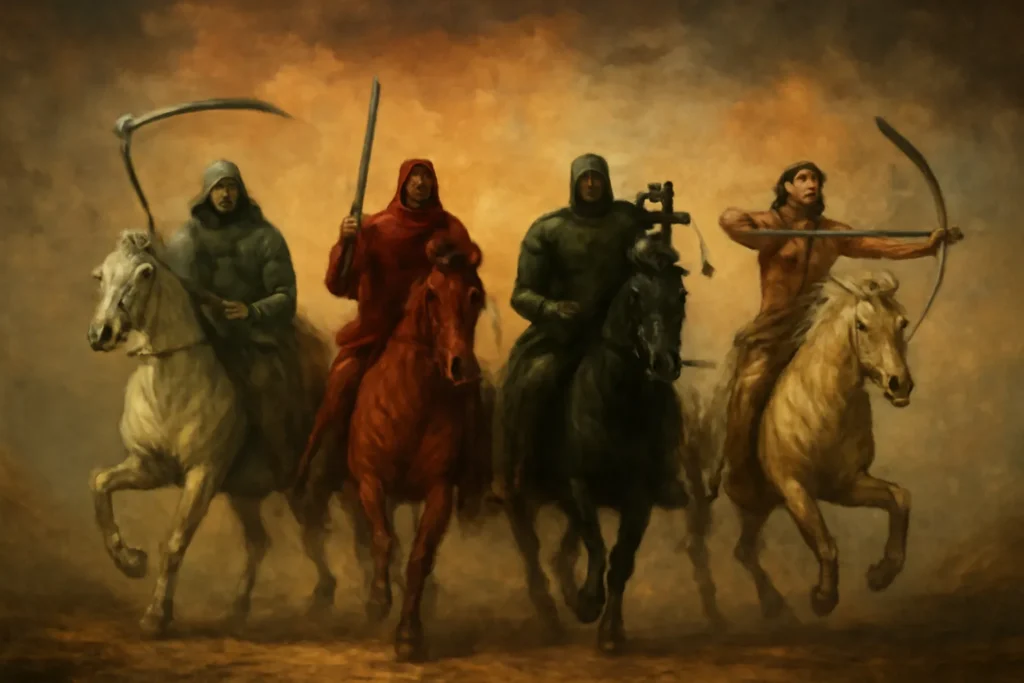
Across centuries, readers and students of religion have encountered the Four Horsemen of the Apocalypse as a striking, biblically rooted symbol set. The canonical spark for this quartet comes from the opening of the seventh seal in the Book of Revelation, where a visionary sequence unfolds in richly allegorical language. In Revelation 6:1–8, a rider on a white horse appears with a bow and a crown, followed by others who ride out in swift succession carrying a red sword, a pair of scales, and a pale or greenish horse, respectively. This vivid tableau sits at the heart of Christian eschatology and has been interpreted in many ways across time and tradition. The imagery is not merely a single prediction; it is a symbolic narrative device that many scholars read as a typology of forces that shape human history. The broader genre in which these figures appear—apocalyptic literature—emerged in a milieu that combined Jewish apocalyptic hopes with Hellenistic rhetorical techniques. As a result, the Four Horsemen have functioned as a lens through which believers have contemplated divine justice, human conflict, and the fragility of earthly order.
In addition to Revelation itself, scholars note resonances with earlier Jewish and Christian apocalyptic works. The idea of rider-figures announcing divine judgments and portending upheaval recurs in other contemporary writings, even if the exact sequence of horsemen is unique to the Revelation of John. Over the centuries, interpreters have repeatedly asked whether these riders symbolize literal future events, timeless moral forces, or historical patterns that recur in different guises. The answer many traditions settle on is nuanced: the Four Horsemen are not simple prophecies; they are archetypal representations of how power, violence, scarcity, and death press upon humanity. This foundational section unfolds the origins of these figures and sets the stage for a deeper look at each rider in turn, as well as the ways in which the whole motif has traveled beyond its biblical birthplace into art, culture, and public imagination.
Canonical origin: Revelation 6:1–8 or the Book of Revelation in the New Testament.
Literary context: apocalyptic literature, a genre that uses symbols to convey spiritual and cosmic conflict.
Symbolic aim: to communicate the seriousness of judgment and the urgency of fidelity in times of upheaval.
Cultural transmission: through medieval theater, visual art, literature, and modern media, the horsemen have become a versatile metaphor for crises and transformations.
The First Horseman: Conquest, Victory, or Pestilence?
The rider on the White Horse stands at the opening of the seal. The description of this horseman—bearing a bow and wearing a crown—has prompted a fascinating range of interpretations across eras. The most traditional reading identifies this figure with Conquest or Victory—a triumphal, almost imperial sign that power expands and asserts itself. Yet some scholars insist that the imagery can also denote Pestilence or False Peace, especially when the rider’s actions are read alongside the other riders as a sequence that unsettles the moral order rather than merely declaring military win.
Historical and theological readings
In early Christian commentary, the white horse often symbolized the triumph of the gospel or the advance of divine proclamation. Later medieval interpreters sometimes described it as a warning that human history flourishes by power, which can be misused or corrupted. In some modern readings, the White Horse is seen as ideological conquest, where dominant powers impose systems and worldviews that reshape societies, sometimes under the banner of civilization or religion. The presence of a bow—an instrument of precision and projection—accentuates the theme of strategic force rather than indiscriminate violence.
Key nuances to notice
Color symbolism matters: white frequently connotes purity, victory, and righteousness in biblical imagery, but it can also signify seduction and illusion when used in political rhetoric. The rider’s crown suggests authority granted by a recognized power structure, while the bow signals an instrument of judgment or conquest rather than an outright war weapon. The debate about whether this figure represents Conquest as a positive, negative, or ambiguous force remains central in both religious and scholarly discussions.
In broader culture, the first horseman often appears as a precursor to upheaval rather than the cause of it—an omen that conditions are likely to become more severe in the days ahead. This anticipatory function helps explain why the White Horse remains a potent symbol in political discourse, prophetic fiction, and moral philosophy alike.
The Second Horseman: War
The Red Horse is traditionally associated with War and bloodshed. The rider carries a great sword and is granted the power to take peace from the earth, so that people would slay one another. The arithmetic of this rider’s action is stark: an escalation of violence that disrupts civil order and triggers widespread conflict. The red color itself evokes bloodshed, anger, and the disruption of social equilibrium. The Second Horseman thus embodies collective vulnerability when political, economic, or ideological pressures escalate into armed conflict.
Throughout history, scholars have linked this rider to periods of large-scale warfare, civil strife, or even systemic violence that transforms communities. Some readers interpret the Red Horse as state-sponsored aggression, while others see it as a more diffuse symbol of social conflict—the rivalries, revolutions, and insurgencies that erupt when resources tighten and loyalties fracture. In any case, the message is that war is a force that rearranges life at every level: families displaced, economies destabilized, and moral questions intensified as violence becomes normalized in desperation.
Ethical reflections on war and judgment
Many religious and secular thinkers reflect on how to interpret war within a broader moral framework. The Second Horseman raises questions about just war, accountability for leaders, and the human cost of conflict. Some commentators emphasize the accountability of nations for the violence they unleash, while others stress the limits of human agency when larger forces seem to push people toward ruin. The image serves as a reminder that war is not an abstraction; it is a dramatic dislocation that entails ethical responsibility, long-term consequences, and the need for healing after violence ends.
The Third Horseman: Famine
The Black Horse rides with a rider who carries a pair of scales or a balance, a symbolic device for weighing out grain and food. This rider is commonly linked to Famine and scarcity, a counterpoint to the abundance that one would expect in a robust economy and a stable society. The text’s famous line—referring to grain being sold by the measure and the cost of bread—underscores the precariousness of sustenance in times of upheaval. The balance-beam suggests that even when resources exist, access and distribution can be severely disrupted, leading to stark inequalities and moral peril.
Economies under strain
Historically, famine has followed or accompanied war, drought, crop failures, or political mismanagement. The Third Horseman’s imagery has been used by reformers and preachers to critique systems that permit extreme scarcity to coexist with plenty elsewhere. The scales also imply calculation and judgment—an image of life-or-death decisions about who receives bread, what price is just, and how policies determine who survives the next season. In many readings, the Black Horse does not necessarily predict total destruction but highlights vulnerability, risk, and the social consequences of scarcity.
Symbolic reach beyond hunger
Beyond literal food shortage, the Third Horseman has been read as diagnosing the moral economy of a society—how wealth is measured, who controls supply chains, and how inequality can threaten communal stability. The weight-bearing scales can also be seen as a metaphor for ethical balancing: weighing what is fair against what is possible under pressure, and recognizing that shortages often reveal the fault lines of a culture’s priorities.
The Fourth Horseman: Death
The final rider on the pale or greenish Horse is typically identified as Death, accompanied by Hades who follows closely behind. This rider’s blanket label as Death does not imply the end of time itself but rather the completion of a particular phase of judgment: mortality in the face of violence, famine, and calamity. The color traditionally rendered as pale or ashen underscores the clinical, universal, and inexorable nature of death as the ultimate equalizer among people, regardless of status or power.
Death as a universal phenomenon
Interpretive traditions often stress that this rider represents not only physical death but the broader sense of mortality that accompanies upheaval: pandemics, systemic collapse, and the erosion of life’s ordinary rhythms. The companion figure of Hades signals a larger realm of the afterlife, judgment, or the unseen consequences of earthly actions. Together, they remind readers that the end of a season of upheaval does not simply restore normalcy; it introduces a new frame of existence for those who survive and for the communities that endure the losses.
For some theologians, the Death figure serves as a sobering reminder of mortality’s universality and the need for spiritual preparedness, ethical stewardship, and care for the vulnerable during times of crisis. In secular readings, the Pale Horse becomes a stark symbol of biopolitics—the ways in which disease, accidents, and death shape social policy, public health, and collective risk. In either frame, the image invites reflection on how communities respond to mortality: with courage, compassion, resilience, and, when possible, a commitment to justice that reduces needless harm.
Doctrinal and Interpretive Threads: How the Four Horsemen Have Been Read
Across Christian history and in the wider cultural sphere, the quartet has been unpacked in multiple ways. The central question has often been whether these riders predict future cataclysm, reveal present realities, or function as timeless symbols that recur in different forms. The following subsections map some of the dominant interpretive modes and how they shape attention to the Four Horsemen as a cohesive image set.
Pre-modern Christian exegesis
In patristic and medieval commentary, the Four Horsemen were commonly seen as divine judgments concerning the church and the world. Some early fathers emphasized moral accountability and the dangers of sin, while later medieval writers sometimes linked the horsemen to the political and ecclesial shifts of their day. The interpretive emphasis varied: some saw them as warnings to the faithful, others as descriptions of the perilous forces that a steadfast community must withstand, and still others as allegories of the cycles of history that recur under God’s sovereignty.
Renaissance, Reformation, and Enlightenment perspectives
During the Renaissance and especially in the Reformation, scholars and theologians re-read Revelation in light of concerns about church reform, political power, and social justice. The Fourth Horseman’s figure of Death often resonated with debates about mortality, divine justice, and the human consequences of religious conflict. In the Enlightenment, some readers preferred to interpret the horsemen as allegories of historical processes—empire-building, civil unrest, scarcity due to economic systems, and the ever-present reality of human mortality—rather than as precise predictions of future events.
Modern interpretive pluralism
In contemporary scholarship, there is a broad willingness to acknowledge multiple legitimate readings. Some scholars emphasize the eschatological aspect—the claim that the horsemen reveal a cosmic timeline of judgment. Others foreground the social-ethical dimension—how these figures illuminate the vulnerabilities and injustices of real-world systems. Still others treat the Four Horsemen as potent symbols for readers to apply to their own context: crises of climate, health, conflict, or economic upheaval. The enduring adaptability of the motif lies in its structural openness: a quartet that can be reinterpreted without losing its core potency as a warning and a call to resilience and moral response.
Art, Literature, and Popular Culture: The Four Horsemen as a Cultural Lens
Beyond theological treatises, the Four Horsemen have left a deep imprint on visual art, theater, literature, film, and video games. Artists have used the riders to express fear, hope, critique, and prophecy; writers have employed the figures to dramatize moral choices under pressure; and filmmakers have constructed narratives where the horsemen symbolize systemic threats that communities must confront. In many works, the imagery is deliberately compressed to heighten emotional impact while inviting viewers or readers to draw their own conclusions about the forces at work in the world.
Iconography in medieval and early modern art
Stained-glass windows, illuminated manuscripts, and church frescoes frequently depict the Four Horsemen as part of the larger apocalyptic program. Their presence in these works served catechetical purposes: to teach Biblical themes to a largely illiterate populace and to frame the moral stakes of life under divine sovereignty. The color codes—white, red, black, and pale—help viewers quickly grasp the roles of conquest, war, famine, and death even without textual explanation.
In novels and poetry, authors have used the four riders as an organizing metaphor for social transformations. Some writers treat the horsemen as external forces acting upon human society, while others cast them as internal temptations or collective myths that communities must confront. The motif also appears in modern dystopian fiction, where the riders symbolize threats such as climate catastrophe, global pandemics, or geopolitical destabilization—forces that test human solidarity and moral courage.
Contemporary media and online discourse
In films, television series, and video games, the Four Horsemen motif is often adapted to fit contemporary anxieties: the commodification of power, the fragility of supply chains, or the fragility of life in the face of temporary systems of control. Even in non-religious contexts, the phrase Four Horsemen is used as a shorthand for major destabilizing trends, while still inviting reflection on ethics, responsibility, and resilience. This cultural fossil of sorts gives people a vocabulary to talk about large-scale threats without resorting to alarmism or fatalism.
Global Perspectives and Theological Variations
Different faith traditions and cultural contexts approach the Four Horsemen motif with distinctive emphases. In some theological communities, the riders are treated as warnings directed at humanity as a whole, while other communities focus on the moral obligations of individuals, institutions, and governments to alleviate the suffering associated with the forces the horsemen embody. The following notes highlight a few cross-cultural viewpoints that enrich the conversation about origins, meanings, and interpretations.
Non-Western readings may foreground themes of ecological balance, social justice, and community resilience, interpreting famine and death within a larger framework of interdependence and stewardship.
Interreligious dialogue sometimes uses the horseman motif as a comparative symbol to discuss common human concerns—conflict, scarcity, illness, and mortality—while honoring differences in how religious traditions understand divine sovereignty and human responsibility.
Public theology practitioners might invoke the Four Horsemen when addressing policy questions about humanitarian aid, disaster relief, climate adaptation, and the ethics of intervention, always mindful of the allegorical roots of the imagery.
Implications for Ethics, Eschatology, and Everyday Life
Whether read as prophecy, symbol, or moral allegory, the Four Horsemen hold a persistent relevance for ethical reflection. They force readers to confront questions about how societies prepare for and respond to collective risk, how resources are allocated in times of crisis, and how communities honor the dignity of the vulnerable when the normal order collapses. The imagery of the horsemen challenges complacency, urging vigilance and compassion while resisting sensationalism. The discussion that follows offers some practical and philosophical bearings drawn from this enduring symbol set.
Ethical preparedness: recognizing that crises are multidimensional—military, economic, ecological, and health-related—can help societies build more resilient and humane institutions.
Social justice: the famine imagery highlights how inequities in access to food, medicine, and shelter reveal the moral contours of a community or nation.
Mortality awareness: the figure of Death invites contemplation of what it means to live well, make just decisions, and support others amid loss and uncertainty.
Hope and action: while the horsemen warn of upheaval, many readings emphasize the human capacity for solidarity, reform, and renewal in the aftermath of catastrophe.
Conclusion: The Living Significance of a Timeless Motif
Rather than a fixed forecast, the Four Horsemen of the Apocalypse function as a living symbol that adapts across ages. Their meaning shifts with the questions we ask about power, violence, scarcity, and mortality. By studying their origins in the apocalyptic literature of late antiquity, examining the meanings that scholars and readers have assigned to each rider, and exploring their wide-ranging reinterpretations in art and modern media, we gain more than historical knowledge—we gain tools for critical reflection about how societies confront crisis, how justice is sustained, and how hope persists even when the horizon darkens. The horsemen remain a provocative lens for understanding the tensions that accompany major upheavals: they remind us that history is rarely a simple march toward triumph or catastrophe, but a complex drama in which human choices, divine mysteries, and communal resilience all play roles.








Leave a Reply