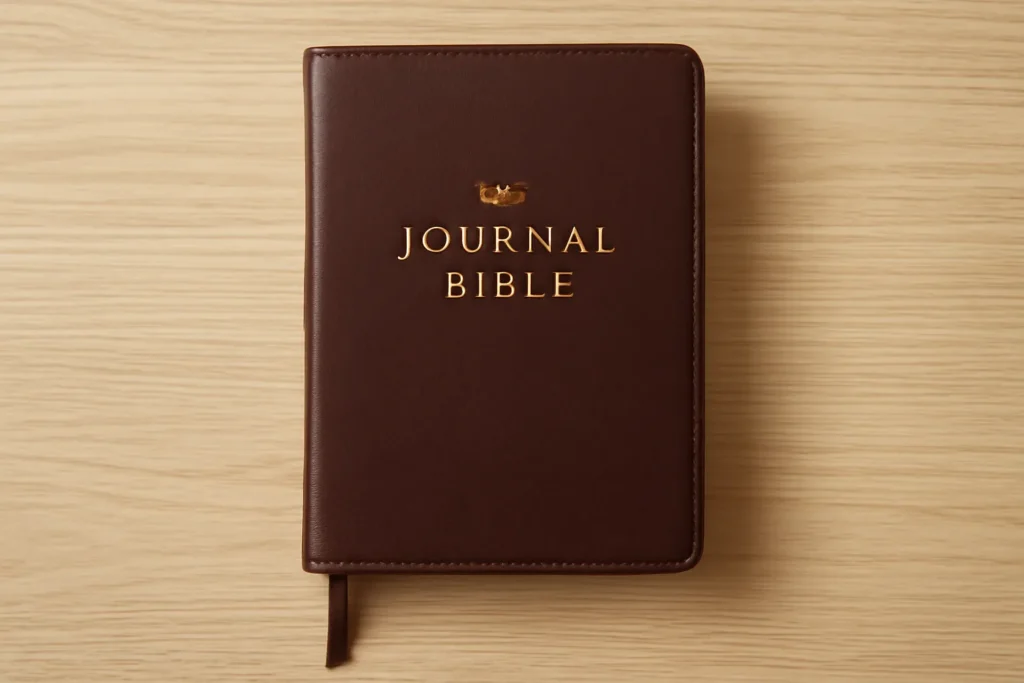
A Journal ESV Bible is more than a regular Bible. It is a format that blends reading, reflection, and creative note‑taking into a single, portable practice. The core idea is simple: as you study the English Standard Version (ESV) text, you reserve space in the margins or on dedicated pages to capture insights, prayers, questions, and art. This approach is often called bible journaling, a practice that has grown in popularity for people who want to engage with Scripture on a sensory and personal level.
Within the family of ESV journaling editions, you will encounter copies that feature wide margins, ruled outlines, or blank space designed specifically for doodles, sketches, or structured journaling. When people refer to the ESV Journal Bible, they are talking about a format that invites a dialogue between the text and the reader—reading with a pen, not just reading with the eyes. In this guide, we will explore what makes Journal ESV Bible editions distinctive, how to use them well, and how to develop a fruitful habit that nourishes spiritual growth.
Why choose the Journal ESV Bible for journaling?
The ESV Bible journaling movement is popular for several reasons. For some, it creates a tactile link between devotion and design. For others, the margins and space become a practical tool for interpretation, sermon notes, or insights gathered during group studies. The Journal ESV Bible format often features:
Clear readability through the ESV translation’s balance of accuracy and clarity.
Ample space in margins for notes, prayers, or quick sketches that reinforce memory.
Long-term value as a personal, annotated record of spiritual journey and study history.
Flexibility to blend devotional prayer with academic study, making it suitable for varied spiritual practices.
Customization opportunities—color coding, different handwriting styles, and art techniques—that help each reader personalize their engagement with Scripture.
When you approach the journal edition of the ESV Bible, you’re choosing a tool designed for ongoing practice. It is not merely a book to read; it is a book to interact with. The journal Bible esv concept invites you to pause, reflect, and respond to the text in a way that aligns with your season of life—whether you are a student, a parent, a pastor, or someone seeking spiritual growth.
Key features of the ESV Journal Bible and how they support practice
Each ESV journaling Bible edition comes with features that make journaling approachable and sustainable. While designs vary by publisher, common elements include:
Wide‑margined pages to provide generous space for notes, drawings, or marginal references.
Light-weight, high‑quality paper that resists bleed‑through from ink or markers.
Readable typography with enough line height to accommodate handwriting and small illustrations.
Verse-by-verse layout that preserves the flow of the text while enabling personal commentary.
Indexing or concordance aids that help you connect journal notes to key themes in Scripture.
The combination of these elements in the journal ESV Bible format creates a practical and enjoyable journaling process. If you are new to bible journaling with the ESV, begin by exploring a few sample pages in a store or online so you understand the layout. If you already own an ESV Bible journaling edition, you can start with a simple routine and gradually expand your practice as you grow more comfortable.
Getting started: setting up your Journal ESV Bible practice
Beginning a new journaling routine around the ESV Bible journal can be transformative. The goal is not to produce perfect art or flawless notes, but to cultivate a meaningful, repeatable pattern of engagement with Scripture. Here are practical steps to launch your practice:
1. Define your purpose
Before you write a single line or make a single doodle, ask yourself: What do I want to gain from this practice? Some common purposes include:
Deeper comprehension of the biblical passage through paraphrase, questions, and cross‑references.
Active memory—creating a personal record that helps you remember key verses and insights.
Permanent prayer—writing prayers that arise from Scripture or reflect your spiritual needs.
Creative worship—expressing praise, gratitude, or repentance through art, lettering, or color.
Your purpose shapes your practice. It may evolve over time, and that evolution is a natural part of growth. A well‑defined purpose helps you stay consistent and purposeful.
2. Choose your tools thoughtfully
Gather a small, reliable set of tools so you can begin without overwhelm. Consider:
Publication quality journal ESV Bible or a readable journaling Bible with wide margins.
Fine liners or brush pens for precise writing.
Pencils for quick sketches or lighter notes.
Watercolor or colored pencils for gentle, non‑bleeding art in margins.
Ruler and eraser for neat margins and clean lines.
Sticky notes or washi tape for temporary marks or cross‑references.
Start small. It is better to commit to a few minutes daily than to pursue long sessions irregularly. As you gain confidence, you can experiment with new media or layout styles.
3. Establish a routine and a safe space
Routine matters. Create a routine that fits your daily schedule. It could be a quiet moment in the morning with the ESV Journal Bible or a contemplative pause in the evening. A dedicated physical space—even if simply a corner of a table with good light—helps anchor the habit. The key is consistency: short, regular sessions beat sporadic bursts of intensive journaling.
A simple, repeatable entry can be extremely effective. Consider the following structure for each journaling session:
Read a short passage (one or two verses, or a paragraph).
Observe what stands out—repeated words, a cause‑and‑effect pattern, a command, or a promise.
Interpret in your own words or with cross‑references to other Scriptures.
Apply—note how this text speaks into your life today.
Pray—a short prayer that reflects your observation and application.
This four‑part structure keeps journaling approachable and avoids the trap of overcomplication. You may add doodles or decorative elements later, once you are comfortable with the core method.
Techniques for Bible journaling with the Journal ESV Bible
The practice of bible journaling with the ESV blends textual engagement with creative expression. Below are techniques you can incorporate, either individually or in combination:
Margin notes and inline reflections
Margin notes are the heart of most journaling Bibles. Use them to capture:
Key insights from the passage.
Definitions of difficult terms or cultural concepts.
Cross‑references that illuminate a theme across Scripture.
Promises or commands that you want to memorize.
When writing in the margins, consider a consistent color code for different categories (e.g., blue for promises, green for commands, purple for questions). This creates an intuitive map on the page that you can revisit later.
Art and illustration in the margins
Bible journaling can include visual elements beyond text. You might:
Doodles that symbolize themes or feelings from the text.
Mini‑illustrations such as a landscape for a psalm or a symbol for a parable.
Lettering—artful titles for passages, or hand‑lettered verses to highlight memory verses.
Color blocks to underscore tone—cool colors for peace, warm colors for exhortation, etc.
While art can enhance engagement, remember that the goal is lasting engagement with Scripture. Art should support comprehension and recollection, not overshadow it.
Color coding and organizational systems
A coherent system helps you locate and interpret notes across many pages. Examples of systems include:
Tag colors for themes (red for sin/repentance, blue for faith, gold for gratitude).
Icons or small symbols that signal different types of notes (a question mark for inquiry, a heart for prayer, a lightbulb for insight).
Sectional dividers to separate sections of life—family devotions, personal study, or study of a particular book.
Experiment with a system that feels intuitive to you and be willing to adjust as your journaling grows deeper.
Reflection prompts to deepen engagement
Use targeted prompts to prompt new reflections. A few well‑chosen prompts can keep you from slipping into mere transcription of the text:
What does this passage reveal about God’s character?
How does this passage illuminate my current circumstances?
Where can I apply this truth in my daily routine this week?
Which person or event in this text invites me to action or prayer?
These prompts can be written in the margin, in a separate margin note, or on a small sticky note as a quick reference for future study.
Practical steps to begin: a step‑by‑step plan
If you are ready to begin a journal ESV Bible practice, here is a practical, scalable plan you can follow over the next few weeks:
Purchase or select a suitable ESV journaling Bible, or use your existing ESV Bible with a separate notebook for margins or notes.
Set a realistic target—5–10 minutes per day, or 15–20 minutes on certain days that allow deeper reflection.
Choose a starting book or passage that resonates—perhaps a gospel narrative, a psalm, or an epistle that invites practical application.
Establish a simple entry routine—read, observe, interpret, apply, pray (the four‑part method discussed earlier).
Document your progress—keep track of what you journaled about and why. This creates continuity over time.
Review periodically—every few weeks, look back over a handful of entries to notice growth, recurring themes, or shifting questions.
By following this plan, you will develop a sustainable rhythm. The goal is not perfection but progress—your ESV journal Bible journey gradually becomes a reliable companion in your spiritual growth.
Prompts and exercises for the Journal ESV Bible
Prompts can be a helpful scaffolding when you are still learning the rhythm of bible journaling. Here are categorized prompts that align with the ESV Bible journaling approach:
Memory and retention prompts
Write the verse in your own words and paraphrase the passage in a single short paragraph.
Copy a verse you want to memorize in a decorative way in the margin.
Identify the main verb in the passage and reflect on its implications for faith and life.
Interpretation prompts
What is the historical or literary context of this passage?
What questions arise as you read this text? Write them in the margin and search for possible answers in other Scriptures.
What promises or warnings does the text offer?
Application prompts
How does this passage shape my attitudes toward a current situation?
What is one concrete action I can take this week based on this text?
What is a habit I may need to adjust in light of this Scripture?
Prayer prompts
Turn a verse into a short prayer, addressing God directly with thanks, praise, confession, or request.
Pray for someone else who could benefit from this passage, writing their name and a note about intercession.
End your entry with a blessing or a benediction drawn from the text.
As you accumulate entries, you may notice thematic arcs: a journey from doubt to faith, a growing sense of gratitude, or a call to service. These trends are natural and meaningful, and they become more visible as you continue to fill pages in the journal edition of the ESV Bible.
Tools and supplies for the ESV journaling journey
A practical toolkit can streamline your journaling process and make it enjoyable rather than cumbersome. Here are recommended tools for ESV Bible journaling:
Quality journaling Bible or a regular ESV Bible paired with a separate margin notebook.
Fine‑tip markers and pens that prevent bleed‑through and produce readable notes.
Colored pencils or watercolors for subtle illustrations without overpowering text.
Ruler, eraser, and pencil sharpener to maintain neat margins.
Sticky notes, tabs, or label stickers for quick cross‑references and theme markers.
Protective cover or sleeve to keep the journal in good condition during travel or study sessions.
You do not need to invest in every tool at once. Start with a basic set, and expand as your routine stabilizes. The most important tools are your Bible, your heart, and a consistent habit.
Maintaining motivation and spiritual focus
The journey of bible journaling with the ESV is not merely a creative pastime. It is a spiritual practice that can shape your thinking, behavior, and relationship with God. Here are principles to help you stay motivated and spiritually grounded:
Consistency over intensity—daily, even for a short time, beats occasional long sessions that fade away.
Humility in interpretation—allow Scripture to speak for itself, inviting correction and growth rather than imposing a personal agenda.
Prayerful reflection—let journaling be a form of conversation with God rather than a purely cognitive exercise.
Patience with progression—some days produce more insight; other days may yield little. Both are part of a lifelong practice.
If you notice your interest waning, revisit the purpose you defined at the outset. Reconnecting with your initial motivations can re‑ignite your enthusiasm and remind you of the value of steady, long‑term engagement.
Digital and hybrid approaches to the Journal ESV Bible
While traditional margin journaling remains highly popular, many readers appreciate digital journaling and hybrid approaches that combine print and digital tools. Here are some options and best practices:
Digital note‑taking apps (e.g., stylus‑friendly note apps) can capture handwriting or sketches in a portable format. Export notes to a preferred cloud service for safety.
Scan and archive margins using a scanner or smartphone camera. Create a digital journal that backs up physical entries and enables search by keyword or theme.
Hybrid journaling—keep a physical Journal ESV Bible for core reflection and use a digital appendix to store cross‑references, prayer lists, or study questions.
Digital art and lettering—experiment with calligraphy or graphic templates and then print selected pages to paste into your journal, or simply keep digital copies for future reflection.
Whether you pursue digital, physical, or hybrid formats, the core practice remains: engage with Scripture in a way that helps you remember, understand, and apply God’s Word.
Common questions about the Journal ESV Bible practice
If you are considering adopting a Journal ESV Bible program, you may have questions. Here are some frequently asked questions and concise guidance:
Is a journaling Bible necessary for bible journaling?
Not strictly. You can journal in any edition of the ESV Bible by using a separate notebook or margins. However, a dedicated journal edition provides built‑in space and structure that can reduce friction and make journaling easier, especially for beginners.
Can I journal in a group or community setting?
Absolutely. Group journaling can enhance accountability and provide fresh perspectives. Consider sharing brief insights, prayer requests, or prompts with the group, while respecting each person’s personal space and notes.
What if I feel overwhelmed by the margins?
Start small. You can begin with short margin notes or a single verse per page. As you discover a rhythm, you can expand your entries. The margins are there to serve you, not to overwhelm you.
How do I integrate journaling with spiritual disciplines?
Journal entries can complement other disciplines such as reading, worship, fasting, or corporate study. Use the journal as a companion to prayer and meditation, letting it record your interactions with God rather than replacing them.
Stories and inspirations: the impact of the Journal ESV Bible
Many readers report that ES V journal bible practice helps them remember Scripture more vividly, develop a habit of prayer, and see personal transformation over time. While each journey is individual, several common outcomes often emerge:
Increased biblical literacy through regular reading and annotation.
Deeper prayer life as notes become starting points for conversation with God.
Longitudinal memory—a growing storehouse of verses, themes, and personal insights you can revisit years later.
Creative worship through lettering and art that reinforces meaning and fosters a sense of reverence.
If you are exploring this practice for the first time, you might find it encouraging to read about others’ journeys, but the most meaningful aspect will be your own repeated, faithful engagement with Scripture.
Best practices for lasting impact
The following best practices summarize practical wisdom for sustaining your Journal ESV Bible practice over the long term:
Keep intention at the center of your journaling; start every session by recalling your purpose.
Balance depth and consistency—prioritize consistent time with Scripture over occasional, lengthy sessions.
Respect the text—let the Word guide your reflections, rather than forcing your own ideas into the passage.
Protect your margins—use non‑bleed inks and keep a clean layout to preserve legibility for years to come.
Review and reflect—set aside time every month to read past entries and observe growth or recurring questions.
Alternative formats and reader preferences
Some readers prefer a looser format that emphasizes journaling without strict margins. In such cases, you might adopt:
Notebook journaling alongside a digital Bible—notes, prayers, and reflections in a dedicated notebook with cross‑references to the ESV text.
Highlighting and margin notes in a standard ESV Bible—utilizing highlighters for passage themes and a separate compact notebook for deeper reflection.
Structural journaling—focusing on book overview, themes, and “big questions” in a structured outline format.
Regardless of the format, the essence remains the same: engage with Scripture in a way that fosters growth, understanding, and meaningful connection with God.
Conclusion: embracing the Journal ESV Bible as a lifelong practice
The Journal ESV Bible offers a practical path to live out Scripture in daily life. By combining the clear, faithful translation of the ESV with deliberate space for reflection, prayer, and art, you create a personal record of spiritual formation. This guide has outlined how to begin, how to maintain momentum, and how to adapt the practice to your unique context and preferences. Whether you call it a journaling Bible, an ESV journal edition, or simply your Journal ESV Bible journey, the core value remains: Scripture read, reflected upon, and applied in love, truth, and grace.
If you are new to the practice, start with a small commitment today. If you are returning to the practice after a break, consider revisiting your core purpose and re‑committing to a gentle, sustainable routine. The Journal ESV Bible is not a destination—it is a pathway to deeper understanding, stronger prayer, and a more integrated life of faith. May your margins be filled with insight, your pages blessed with gratitude, and your heart moved toward Christ as you embark on this meaningful journey.










Leave a Reply