Commentary on Revelation 4: A Comprehensive Verse-by-Verse Study
Commentary on Revelation 4: A Comprehensive Verse-by-Verse Study
Revelation 4 presents a dramatic pivot in the book, moving from letters to congregations to a majesty-filled glimpse of the heavenly throne room. The scene is unapologetically cosmic: a throne, a singular Ruler, and an ordered chorus of beings who sustain perpetual worship. In this verse-by-verse study, we trace the architecture of the vision, examine the symbolism, and explore how different interpretive angles illuminate the significance for faith, worship, and imagination. The goal is not merely technical explanation but a cultivated understanding of the themes, imagery, and liturgical dynamics that Revelation 4 contributes to the larger arc of the Apocalypse.
Opening the Vision and the Invitation to Ascend (Revelation 4:1-2)
The chapter opens with a deliberate transition: a new scene breaks into the narrative as a door opened in heaven, and a voice invites John to come up hither. This triggers the transport into the cosmic realm, signaling the shift from earthly assemblies to heavenly worship. The sequence sets a pattern for prophetic encounter: access is granted not by merit but by sovereign invitation, and the observer’s perspective is elevated to participate in what unfolds in the divine council.
Door opened in heaven: A hinge moment that signals access to the divine realm and the disclosure of what must take place. It marks transparency between heaven and earth for the rest of the vision.
Voice like a trumpet: The auditory imagery evokes authority and clarity, underscoring the seriousness and revelatory nature of the communication.
Come up hither: An invitation to ascent—an experiential invitation to a prophetic perspective beyond ordinary perception.
The immediate transition to being in the Spirit foreshadows the trance-like or visionary mode of the revelation, indicating that ordinary sensory limits are suspended for the moment.
The Throne Setting: The One on the Throne and the Peacock-Hued Vision (Revelation 4:2-3)
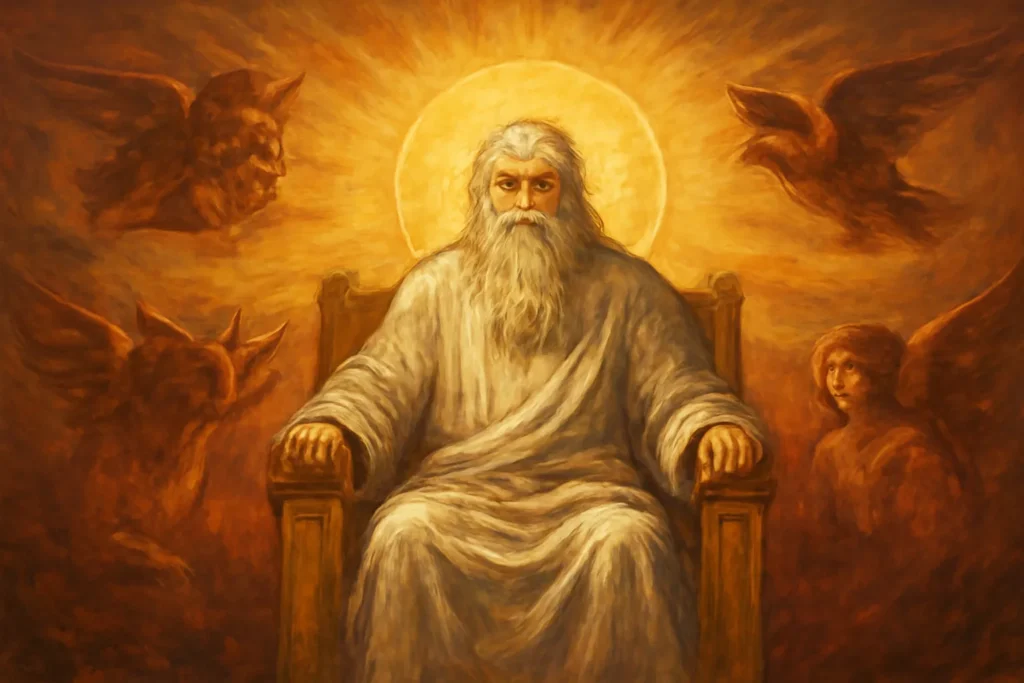
Verse 2 transports John into a scene where a singular throne dominates the center of heaven, and on the throne sits one who governs the scene. The description blends clarity with mystery, providing symbolic color through the precious stones and a surrounding rainbow. The text intentionally focuses attention on the throne as the locus of divine sovereignty and worship.
The throne: The central symbol of rule, authority, and order within creation. Its placement communicates a God-centric cosmos where all activity orbits the divine will.
One sitting on the throne: A personal, enthroned Presence who commands reverence and attention. The identity is intentionally nuanced to invite contemplation about God's character and governance.
Appearance of jasper and sardine stone: The stones evoke beauty, durability, and luminescence—colors associated with purity (jasper often seen as clear or brilliant) and vitality or passion (sardine, a vivid red). Together they suggest radiant, multifaceted splendor rather than a single monochrome image.
Rainbow around the throne: The rainbow functions as covenantal sign and cosmic reminder of mercy. Its emerald hue in many traditional readings signals hope and continuity with creation’s original beauty.
Interpretive note: The combination of the throne’s majesty, the luminous stones, and the surrounding rainbow communicates that divine sovereignty is both glorious and gracious—glory to be celebrated, mercy to be trusted. The imagery invites readers to view divine authority through a lens that harmonizes awe with fidelity to God’s redemptive purposes.
The Twenty-Four Elders: Royal Presence and Redeemed Fellowship (Revelation 4:4)
In a scene of reverent order, a multitude of twenty-four elders sits on twenty-four seats, clothed in white raiment with crowns of gold. Their position around the throne suggests a governance or representative assembly that encompasses both the promises of the old covenant and the blessings of the new. The elders’ attire and status signal purity, victory, and authority granted by the Creator.
White raiment: Symbolizes purity, righteousness, and belonging to the redeemed community.
Crowns of gold: Crown imagery is not merely triumphal; it connotes responsible authority and final submission to the Lamb who governs the eternal order.
Placement on thrones around the central throne: Acknowledges the hierarchical structure of heaven’s worship and governance, while emphasizing unity with the divine will.
Interpretive lens: The elders are sometimes read as representing the fulfillment of Israel (the 12 tribes) and the church (the 12 apostles), symbolizing the unity of God’s people across ages. Other readings emphasize a celestial council or a heavenly court.
Verse 10 explicitly shows their action in worship, sometimes described as casting their crowns before the throne as an act of worship and relinquishment before the supremacy of God. This gesture of humility reinforces the central motif: even the most exalted beings in heaven acknowledge the sovereign worthiness of the Creator.
Lightnings, Thunder, and the Sea of Glass: The Place of Order and Awe (Revelation 4:5)
The atmosphere surrounding the throne is filled with lightnings, thunder, and voices, underscoring the dynamic and thunderous majesty of God’s rule. In front of the throne stands a sea of glass like crystal, a surface that both reflects heavenly brightness and provides a figurative barrier that still permits the divine presence to inhabit the space with awe and order.
Lightnings and voices: These images convey a sense of power, revelation, and cosmic speech—the sense that God’s word has the force of thunder and the brilliance of lightning.
Sea of glass: A stunning symbol of separation and purity, an intermediary plane that nonetheless remains near enough to reveal divine activity. It suggests clarity, contemplation, and the apprehension of majesty without chaos.
Interpretive note: The sea of glass commonly functions as a liturgical and architectural metaphor in Revelation, signaling a sanctuary where worship unfolds in the presence of a transcendent, yet approachable, God.
The four living creatures are positioned within this liturgical cosmos as guardians and announcers of divine activity, making explicit that revelation proceeds in a framework of eternal worship and obedient closeness to the throne.
The Four Living Creatures: Visions of Creation and Worship (Revelation 4:6-8)
In the immediate vicinity of the throne and the sea of glass, John sees four living creatures surrounding the throne. Each creature bears a descriptive likeness that has sparked a long tradition of interpretation and poetic imagination: the first is like a lion, the second like an ox, the third has the form of a man, and the fourth is like an eagle in flight. These beings are full of eyes, within and without, suggesting heightened perception and unceasing vigilance in the divine presence.
Four living creatures: A tetrad that some readers connect to the four evangelists and to broader facets of creation—strength, service, intellect, and swiftness—all oriented toward the worship and service of God.
Eyes within and without: An image of total awareness and comprehensive perception—nothing escapes their scrutiny or their participation in the divine chorus.
Divine proclamation: Each creature features a perpetual response of praise, declaring “Holy, holy, holy, Lord God Almighty”, a triple epithet that intensifies the sense of divine majesty and uniqueness.
Two interpretive threads often emerge in studies of these creatures. One tradition sees the four faces as a tetramorph motif borrowed from ancient symbolic art, later developed in Christian iconography to symbolize the universality of Christ’s revelation across creation and history. A second approach emphasizes their role as worshipful heralds who illuminate the divine glory by calling attention to the holiness of God with every repetition of “Holy, holy, holy”.
Worship in Response: The Hymn of the Elders and the Creatures (Revelation 4:9-11)
With the throne radiusened by the throne bearers and living creatures, the narrative reaches a climactic hymn: the elders and the living creatures continually give glory, honor, and thanks to the Lord who lives forever and ever. They acknowledge God’s sovereignty over creation, celebrate the divine act of creation itself, and affirm God’s ultimate worthiness to receive worship because of the status and purpose of God as the Creator.
“Worthy are you, our Lord and God, to receive glory and honor and power”: A trinitarian-ish doxology that centers on glory, honor, and power as the rightful response to divine status.
“For you created all things” and “for your pleasure they are and were created”: The teleology of creation is captured in terms of God’s will and joy—reality exists because God desires to reveal and display Himself through creation.
Response pattern: The worship is continuous and interlocking—elderly adoration complements creaturely praise, forming a chorus that encircles the throne.
Interpretive notes about this doxology include: the emphasis on God’s worthiness is not merely theoretical; it is asserted as the driving motive of creation and history. The phraseology highlights two related commitments: (1) God’s sovereignty and (2) the purpose of creation as a stage for God’s pleasure. The worship is not static; it is energizing and eternal, offering the church a template for present-day worship that acknowledges God’s supreme authority while embracing the reality of divine generosity.
Verse-by-Verse Mapping: A Practical Guide through Revelation 4
For readers who desire a compact reference to each verse’s central themes, the following outline highlights the core ideas, with a focus on symbolic meaning and liturgical function.
Verse 1: An opening door signals access to heavenly realities; the invitation to ascend marks perspective-shift and prophetic participation.
Verse 2: The speaker is in the Spirit, giving weight to the visionary mode and promising a realm beyond ordinary experience.
Verse 3: The throne and the One seated there convey sovereignty; the lineage of stones and the rainbow symbolize integrity, mercy, and covenant faithfulness.
Verse 4: The elders on thrones show communal leadership in worship and authority delegated by the Creator. Their white robes and crowns denote purity and victory.
Verse 5: The imagery of lightnings and voices underlines dynamic revelation; the sea of glass introduces order amid divine activity.
Verse 6: The four living creatures participate in the heavenly liturgy with eyes and constant praise, illustrating attentive, worshipful citizenship in the cosmos.
Verse 7: The creature forms (lion, ox, man, eagle) invite reflection on facets of creation and revelation—strength, service, humanity, mobility.
Verse 8: The refrain “Holy, holy, holy” crystallizes the character of God and echoes through the rest of Revelation’s musical liturgy.
Verse 9: The elders respond with eternal doxology, acknowledging God’s worthiness to receive glory, honor, and power specifically “because you created all things.”
Verse 10: Cast-down humility—crowns laid before the throne—demonstrates absolute allegiance to the divine will.
Verse 11: The creative purpose of all beings is acknowledged: God’s pleasure and sovereignty are the ground of reality and worship.
Interpretive Lenses: How Different Traditions Read Revelation 4
Scholars and readers approach Revelation 4 from several angles, each offering meaningful insights without contradicting the others. A few broad lines of interpretation illuminate the texture of the text:
Historical-Cultural Lens
In the first century, Jewish and early Christian readers would have noticed temple imagery, priestly order, and a royal-realm motif that harmonizes with the Hebrew Bible’s temple theology. The throne imagery resonates with a sense of priestly intercession and the idea that heaven is a sanctuary where divine majesty and human worship converge.
Liturgy and Worship Lens
From a worship perspective, Revelation 4 provides a model of heavenly liturgy that shapes earthly worship. The rhythm of proclamation, praise, and redirection of attention to God’s worthiness serves as a blueprint for congregational worship, particularly in settings that prize acclaim for God’s creative and redemptive acts.
Symbolic and Theological Lens
The imagery—throne, sea of glass, rainbow, living creatures, elders—functions symbolically to reveal truths about God, creation, and salvation. The presence of a covenant sign (the rainbow) alongside creatures representing creation’s spectrum reinforces a theology that binds mercy and majesty into a coherent cosmic narrative.
Theological Themes Running Through Revelation 4
Several persistent themes arise as one surveys the chapter’s texture. These themes recur across Revelation and illuminate the text’s enduring relevance for faith communities today.
Sovereignty and worship: God's ultimate authority grounds all worship, history, and cosmic order.
Holiness: The refrain “Holy, holy, holy” intensifies the sense of God’s moral majesty and separateness from creation, while inviting reverential response.
Glory and honor: The lifting up of God’s glory and worthiness forms the heart of the heavenly chorus and provides a template for human praise.
Creation and artistry: The stones, colors, creatures, and material imagery celebrate beauty as the language through which God reveals divine reality.
Cosmic coherence: The arrangement of beings around the throne reflects a cosmos ordered by divine design, not random contingency.
Implications for Personal Faith and Corporate Worship
Beyond allegorical or academic interest, Revelation 4 invites contemporary readers to consider how cosmic worship shapes daily life. The chapter’s vision encourages believers to cultivate reverence, trust in God’s sovereignty, and a posture of humble adoration amid life’s complexities.
Perspective in trials: The throne-room vision offers stability—God’s governance remains intact even when earthly circumstances feel turbulent.
Worship as response: The recurring doxology models worship not as a mere reaction to blessing but as a sustained and prioritized discipline.
Participation in heaven’s cadence: Believers are invited to join the heavenly chorus in expectation of the ultimate fulfillment of God’s purposes.
Covenant memory: The rainbow around the throne invites believers to recall God’s mercy and faithfulness across generations.
Textual and Thematic Notes: How the Language Conveys Meaning
Revelation 4 uses a precise but expansive diction that encourages readers to attend to both literal and symbolic dimensions. The language suggests:
Literal anchor: Some images are vivid enough to be understood as literal features of a heavenly temple; others are metaphoric in meaning and invite interpretive exploration.
Symbolic depth: Stones, colors, and creatures carry layered meanings that point to theological constructs—covenant, purity, authority, and divine creativity.
liturgical continuity: The rhythm of worship contrasts with the newsworthy shocks of later chapters, providing a counterbalance that grounds revelation in praise.
Comparative Reflections: Similar Scenes in Scripture
Readers often compare Revelation 4 with other biblical depictions of heavenly courts to discern patterns of divine civilization and worship. Notable parallels include:
Daniel’s vision of thrones and one like a son of man, which shares the motif of a divine council and enthroned authority, though refracted through a different prophetic purpose.
Isaiah’s temple visions, where seraphim cry “Holy, holy, holy” and God’s throne fills the heavenly temple, foreshadowing the liturgical gravity of Revelation’s own scene.
Psalms of praise that celebrate God as creator and worthy of worship, offering a human counterpart to the heavenly doxology in Revelation 4.
Variations in Translation and Their Effects on Meaning
Different Bible translations sometimes render key phrases with small but meaningful nuances. Important terms to notice include the way “a door was opened” is phrased, the precise description of the stones, and the cadence of the doxology. While the core meaning remains stable, readers may notice shifts in emphasis that influence interpretation, such as:
The choice between “a door is opened” and “an entrance is granted”
Whether “the first voice” is understood as a human voice or a divine command
Variants in the depiction of the elders’ attire, color symbolism, or the exact wording of the doxology in different manuscript traditions
Across translations, the overall architecture remains coherent: a vision of the throne, a set of celestial beings in close proximity to divine authority, and a choir of praise that acknowledges God as sovereign Creator and worthy of glory.
Visual and Literary Impressions: How to Read Revelation 4 as a Modern Audience
Modern readers can engage Revelation 4 through several practical reading strategies that honor both the text’s artistry and its spiritual purpose:
Slow reading: Approach the imagery gradually, allowing symbol after symbol to resonate and invite reflection.
Cross-referencing: Compare the imagery with parallel biblical scenes (temple imagery, sovereignty, doxology) to detect shared motifs and unique emphases.
Worshipful posture: Let the text guide personal or communal worship, recognizing that the goal is to reorient attention toward God’s majesty and mercy.
Creative imagination: Engage with the imagery as a conduit for spiritual imagination—seeing creation and redemption from the vantage point of heaven may deepen faith and perseverance.
Conclusion in Perspective: What Revelation 4 Teaches for Believers
Though not a conclusion in the sense of closure to Revelation’s entire arc, the throne-room vision offers a foundational frame for understanding the rest of the book. It situates the narrative in a cosmic courtroom and sanctuary where God’s sovereignty, holiness, and creative purpose are on clear display. The vision invites believers to:
Adhere to divine sovereignty in all circumstances, trusting that history is under the care of one who reigns from the throne.
Join in perpetual worship with the heavenly chorus, not as a mere act of ritual but as an orientation of heart toward the Magnificent One who is worthy of all honor.
Embrace humble gladness as the elders do—acknowledging blessing as belonging to God’s will and finding joy in participating in the cosmic hymn.
In sum, Revelation 4 offers a panoramic introduction to the divine throne room—a scene where majesty and mercy intersect, where creation’s vitality sings in harmony with its Creator, and where a people bound for tumultuous times can find orientation through awe-filled worship. Understanding this chapter verse by verse enriches not only exegesis but also the daily rhythms of faith, prayer, and communal life.




Leave a Reply