Ezekiel Visions Explained: Meaning, Prophecy, and Symbolism
Ezekiel Visions Explained: Meaning, Prophecy, and Symbolism
Ezekiel’s visions stand among the most striking and debated images in ancient literature. They blend cosmic imagery, temple symbolism, and visionary journeys to speak about judgment, renewal, and the relationship between God and a people in exile. This article, Ezekiel Visions Explained: Meaning, Prophecy, and Symbolism, surveys the major visions attributed to the prophet Ezekiel, explains their historical and theological contexts, and explores what these images have meant for readers across centuries. Throughout, key terms and ideas will be highlighted to help distinguish symbolism, prophecy, and interpretation.
Ezekiel’s active period unfolded during the Babylonian exile, roughly in the early 6th century BCE. Trained as a priest, he was carried away from Jerusalem to Babylon where he received a series of dramatic revelations. The book of Ezekiel is not a single, linear narrative but a collection of visions, symbolic acts, oracles, and announcements that move between judgment and restoration, crisis and hope. The visions function on several levels: they authenticate Ezekiel’s prophetic authority, they address the present crisis of exile, and they point toward a future restoration that redefines Israel’s identity and worship.
In understanding Ezekiel’s visions, several themes recur. First, divine communication is mediated through vivid imagery: chariots and wheels, flying creatures, scrolls, and landscapes of deserts, valleys, and temples. Second, the visions insist on holiness and responsibility; even a people in exile are called to live in accordance with God’s standards. Third, many visions insist on the centrality of the temple—not merely as a building but as a locus of divine presence and order—yet they often disclose a future where the temple’s meaning is redefined. Finally, Ezekiel’s visions engage with cosmic and geopolitical dimensions, imagining how divine judgment and mercy intersect with world powers and nations.
Core Symbols in Ezekiel’s Visions
To read Ezekiel’s visions well, it helps to recognize recurring symbols that recur across chapters. While each vision has its own context, its imagery often echoes across the book, creating a coherent theological message about divine sovereignty, holiness, and renewal.
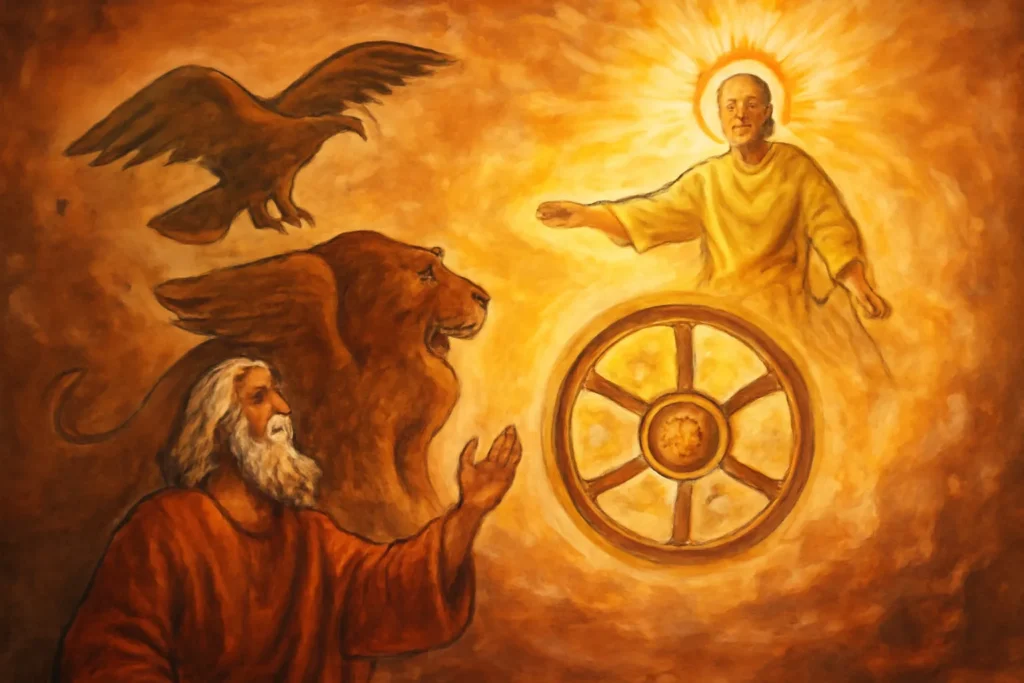
Merkavah (the divine chariot) and wheels within wheels: A theophanic image of God’s mobility and sovereignty. The vision emphasizes God’s presence with, and sovereignty over, all creation, even amid exile and judgment.
The cherubim and living creatures: A complex cosmic vision that signals the closeness of God’s throne to the world, and the integrity of divine plans even when human institutions fail.
The scroll and written message: A symbol of speech, responsibility, and the prophet’s commission. Eating the scroll represents internalizing God’s words and then delivering them to others.
The glory of the Lord (the Kabod or Shekinah imagery): The visible manifestation of God’s presence, which in Ezekiel sometimes departs and later reappears in restored form.
The valley of dry bones: A powerful image of national restoration and spiritual renewal, where breath or wind represents life-giving divine Spirit.
The temple vision (Ezekiel 40–48): A detailed architectural portrait of a future temple and its rituals, often read as a symbolic reordering of worship and social life.
Two sticks” (the reunification of Israel and Judah): A symbolic act demonstrating the restoration of the two kingdoms into one people.
Gog and Magog (Ezekiel 38–39): A prophetic scenario describing a climactic invasion and its defeat, framed within the larger purpose of divine glory and judgment against nations.
The Major Visions: A Guided Tour
Below are the most influential visions in Ezekiel, presented with attention to their setting, imagery, and interpretive significance. Each subsection opens a window into how Ezekiel’s audience would have heard the vision and how later readers have understood its message.
Ezekiel 1–2: The Vision of the Four Living Creatures and the Heavenly Throne
In this opening vision, Ezekiel is carried by the Spirit to a dramatic composite scene by the Kebar River. He sees four living creatures, each with multiple faces and wings, accompanied by wheels intersecting with the creatures’ movements. The whole vision culminates in the appearance of a radiant throne on which a figure like a man sits, surrounded by brilliant fire and brightness.
The wheels intersecting with the living beings symbolize the full mobility of God’s presence—moving with purpose across the horizon of history, not confined to a single locale.
The splendor of the divine throne communicates majesty, holiness, and the tremor of judgment that accompanies prophetic commissioning.
For Ezekiel, this vision confirms his authority: God has seen the exile, knows its pain, and can speak a word that matters for justice and renewal.
Interpretive note: many readers emphasize the vision’s insistence on divine sovereignty and presence in exile. It also frames prophecy as a response to crisis, not merely a reward for piety. The symbolism invites readers to ponder how God’s rule persists beyond political upheaval and how divine purposes permeate all corners of creation.
In this phase of the vision, Ezekiel is addressed as he sits overwhelmed in his house. He sees a hand reaching out with a scroll, which is filled with lamentations, mourning, and woe. He eats the scroll, symbolically internalizing God’s words before delivering them to the people. The vision concludes with his commission: he must go to a people who do not listen, yet he is told to speak what God commands, whether or not they heed it.
The act of eating the scroll represents internalization of revelation and the moral seriousness of communication to others.
The repeated refrain that the people “will know that there is a prophet among them” underscores a central aim of Ezekiel’s ministry: to reveal God’s intentions and call forth accountability.
Interpretive note: readers often reflect on how prophetic authority is earned through obedience, courage, and fidelity to the divine message, even amid resistance and danger. Ezekiel’s readiness to speak truth to power is a recurring thread in the prophetic tradition that bears interest for readers confronting political and moral complexities today.
Ezekiel 8–11: The Departure of the Glory from the Temple
In a wrenching sequence, Ezekiel is shown visions inside the Temple in Jerusalem, where he witnesses idolatrous practices and menacing rites. The glory of the Lord is shown departing from the temple, moving toward the threshold, the inner courts, and finally leaving the city. This is a dramatic symbol of judgment: the people have broken covenant, and the divine presence withdraws as a consequence.
The departure of the divine glory signals a theology of covenant breach and consequence, but it also sets the stage for future restoration.
Even in a moment of abandonment, Ezekiel’s visions insist that God’s plan remains active in the waking of a new future beyond the exile.
Interpretive note: some scholars read this as a critique of idolatry in Jerusalem and a symbolic map of how divine presence can be affected by human choices. Others see it as a dramatic literary device that heightens anticipation for a rebuilt community and a transformed worship life in a renewed future.
One of Ezekiel’s most iconic images, the valley is filled with dry bones that come together and are covered with sinews and flesh. The prophet prophesies to the breath, and the bones receive life, standing as a vast army. This vision culminates in the promise that God will breathe life into Israel again, binding the people with a new unity and a renewed vitality. Two central ideas emerge: a physical reconstitution and a spiritual revival.
The breath or ruach moving through the bones is a recurrent motif for divine life and vitality.
The vision underscores a fundamental message of Ezekiel: exile is not the end of Israel’s story; restoration will come through God’s action and the people’s engagement with divine will.
Interpretive note: readers often see this vision as a theological bridge between judgment and restoration. It validates hope for a future in which God’s promises to the people are realized in concrete, national terms as well as in spiritual renewal.
Ezekiel 40–48: The Vision of the New Temple and the Reordered Land
In the latter section of Ezekiel, the prophet is granted an extended, highly detailed vision of a new temple, its measurements, its ordinances, and a mapped land with tribal boundaries. This utopian or symbolic temple is not just about architecture; it is about the reordering of worship, leadership, and social life after the exile. The vision culminates in a revised division of land and a redefinition of holiness and ritual.
The temple architecture becomes a language for order, purity, and the presence of God in a reconstituted community.
The detailed measurements and divisions invite readers to see sacred space as a framework for ethical life, social justice, and communal identity.
Interpretive note: scholars debate whether Ezekiel’s temple vision is a literal plan, a symbolic blueprint, or a combination of both. Regardless of literalism, its message about renewed worship, ethical governance, and restoration of community has had lasting influence on Jewish and Christian interpretive traditions.
Ezekiel 38–39: The Prophecy of Gog and Magog
One of the book’s climactic visions concerns a coalition of nations led by Gog from the land of Magog. This prophetic scenario proclaims a dramatic invasion of the land of Israel, which is ultimately thwarted by divine intervention. The narrative emphasizes the distinction between human warfare and spiritual sovereignty: God’s name will be magnified among the nations as an act of judgment and mercy.
The invasion serves as a stage for God’s glory and power to be revealed publicly among the nations.
Readers encounter a cosmological frame in which history and eschatology intersect, reminding them that even enormous geopolitical events are nested within God’s purposes.
Interpretive note: much commentary highlights the dual horizon of these chapters: a historical setting in which neighboring powers threatened Judea and a future-oriented hope in which ultimate victory belongs to God. Across traditions, Gog and Magog function as a symbolic crisis that tests faith and clarifies hope for a restored people under divine sovereignty.
Meaning and Theological Significance of Ezekiel’s Visions
Across its many images, Ezekiel’s visionary program centers on a set of enduring questions: Who is God? What does it mean to live faithfully under divine authority? How can a community endure suffering and betrayal while becoming a beacon of hope? The answers, embedded in the visions, can be summarized through several key themes.
Holiness and responsibility: Ezekiel’s visions insist that God’s presence rests on a life shaped by covenant faithfulness, ethical conduct, and communal integrity. Worship is not purely private piety but public fidelity to divine requirements.
Divine sovereignty in history: The mobility of the divine throne and the involvement of earthly powers in divine plans stress that history unfolds under God’s oversight, even when people misread events.
Restoration rooted in transformation: The valley of dry bones and the temple vision together show that restoration is not merely political recovery but a renewed heart, worship, and social order guided by God’s breath.
Unified identity after the break: The vision of the two sticks and the reunification of Israel and Judah underlines a theological claim: identity is reconstituted through divine initiative and communal repentance, not merely through political unity.
Prophecy as trust-building: Ezekiel’s call to deliver challenging messages to a resistant audience models trust in God’s plan, even when immediate outcomes are not apparent.
How to Read Ezekiel’s Visions: Approaches and Variations
Scholars and faith communities engage Ezekiel’s visions through varied frameworks, each highlighting different aspects of meaning. Here are several common lenses that illuminate different layers of the text.
Historical-critical reading: Focuses on the text’s original context in exile, its interaction with neighboring cultures, and its function in shaping a displaced community’s identity.
Literary-theological reading: Emphasizes the poetic imagery, symbolic consistency, and the book’s overarching narrative arc from judgment to restoration.
Theological-moral reading: Explores how the visions teach ethics, justice, and hope in the face of suffering and brokenness.
Sacred space and worship: A close look at Temple imagery, liturgical patterns, and how the remote future temple shapes present worship and community life.
Ecological and cosmic dimensions: Some readers notice the book’s concern with the order of creation, divine presence across realms, and the moral ecology of nations.
Throughout these readings, certain phrases recur. Readers who search for a phrase like “Ezekiel visions explained” will find a spectrum of interpretations, from literal architectural plans to symbolic projections of divine future. The diversity of interpretation does not negate the core messages: God’s sovereignty, the seriousness of covenant faithfulness, and the hope of renewal that begins in the heart as well as in the community’s life.
Practical Implications: What Ezekiel Teaches for Faith Today
Although the visions originate in a specific historical moment, they offer durable lessons for readers today. The following points summarize some practical takeaways that readers often draw from Ezekiel’s visions.
Hope amid crisis: Even when the present seems ruined, Ezekiel’s visions insist that God’s life-giving Spirit can awaken what looks dead, whether in a nation or in an individual life.
Renewal of worship: The temple vision invites communities to reconsider what worship means—how it integrates justice, mercy, and daily living with the divine presence.
Ethical leadership: Ezekiel repeatedly places responsibility on leaders and people alike to pursue integrity and truth, even at personal cost.
Collective identity: The reunion of Israel and Judah in the imagery of two sticks calls communities to redefine themselves not by past separations alone but by shared purposes under God’s direction.
Hope that transcends borders: The visions address universal questions about power, sovereignty, and divine justice that resonate beyond one historical moment or geographic locale.
Variations of “Ezekiel Visions Explained” in Scholarship and Faith Communities
To acknowledge variations in how the visions are understood, many scholars and educators phrase the topic in alternatives that highlight different emphases. Some common variants you might encounter include:
Understanding Ezekiel’s prophetic visions as a guide to interpretive frameworks for the book as a whole.
Explaining the symbolism in Ezekiel with a focus on hermeneutics—the methods by which readers interpret ancient texts.
Meaning of Ezekiel’s allegories for modern faith communities seeking practical steps for justice, worship, and reconciliation.
Prophetic symbolism in Ezekiel that connects the ancient images to present-day concerns about power, justice, and spiritual renewal.
Symbolic architecture in Ezekiel that uses the temple’s design to speak about social order and communal life.
Conclusion: Why Ezekiel’s Visions Matter Across Time
While the specific historical circumstances of Ezekiel’s prophecies belong to ancient Israel’s exile, the visions’ core motifs—God’s sovereignty, the seriousness of moral life, the possibility of renewal after judgment, and the hope of a future reconstituted community—continue to speak with relevance. The images invite readers to acknowledge the discomfort of judgment while embracing the transformative possibility of restoration. Whether approached as historical poetry, theological argument, or spiritual symbol, Ezekiel’s visions remain a powerful reminder that divine purposes extend beyond present pain and local horizons into a future where life and worship are renewed by the breath of God.






Leave a Reply