Catholic Christmas Cards: Nativity Designs and Meaningful Messages
Christmas cards have long been a cherished part of Catholic culture, offering a way to share faith, hope, and joy with family, friends, and the wider church community. In this article, we explore the world of Catholic Christmas cards, with a focus on Nativity designs and Meaningful messages. We will look at traditional imagery, symbolic language, and practical guidance for choosing, writing, and sending cards that honor the Catholic faith during the Advent and Christmas seasons. Whether you are a parish reader, a priest preparing card programs for a church, a family looking to send season’s greetings, or a Catholic stationery enthusiast, this guide aims to inform and inspire.
Throughout the Catholic tradition, seasonal greetings are not merely a form of courtesy; they are an opportunity to witness to the Incarnation—the moment when God became man in Jesus Christ. A well-chosen Catholic Christmas card can illuminate core beliefs, recall biblical narratives, and invite recipients into prayerful reflection. In what follows, we will consider how Nativity imagery communicates theology, how messages can express reverence while remaining accessible, and how card design choices can enhance message and meaning.
Nativity-inspired designs in Catholic Christmas cards
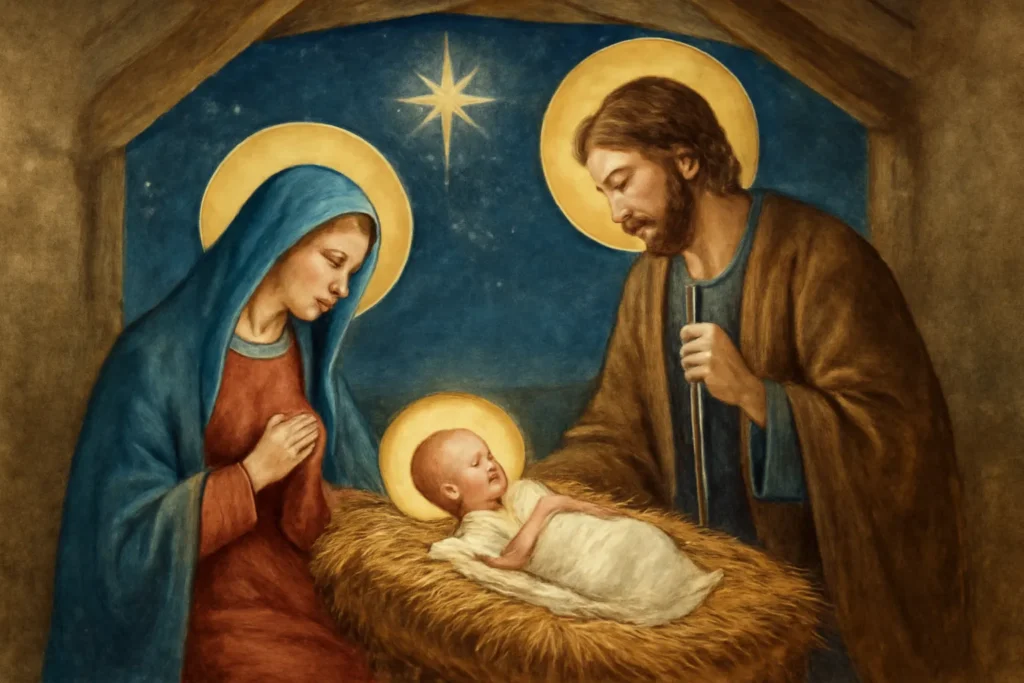
One of the defining characteristics of Catholic Christmas cards is the central placement of Nativity scenes. The Nativity—often called the Crèche or Manger scene—encapsulates the mystery of the Incarnation: the birth of Jesus in humility, announced to shepherds, glorified by angels, and guided by a star. Card designers draw on centuries of Christian art to render these scenes in ways that are visually compelling and spiritually instructive.
Iconography and symbolism in Nativity art
Nativity designs on Catholic Christmas cards draw on a shared vocabulary of symbols. Understanding these symbols helps you select cards with deeper meaning and helps recipients appreciate the imagery.
The manger and the infant Jesus emphasize the Incarnation’s radical humility: God becoming man within ordinary human events.
Mary and Joseph often appear as a Holy Family figure, underscoring trust in God’s plan and family life as a place of faith formation.
Angels proclaimers of good news and messengers of divine presence remind readers of God’s ongoing interaction with creation.
Shepherds and Wise Men represent the universal reach of Christ’s birth—from the humble to the magisterial, from the earthly to the cosmic, and from the immediate to the eternal.
The Star of Bethlehem or a guiding light signals revelation and the journey of faith toward Christ.
Bethlehem’s stable is a reminder that God enters human history not in grandeur but in simplicity and vulnerability.
In Catholic art, Nativity imagery is often integrated with other elements such as a church architecture silhouette, floral motifs from Advent wreaths, or an atmospheric night sky. These combinations help convey a sense of sacred time—the season of waiting before Christmas (Advent) and the celebration of Christ’s birth on Christmas Day. When selecting Nativity designs, consider how the imagery aligns with the recipient’s spiritual life and with your message’s tone—reverent, joyful, contemplative, or catechetical.
Common Nativity scenes found on Catholic Christmas cards
Different cultural traditions contribute variations that enrich the standard Nativity motif. Here are some common scenes you might encounter:
The Holy Family gathered in a stable or cave, often with animals nearby and a serene baby Jesus in a manger.
Angels and shepherds announcing the birth, sometimes with a celestial glow or musical motif that echoes the heavenly chorus.
The Magi presenting gifts, highlighting the recognition of Jesus as King by all nations and epochs.
The Annunciation panels that connect the moment of Mary’s fiat (her willing acceptance of God’s plan) to the Nativity itself.
Regional creches that incorporate local architectural styles, landscapes, or cultural dress while preserving core theological symbols.
For parishes or Catholic schools designing Christmas cards, these Nativity scenes offer ready-made narratives that can be mass-produced or customized with a parish message. For families, they provide a meaningful backdrop for personal notes, prayers, and pastoral sentiments during the Advent-to-Christmas season.
Meaningful messages for Catholic Christmas cards
The text on a Catholic Christmas card—whether a short verse, a longer reflection, or a Scripture passage—should be faithful to Catholic doctrine while being accessible and warm. Messages can be scripture-based, prayerful blessings, or catechetical reflections that invite recipients to contemplate the mystery of the Incarnation and the joy of the season.
Scripture-based messages
Scriptural passages provide a firm theological foundation for Christmas greetings. When using scripture, consider context, length, and the recipient’s familiarity with biblical language. Short, well-chosen verses are often more impactful than longer quotations on a small card.
“Glory to God in the highest, and on earth peace among men with whom he is pleased.” (Luke 2:14, RSV-CE or Luke 2:14 in common English translations).
“For today in the city of David a Savior has been born for you, who is Messiah and Lord.” (Luke 2:11).
“Behold, I bring you good news of great joy.” (Luke 2:10).
“And the Word became flesh and dwelt among us.” (John 1:14).
“O come, let us adore Him.” (An Evangelical hymn text often used in Catholic devotion, reflecting the Magi and shepherds’ posture of worship).
When including scripture, pair it with a brief reflection that ties the verse to daily life. For example: “May the Word made flesh dwell among you this Christmas season, guiding your steps in faith and hope.”
Prayerful blessings and devout wishes
Prayerful messages emphasize personal blessing for the recipient, seeking God’s grace in the coming year while centering Christ’s birth as the source of light and life.
“May the newborn Child bring you peace, joy, and enduring faith.”
“Wishing you a blessed Christmas filled with the light of Christ’s love.”
“May the blessing of Christmas fill your home with grace and gratitude.”
“May Emmanuel—God with us—be your constant companion this Christmas and always.”
Tips for blessing-focused messages: keep them concise and sincere, avoid overly sentimental language, and tailor to the recipient’s life stage (elderly relatives, catechists, new families, and young children). For clergy or religious educators, you might include a note about ministry or service in the coming year.
Catechetical reflections for Catholic Christmas cards
Some card sets purposefully combine Nativity art with short catechetical messages or questions that invite contemplation. Examples include:
“Why did God become man?” followed by a sentence or two of reflection on God’s love and the gift of Jesus’ humanity.
“What does it mean that Jesus is the Word made flesh?” with a simple catechetical explanation suitable for older children or adult recipients.
“How can we imitate the humility of the Nativity in daily life?” prompting a personal daily action or prayer intention.
For families, parish groups, or Catholic schools, catechetical messages on Christmas cards can serve as quick reminders of the season’s core truths and as catalysts for small group reflections or prayer corner displays.
Design considerations and production techniques
Beyond the imagery and text, the physical design of Catholic Christmas cards contributes to the listener’s experience. The card’s materials, finishes, typography, and layout affect readability, reverence, and overall aesthetic impact. Here are common design elements to consider when selecting or creating Catholic Christmas cards.
Materials and finishes
Card stock varies in weight, finish, and texture. Catholic churches and schools often opt for:
Heavy-weight card stock for durability and a premium feel.
Matte or satin finishes that reduce glare and enhance readability of text.
Foil stamping or embossing to highlight holy figures or scriptural phrases.
Recycled paper options for environmentally conscious churches and families.
Typography and readability
Choose typefaces that convey reverence yet remain legible for all ages. For Catholic Christmas cards, common choices include traditional serifs for a timeless feel and humanist sans for modern simplicity. Ensure that the font size is comfortable to read in typical card dimensions, and that high-contrast color combinations (for example, dark ink on light backgrounds) aid readability.
Layout and hierarchy
A well-designed Catholic Christmas card balances imagery with text. Consider:
Hierarchy that places the Nativity image as the focal point, with messages and Scripture arranged in a visually clear order.
White space to prevent clutter and allow the eye to rest on key symbols and words.
Marginal notes for liturgical reminders (e.g., Advent, Christmas, Epiphany) that can be useful for parish bulletins or school displays.
Artistic styles and cultural variations
There is no single style for Catholic Christmas cards. Some congregations prefer traditional iconography that resembles classical European paintings, while others enjoy warm, homey depictions of the Holy Family in rustic or rural settings. International Catholic communities may feature:
Icon-inspired designs that use gold leaf, stylized figures, and a formal composition.
Folk-art influences that reflect local culture, language, and color palettes while preserving essential sacred symbolism.
Modern minimalist cards that emphasize clean lines and a concise spiritual message.
Choosing Catholic Christmas cards for different recipients
Selecting the right card involves understanding the recipient’s faith background, relationship to you, and the context in which you are sending the card. The goal is to communicate respect, affection, and shared faith through an appropriate card type and message.
For grandparents, parents, siblings, and children, consider a balance of warmth and faith-centered content. Family cards often benefit from:
Personalization with a family photo and a short blessing tailored to the number of children or relatives.
Clear, concise messages that celebrate both Christmas joy and the gift of family life in Christ.
Inclusive language that welcomes all faith backgrounds while keeping the Catholic focus.
Clergy and parish staff
When sending to priests, deacons, catechists, and parish volunteers, you may wish to emphasize service, stewardship, and the Church’s mission in your message. In such cases:
Acknowledgment of ministry and gratitude for their service to the community.
A call to prayer for peace, justice, and ongoing evangelization.
Formal yet warm language that reflects the ecclesial relationship.
Friends and neighbors
For friends or neighbors who may or may not share the Catholic faith, consider a greeting that is respectful of beliefs while clearly rooted in Catholic tradition. Options include:
Non-denominational-friendly phrases paired with a Nativity image that communicates the universal significance of Christmas.
Short prayers or reflections that invite conversation about faith and charity.
Bilingual or multicultural cards that reflect shared community life and linguistic diversity.
Practical tips for sending Catholic Christmas cards
Sending cards is not just a logistical task; it is an act of pastoral care and a small form of evangelization. Consider the following practical points to maximize the impact of your Catholic Christmas card program or personal practice.
Timing and timing strategy
The Advent season is a time of preparation; Christmas cards often go out in December, leading up to Christmas and continuing through Epiphany. Practical strategies include:
Send early to ensure delivery before Christmas for most households.
Provide an Epiphany extension angle on a subset of cards, inviting recipients to reflect on the Magi or to prepare for the new year with spiritual goals.
Group mailing from a parish or school can be cost-effective and inclusive.
To ensure your Catholic Christmas cards are accessible to a broad audience, consider:
Clear text with large enough font and high contrast.
Plain language that avoids overly technical or insider Catholic jargon.
Alternative formats such as a small card with a QR code linking to a short reflection or prayer, for those who read digitally.
Educational uses and catechesis through Catholic Christmas cards
A thoughtful approach to Catholic Christmas cards can incorporate catechesis—teaching the faith—without becoming didactic. Churches, Catholic schools, and families can leverage cards as teachable moments during the Advent and Christmas seasons.
Card-based catechesis for classrooms and families
Ideas for using cards as teaching tools:
Discussion prompts printed on cards or included in a teacher’s guide, such as questions about the Nativity story, Advent expectations, or the meaning of Christmas beyond gifts.
Scripture-and-art pairs that invite students to connect a biblical text with a Nativity image and a short reflection.
Advent-to-Christmas devotionals that unfold over several days, with a new card exchanged daily among families or small groups.
For catechists, consider a card series that follows the timetable of the liturgical year: Advent anticipation, the Nativity narrative, the Holy Family, and Epiphany insights. Each card can include a brief prayer, a short catechetical note, and a scripture reference.
Parish and school displays
Card displays in churches, classrooms, or parish halls can become small acts of catechesis. Suggestions include:
Exhibit walls with Nativity-themed cards from various cultures, explaining the symbolism in each design.
Prayer corners featuring selected cards as focal points for personal devotion or communal prayer.
Student projects where students research and present the theology behind a chosen Nativity image.
Variations and formats of Catholic Christmas cards
The market for Catholic Christmas cards is diverse. If you are seeking variations to fit different preferences, here are several common formats and approaches you might explore. Each variation preserves a Catholic focus on the Nativity and meaningful messaging while adapting to different audiences and purposes.
Traditional vs. contemporary styles
Traditional cards emphasize classic religious art and formal typography, while contemporary cards may feature modern design elements, brighter color palettes, and streamlined messages. Both approaches can accurately convey Catholic faith, so the choice depends on the recipient and intended impact.
Photo cards with Scripture
Photo-based Catholic Christmas cards combine a personal family image with a scriptural inscription or a short blessing. These are popular for family greetings while keeping a strong religious focus. When using photo cards, consider:
Choosing a Holy Family or Nativity-themed photo that complements the card’s message.
Adding a brief, scripture-based line or prayer to maintain the Catholic emphasis.
Consistency between the image and the cardinal message of the card.
Bilingual and multicultural cards
In diverse Catholic communities, bilingual cards (for example, English and Spanish, English and Vietnamese, or other languages) foster inclusivity and reflect the universality of the Church. Bilingual cards typically present text on parallel lines or within two panels, ensuring readability in both languages.
Advent-focused cards vs. Christmas-focused cards
Some Catholic cards are designed specifically for Advent, emphasizing preparation and repentance, while others center on Christmas joy and the Incarnation. A few cards blend both themes to accompany the liturgical transition from Advent to Christmas.
Handmade and artisanal cards
Artisans and religious orders create hand-crafted cards with distinctive textures, embossed imagery, and hand-lettered scripts. These cards tend to be valued for their craftsmanship and unique spiritual ambiance, making them ideal for meaningful, intimate sharing with close family members and clergy who appreciate traditional craft.
Ecumenical and interfaith family cards
In ecumenical contexts, Catholic Christmas cards may be designed to respect other Christian traditions while clearly presenting Catholic belief in the Incarnation. Cards in this category often emphasize shared themes such as peace, charity, and the universal significance of Christmas, while maintaining a respectful Catholic tone.
Conclusion: embracing Nativity designs and meaningful messages in Catholic Christmas cards
Catholic Christmas cards offer more than a seasonal greeting. They are a vehicle for catechesis, a means of pastoral care, and a way to carry forward the Church’s mission to bear witness to the wonder of the Incarnation. By choosing Nativity designs that illuminate doctrinal truths and pairing them with meaningful messages grounded in Scripture, prayer, and Catholic devotion, you can create a card that resonates with faith and invites recipients into contemplation and gratitude during Advent and Christmas.
Whether you prefer the time-honored elegance of a traditional Nativity scene or the contemporary appeal of a photocard with a succinct blessing, remember that the impact of a Catholic Christmas card is shaped not just by beauty, but by intention. Take a moment to reflect on what you want the card to say about your faith, your relationships, and your hope for the coming year. In doing so, your greetings become a small but meaningful act of evangelization—an invitation to humbly welcome Christ into the heart and home of every recipient.
May your exploration of Catholic Christmas cards help you discover designs that speak truth and artistry, and may your messages bless others with the peace and joy that come from the Nativity—the moment when God drew near in love.










Leave a Reply