Introduction: The Night when a Patriarch Struck Ties with the Divine
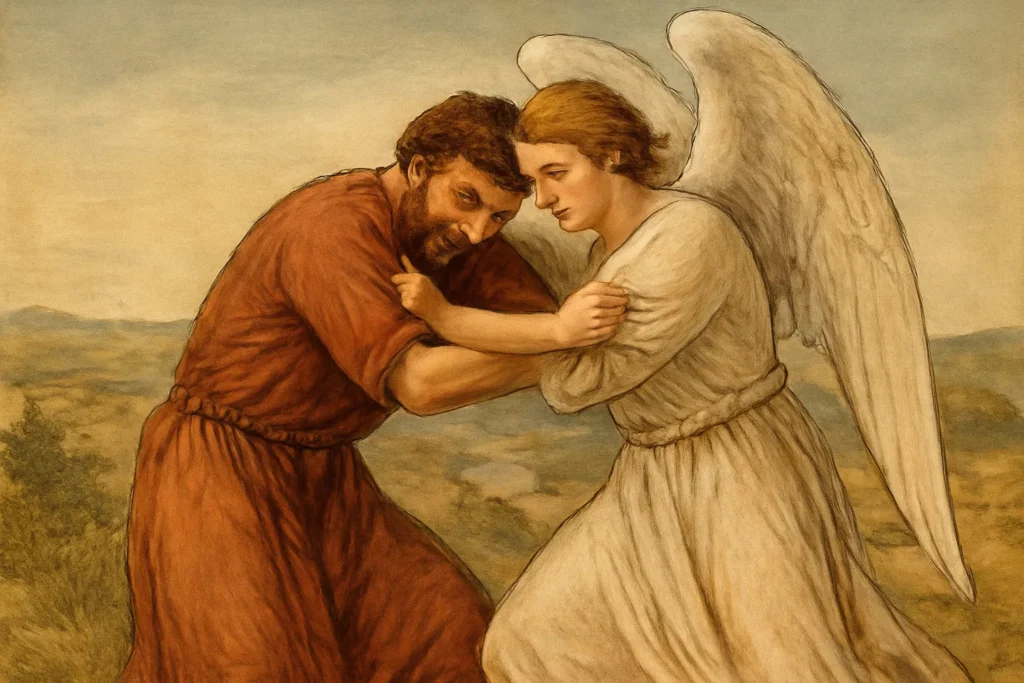
And Jacob wrestled with God is a phrase that evokes a scene of raw confrontation, intimate struggle, and lasting transformation. This nocturnal encounter, recorded in Genesis 32, sits at a hinge moment in the biblical narrative. It marks the turning point where the patriarch who had once relied on cunning and scheming encounters a power greater than himself and emerges with a new identity. The episode is compact in its literary space, yet expansive in its theological implications, offering a wealth of lessons about prayer, perseverance, humility, and the formation of a national and spiritual people.
In this article, we will explore the emotional texture, historical context, theological meanings, and practical applications of Jacob’s night-long wrestling with a divine visitor. We will consider several ways the story has been understood across traditions, including Jewish and Christian readings, and we will draw out enduring insights for readers who seek to grow in faith, resilience, and integrity. Our aim is not to sensationalize mystery but to illuminate the range of meanings that emerge when a figure as complex as Jacob is pressed by the divine in the middle of a real-life crisis.
Setting the Scene: A Family Crisis and a Strategic Return
To appreciate Genesis 32, it helps to recall the relay of events leading up to the encounter. Jacob has fled from his home after deceiving his father, Isaac, and cheating his twin brother Esau of the blessing meant for the elder. Years later, he returns home with a growing family, a wealth of flocks, and a history of strained relationships. The journey back is not simply geographical; it is spiritual and social. Jacob faces the fear of reconciliation with Esau, the risk of renewed family conflict, and the uncertainty of what the future holds for the nation that God promised to him.
In the midst of this tense homecoming, Jacob arrives at the ford of the Jabbok River, a place that becomes the setting for an extraordinary holy hinge moment. The text emphasizes the strategic nature of his movements—sending gifts ahead to Esau, choosing a retreating posture for the night, and creating space for a decisive encounter that would redefine his life and vocation.
What Does It Mean to Wrestle with the Divine?
Who is the Opponent in the Night?
The opening ambiguity of Genesis 32:22–32 invites readers to ask: Who is the one with whom Jacob wrestles? The figure is described as a mysterious combatant, sometimes interpreted as an angel, sometimes as an appearance of God Himself, and in other readings as a symbolic representation of Jacob’s own inner struggle. The text’s ambiguity invites a wide range of readings, all of which acknowledge that the encounter is deeply personal and transformative.
Across traditions, the wrestling match is less about a physical contest and more about a theological confrontation. The
recognition of weakness before a stronger reality,
refusal to release until a blessing is granted, and
an eventual naming crisis that reframes identity and purpose.
Most readers interpret the event as a deliberate, intimate negotiation between human vulnerability and divine prerogative. In that sense, Jacob’s struggle is not merely a struggle with a person; it is a struggle within a person—between the life he has lived and the life God intends to forge through him.
Variant Readings and Their Meanings
Different traditions emphasize different aspects of the encounter:
As a mystical embrace of God’s grace, in which Jacob is confronted with grace that is hard to receive but transformative.
As a theological testing in which Jacob’s faith and persistence are refined under pressure.
As a covenantal turning point in which the name Jacob gives way to Israel as a sign of a new national and spiritual vocation.
Regardless of interpretation, the core phenomenon is consistent: a person who has lived by cunning and self-preservation is called to a new mode of existence—one that involves dependence, courage, vulnerability, and fidelity to a calling beyond personal security.
Jacob, His Struggle, and the Making of a Nation
The moment when Jacob lumbered into a night of wrestling is inseparable from the formation of the people of Israel. The new name—“Israel”—becomes not merely a label for a man but for a people who must contend with God and with the forces of history. The narrative makes clear that this is not a friendly blessing but a strenuous, sometimes painful encounter through which God shapes a leader and, by extension, a people.
One of the most compelling arcs in this passage is the movement from a life built on deception to a life oriented toward dependence on divine grace. Jacob’s earlier life is full of calculated moves: he persuades, he cons how he can gain an advantage, and he leverages what he has to secure his future. The night of wrestling strips away the illusion of self-sufficiency. It exposes the fragility of human strength and invites the one who wrestles to lean not on personal cunning but on the power and mercy of God.
The Limp as a Sign
The biblical text notes that Jacob leaves the encounter with a dislocated hip, a visible limp that would remind him and others of the night when he wrestled with the divine. This limp is more than a physical consequence; it becomes a symbolic emblem of a transformed life. The limp marks a person who has endured struggle and survived by grace. It is a durable reminder that true strength often emerges through vulnerability, limitation, and dependence on a power greater than one’s own.
The Names: Jacob, Israel, and the Meaning of a Change in Destiny
Names in the biblical world are not merely labels; they are declarations about vocation and destiny. In this episode, a change of naming accompanies a change of direction. Jacob, whose name carries the sense of “he who grabs the heel” or “supplanter,” is renamed Israel, a term traditionally understood to mean “one who struggles with God” or “God contends”—though some scholars offer nuances such as “God prevails” or “the prince with God.”
Jacob represents the human condition of striving, scheming, and surviving by cleverness.
Israel represents a vocation of ongoing struggle, wrestling with questions of faith, morality, and trust in divine promises.
The change from Jacob to Israel signals a shift from a personal trajectory of self-reliance to a national and spiritual pilgrimage under God’s guidance.
The renaming is thus not merely about a personal makeover; it is a redefinition of purpose. From that point forward, the descendants of Jacob are not simply a family with a homeland; they are a people who must “wrestle with God” as part of their very identity. This is why the story resonates across generations: it speaks to the ongoing human condition—our calling to engage with the divine even when the encounter is mysterious, challenging, or confronting.
Lessons for Prayer, Faith, and Perseverance
The Genesis 32 narrative offers a rich trove of practical lessons for modern readers seeking to grow in faith. Here are several durable takeaways, framed as hard-won truths rather than abstract ideals.
Persistence in Prayer
Jacob’s famous line—“I will not let you go until you bless me” (in paraphrase)—is a memorable articulation of persistent, engaged prayer. The emphasis is not on bargaining with God but on the posture of a petitioner who refuses to abandon the encounter until it yields a blessing. This teaches that prayer can be a stubborn, exacting practice that refuses to be hurried, superficial, or transactional.
Humility under the Weight of Mystery
The encounter requires humility. The divine who appears might be inscrutable; the path to blessing is not a predictable formula but a surrender to a larger, wiser plan. The limp, the night, the withholding of immediate clarity—all contribute to a posture of humility before God’s purposes that may not align with human expectations.
Identity in Scripture is often forged in encounters with the holy that press beyond self-understanding. For Jacob, the night’s struggle is less about winning a match and more about discovering a new role: a father of a people, a carrier of a covenant, and a leader who must shepherd others through the complexities of life with integrity.
Blessing through Transformation
The blessing Jacob receives is not only about material provision or personal comfort. It is about transformation—being remade to fulfill a calling that requires trust, obedience, and a willingness to move in ways that are beyond one’s own capacity. The narrative suggests that blessing and transformation often come through trials that reshape the person, not just provide for the person’s needs.
Vulnerability as a Strength
The idea that vulnerability can be a source of strength runs counter to many cultural impulses. Yet in this story, by showing up in weakness (the limp) and by leaning into God’s presence, Jacob embodies a form of strength enabled by divine grace. The lesson is not that vulnerability is virtue in itself, but that vulnerability opened to God’s mercy becomes a place of true empowerment.
Wrestling as Covenant-Making: The Broader Theological Frame
The Genesis 32 account sits within a broader biblical pattern where encounters with the divine lead to covenantal identity. In Hebrew Scripture, covenants often involve a new name, a new mission, and a re-ordered relationship with God and neighbor. The moment Jacob’s name changes to Israel does not end his wrestling; it redefines its aim: the ongoing relationship with God that characterizes the people Israel.
Communication and blessing as integral parts of covenantal life
Transformation that aligns personal destiny with God’s purposes
The importance of perseverance in faith even when outcomes are uncertain
This framework helps readers see that the story is not a one-off legend but a paradigmatic example of how the divine-human relationship unfolds—through struggle, discernment, and a re-centering of life around God’s promises.
Practical Applications for Today’s Readers
How does the ancient wrestling match translate into practical living in contemporary faith communities? Here are some avenues for applying the Genesis 32 lessons to personal life, family dynamics, and communal faith formation.
In Personal Spiritual Practice
Establish a practice of “holding on to the blessing” through consistent, honest prayer that doesn’t let go until it yields insight or discernment.
invite God into fear and uncertainty. When anxiety rises about relationships, finances, or health, practice naming the fear and inviting God to bless you with wisdom and peace.
Reflect on personal “limps” as signs of dependence on God’s strength working through weakness.
Approach conflicts with a posture of humility, recognizing that healing and blessing often require vulnerability and grace rather than control.
Use the Jacob-to-Israel arc as a family narrative about growth, resilience, and the importance of faith commitments across generations.
Encourage conversations about identity, vocation, and purpose as a means of shaping healthy family expectations and spiritual direction.
In Community and Ministry Contexts
Promote spaces where people can wrestle with hard questions about faith, doubt, and God’s purposes without shame or hurry toward simplistic answers.
Emphasize the importance of blessing as both spiritual nourishment and a call to responsibility—blessings that transform individuals into agents of blessing for others.
Teach that true leadership often requires listening deeply to God and to those who bear the burdens of others, rather than simply making strategic moves for advantage.
Common Questions and Misconceptions
The Genesis 32 passage raises several questions that readers often ask. Here are some common inquiries and concise responses that aim to clarify and enrich understanding.
Was Jacob really wrestling with God?
The text’s ambiguity invites interpretation. Whether the opponent is an angel, a theophany (a visible manifestation of God), or a symbolic representation of Jacob’s own struggle, the result is undeniably spiritual: a profound confrontation that leaves a lasting impact on the man and his people.
Why did Jacob demand a blessing?
Blessing in biblical terms often signals covenantal affirmation, legitimacy, and security for the future. Jacob’s demand reflects a deep need to secure divine favor for his newly forming life and mission. It is less about material gain and more about aligning his life with God’s purposes.
What does the limp signify for the community?
The physical limp becomes a visible sign of an internal transformation. For the community, it communicates a model of leadership shaped by grace, dependency on God, and willingness to bear the costs of the calling God places on a person and on a people.
Understanding the Genesis 32 episode also benefits from a careful reading of its historical and literary contexts. The Jabbok encounter occurs within the ancestral narratives that shape Israel’s memory of its origins. The genealogy, the promises, and the repeated conflicts with neighboring nations all intersect with the personal drama of Jacob’s night-long encounter. The way the text organizes time—moving from night into dawn, toward reconciliation with Esau, toward a new identity—reflects an editorial strategy that highlights transformation as a collective and divine project, not merely an individual victory.
Some readers highlight the nocturnal setting as a symbolic space where normal rules are suspended. In such liminal spaces, a person can encounter truths that become impossible to ignore once daylight returns. The narrative’s artistry invites readers to consider how their own moments of waiting, fear, or crisis might be occasions for genuine encounter with the divine that recalibrates priorities and loyalties.
Closing Reflections: What It Means to Encounter a Living God
The story of and Jacob wrestled with God challenges readers to consider what it means to engage with the divine in real time, under pressure, and with the willingness to be changed. That encounter does not eliminate struggle; it reframes it. The pain of the night becomes the seedbed of a stronger, more hopeful future. The name that Jacob receives—Israel—becomes a lasting reminder that faith is a drama of persistence in which God’s promises are pursued through earnest prayer, honest self-examination, and a readiness to live out a life that bears the scars of divine encounter.
As readers today, we may not face a literal wrestling match at a river’s edge. Yet we do face moments when the path ahead is unclear, the future uncertain, and the way forward requires a turn toward God in the deepest part of ourselves. The biblical witness invites us to imitate Jacob’s courage in prayer, to embrace our weaknesses as places where God’s strength can be displayed, and to trust that blessing—true blessing—accompanies a transformation of identity and vocation.
Key Takeaways and Quick Reference
Here is a concise synthesis of the most enduring ideas from the account of Jacob’s night-long struggle:
God meets human vulnerability in a personal and sometimes challenging way.
Perseverance in prayer can culminate in a life-changing blessing that redefines identity and mission.
Transformation through struggle often appears as a change in name, purpose, and relationship with God and others.
The body as sign (the limp) and the name as sign (Israel) converge to teach that spiritual growth involves the whole person—mind, heart, body, and will.
Faithful leadership emerges not from cleverness alone but from dependence on God and willingness to bear consequences for the sake of the calling God places on a person and a people.
Whether one reads the story as a literal historical event or as a richly symbolic narrative, the core message remains: true encounters with the divine reshape who we are, how we live, and what we hope to become. As Jacob’s descendants learned to live as a people who wrestle with God and with one another, readers today can reflect on their own stories—where they have wrestled, what they have learned, and how they have been called to live in ways that honor the grace that meets them in times of trial.
Further Reading and Resources
For readers who wish to explore the topic further, here are recommended avenues for study and reflection:
Commentaries on Genesis, focusing on chapters 32–33 and the figure of Jacob/Israel
Textual studies about the use of names and renaming in biblical covenant narratives
Translations and interlinear Bibles to compare how different traditions render the key phrases in Genesis 32:22–32
Devotional guides that frame the Jacob-and-Israel arc as a pattern for personal spiritual growth
In sum, the story of And Jacob Wrestled with God offers a timeless invitation: to engage with the divine with honesty, to persevere in the face of mystery, and to receive a blessing that reorients life toward God’s larger purposes. May this ancient episode continue to prompt readers toward deeper faith, steadier hope, and a more faithful life marked by courage and grace.









Leave a Reply