7 Churches in Revelation Map: Location Guide and Bible Study
7 Churches in Revelation Map: Location Guide and Bible Study
You may know them as the seven churches in Revelation, the classic itinerary of Asia Minor’s early Christian communities. This article offers a comprehensive location guide and bible study perspective on the 7 Churches in Revelation map. We’ll journey from the coastal city of Ephesus to the inland heart of Laodicea, tracing a historical route that shaped biblical interpretation and archaeological interest for two millennia. Whether you’re a student of Bible geography, a reader seeking deeper devotional meaning, or a teacher preparing a study plan, you’ll find practical lay-by sections, modern-day coordinates, and study prompts for each church, along with a broader map-based overview that connects geography, history, and text.
For clarity, we will refer to the churches by their traditional names, and we will also note their modern equivalents and places where you can find the remains or markers today. To keep the landscape clear, the article uses a few recurring phrases: the seven churches of Asia, Revelation chapters 2 and 3, and the Revelation letters to the seven congregations. You’ll notice several variations like the seven ecclesiastical communities or the Revelation map of Asia Minor, all pointing to the same set of historic assemblies.
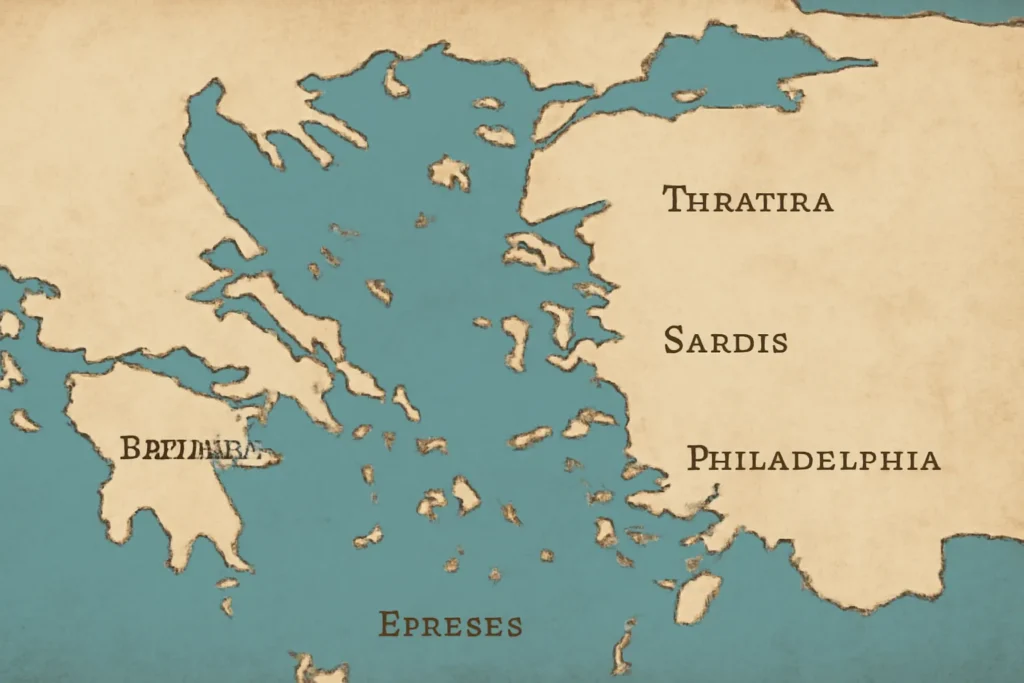
The Revelation’s map of the seven churches charts a route that begins on the Aegean coast and proceeds through inland valleys and elevated plateaus of western Anatolia. While the letters in Revelation 2–3 are not a literal geographic travelogue, many students of Bible geography find it helpful to imagine the route as a symbolic journey through urban centers that were once hubs of commerce, philosophy, and religion. The modern-day sites correspond to towns and ruins across present-day Turkey, each with unique topography and access points. Here is a concise route overview you can reference as you study:
Ephesus — the great harbor city on the Aegean coast; today’s Selçuk and nearby İzmir province host the main ruins and museums related to the ancient metropolis.
Smyrna — the port city near today’s İzmir; the revival of the old harbor region makes Smyrna a living link to the Roman-era seafront.
Pergamum (Pergamon) — a hilltop citadel city near today’s Bergama, famed for its acropolis and medical history (the Pergamene Altar and library influences).
Thyatira — located near modern Akhisar, in an inland valley rich in trade routes and crafts in antiquity.
Sardis — near Sart, an ancient capital of Lydia with famed ruins and a sense of strategic military presence.
Philadelphia — near present-day Alaşehir, set in fertile valleys with connections to vineyard culture and travel routes.
Laodicea — near today’s Denizli province, a wealth-rich city famous for banking, textiles, and medicine; the ruins sit in a broad plain.
As you study these sites, you’ll discover that the physical geography often mirrors the spiritual themes of the letters: Ephesus’s commendation for perseverance juxtaposed with a loss of first love, or Laodicea’s wealth tied to a warning against spiritual complacency. The map is not merely lines on a page; it’s a doorway to historical context, archaeological layers, and practical and devotional insights.
Ephesus: Location, Context, and Early Christian Foundation
Location and the modern map view
Ephesus sits on the western edge of modern Turkey, near the coast of the Aegean Sea. The city’s ruins are primarily in the district of Selçuk, with the greater metropolitan area near modern İzmir. If you imagine a map pin, Ephesus marks a coastal anchor that traders and travelers would have used to reach inland gate towns. The modern journey to Ephesus is a gateway into the world of Paul the Apostle, Artemis worship, and a bustling ancient port economy.
Economic hub and gateway between the Aegean and Anatolian heartland.
Temple of Artemis and other cultic centers shaped religious life; the city’s identity intersected with imperial power and commerce.
Paul’s ministry and the formation of early Christian communities, along with the later period of Revelation’s letters to the churches.
Revelation 2:1–7 — Key message to the church in Ephesus
Commendation: labor, perseverance, and rejection of evil deeds.
Condemnation: they have forsaken the love they had at first.
Instruction: return to their first love and perform deeds they did at the start.
Lesson and study prompts
What does “first love” look like in a faith community today?
How do strong theological convictions coexist with emotional devotion in a healthy church?
Smyrna: Persecution, Endurance, and the City by the Sea
Location and map context
Today’s Smyrna sits near the modern city of Izmir, Turkey, with a long harbor tradition that has shaped its identity across Roman, Byzantine, and Ottoman eras. The city’s geography emphasizes a coastal economy, urban resilience, and a crossroad role in the region.
Historical frame
One of the oldest urban centers in the region with a history of Hellenistic and Roman influence.
Experienced intense pressure from imperial and local powers, leading to a strong, loyal Christian community for a time.
Revelation 2:8–11 — The letter to the church in Smyrna
Encouragement amid persecution and the call to remain faithful even during imprisonment and suffering.
Promise of the crown of life and protection from the second death.
Reflection points
How does a community maintain faithfulness when external pressures intensify?
What are practical ways to cultivate courage and hope in times of trial?
Pergamum (Pergamon): A City on a Hill, a Center of Learning and Strife
Geography and modern markers
Pergamon sits on a hill above the modern town of Bergama. Its acropolis and steep slopes made it a natural fortress and a cultural beacon in antiquity. The site remains a powerful illustration of urban planning, religious syncretism, and political power in the Roman era.
Center of learning with a famed altar and scholarship; a place where Greek culture and Roman governance intersected.
Satan’s throne imagery in Revelation 2:12–17 — interpreted by some scholars as a reference to Pergamum’s political and religious complexity, including imperial cult influence.
In Revelation 2:12–17 — Core notes
Affirmation for holding to good faith, yet criticism for false teaching and the toleration of Nicolaitans.
Call to repentance and a promise to the faithful who overcome.
How to study this in context
Explore the tension between loyalty to tradition and new spiritual challenges in the early church.
Examine how power structures, cult worship, and philosophical schools influenced early Christian communities.
Thyatira: Complexity, Correction, and Growth in a Trading City
Geography and present-day site
Thyatira lies inland near the modern town of Akhisar, within a fertile plain linking trade routes across the region. The city’s long-standing trades in textiles and guilds colored its social and religious life, making it a unique environment for the church addressed in Revelation.
Guilds and crafts shaped social life and risked compromising ethical boundaries.
Religious syncretism and idolatry interwoven with daily commerce and civic pride.
Revelation 2:18–29 — The message to Thyatira
Commendation for works, love, and servanthood.
Warning about Jezebel and complicity with idolatrous practices; a call to repentance and to hold onto faith until the end.
Study prompts for Thyatira
How can a community maintain integrity under pressure from economic forces?
What does it mean to "hold fast" to truth while engaging a diverse cultural milieu?
Sardis: The City of Reputation and Real Spiritual Danger
Modern geography and map notes
Sardis is associated with the site near Sart, in western Turkey. The historical capital of the region is perched with a commanding view and a sense of policy and defense that matched its power. The ruins reveal a city that had seen better days and complex civic life, with temples, markets, and a vibrant political culture.
Historical frame
Once a thriving capital and military center; a place where wealth and prestige were tangible.
Spiritual warning about deadness despite a name of life.
Revelation 3:1–6 — The report to Sardis
A strong rebuke for spiritual deadness; a call to wake up and strengthen what remains.
Promise of white garments and the assurance of being named in the book of life for those who overcome.
Reflective questions
What are the signs of spiritual life that still endure in a community with outward form?
How can a church recover energy, zeal, and authentic faith from a history of achievement?
Philadelphia: Open Doors, Enduring Faith, and the Promise of Access
Location insight
Philadelphia sits in a fertile valley near today’s Alaşehir. The name—“brotherly love”—reflects the city’s historical self-understanding as a place of hospitality and exchange across cultures. The geography emphasizes transport routes and agricultural abundance, key features for a city that had weathered various geopolitical pressures.
Historical and prophetic background
Church marked by endurance despite persecution and external pressure.
Revelation 3:7–13 highlights open doors and a promise of protection in a difficult era.
Revelation 3:7–13 — The letter to Philadelphia
Affirmation of keeping the word of patience and not denying His name.
Promise of a secure destiny and a shift in the spiritual climate for faithful followers.
Practical study ideas
Explore the concept of open doors in biblical prophecy and how communities discern divine opportunities.
Consider the balance between minor persecution and a larger sense of spiritual victory.
Laodicea: Wealth, Blindness, and a Call to Genuine Spiritual Health
Geography and site context
Laodicea lies in a broad plain near the modern Denizli province. The city’s wealth—famed for banking, clothing, and medical supplies—tueled a refined culture, but the letters to Laodicea reveal a spiritual vulnerability that wealth can mask when not accompanied by discernment and humility.
Economic and religious climate
Riches and prestige produced a sense of security that could dull spiritual sensitivity.
Unclear spiritual depths, despite external evidence of prosperity, as highlighted in Revelation 3:14–22.
Revelation 3:14–22 — The message to Laodicea
A stern critique: the church is neither hot nor cold, but rather lukewarm.
Call to repentance, to seek a genuine, vibrant relationship with Christ, and to invite Him to come in.
What can we take away for study?
Assess how wealth and spiritual vitality can be in tension within a community.
Reflect on how personal and corporate spiritual health requires a daily decision to invite Christ into the center.
Having walked through each church, you can build a structured study plan that blends geography, history, and theology. Below are several practical approaches to maximize learning from the map of the seven churches in Revelation:
Geography-first study: Start with the physical locations. Look at a modern map to identify coastal vs inland sites, altitudes, and trade routes. Consider how geography might have shaped religious life, economic activity, and political influence in each city.
Historical-context modules: Pair each church with its key historical moments (Roman imperial rule, local cults, early Christian leadership). Track how the apostolic era informs the letters’ tone and exhortations.
Literary analysis segments: For each church, read Revelation 2–3 passages, noting the specific attributes addressed (commendations, condemnations, exhortations, and promises). Compare parallel themes across the seven letters.
Devotional prompts: Use the messages as daily or weekly meditations. Reflect on what first love, endurance under persecution, or humble repentance could look like in today’s church context.
Map-based memory tools: Create flashcards or a mnemonic to recall the order of the churches: Ephesus, Smyrna, Pergamum, Thyatira, Sardis, Philadelphia, Laodicea. Add a one-line note about each site’s distinctive theme.
Additional variations and semantic breadth
To expand the semantic reach of this topic, consider using these variations in discussion, writing, or search queries:
“Revelation map of Asia Minor churches” to emphasize the regional setting.
“Letters to the seven churches of Asia” for a focus on biblical epistolary form.
“The seven ecclesiastical communities in Revelation” to highlight community life and governance.
“Route through ancient Ephesus to Laodicea” as a geographical itinerary for scholarly or tourism purposes.
“Seven church sites of Revelation in modern Turkey” for a practical travel framing with current geography.
For readers who wish to physically visit these sites, the following practical tips help maximize safety, learning, and spiritual reflection:
Plan a multi-city itinerary that starts with coastal Ephesus and Smyrna and gradually moves inland toward Pergamum, Thyatira, Sardis, Philadelphia, and Laodicea. Allow time to explore museums and local ruins that illuminate the biblical context.
Check seasonal weather and local travel advisories. Western Turkey’s climate can vary by season, affecting site accessibility and crowds.
Bring field resources such as maps, a notepad for note-taking, and a compact Bible with cross-references to Revelation 2–3. Consider a travel guide that includes archaeological highlights for each site.
Engage local guides who can provide historical background, language context, and insights into ongoing archaeological work at each site.
Conclusion: The enduring value of studying the Revelation map
The 7 Churches in Revelation map is more than a geographic exercise; it is a window into the early Christian world—its challenges, its commitments, and its enduring message. By combining location awareness, historical background, and biblical exegesis, readers gain a multi-dimensional understanding of Revelation 2–3 and the communities addressed there. The modern sites that correspond to Ephesus, Smyrna, Pergamum, Thyatira, Sardis, Philadelphia, and Laodicea offer tangible links to the past, inviting readers to reflect on how ancient urban life intersected with spiritual life and how those themes continue to resonate in churches today.
Whether you study this topic as a map-based geography project, a devotional guide, or a scholarly cross-reference for your class, the core message remains clear: the revelation to the seven churches is a call to authentic faith, steadfast love, discernment, and humble repentance. The journey across the map of Asia Minor becomes a journey of the heart—an invitation to examine one’s own community, its strengths and its shortcomings, and to seek a renewed commitment to the values Jesus commends and warns against in Revelation 2–3.