Advent Wreath Christmas: The Complete Guide to Advent Wreaths, Decorations and Traditions
Advent Wreath Christmas: The Complete Guide to Advent Wreaths, Decorations and Traditions
As Christmas draws near, the Advent wreath becomes a quiet focal point in many homes, churches, and classrooms. This article offers a complete guide to Advent wreath Christmas traditions, from history and symbolism to practical assembly, decoration ideas, and family rituals. Whether you follow the liturgical calendar or simply enjoy the seasonal ambiance, the wreath provides a meaningful way to mark the weeks leading up to Christmas. Throughout this guide we’ll use variations like Advent wreath, Advent Wreaths, and Advent candle wreath to reflect different regional phrases and practices, while keeping the core concepts clear and actionable.
The Advent wreath is a circular evergreen arrangement that symbolizes the cyclical, hopeful nature of the Advent season. The circle’s shape signifies eternity and the never-ending love of God, while the evergreen needles remind us that life persists through winter. The wreath typically includes four candles, which mark the four Sundays leading up to Christmas. In many traditions, a fifth candle is placed in the center or outside the circle and lit on Christmas Eve or Christmas Day. Here is a concise look at why this tradition matters:
Hope—the first candle is often associated with hope and the prophecy of the Messiah.
Peace—the second candle represents peace and reconciliation in anticipation of the coming King.
Joy—the third candle, sometimes pink or purple, signals joy as Christmas approaches.
Love—the fourth candle embodies love made visible in the world through the birth of Christ.
The Advent wreath Christmas tradition has roots in medieval and Protestant practices, with strong German and Scandinavian influences that spread across Europe and into North America. In many households, the lighting of each candle becomes a gentle ritual that families perform together, often accompanied by a short reading, a prayer, or a favorite carol. The practice has evolved to include non-religious variations as well, enabling people of diverse backgrounds to participate in the seasonal ambiance without compromising personal beliefs.
The symbolism of the wreath and its candles
Beyond the obvious beauty, the Advent wreath carries layered symbolism that enriches the Christmas season. The circle, the evergreen, and the candles all have meaningful interpretations that make the ritual more than decorative:
Circle and evergreen: The circle has no beginning or end, symbolizing eternity and God’s eternal love. Evergreen foliage stands for endurance, resilience, and life that persists through winter.
Candles as spiritual light: Each weekly light signifies illumination, guidance, and the hope that comes with anticipation. Lighting candles creates a moment of pause and reflection amid a busy season.
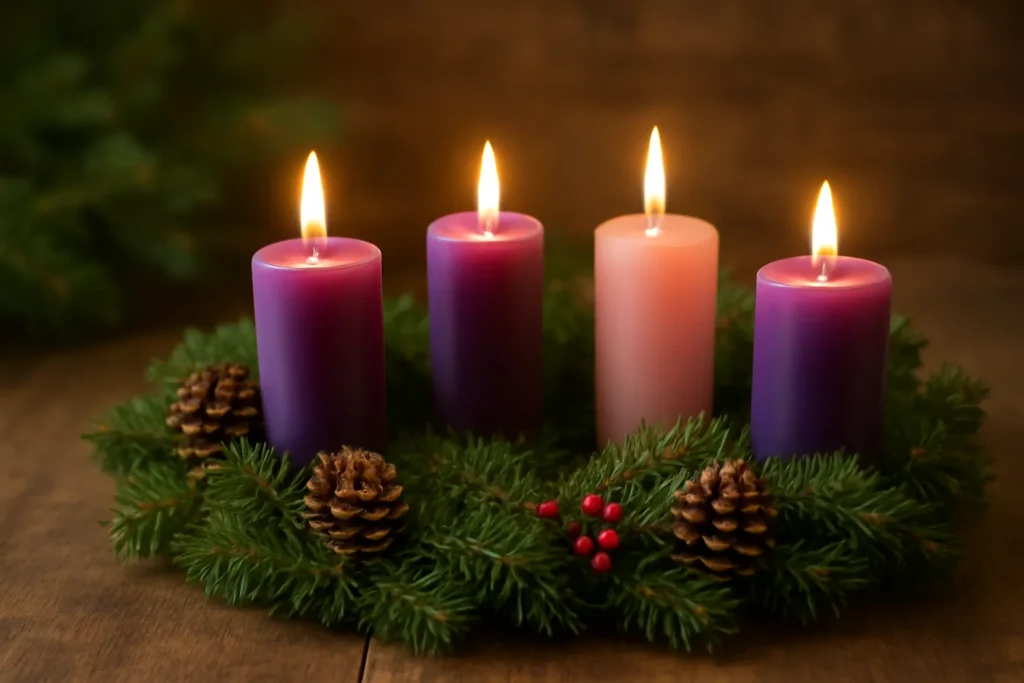
Color symbolism: Traditional Advent wreaths use three purple candles and one pink/rose candle. Purple represents penance and preparation; pink conveys joy and anticipation for the coming of Christ. Some modern variations replace purple with blue or use all white with gold accents, depending on local custom.
Number of candles: The standard four-candle arrangement emphasizes the four weeks of Advent. A fifth white or gold candle, sometimes called the Christ candle, is lit on Christmas Eve or Christmas Day to mark the nativity and the light that arrived with Jesus.
Variations of Advent wreaths around the world
While the core concept remains consistent, Advent wreath styles differ by culture, region, and faith tradition. Here are several notable variations you might encounter during the Advent season:
Classic German and Austrian wreaths: Typically feature four purple candles with a single pink candle in the center or at the outer ring, plus decorative elements like pine cones and berries. Some versions include a white center candle for Christmas Eve.
Nordic and Scandinavian traditions: Emphasize simplicity and natural materials—spruce branches, candles in muted tones, and sometimes tealight arrangements that can be placed on a table or hung on a wall.
Polish and Eastern European variations: May incorporate red ribbons, amber beads, or glass ornaments. Catholic families sometimes integrate small religious symbols or nativity figures into the wreath’s base.
Non-religious and secular wreaths: In many urban homes, the Advent wreath is purely decorative or uses LED candles and rescue colors (blue, gold, white) to evoke winter light rather than liturgical symbolism.
Church-based advent wreaths: In liturgical settings, the candles and readings follow a formal order with specific scriptural passages. Some churches add additional candles for a season-long emphasis on hope, peace, joy, and love.
Setting up a Advent wreath Christmas wreath for home use can be simple or elaborate, depending on your space, budget, and skill. The basic elements are the circular base or ring, evergreen foliage, four (or five) candles, and some decorative accents. Here is a practical, step-by-step approach to assembling a home wreath that feels both traditional and personal:
Choose your base: A sturdy base is essential. Options include a wire ring, a foam ring, a wooden ring, or a ready-made wreath form. If you expect to light the candles regularly, ensure the base is heat-resistant and safe for candle use.
Pick evergreen and fillers: Common choices are pine, fir, spruce, and laurel. Use a mix of greenery to create depth. Add fillers such as pinecones, dried orange slices, cinnamon sticks, berries, dried florals, or ribbons to reflect your style.
Arrange the greenery: Secure the greenery to the base with floral wire or hot glue. Start with a circular frame and build outward, covering the ring completely to make a lush, uniform surface.
Place the candles: The typical arrangement places four candles evenly around the wreath, with a size appropriate to the base. If you use a central Christ candle, set it slightly apart so it remains accessible for lighting on Christmas Eve or Christmas Day.
Secure the candles safely: Use candle holders, glass chimneys, or a ring of non-flammable padding to keep the candles upright and stable. Ensure there is sufficient space between the flames and the greenery to prevent scorching.
Decorate thoughtfully: Add ribbons, ornaments, or natural accents that suit your home’s decor. Consider a color scheme that aligns with your Christmas decor—classic purples, pink, and gold; or modern blues and silvers; or rustic reds and greens.
Accessibility and safety check: Place the wreath on a stable surface away from drafts, curtains, and heat sources. If you have pets or children, consider LED candles for safety, or use battery-operated options for the main lights.
For those who prefer ready-made units, many retailers offer Advent wreath Christmas kits that include a base, a set of candles, and decorative elements. These kits can simplify assembly and ensure a safe, cohesive result. If you have limited space, you can opt for a tabletop Advent wreath or a wall-hung version, which still preserves the ritual of lighting and reflection without taking up floor space.
Decorating ideas to personalize your Advent wreath
Decorating your Advent wreath is a great way to reflect your family’s values, regional traditions, or seasonal aesthetics. Here are some ideas to inspire your design choices:
Natural textures: Combine evergreen fir with dried citrus, cinnamon sticks, and pinecones for a warm, fragrant look. Use burlap or linen ribbons for a rustic vibe, or switch to velvet for a more formal appearance.
Color themes: Traditional colors are purple and pink, aligning with liturgical weeks. Modern color palettes include gold and white for a bright Christmas feel, or deep forest green with metallic accents for a classic winter mood.
Nature-inspired accents: Incorporate items like acorns, acacia pods, lavender sprigs, or eucalyptus to add texture and scent while keeping the arrangement elegant.
Lights and glow: Battery-operated LED candles create a soft, steady glow without fire hazards. You can also weave micro-LED strands around the wreath for a twinkling effect that remains safe and energy-efficient.
Seasonal symbolism inside the circle: Add small symbols such as dove charms for peace, stars for guidance, or hearts representing love. These elements can help children connect the ritual to broader themes of Christmas.
If you want to emphasize the Advent season more than the Christmas holiday, you can opt for a minimal wreath with fewer decorations and more emphasis on the spiritual practice of lighting candles and reflecting on the readings for each week.
Lighting the candles: a week-by-week guide
The lighting sequence is a key part of the Advent wreath Christmas tradition. Each Sunday of Advent, one additional candle is lit, culminating in the final Sunday before Christmas. In some homes, a small blessing or reading accompanies the lighting. Here is a practical overview to help you establish a routine that fits your family:
First Sunday of Advent: Light the first purple candle. Read a short passage about hope. A simple prayer or reflection can focus on preparation for the coming of the Messiah.
Second Sunday of Advent: Light the second purple candle. Consider a reading about peace and reconciliation, and discuss how peace can be practiced in daily life.
Third Sunday of Advent: Light the pink (or lighter colored) candle. Celebrate with a message about joy, and perhaps share a moment of gratitude for small blessings during the week.
Fourth Sunday of Advent: Light the fourth purple candle. Reflect on love and the readiness for the Nativity, inviting family members to share hopes for the upcoming Christmas celebration.
Christmas Eve or Christmas Day (optional fifth candle): If you include a Christ candle, light it on Christmas Eve or Christmas Day to mark the birth of Jesus and to symbolize the light entering the world.
Set a consistent time when lighting the candles, such as after dinner or during a family prayer or song.
Keep readings brief and accessible for children, using a child-friendly Bible verse or a short meditation.
Involve everyone by having each member light a candle or offer a reflection, making the ritual participatory rather than passive.
In neighborhoods with a community Advent wreath, consider inviting neighbors or friends to join in one week to broaden the sense of season-wide celebration.
Advent wreaths and Christmas traditions: how they fit together
The Advent wreath Christmas tradition is intimately connected with other Christmas customs. It acts as a bridge between the waiting period of Advent and the celebration of Christmastide. Some of the key relationships include:
A liturgical rhythm: For many Christians, Advent sets the tempo for the entire religious year. The wreath helps translate liturgical readings into a tangible, seasonal ritual at home.
Family togetherness: The ritual of lighting candles invites family members to pause, reflect, and discuss meaningful topics, strengthening bonds during a busy season.
Educational value for children: Reading passages, singing carols, and discussing hope, peace, joy, and love provides a gentle catechesis during a time of heightened sensory experiences and social activity.
Seasonal ambiance: In secular homes, Christians and non-Christians alike can enjoy the warm glow of the candles and the evergreen fragrance, which creates a cozy, festive atmosphere aligned with the Christmas mood.
Alternative versions for small spaces or non-religious households
Not every home can accommodate a traditional, four-candle wreath, and some families prefer non-religious approaches to celebrate the season. Here are practical adaptations that keep the spirit of Advent wreaths while respecting space and beliefs:
Mini wreaths or garlands: Use a compact ring or a garland with four low-profile LED candles tucked among greenery. Perfect for apartments or desks.
Wall-mounted options: A wall wreath or a hanging frame with four LED candles provides a space-saving alternative that still preserves the ritual cadence.
Tabletop centerpieces: Build a shallow centerpiece with a ring, candles, and decorative elements. Place it as a central table feature for daily or weekly lighting sessions.
Non-religious symbolism: If desired, replace traditional candles with decorative lights and use symbols like stars, snowflakes, or seasonal motifs to evoke the Advent season without a religious dimension.
Digital or memory wreath: For households that want a modern twist, a digital wreath timer or a memory-based ritual can accompany a small, symbolic wreath that remains unlit or uses battery candles.
Safety and maintenance for Advent wreaths
Practical safety is essential when working with fire and candles in the home. Here are several guidelines to ensure that your Advent wreath remains a beautiful and safe centerpiece throughout the season:
Never leave candles unattended: Extinguish all candles if you leave the room or go to sleep.
Use candle holders: Place every candle in a heat-resistant holder that catches wax drips and provides stability.
Keep away from flammables: Position the wreath away from curtains, furniture, and paper decorations.
Use LED alternatives: For homes with children, pets, or sensitive individuals, consider LED candles that mimic a real flame without the risk of fire.
Check the wreath periodically: Ensure that the ring is intact, the foliage is not drying out rapidly, and there is no overheating from the candle’s flame or heat source.
DIY crafts: creating your own Advent wreath from scratch
Crafting your own Advent wreath Christmas arrangement can be a rewarding family project. Below is a straightforward DIY approach to build a wreath from base materials. This is suitable for beginners and can be tailored to suit your style and space:
Materials: Wire or foam ring, greenery (pine, fir, or holly), floral wire, pruning shears, four candles (and a Christ candle if you wish), candle holders, decorative elements (ribbons, berries, pinecones, dried fruit).
Base construction: Attach greenery to the ring using floral wire. Build an even layer around the circumference, layering different greens for texture and aroma.
Position the candles: Space the four candles evenly around the ring. Secure each in its holder and attach the holders to the wreath with wire or glue as needed.
Decorate: Add accent elements in your chosen color palette. Consider scent elements like citrus or cinnamon for a festive fragrance that complements the season.
Final touches: Add a ribbon for hanging or a stabilizing base if you will place the wreath on a table. If you’re integrating a fifth Christ candle, position it at the center or near the outer edge with a separate holder.
For those who prefer a low-cost route, you can also repurpose a store-bought wreath base, add a handful of fresh greens, and install the candles with basic holders. The key is to ensure safety by using heat-resistant materials and securing the candles firmly.
Care and storage of your Advent wreath
To maximize the lifespan of your Advent wreath, especially if you reuse it for several years, follow these maintenance tips:
Condition the greenery: If your greens begin to dry out, mist them with water or replace sections with fresh sprigs to maintain a vibrant appearance and fragrance.
Protect from moisture: Avoid storing the wreath in damp areas, which can promote mold or mildew and degrade natural materials.
Store safely: When not in use, keep the wreath in a cool, dry place in a box or bag to protect it from dust and pests.
Rotate lights: If you use candles annually, replace candles as needed and consider rotating the order in which you light them to maintain novelty in year-to-year traditions.
Advent wreaths in churches, schools, and communities
Beyond the home, the Advent wreath Christmas practice is common in churches, schools, and community centers. These wreaths often serve as focal points for communal worship and educational programs. Here are some typical roles and formats:
Churches: In many congregations, the advent wreath is placed near the altar or in a prominent nave location. A pastor or liturgical assistant leads the candle-lighting sequence, with readings from Scripture and short prayers.
Schools: In classrooms, the wreath may be used as a teaching tool to explore Advent topics, religious tolerance, and seasonal customs. Students might take turns reading passages or singing carols during the lighting ceremony.
Community centers: Local groups may host Advent wreath gatherings as part of a seasonal festival or outreach event. These occasions often involve families sharing meals, crafts, and reflections.
For organizations that wish to include diverse participants, it can be beneficial to present the wreath as a symbol of light and anticipation rather than a strictly liturgical object, thereby making the tradition inclusive while preserving its spirit.
Frequently asked questions about Advent Wreaths
Here are answers to common questions people have about Advent wreath and Advent wreath Christmas traditions:
How many candles are on an Advent wreath? Most traditional wreaths have four candles around the ring, one lit on each Sunday of Advent. Some designs include a fifth candle in the center or outside the ring for Christmas Eve or Christmas Day.
What do the colors mean? Purple or blue candles signify preparation and penance; the pink candle signals joy, lit on the third Sunday (Gaudete Sunday). The Christ candle, if used, is typically white and lit on Christmas Eve or Christmas Day.
Can I use LED candles? Yes. LED candles are a safe and popular alternative, especially for households with children or pets, or in schools and public spaces where open flames are discouraged.
Is an Advent wreath only for Christians? While the wreath originated in Christian traditions, secular and interfaith households often use it as a seasonal symbol of light and anticipation during winter, focusing on themes like hope and peace.
How early should I set up the wreath? Many families set up their Advent wreath at the start of Advent (the first Sunday of Advent) or in late November, depending on their calendar and church schedule.
Bottom line and conclusion
The Advent wreath is more than a decorative piece. It is a daily and weekly reminder of waiting, preparation, and the light that arrives with Christmas. Whether you embrace the Advent wreath Christmas tradition in its classic form, adapt it for secular use, or create a hybrid approach that blends personal meaning with cultural heritage, the central idea remains the same: to invite calm, reflection, and connection during a season that is often filled with activity. By building or buying a thoughtful wreath, by lighting the candles in a deliberate rhythm, and by sharing meaningful readings or prayers with loved ones, you can cultivate a sense of presence and gratitude that enriches the entire Christmas experience.
As you explore variations of the Advent wreath, you may discover new ways to celebrate that resonate with your family, your faith tradition, or your community. The key is to keep the ritual accessible, safe, and personally meaningful. The Advent wreath Christmas tradition offers a flexible framework: a circle of evergreen, a sequence of candles, and a moment of quiet anticipation that culminates in the joyous birth of the season’s central message. Whether you call it Advent wreaths, Christmas Advent wreaths, or simply a winter wreath with candles, the practice fosters reflection, togetherness, and luminous moments that linger well beyond the holiday lights.
Supplementary ideas to extend the season
Advent calendar pairing: Create or purchase an Advent calendar to complement the wreath, offering daily small joys or activities that reinforce the weekly themes of hope, peace, joy, and love.
Community service: Tie charitable acts to each week’s candle—for example, a toy drive during the week of love or a volunteer day during the week of peace—to deepen the season’s meaning.
Music and carols: Include a short carol or hymn associated with each week’s theme, which can be sung around the wreath during lighting moments.
Educational activities: For families with children, combine readings with simple crafts that illustrate the week’s theme, such as making stars or angels to accompany the wreath.









Leave a Reply