What 1 Thessalonians 4:16-18 Says in Plain Language
The passage known as 1 Thessalonians 4:16-18 is one of the clearest, most cherished expressions in the New Testament about a future event often called the rapture and the comfort Christians draw from it. In the English Standard Version, for example, the text reads: “For the Lord himself will descend from heaven with a cry of command, with the voice of an archangel, and with the trumpet of God. And the dead in Christ will rise first. Then we who are alive, who are left, will be caught up together with them in the clouds to meet the Lord in the air, and so we will always be with the Lord.” (1 Thessalonians 4:16-17). This short sermon-length passage contains two main promises: a dramatic arrival of Jesus and a future reunion of believers, followed by a note of comfort that is still meaningful for readers today.
In the Greek of the original text, this message is compact but packed with imagery: descend from heaven, with a shout, the voice of the archangel, the trumpet of God, the dead in Christ shall rise first, and we who are alive and remain shall be caught up together. The way these phrases intertwine helps theologians and readers alike think through what it means to be gathered to Christ, what happens to those who have died in the faith, and what it means for the living to be transformed at that moment. Across translations and centuries, one thing remains clear: this is a moment of hope, a decisive interruption in the ordinary course of time, designed to bring comfort to a church that faced perplexing questions about those who had died before Christ’s return.
Historical Setting and Thematic Aim
The letter to the Thessalonians is among the earliest writings of the New Testament, likely penned by the Apostle Paul during his ministry in the mid-50s CE. In the context of a young Christian community facing persecution, confusion about death, and anxiety about the fate of believers who had already died, Paul writes with a pastoral aim: to offer courage and clarity. The verses under consideration are not a philosophical treatise but a pastoral assurance that God’s plan cannot be thwarted by human fear or by the uncertainties of history.
The phrase “the Lord himself will descend from heaven” emphasizes a direct, personal return by Jesus, rather than a secondary agent. The image of a shout or command reflects a royal proclamation, while the voice of the archangel adds a cosmic dimension. Finally, the trumpet of God signals a divine signal that cannot be mistaken. Together, these elements create a vivid expectation: Christ’s return will be unmistakable, public, and transformative for all who belong to Him.
Dissecting the Key Phrases
“The Lord himself will descend from heaven” — This locates the event in space and person: Jesus returns, not an angel or a symbolic sign. The language underscores intentional personal involvement and direct divine action.
“With a shout, with the voice of the archangel” — The shout is a powerful summons, possibly signaling a public and decisive moment. The voice of the archangel adds a layered heavenly witness to the event.
“With the trumpet of God” — A common biblical sign of revelation and gathering. The trumpet calls hearers to attention, signaling something extraordinary is unfolding.
“The dead in Christ shall rise first” — The phrase acknowledges that believers who have died are not left behind; they are raised in a resurrection that precedes the transformation of the living.
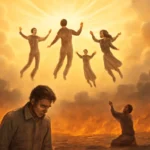
“We who are alive and remain shall be caught up together with them in the clouds” — The living believers are transformed in such a way that they join the resurrected saints in the air, meeting Christ and returning with Him.
“To meet the Lord in the air” — The language of meeting indicates a human reception of the returning Lord in a manner that is both welcoming and ceremonial, drawing on a Greco-Roman custom of meeting dignitaries on their arrival.
“And so shall we ever be with the Lord” — This final promise emphasizes the end-state of the believer: an unending fellowship with Christ.
Across these phrases, a coherent arc emerges: Christ returns with glory, believers who have died are vindicated and raised, the living are transformed and joined with them, and all are welcomed into an eternal relationship with the Lord.
Biblical translations differ in a few key terms, which can affect how readers visualize the event. Here are some common renderings:
“trumpet of God” (KJV and some others) vs. “trumpet call of God” (NIV, NASB, ESV) — This difference highlights how God’s trumpet is not merely an instrument but a divine summons.
“the dead in Christ shall rise first” vs. “the dead in Christ will be raised first” — Both convey the primacy of the resurrection of believers who have died, preceding the living transformation.
“caught up” vs. “snatched up” (as some English readers encounter in different translations) — The Greek term harpazo underpins a sense of sudden, decisive gathering, not merely a gradual escort.
“meet the Lord in the air” vs. “meet the Lord in the clouds” — Some versions stress the "air" as the medium of the gathering; others emphasize the celestial, cloud-lit setting. The core idea remains the same: believers are gathered to Christ in a dramatic moment.
Regardless of translation choices, the core message remains unified: a singular event in which Christ returns publicly, believers—both those who have died and those alive at that moment—are gathered, and an eternal fellowship with the Lord is secured.
Theological Perspectives: When Does This Event Happen?
The verses in 1 Thessalonians 4:16-18 have inspired a range of eschatological (end-times) viewpoints. The central question concerns chronology: Is this moment a pre-tribulation event, a mid-tribulation occurrence, a post-tribulation gathering, or is it interpreted in a non-literal, symbolic way? Here are concise summaries of several common interpretations, with emphasis on how they read the passage in relation to other biblical prophecies.
Pre-tribulation Rapture
In the pre-trib view, the rapture occurs before the Tribulation, sparing believers from the most intense time of trial on earth. Proponents often appeal to a distinction between Christ’s return for His people (the rapture) and His return with His saints (the Second Coming). From this angle, 1 Thessalonians 4:16-18 functions as a comforting promise that Christians will be spared from the period of intense testing described elsewhere in Daniel and Revelation.
Mid-tribulation and Post-tribulation Scenarios
Other traditions place the rapture somewhere during or after the Tribulation. A mid-trib view sees believers being transformed around the time of a major cosmic distress, while a post-trib view locates the gathering at the end of the Tribulation, coinciding with Christ’s visible return to earth. In these frameworks, 1 Thessalonians 4:16-18 is read as the moment when earthly believers—whether in the air or on the earth—are aligned with Christ in a climactic moment of deliverance and victory.
Some interpreters downplay a literal, chronological "rapture" and emphasize the passage as a theological assurance about the comfort of believers in light of death and persecution. In amillennial readings, the emphasis might be less on a future escape from tribulation and more on the ultimate, final vindication of Christ and the hope of eternal life with Him.
Practical Takeaway Across Views
Hope and consolation remain central in all readings. The text repeatedly instructs believers to be affected by the future in a way that informs present conduct.
Continuity between the dead and the living—the unity of those who have died in Christ and those who are alive at Christ’s return—helps pastors speak to both grieving families and living members of the church.
The exact timing is less clearly defined in Paul’s letter than the certainty of the promise it communicates.
Language, Context, and Exegesis: Why This Matters
The passage’s power rests not only in its content but in its form. The author, Paul, uses vivid, almost cinematic imagery to paint a scene that is both cosmic and intimate. The language intends to reassure a community wrestling with fear—fear about those who have died before Christ’s return and fear about what the future holds. The exegesis of terms such as harpazo (the catching up), apantesis (meeting), and the parousia (the presence or coming of Christ) can yield a nuanced understanding of how early Christians imagined the climactic intersection of heaven and earth.
Scholars often note a tinge of Jewish apocalyptic language in this text, while also seeing a distinctly Greco-Roman rhetorical shape. The meet-and-greet in the air, for instance, echoes a customary practice of city delegations meeting a returning dignitary on the outskirts of a city. The crowd’s reception, the public proclamation, and the resurrection motif all work together to present the event as both a display of divine glory and a moment of human encounter with the living God.
Practical Implications for Believers Today
How should readers apply the message of 1 Thessalonians 4:16-18 in daily life? The verses speak into the everyday realities of hope, courage, and ethical living by linking future expectation with present fidelity.
Hope amid grief — For families who have lost loved ones, the promise that “the dead in Christ shall rise first” can be a source of profound comfort, not merely a doctrine to be asserted but an anchor for mourning and trust in God’s sovereignty.
Encouragement to perseverance — The knowledge that believers will be gathered and forever with the Lord can energize a life of faithfulness, patience, and moral integrity in the face of hardship.
Perspective on time — The brass-tack reality of a decisive moment in human history can recalibrate priorities, inviting Christians to invest in things that endure beyond this life.
Pastoral care for anxious believers — In communities where fear of death or fear of the future runs high, this passage can function as a balm, offering clarity and direction rather than panic.
Questions to Reflect On
How does the vision of Christ’s return shape my daily decisions and commitments?
In what ways can the church cultivate a constructive hope that honors the dead while trusting God for the living?
What are practical ways to comfort one another with these words in times of trial?
How to Read 1 Thessalonians 4:16-18: A Step-by-Step Guide
Recognize the source — Paul’s authority as an apostle and his pastoral concern for a community under pressure grounds the exhortation.
Identify the sequence — Descend from heaven, shout, archangel’s voice, trumpet, raise the dead, transform the living, meet in the air, everlasting fellowship.
Note the inclusivity — The promise encompasses both those who have died in faith and those who are alive when Christ returns, ensuring continuity for all believers.
Attend to the comfort — The closing exhortation to comfort one another emphasizes communal solace rather than individual speculation.
The term “rapture” is a theological label used to describe the moment when Christians are gathered to meet Christ—often associated with 1 Thessalonians 4:16-18—even though the word itself does not appear in most Bible translations. It emphasizes the sudden, transformative gathering of believers.
Is this event the same as the Second Coming?
In many traditions, the rapture is distinguished from the Second Coming. The rapture refers to believers being caught up to meet Christ in the air, whereas the Second Coming describes Christ’s visible return to earth with His saints at the end of the age to judge and reign. Some authors conflate the two, but many theological frameworks keep them distinct events in a sequence of eschatological events.
Does this passage teach a pre-tribulation escape?
Some readers interpret it that way; others argue for mid-tribulation or post-tribulation timing. The text itself focuses on the certainty of Christ’s return and the resurrection of believers, while the precise timeline is debated among scholars and church traditions.
What comfort does this passage offer for modern believers?
It offers a robust reminder that death is not the final word for those in Christ, that God has a plan that encompasses both the dead and the living, and that eternal fellowship with Jesus is the ultimate consolation and hope for the church in all ages.
1 Corinthians 15 — A comprehensive discourse on the resurrection, including the transformation of the mortal body and the victory over death.
John 14:1-3 — Jesus’ promise to prepare a place for his followers and to come again to receive them unto himself.
Matthew 24-25 — Jesus’ teaching about end-times events, warnings, and the need to be ready.
Revelation 19-20 — The broader cosmic perspective on Christ’s return, the defeat of evil, and the establishment of the new order.
The way 1 Thessalonians 4:16-18 sits among these other texts helps readers grasp not only the content of hope but also the continuity of biblical eschatology across the canon.
Different Christian communities interpret the timing and nature of the rapture through varied doctrinal lenses. In all cases, the pastoral aim of the text is clear: to speak comfort and courage into communities facing death, confusion, or persecution. When preaching or teaching this passage, pastors and teachers typically emphasize:
Affirmation of the resurrection and the hope for new life in Christ.
Assurance of God’s ultimate justice and sovereignty even amid present sufferings.
Ethical exhortations that reflect the reality of Christ’s return—living in a way that honors the gospel now.
Boundless comfort rooted in the promise of eternal fellowship with the Lord.
For readers today, the message of 1 Thessalonians 4:16-18 can function as a map for hope, worship, and mission:
Worship and wonder — The grandeur of Christ’s return invites praise, awe, and reverent humility before God.
Hope that outlives hardship — In the face of loss, the promise of resurrection and eternal fellowship points to a future that outshines present pain.
Faithful living in light of a coming King — Knowing that a decisive moment will redraw the map of human history should shape decisions, ethics, and daily routines.
Comfort offered to others — The church is called to be a beacon of consolation, helping one another to endure, hope, and witness with gentleness and truth.
When people encounter the phrase “1 Thessalonians 4:16-18” in English, they are stepping into a thread that links ancient worship, early Christian persecution, and modern hopes. The meditation on a divine descent, a trumpet blast, a resurrection, and a gathering in the clouds is more than a theological diagram. It is a cry of comfort: God has a plan for the end of the present era, and that plan is not to abandon His people but to restore them in radiant life with Him forever.
As you read First Thessalonians 4:16–18 in any translation—be it verse 16 through 18 of chapter 4, or the broader passage often cited as a key eschatological text—the overarching message remains: God’s glory will break into history in a dramatic, public way, the dead and the living will be united in a moment of triumph, and believers will remain with the Lord for all eternity. This is a message of profound comfort as much as it is a message of prophecy.








Leave a Reply