Psalm 150 Praise Explanation: A Clear Guide to Worship
Praise is perhaps the most recognizable mode of response in the biblical Psalms, and Psalm 150 stands as a grand finale to that entire collection. It distills worship into a single, uncompromising call: lift up praise with everything you have. This article offers an in-depth, practical, and pastoral guide to understanding Psalm 150, its language, its imagery, and how believers today can embody its spirit in daily life, communal worship, and personal devotion. Throughout, key ideas are highlighted so they can guide study, preaching, or personal reflection.
What Psalm 150 Calls Us To Do
At its core, Psalm 150 is a compact manual for worship. It invites readers to praise the Lord in every dimension of reality—where God is worshiped, what God has done, and how human beings can respond. The psalm’s structure is both simple and sweeping: a call to praise in multiple settings, for multiple reasons, with multiple musical expressions, and finally a universal exhortation for all creation to join in.
Praise the Lord—the opening line resets the entire frame: worship begins with a decisive, confident orientation toward God.
Praise God in his sanctuary and Praise him in his mighty heavens—praise is not confined to one space; it spans the earthly dwelling of God and the celestial realms above.
Praise him for his acts of power and Praise him for his surpassing greatness—praise is anchored in God’s character and deeds, not in human sentiment alone.
Praise him with musical forms—a wide catalog of instruments and expressions is listed, inviting creativity within reverence.
Let everything that has breath praise the Lord—the invitation expands to the entire creation; praise becomes the quintessential response to life itself.
Throughout this guidance, the emphasis is not merely on saying the right words but on cultivating a posture of gratitude, awe, and fidelity that animates life. The repetition of “praise” (or “praising”) emphasizes movement—worship is active, not passive. The psalm’s insistence on variety—different places, different instruments, different voices—models a robust, dynamic faith that cannot be reduced to a single style or setting.
The Verse-by-Verse Compass: Key Motifs in Psalm 150
To grasp the breadth of Psalm 150, it helps to map the major motifs that recur, and how they connect to the overarching purpose of worship.
Direction and location: “in his sanctuary” and “in his mighty heavens” imply that God’s glory fills both the earthly and heavenly realms. Worship is not limited to one locale; it spans creation.
Recollection and response: the psalm grounds praise in God’s acts and merits rather than in mere feelings. Remembering what God has done fuels authentic praise.
Audible and visible expression: the inventory of instruments and the call for dancing highlight that worship engages body, voice, and movement, not only the intellect.
Inclusivity of creation: “Let everything that has breath…” widens the circle to include all living beings and, by extension, all people who respond joyfully to God.
Doctrinal salience: the psalm assumes God’s sovereignty and power, inviting a response that honors God’s greatness above human achievement.
In synthesis, Psalm 150 is a roadmap for worship that is big enough to include a congregation’s song, a solitary morning prayer, a liturgical procession, and a life lived in alignment with God’s glory. Its cadence—summons, reasons, instruments, and universal participation—offers a framework for any community seeking to renew its sense of worship as a lived reality rather than a weekly ritual.
Literary and Theological Significance
The psalm’s literary design is compact yet expansive. It uses parallelism, repetition, and concrete imagery to move from general exhortation to specific, sensory practice. The opening and closing lines function much like bookends or a doxology, binding the entire collection of Psalms to a single, radiant consensus: praise God for who God is and what God does, using all the means at hand.
Doxological framing: Psalm 150 is a closing doxology to the Book of Psalms, but its content is not merely celebratory; it serves as a theological summary of what it means to live in relationship with God. The doxology is active: it calls for praise in a multitude of forms and settings.
Incarnational worship: The insistence on bodily expression—dancing, clapping, playing instruments—renders worship tangible. Praise becomes something you do with your whole person, not something you feel with your emotions alone.
Universal invitation: The final phrase widens the circle beyond priests or musicians to every person who breathes, making worship accessible to children, elders, farmers, scholars, athletes, and artisans alike.
Theologically, Psalm 150 communicates a robust understanding of God’s character: God is worthy of praise because of divine acts of power and surpassing greatness, and because God is good, steadfast, and worthy of awe. The psalm trusts that creation recognizes its Maker and responds accordingly, even if that response takes many cultural forms across generations and cultures.
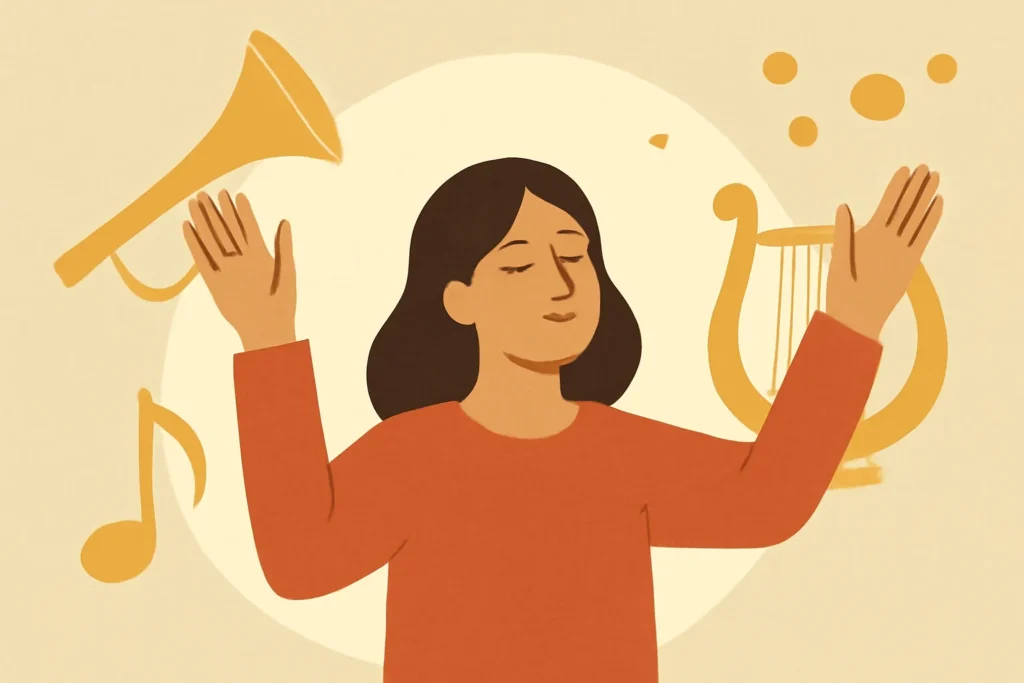
In Psalm 150, the list of instruments is not merely a catalog of ancient music. It signals a theology of worship that values a broad sonic palette. Each instrument carries a particular texture and mood, inviting worshippers to use diverse sounds to express different facets of God’s character and works.
Trumpet: often associated with proclamation and ceremonial occasions; it signals attention and grandeur.
Harp and lyre: strings that evoke gentleness, balance, and intricate, melodic praise.
Tambourine and dancing: motion and rhythm that accompany communal joy; dancing intensifies the worshiper’s participation.
Strings and pipe: the wind and string families symbolize harmony and creative breath within creation.
Cymbals and clashing cymbals: bright, percussive sounds that punctuate the praise with exalted energy.
Taken together, these instruments convey a theology of musical worship that embraces both beauty and exuberance, reverence and celebration. The emphasis is not on one instrument over another but on the collective power of diverse voices uniting to magnify God.
Historical and Cultural Context
Psalm 150 belongs to an ancient temple-centered culture, yet its message transcends time and place. Its language reflects liturgical life familiar to the people of Israel: sacred spaces, ceremonial acts, and community music that express gratitude, awe, and allegiance to God. The psalm’s portable, universal call to praise makes it adaptable to different historical eras and religious communities that value praise as a central practice.
Temple worship: The mention of God’s sanctuary points to a worshiping community that gathers in a sacred space to honor God’s name. The sanctuary is not just a building but a symbol of God’s presence with the people.
Heavenly worship: The reference to “his mighty heavens” expands the worship frame to the cosmic dimension, inviting the community to imagine a chorus that includes celestial beings and the created order in praising God.
Public and private praise: The psalm’s call to praise in multiple environments suggests that worship should permeate everyday life, not be confined to a single ritual moment.
Historically, the psalm also functioned as a liturgical toolkit for both individual devotion and corporate gatherings. It provided practitioners with concrete expectations for how to praise: what to say, what to sing, and how to engage with others in a shared rite of worship. Although the cultural artifacts (specific instruments, dance, procession) reflect ancient Near Eastern worship, the underlying principle—praise as a response to the God who acts—remains universal and timeless.
What does it look like to translate Psalm 150 into contemporary worship and daily life? The following practical applications aim to honor the spirit of the psalm while respecting varied church traditions, musical styles, and personal contexts.
Move beyond a single style: If your community’s worship is predominantly acoustic or contemporary, consider incorporating some of the psalm’s varied expressions. A brief instrumental interlude, a clap-along during a chorus, or a moment of gentle dancing or movement can help embody the call to praise with different forms.
Embrace the sanctuary and the street: Worship is not constrained to a church building. Private prayer, family worship around a table, or service activities that reveal God’s acts of power (like charity, justice, mercy) can all become acts of praise.
Celebrate God’s acts and greatness: Create sermon notes, prayer prompts, or liturgical cues that remind participants of God’s mighty deeds and surpassing greatness—both documented in Scripture and experienced in daily life.
Develop a diverse musical palate: The psalm’s call to use many instruments invites choirs, bands, orchestras, and soloists to explore a broad range of tonal textures. Use songs that echo biblical themes of power, greatness, and gratitude.
Invite all who breathe to participate: In family worship or congregational settings, design activities that include children, seniors, newcomers, and those who worship through different cultural expressions. Accessibility and inclusion are essential to fulfilling the psalm’s universal impulse.
Practically, a modern approach to Psalm 150 might include a weekly “praise segment” featuring a short reflection on a divine act, followed by a hymn or contemporary worship song, a brief instrumental interlude, and a communal moment of spoken or sung praise. In small groups and personal devotions, one can cycle through the instrument imagery as a meditation: imagine God’s power like a trumpet blast, or reflect on God’s sustaining presence as a verse for strings and pipes.
Interpretive Angles Across Traditions
Psalm 150 has been read and applied in various ways within Judaism, Christianity, and broader spiritual contexts. Here are some of the main interpretive angles and their pastoral implications.
Jewish liturgical reflection: In Jewish worship, the psalm’s emphasis on sanctuary and universal praise resonates with the temple’s legacy and the hope of sacred space becoming universal. It invites gratitude for God’s acts and the richness of communal life in faith.
Christian doxology and Christocentric readings: Christian readers often read Psalm 150 through the lens of Christ’s lordship and the church’s worship as the fulfillment of God’s salvific acts. The doxology becomes a proclamation of Jesus as the one who makes all creation capable of praise through the Spirit.
Creation-centered spirituality: Some interpreters emphasize the cosmic dimension—praising God in the heavens, the earth, and through all living things—advancing a theology that honors creation’s inherent call to worship and care.
Pastoral and missional use: The universal reach of the final exhortation can inform outreach, social justice, and mercy ministries, inviting communities to praise God by serving others and addressing suffering as an act of worship.
In practice, communities might weave these strands into sermons, teaching series, and worship planning, ensuring that Psalm 150 remains a vibrant, living text that speaks across time and culture.
Creativity in Worship: Practice Ideas Rooted in Psalm 150
Below are concrete ideas for churches, study groups, and families to engage with Psalm 150 in meaningful, hands-on ways. Each idea keeps the emphasis on praise while inviting diverse expressions of worship.
Instrumental ensemble workshops: Host seasonal workshops where participants learn and perform a selection of instruments mentioned in the psalm. Even if participants are beginners, the goal is to experience collective praise through musical collaboration.
Dance and movement sessions: Offer a safe space for dancing or expressive movement as a form of praise, reflecting the psalm’s call to dancing alongside the other forms of instrumentation.
Breath-centered prayers: Since the final command centers on breath, guide participants in breath prayers—short, repeating phrases synchronized with inhalation and exhalation (for example, “Praise the Lord” on the inhale, “praise him forever” on the exhale).
Toast to God’s deeds: A liturgical moment in which congregants share brief testimonies of God’s acts of power or moments of grace, reinforcing the reason behind praise.
Creation-audio reverberation: Use nature sounds as a backdrop for a time of worship, reminding attendees that creation itself is part of the sanctuary and the Heavens’ praise.
These activities are not about performance but about participating in a shared, multisensory act of worship that honors God’s authority, power, and goodness. The aim is to help participants move from reading about praise to actually embodying it in everyday life.
Verse-Driven Reflections: Short Meditations for Personal Devotion
For personal growth, here are brief meditations that track Psalm 150’s core ideas. Each meditation focuses on a key phrase and offers a practical prompt for daily practice.
Praise the Lord — Start and end each day with a sentence of praise. Tell God who He is and who you understand Him to be in your own words. Prompt: Write a one-sentence psalm about today.
Praise God in his sanctuary — Consider the places in which you encounter God this week. Even in ordinary rooms, you can create a small “sanctuary” moment for prayer and attention. Prompt: Create a 5-minute sacred space anywhere you are.
Praise him for his acts of power — List two or three moments when you witnessed or experienced God’s power in your life or the life of someone you know. Prompt: Journal three acts of power you saw in the past month.
Praise him for his surpassing greatness — Reflect on God’s character that goes beyond your understanding. Prompt: Read a psalm about God’s greatness and write a response of awe.
Praise him with instruments and voices — Choose an instrument or vocal expression you enjoy and offer a 2–3 minute moment of praise using that medium. Prompt: Record a short worship excerpt for personal memory.
Let everything that has breath — Consider how your daily life can be a continuous act of worship. Prompt: Choose one ordinary task and perform it as a service to God, thanking Him as you work.
These bite-sized exercises transform the biblical invitation into concrete routines, enabling a life of worship that flows from gratitude rather than from obligation.
Common Questions about Psalm 150
Worship communities often wrestle with how to apply Psalm 150 in a modern setting. Here are some frequently asked questions and concise answers to help clarify the text’s relevance today.
Does Psalm 150 require a temple or formal ritual? No. While the psalm speaks of God’s sanctuary, its primary message is that praise is appropriate in every setting and moment of life, wherever God’s presence is acknowledged.
Is dancing always appropriate in worship? The text mentions dancing as one form of praise; in many contexts, dancing is a legitimate expression of joy. Tradition matters, so communities should discern respectfully and inclusively.
Are modern instruments acceptable in light of Psalm 150? Yes, as long as they are used to honor God. The list is illustrative, not prescriptive, encouraging a broad, creative range of expressions that fit a given church's culture and customs.
What about those who cannot sing or play instruments? The psalm emphasizes participation through breath and life itself. Silence can be an honored space when offered to God in reverential worship, and those who cannot perform can still join with grateful hearts in prayer and testimony.
In all these discussions, the guiding principle remains: worship is a response to God’s character and deeds, expressed through community, creativity, and compassion. Psalm 150 invites a worship life that is both rooted in ancient faith and flexible enough to honor diverse expressions of praise in the present day.
Closing Reflections: Why Psalm 150 Still Speaks Clearly
At a glance, Psalm 150 is a simple call: praise God with all you have, in every place, for every reason, using every form of beauty and sound you can bring. Yet beneath its brevity lies a deep invitation: worship is not a momentary feeling but a way of living—an orientation toward God that shapes speech, action, and community. The psalm’s insistence on inclusive participation—“Let everything that has breath praise the Lord”—reminds us that worship is not a luxury for a few but a central heartbeat of life for all creation. This is why Psalm 150 remains a clear guide to worship, a reliable compass for churches, families, and individuals seeking to honor God in a changing world.
As you carry these insights forward, consider how you might weave the psalm’s wisdom into your daily rhythms. Use the verses as a living template for worship that adapts to your context while staying faithful to the core: God’s majesty, God’s acts, and the joyful response of all creation—body, voice, and life in harmony with God’s design. May your worship be as wide as the heavens and as intimate as a whispered prayer, a symphony of praise that makes room for every note God intends to hear.






Leave a Reply