Passover Lamb and Jesus: Examining the Biblical Link
The figure of the Passover lamb stands at a crossroads between the Hebrew Scriptures and the Christian claims about Jesus as the fulfillment of Old Testament promises. This article explores how the biblical writers understood the lamb without blemish sacrificed during the first Passover in Egypt and how Christian interpreters view Jesus as the culmination of that ancient sign. By tracing the motifs of sacrifice, redemption, and deliverance, we can better appreciate how the language of a single sacrificial animal became a powerful lens for the gospel message in the New Testament.
The Passover lamb in Exodus: a story of deliverance and substitution
The story of the Passover lamb is anchored in the dramatic events of Exodus, when the Egyptians oppressed the Israelites for generations. In the instructions given to Moses, the LORD specifies that every household should select a one-year-old male lamb without defect, slaughter it at twilight, and mark the doorposts and lintel with its blood. The sacrifice would serve as a sign: the LORD would pass over the houses with the blood, sparing the inhabitants from the plague that would strike the firstborn of Egypt. In this way, the lamb's blood becomes a sign of protection and a guarantor of deliverance for God’s people.
Several features of the Passover lamb become enduring motifs in biblical storytelling and later theological reflection:
Unblemished sacrifice: The requirement that the animal be without defect points to ideals of holiness and perfection in the offerings of the ancient system.
Substitutionary atonement: The lamb dies in place of the Israelites’ firstborn, a powerful model of substitutionary mercy in which a creature bears the penalty that humans deserve.
Blood as protection: The blood on the doorposts functions as a sign that marks those who belong to the covenant people, ensuring safety from death.
Memorial and ritual: The Passover becomes a yearly festival, a ritual remembrance that binds generations to a narrative of salvation.
Communal meal: The Passover meal—unleavened bread, bitter herbs, and roasted lamb—provides a concrete, sensory framework for memory and identity.
Scholars often emphasize that the Passover narrative is not merely a historical account but a paradigmatic story about God’s ongoing intervention in history: oppression, judgment, liberation, and covenant-making. The blood-stained doorposts and the household deliverance are emblematic of a broader pattern that biblical authors carry into later writings. For readers of the Hebrew Bible, the lamb is not just a domestic animal but a sign of divine mercy enacted within a covenantal framework.
From Passover symbolism to the lens of the New Testament
As the Hebrew Bible closes, the stage is set for a continual deepening of the lamb motif within Jewish thought. When Christians later identify Jesus as the Lamb of God, they are drawing on a vocabulary that already carried urgent implications about sacrifice, deliverance, and faithfulness to God’s covenant. The linkage rests on a tension and continuity between the old and the new: how the sacrificial imagery of the Paschal lamb acquires a new depth in the person and work of Christ, while still carrying the memory of Egypt’s night of deliverance.
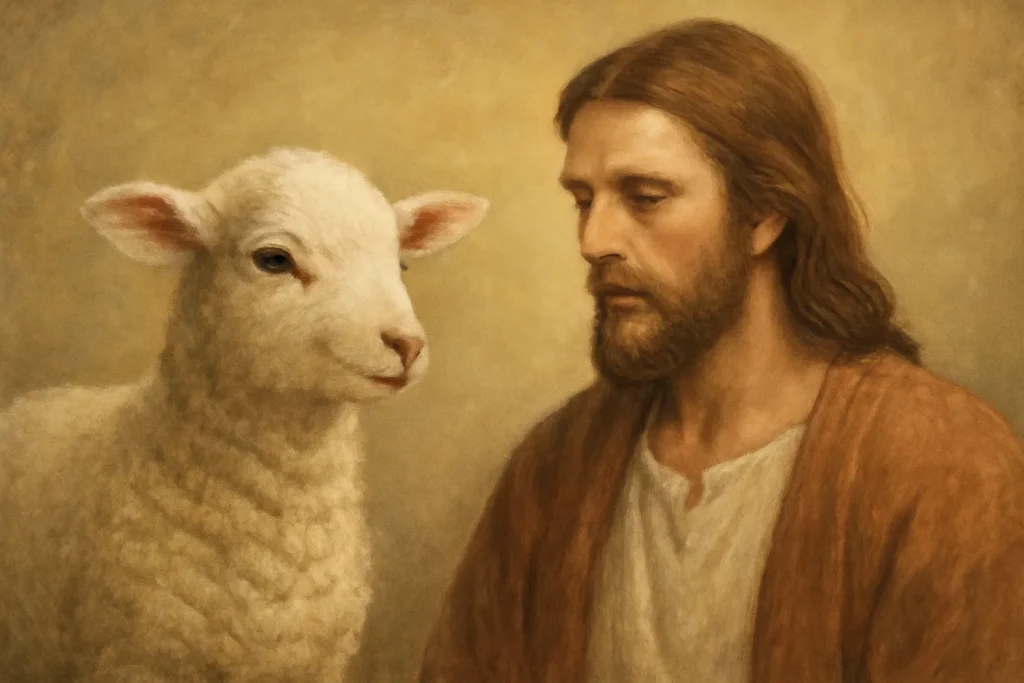
In the New Testament, the language of the Lamb of God becomes especially prominent. The Gospel of John presents John the Baptist pointing to Jesus with the famous declaration, “Behold the Lamb of God who takes away the sin of the world” (John 1:29). This declaration situates Jesus within a sacrificial framework that Christians interpret as the fulfillment of Israel’s sacrificial system. Early Christian writers soon echoed and expanded this motif. For example, the Apostle Paul connects the celebration of the Eucharist to the Passover by stating that Christ is our Passover lamb, sacrificed for us (1 Corinthians 5:7). The language of redemption, atonement, and deliverance thus becomes a hinge between the former era’s covenant life and the gospel’s claim about Jesus’ death and resurrection.
Key New Testament threads: Jesus, the Passover, and the Lamb imagery
Behold the Lamb of God: John’s gospel and the inauguration of a new covenant
In the Gospel of John, the identification of Jesus as the Lamb of God is not merely a metaphor; it is a claim about who Jesus is and what his mission entails. John 1:29 and similar passages invite readers to see Jesus as the one who accomplishes a decisive salvation, not just for one household but for all humanity. The imagery resonates with Exodus and with later Christian reflections on atonement, since the lamb’s sacrifice is pictured as coordinating with the crossing of a boundary—the boundary between bondage and freedom, between sin and righteousness, between death and life.
For many Christian readers, this connection culminates in the recognition that the crucifixion of Jesus occurs in a Passover frame of mind. When the Gospel writers recount the events around the Last Supper, the crucifixion, and the resurrection, they repeatedly weave Passover motifs into the narrative. Some scholars even describe the Last Supper as a Passover Seder adapted by Jesus and his followers, even as others emphasize distinct theological emphases that go beyond a strictly liturgical Passover reading. The essential claim remains: Jesus is presented as the fulfillment of the lamb motif, whose sacrifice inaugurates a new exodus—one that carries people from bondage to a promised life within the new covenant.
1 Corinthians 5:7 and the language of fulfillment
In 1 Corinthians 5:7, Paul uses the explicit phrase that “Christ, our Passover, has been sacrificed for us.” Here the apostle anchors Christian identity in Jesus’ death as a salvific act that replaces the old Passover cycle with a new, continual remembrance of liberation. The parallel is powerful: just as the blood on the doorposts safeguarded the Israelite households from the plague, the blood of Christ—through faith and baptism—safeguards humanity from sin and spiritual death. The linkage rests on a shared vocabulary of sacrifice, liberation, and a moving from a marked night of deliverance to a perpetual, communal remembrance of the saving act.
Many biblical interpreters describe a typological relationship between the Passover lamb and Jesus. A typology is a literary or symbolic pattern where an Old Testament figure or event prefigures a later reality in the New Testament. In this sense, the Passover lamb serves as a type that points forward to the one who would deliver humanity from sin through an ultimate sacrifice. Several strands of this typology recur across Christian exegetical traditions:
Unblemished sacrifice mirrors the sinless life of Christ, highlighting how purity is essential for a salvific offering.
Substitutionary death foreshadows Jesus’ bearing of human guilt on the cross, enabling a new relationship with God for many.
Blood as protection translates into the Christian understanding of atonement achieved not by literal doorposts, but by faith in the salvific work of Jesus.
Memorial meal evolves into the Christian practice of the Eucharist or Lord’s Supper, which recalls Christ’s saving act with bread and cup as symbols of his body and blood.
Different Christian traditions emphasize various aspects of this typology. Some highlight substitution and atonement; others stress covenant renewal and intimate fellowship with God through faith. In all cases, the Passover imagery remains a stable frame for understanding who Jesus is and what his life, death, and resurrection accomplish.
Religion is interpreted through lenses shaped by history, culture, and ecclesial commitments. When Christians speak of Jesus as the fulfillment of the Passover, they typically present a coherent narrative in which the ancient ritual finds its ultimate meaning in the crucified and risen Messiah. Yet there are important nuances to acknowledge:
Christian interpretation: The death of Jesus is read as the culmination of the covenantal story, with the Lamb of God fulfilling the symbol of substitution and mercy. The Lord’s Supper is understood as a memorial meal that makes present the saving act of Christ for the church.
Judaism and the Passover: In Jewish thought, the Passover remains the annual festival that commemorates liberation from Egypt, without adopting Jesus as a divine figure within the ritual’s framework. The lamb remains a historic symbol of national identity, faithfulness, and gratitude to God for deliverance.
Interfaith conversation: The biblical material invites respectful dialogue about how the same texts can be read in different ways, and how the memory of a single animal sacrifice can acquire multiple layers of meaning across traditions.
Even within Christian communities, there is diversity regarding how exactly to read the linkage. Some theologians stress the continuity between the Passover’s blood-sign and the blood of Christ as a universal act of redemption; others emphasize the discontinuity—the idea that Jesus inaugurates a new covenant that transcends the old ritual framework, even as it fulfills its deepest purposes.
The narrative arc from the Last Supper to the cross and then to the resurrection is central to Christian confession. The supper scene is often seen as a night-time Passover meal where Jesus reinterprets the bread and wine as his body and blood, given for many for forgiveness of sins. The cross, then, is perceived as the decisive act that accomplishes liberation from sin’s power. The resurrection affirms the victory of God’s new creation over death, sealing the promise of eternal life for those who belong to Christ. In this arc, the Passover motif becomes a framework for understanding the Christian claim that Jesus is the agent of salvation in the present age and the age to come.
Different Gospel writers emphasize different aspects of this arc. The Synoptic Gospels (Matthew, Mark, Luke) tend to situate the Last Supper in the Passover context, though geographical and calendrical details vary. The Gospel of John, while not presenting the meal in the same liturgical frame, foregrounds the idea of Jesus as the lamb who gives his life for the world and signals the same binding truth through a different narrative route. Across these tellings, the central claim remains: through Jesus' death and resurrection, the ancient symbol of the lamb without blemish finds its ultimate fulfillment in a person, not merely an animal in a ritual category.
Scholars often distinguish three layers of the Lamb-and-Exodus-to-Christ motif: ceremonial, cosmic, and ethical. Each dimension adds depth to how readers understand the biblical link.
Ceremonial: The Passover lamb is part of a liturgical system that orders time through festivals, offerings, and ritual meals. In Christian practice, this ceremonial frame is transformed into liturgical memory—the Eucharist or Communion—where believers remember Christ’s work and anticipate the coming kingdom.
Cosmic: Beyond a single family’s safety, the biblical motif moves toward a universal redemption. The Lamb of God is portrayed as the one who bears sin for many, opening the way for reconciliation with God for all who trust him. The cosmic dimension invites readers to see salvation not only as moral correction but as the creation of a renewed order in God’s world.
Ethical: The call to respond to God’s mercy with faith, obedience, and love becomes a practical consequence of the Passover-to-Christ story. Believers are invited to live as a people marked by mercy, justice, humility, and fidelity to God’s covenant—echoing the Liberating God who delivered Israel from oppression.
Each layer helps to explain why the Passover lamb remains a potent symbol in Christian teaching even centuries after the first Easter. The symbolism remains alive in sermons, catechesis, and devotional life, reminding communities of the gravity of salvation and the generosity of God’s provision.
What does the Passover-into-Christ narrative mean for contemporary faith communities? A few practical threads emerge:
Worship and liturgy: Many churches frame the Lord’s Supper as a re-enactment of the original Passover event, but with Christ as the focus. The ritual becomes a proclamation that the living God has acted decisively to redeem his people, and it invites participants into a spiritual solidarity with all who have trusted in Jesus across time and space.
Scriptural interpretation: The Lamb motif invites readers to read the Old Testament with new eyes, recognizing how ancient echoes anticipate a greater fulfillment. This approach can nurture a deeper sense of biblical unity and continuity across testaments.
Ethical living: A liberated people is called to embody justice, mercy, and faithfulness in daily life. The Passover narrative, reframed through Jesus’ redemptive work, challenges communities to address oppression, poverty, and injustice in their own contexts.
Interfaith dialogue: The cross-cultural dimension of the Passover story invites respectful dialogue between Christians and Jews, acknowledging both shared heritage and divergent interpretations. This conversation can foster mutual understanding, humility, and cooperation in addressing social concerns and religious education.
In devotional practice, terms like deliverance, mercy, redemption, and covenant renewal often appear in tandem with imagery of the Passover lamb and Jesus the Messiah. The language is carefully chosen to honor the memory of the historical Passover while giving voice to the Christian claim about the person and work of Christ. The result is a theology that seeks to connect the ancient narrative to present-day life, inviting faith communities to embody the transformation proclaimed in the gospel.
As with any reading that moves between testaments, there are interpretive cautions worth noting. Some readers emphasize the unity of the biblical story and stress continuity; others stress novelty and discontinuity between the old and new covenants. A balanced approach respects the Jewish roots of the Passover narrative while acknowledging the Christian conviction that Jesus fulfills and transcends the old sacrificial system. In scholarly discussions, it is helpful to distinguish between:
Historical memory: What did the Passover lamb signify for ancient Israelites in their historical context?
Theological interpretation: How do Christian writers understand the meaning of Jesus’ death in light of Passover symbolism?
Linguistic and ceremonial nuance: How do terms like “Passover,” “lamb,” and “sacrifice” function differently across biblical books and traditions?
Engaging with these questions helps readers appreciate why the Passover-lamb motif has endured as a powerful, multi-faceted symbol in both Jewish and Christian thought. It also shows how the Bible uses a single image to carry a spectrum of meanings—from a literal household salvation to a cosmic, redemptive drama enacted through the life, death, and resurrection of Jesus.
The Passover lamb began as a pragmatic sign of deliverance for the households of Israel under God’s protection. It became a theological symbol that invited reflection on human sin, divine mercy, and the power of God to redeem. When Christians read these texts through the lens of the coming Christ, the image of the Lamb of God invites a profound meditation: a belief that the same God who delivered Israel from Egypt has acted decisively in history through Jesus to rescue humanity from sin and death. The narrative arc—from the night of blood-marked doorposts to the cross, and then to the empty tomb—offers a continuous thread of salvation that spans the Hebrew Bible and the Christian New Testament. Whether approached as typology, fulfillment, or a combination of both, the link between the Passover lamb and Jesus remains a central, dynamic claim about God’s character, his promises, and the moral shape of life for those who follow him.
For readers who want to explore further, some fruitful avenues include studying the Passover regulations in Exodus, tracing how New Testament writers quote or allude to those passages, and examining how different Christian traditions interpret the Lord’s Supper in light of Passover symbolism. As a living tradition, this dialogue between ancient ritual and Christian proclamation continues to shape devotional practice, ethical commitments, and interfaith understanding in the modern world.






Leave a Reply