Introduction: The Allure of the Smallest Sacred Texts
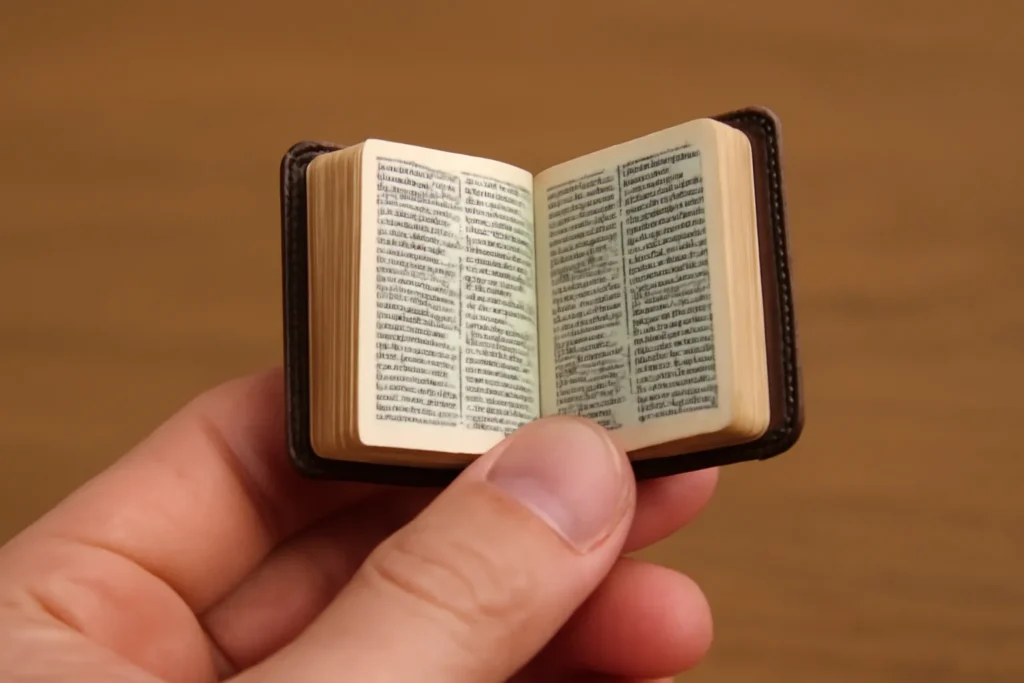
Across centuries and cultures, readers have sought faith and Scripture in forms that fit their hands, pockets, and daily rhythms. Among the most intriguing manifestations of this impulse are the miniature Bibles, a category that encompasses a spectrum from exquisitely illuminated manuscript microtexts to portable printed editions. These diminutive scriptures—often no larger than a modern passport or a wallet card—offer a remarkable intersection of devotion, craft, technology, and social history. In this guide, we explore the tiny Bibles, pocket Bibles, and other variants that have shaped how people access sacred words in compact, portable, and sometimes revolutionary formats.
The miniature Bible is more than a novelty; it is a portable theology, a technological achievement, and a cultural artifact. From early manuscript traditions to the birth of print and into contemporary artisan presses, the journey of the micro Bible reveals how faith communities adapted Scripture to new circumstances—whether for travel, secrecy, education, or personal devotion. In the following sections, we trace the history, examine the techniques, and outline how modern readers and collectors think about these tiny scriptures today.
What is a miniature Bible? Definition, Variants, and Scope
The term miniature Bible is informal, but it commonly refers to any form of sacred text that is physically small enough to be carried easily, studied discreetly, or used in settings with limited space. Different languages, denominations, and artistic traditions have produced a variety of formats under the umbrella of the small Bible or compact Bible.
Terminology and semantic breadth
Miniature Bible: The broadest umbrella term for tiny editions of the Bible, from illuminated codices to micro-printed volumes.
Pocket Bible: A practical designation for editions designed to fit into a pocket, purse, or glove compartment. Often associated with the early modern period in Europe.
Tiny Bible / Small Bible: Everyday descriptors emphasizing physical scale, used in catalogues and popular writing.
Micro Bible: A modern or historical term that highlights extreme diminutiveness, including manuscripts with minute scripts or even micrographic formats.
Printed compact Bible: A Bible produced through printing technologies in a deliberately small size, typically from the early modern period onward.
Illuminated mini Bible: A miniature manuscript Bible that preserves artistic illumination, often with gold leaf and intricate marginalia.
Historical overview: from manuscript microtexts to the dawn of printing
Early roots: the medieval and early postclassical contexts
Long before movable type, scribes and illuminators experimented with diminishing scales for religious texts. In monasteries and scriptoria, hand-copied manuscripts could be created on vellum or parchment in formats meant for close reading or personal devotion. While most surviving medieval Bibles were substantial in size, the culture of monastic copying also produced smaller volumes, especially as devotional books evolved in the later Middle Ages. These early microscripts reflected a fascination with portability, secrecy, or specialized liturgical use.
It is in the late medieval period that the concept of a Bible intended for travel or daily carry begins to crystallize in more concrete forms. The rise of devotional literature—including pocket prayers, gospel extracts, and Gospel books designed for clergy on the move—established a precedent for smaller, more personal Scripture objects. The artistry of these early microtexts often fused with illumination, marginalia, and careful binding, signaling that even the smallest editions could be treasured as works of beauty as well as spiritual instruments.
Renaissance and the expansion of portable Scripture
The invention and spread of printing in the 15th and 16th centuries catalyzed a new wave of compact Bibles. Printers recognized a demand for portable editions that believers could keep in their robes or pockets. The pocket Bible emerges as a literal and figurative compact form—light in weight, manageable in size, and often affordable enough to enable broader access to Scripture beyond monastic libraries.
In this era, a number of geographies and religious communities produced pocket Bible editions in various languages, including Latin, vernacular German, English, French, and Italian. The interplay between reform movements, literacy, and the spread of printed Bibles helped fuel demand for smaller formats. These early miniature Bibles might be printed in a couple of hundred pages, with fonts sized for thumb-reading, and bound in leather or blind-embossed covers for durability in travel.
Early modern to 18th century: popularization and standardization
By the 16th through 18th centuries, tiny Bibles had become widely distributed across Europe and its colonies. They served as practical tools for travelers, soldiers, merchants, and missionary workers who needed access to Scripture away from home-enabled reading rooms. In some cases, pocket Bibles included marginal references, concordances, or breviaries—compact tools that helped readers navigate the text with ease.
19th and 20th centuries: mass production, new materials, and design refinements
The industrial era brought improved paper quality, cheaper bindings, and more consistent typography, all of which fed a flourishing market for micro Bibles. Advocates of literacy and religious education embraced the small Bible as an instrument for personal piety and family devotions. The 19th century, in particular, saw a surge in pocket Bibles produced for a growing middle class, with translations into local languages and editions featuring illustrations or devotional aids.
Types, formats, and characteristics: what makes a miniature Bible?
Hand-copied illuminated miniatures vs. printed compact editions
The miniature Bible category spans two broad production traditions:
Illuminated microtexts: These are hand-copied manuscripts that retain precious decorations—miniature illuminations, calligraphy, and sometimes gold leaf. They required highly skilled scribes and artists and could be created for private devotion or as courtly gifts.
Printed pocket Bibles: These emerged with the arrival of movable type and later refinements in typography. Printed tiny Bibles offered mass accessibility, consistent text, and durable bindings suited to daily use in a pocket or saddlebag.
Common formats by size and binding
While individual editions vary, several recurring formats define the small Bible landscape:
Pocket-sized editions: Typically around 3–6 cm tall, designed for one-handed reading and everyday carry.
Miniature gospels: Bibles that focus on the four Gospels, often bundled with devotional commentary or devotional paraphrases.
Concordance- or primer-assisted editions: Compact editions that include cross-references and concise glossaries for quick study.
Leather-bound and decorative bindings: Durable covers, sometimes with tooling, gold embossing, or precious stones, reflecting the care and status of the owner.
Illuminated miniatures: Small-scale manuscripts where artists reproduce or reinterpret initial letters, marginalia, and miniature scenes in miniature scale.
Material considerations: parchment, vellum, and paper
The miniature Bible has been produced with a variety of substrates:
Parchment/Vellum: Traditional for medieval manuscripts, offering durability and a smooth surface for fine calligraphy and illumination.
High-quality paper: Particularly relevant to early modern and modern pocket Bibles, enabling mass production and more affordable pricing.
Leather or cloth bindings: Protects the fragile interior and adds portability for travel and daily use.
Typography and legibility: the art of small type
The tiny Bible relies on careful typography, with ligatures, ligature-rich scripts, and efficient use of line breaks to keep content readable at a reduced size. Scribes and printers faced the challenge of balancing legibility with compactness. Some editions employed very small fonts with high-contrast ink, while others used bifolios or multi-column layouts to maximize content on each page.
Notable examples and collections: where to find miniature Bibles
Major libraries and museum collections
If you are curious about seeing a micro Bible in person, several institutions maintain substantial holdings of pocket and miniature editions:
The British Library’s collections include a broad array of pocket Bibles, loaded with provenance notes and historical context.
The Bibliothèque nationale de France houses compact editions in multiple languages, illustrating the cross-cultural diffusion of portable Scripture.
The Bodleian Libraries at Oxford hold notable examples of illuminated miniatures and early printed micro Bibles, sometimes accompanied by contemporary devotional works.
The Metropolitan Museum of Art and other major museums often display miniature gospel books and related devotional volumes as part of exhibitions on medieval book arts.
Observing the craft: what collectors look for
Collectors of the tiny Bible often assess several attributes:
Authenticity and date: Provenance, colophons, and stylistic cues help verify era and origin.
Condition: Parchment or paper integrity, binding strength, and preservation of illuminations are critical factors.
Rarity: Editions with limited print runs or unique bindings command attention and value.
Artistic value: The presence of high-quality marginalia and decorative illumination adds to the object's significance.
Historical context: Editions associated with particular movements, regions, or religious communities offer rich storytelling potential.
Curatorial and conservation considerations
Preservation challenges for micro Bibles
The small scale of these volumes makes them especially fragile. Key concerns include:
Humidity and temperature fluctuations that can cause vellum to warp or ink to fade.
Acidic paper and bindings that become brittle with age.
Light exposure that can bleach pigments, especially in illuminated miniatures.
Handling risks, which require careful training for scholars and visitors in museums and libraries.
When displaying these editions, curators typically:
Control light levels and use UV-filtered glass.
Place the object in climate-controlled cases with a stable humidity and temperature regime.
Provide contextual information that helps visitors understand the manuscript’s purpose, format, and historical moment.
Use gloves or micro-fiber cloths to handle fragile volumes and minimize direct contact.
Technical and cultural significance: why tiny Bibles mattered
Religious and devotional roles
The small Bible fulfilled practical religious purposes: it offered scripture for daily devotions, family prayers, travel prayers, and catechetical instruction. These little volumes enabled lay readers to carry the Word into their routines—whether at market, on the road, or within the walls of a home. For some communities, the pocket Bible represented a tangible link to orthodoxy and personal piety in contexts where access to larger libraries or churches might be limited.
Education and literacy
The spread of portable Scripture paralleled rising literacy rates and vernacular translations. A tiny Bible in the vernacular served as a practical classroom text, a reference tool, and a means of encouraging private study. In certain settings, compact editions were distributed by reformers or lay associations as part of broader educational campaigns.
Illumination, binding choice, and decoration in a miniature Bible could signal status, patronage, or devotion. In aristocratic households, a diminutive, richly bound Bible could function as a portable reliquary of sorts—a demonstration of wealth, taste, and faith that traveled with the owner. In other contexts, the simplicity of a pocket edition could democratize access to scripture, turning the Bible into a brace for daily life rather than only a liturgical object.
For illuminated miniatures, the process begins with prepared parchment or vellum. Scribes write the biblical text with specialized inks, while artists create miniature illuminations in stages, often with gold leaf and vivid pigments. The scale demands extraordinary control of line, color, and composition. Binders then assemble the leaves into a compact volume, often with individualized bindings that reflect the owner’s status or purpose.
Print culture: from moveable type to micro typography
The advent of printing ushered in a new era for the compact Bible. Printers developed new font sizes, typefaces, and layouts to maximize content while preserving legibility. Techniques included:
Adjusting line length, column layout, and margins to fit more text into each page.
Using decorative initials and drop capitals to enhance aesthetics without sacrificing space.
Employing durable bindings and protective cases to withstand frequent handling.
In some cases, pairing text with marginal notes or devotional prayers suited for short readings.
Modern artisans and innovations
Contemporary makers continue the tradition of the micro Bible through custom bindings, laser-cut engravings, and micro-engraving on unusual substrates (metal, wood, or ceramic). Some modern artists produce nano Bibles that push the boundaries of scale, while others reproduce classic pocket Bibles using new lightfast inks and synthetic vellums. The convergence of traditional craft with modern technology has opened new avenues for collectors and enthusiasts, expanding what counts as a miniature Bible in the 21st century.
How to start collecting: a practical guide
What to look for in a first acquisition
If you are new to collecting tiny Bibles, start with clear goals. Decide whether you prefer historical significance, artistic merit, or mechanical rarity. Consider these questions:
Is the edition manuscript-based or printed?
What is the approximate date and geographic origin?
What is the condition of the binding, pages, and illuminations?
Does the item come with provenance, catalog entries, or scholarly references?
Price ranges and market reality
Pricing for pocket Bibles and miniature Bibles spans a broad spectrum depending on age, rarity, and condition. Common 19th-century pocket Bibles in good condition can be accessible to dedicated collectors, while medieval illuminated miniatures or early printed editions with rare bindings may command significantly higher sums at auction or through specialist dealers. Appraisal often requires an expert in book arts or an established antiquarian dealer who can verify date, origin, and condition.
Reliable provenance enhances value and trust. When possible, seek documentation such as:
Previous ownership records and sale catalogs
Photographs of bindings and illuminations
Scholarly catalog entries or reference works
Conservation reports describing materials and treatments
Care tips for collectors and owners
Proper storage and handling can significantly extend the life of a micro Bible:
Store in a climate-controlled environment (stable humidity and temperature).
Avoid direct sunlight and bright, inconsistent lighting.
Use archival-quality storage boxes and acid-free tissue for protection.
Limit handling and use clean cotton gloves when examining the volume.
Consult a professional conservator for any necessary restoration work.
Modern relevance: digital, scholarly, and educational angles
Digital echoes of the miniature Bible
In recent decades, digital technologies have provided new ways to explore and study tiny Bibles. High-resolution digital reproductions, searchable transcriptions, and annotated digital catalogs make these objects accessible to a global audience. While digital editions cannot replace the tactile and visual experience of the original pocket Bible, they offer invaluable scholarly resources for researchers and students who cannot visit the physical holdings.
Museums, libraries, and universities increasingly present miniature Bible holdings in educational programs, teaching students about the history of the book, the evolution of writing and printing, and the social history of religion. Interactive displays might show the process of illumination, the mechanics of tiny type, or the binding craft in action, enriching public understanding of how faith and text meet material culture.
Contemporary artistry and the revival of interest
There is a growing interest in tiny Bibles as contemporary art objects. Modern artisans blend historical techniques with innovative materials, producing new works that honor the old while pushing the boundaries of scale and design. This revival fosters cross-disciplinary dialogue among theologians, literary scholars, bookbinders, and designers.
Frequently asked questions about miniature Bibles
Here are concise answers to common inquiries readers often have about these remarkable texts.
How small can a miniature Bible realistically be? Sizes vary, but some micro Bibles are just a few centimeters tall, while others remain thumb-sized. The limit is largely practical: legibility and durability constrain how small a Bible can be and still be useful.
Were there ever "grains of rice" Bibles? There are legendary anecdotes and occasional artistic experiments describing micro-texts in extraordinary scales. While some claims are mythic, there are certainly highly compact, highly crafted editions and engravings in the historical record.
Are miniature Bibles still produced today? Yes. Modern artisans and small presses continue to make pocket Bibles and commemorative miniatures, often with contemporary translations or original devotional art.
What distinguishes an illuminated mini Bible from a non-illuminated one? The presence of decorative initials, borders, or miniature illustrations that accompany the text; illumination adds an extra layer of artistry and value to the object.
How should I study a tiny Bible to gain the most from it? Approach it like any scholarly object: study its script, binding, and era; consult catalogues and provenance; understand the text in its historical vernacular; and, if possible, compare it with larger editions from the same period to grasp editorial practices.
Conclusion: appreciating the enduring charm of the smallest sacred texts
The miniature Bible stands as a testament to human ingenuity and devotion. In the hands of readers from ancient monasteries to modern study rooms, these compact volumes prove that sacred texts do not require grandeur alone to convey significance. They can be as compact as a note tucked into a pocket, and yet as expansive as a corridor of centuries, bearing witness to changing technologies, literacy, and religious life. Whether admired for their artistic beauty, historical context, or the sheer audacity of their scale, tiny Bibles remind us that the Word, in any format, invites intimate encounter.
If you are embarking on a journey through the world of miniature Bibles, you will encounter a spectrum of possibilities—from illuminated, hand-written miracles preserved in museum cases to pragmatic, printed pocket editions designed for daily life. Each object encodes a story: of the hands that created it, the hands that used it, and the hands that carry faith forward in small but meaningful ways. The history of the micro Bible is not just a story of scale; it is a story of how communities sought to keep sacred words close, accessible, and legible in a world that was constantly changing its means of communication.










Leave a Reply