List Jesus 12 Disciples: Names of the Twelve Apostles
List Jesus 12 Disciples: Names of the Twelve Apostles
This article provides a thorough overview of the List Jesus 12 Disciples, focusing on the names of the Twelve Apostles and what the biblical texts and historical tradition say about each one. Whether you are exploring the topic as a student of biblical studies, a reader of Christian history, or a curious learner seeking a clear outline of the Jesus' twelve disciples, this guide aims to be both accurate and accessible. Throughout this piece you will encounter variations of the search phrase list jesus 12 disciples because scholars and translators often use different wording to refer to the same group. The intent here is to present a cohesive, well-sourced view of the twelve apostles and their roles in the Gospels, while highlighting the diversity of naming conventions found in the New Testament.
The phrase “the twelve” appears frequently in the first four books of the New Testament, often in the context of Jesus commissioning his closest followers to ministry, teaching, and mission. A well-constructed list of Jesus 12 Disciples serves several purposes:
It provides a concise reference to the people who formed the core circle around Jesus during his public ministry.
It helps readers distinguish among similarly named figures in the Gospel narratives, where names were common and roles sometimes overlapped.
It highlights the diverse backgrounds of the apostles—from fishermen and tax collectors to political enthusiasts—offering a window into the social world of first-century Galilee and Judea.
It sets the stage for studying the later chapters of Acts and the early church, where these same figures carry forward the mission after the Resurrection.
The twelve apostles: Names and variants
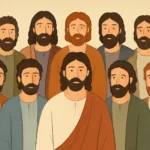
Below is a clear, conventional list of the Twelve Apostles, with common alternative names noted in parentheses. This is the canonical roster that appears across traditional Christian liturgy and biblical commentaries. For readers seeking a straightforward enumeration, this is the core names of the Twelve to memorize and reference.
Peter — also called Simon Peter or Cephas. A fisherman from the Galilee region who becomes a leading figure among the disciples and a foundational pillar of the early church.
Andrew — Peter’s brother. A fisherman by trade who is described in the Gospels as bringing others to Jesus and often portrayed as a seeker who brings people into the circle of learning.
James (son of Zebedee) — sometimes referred to as James the Great to distinguish him from James the son of Alphaeus. He is part of Jesus’ inner circle alongside his brother John.
John (brother of James) — the son of Zebedee who shares the inner-circle status with James. Traditionally credited with a significant part of the Gospel of John and the Book of Revelation in later Christian tradition.
Philip — a practical thinker who plays a role in scenes where faith and understanding are tested, and who facilitates encounters that reveal Jesus’ messianic identity.
Bartholomew — often identified with Nathanael in the Gospel of John; some traditions identify Bartholomew as Nathanael, while others treat them as distinct individuals in different lists. He is associated with questions that move toward recognition of Jesus as the Son of God.
Thomas — also known as Doubt or Didymus in some translations, due to the famous moment where he questions the Resurrection. He nonetheless asserts a strong faith upon meeting the risen Lord.
Matthew — also called Levi, the tax collector who becomes a Gospel author in tradition and is remembered for his association with the social and economic margins of first-century society.
James (son of Alphaeus) — often labeled as James the Less in contrast to James the son of Zebedee; his name points to a separate lineage within the apostolic circle.
Thaddaeus — sometimes rendered as Judas, son of James, or Lebbaeus in some manuscripts; often identified with Jude in later tradition, and associated with the request to see the Father in John 14.
Simon the Zealot — also known as Simon the Canaanite in some gospel lists; a figure whose epithet points to his historical alignment, political bent, or geographic origin in various traditions.
Judas Iscariot — the apostle who betrays Jesus, whose tragic arc culminates in the betrayal and the events of the Crucifixion; following his renown, the early church makes a choice to replace him in Acts with Matthias.
Note on naming: the Gospel writers sometimes differ in how they refer to the same person. For example, Bartholomew is often identified with Nathanael in the Gospel of John; Thomas is also called Didymus, Greek for “twin.” These naming variants illustrate the rich and sometimes complex textual history of the New Testament, where multiple names were used for the same person or where different communities used different labels.
Why the variations matter in studying the twelve
The variations in names often reflect the social roles and networks of the apostles, as well as the linguistic diversity of the early Christian world—Aramaic, Hebrew, Greek, and Latin cultures all left their mark. Understanding these variants helps readers:
Trace cross-references across the Gospels and Acts, where the same person may appear with different identifiers.
Appreciate the historical context in which early Christians encountered Jesus and carried forward his mission.
Navigate scholarly discussions about authorship, apostolic succession, and early church leadership.
Profiles in brief: themes and highlights for each apostle
To help readers connect the names to their narratives, this section offers concise profiles of each member of the Twelve Apostles. Each profile highlights a few core facets: background, distinctive moments in the Gospels, and the contribution attributed to the apostle in early Christian tradition.
Peter
Peter acts as the de facto leader among the disciples in the Gospels. Known for his impulsive faith and his pivotal confession at Caesarea Philippi, he becomes a central figure in the church’s formation after the Resurrection. The arc of Peter includes both moments of strong faith and notable human frailty, such as his denial of Jesus in the night of the Passion. Traditional traditions identify him as a linked father figure of the church, and he is commonly portrayed as a figure who anchors missionary activity in the early chapters of Acts.
Andrew is celebrated as a bringer of others into contact with Jesus: he is described in the Gospel accounts as bringing his brother Peter to Jesus and introducing people to Jesus in various encounters. In biblical memory, Andrew stands for the missionary impulse that precedes formal church leadership, embodying hospitality toward the divine invitation.
James (son of Zebedee)
The elder James and his brother John form part of Jesus’ inner circle, often accompanying Jesus to mountain experiences and important teaching moments. As one of the closest associates, James’s story intersects with themes of faith, loyalty, and the responsibilities of those who are trusted with the early revelation of Jesus’ mission.
John
John is traditionally associated with a life of deep spiritual reflection and with the authorship of the Gospel bearing his name, as well as the Revelation. His posture toward Jesus—intimacy, love, and a contemplative tone—frames a distinctive strand in early Christian memory about the nature of Christ and the mission he entrusted to his followers.
Philip
Philip appears in stories that emphasize questions about faith and comprehension of Jesus’ identity. His exchanges often probe for a clearer understanding of spiritual truth, and the narrative momentum through Philip’s interactions underscores how the disciples learned to recognize and articulate the messianic claim embedded in Jesus’ words and deeds.
Bartholomew
Bartholomew stands as a figure whose name tradition connects with Nathanael in John’s Gospel. The Bartholomew narrative arc is often read as a case study in recognizing Jesus as the Son of God and the King of Israel—an early moment that reinforces faith through direct encounter with the divine in earthly life.
Thomas
Thomas is remembered for his skepticism and subsequent confession of faith after the Resurrection. In many readers’ minds, the label “Doubting Thomas” highlights the importance of preservation of doubt in the journey toward steadfast belief, a theme that resonates with readers who encounter challenging questions in faith.
Matthew
Matthew, also called Levi, brings a distinctive perspective given his background as a tax collector and his role as a writer who compiles the Gospel narrative bearing his name. His inclusion in the Twelve emphasizes the scope of Jesus’ mission as inclusive of people from various social strata.
The apostle James (son of Alphaeus) appears in the lists with relatively fewer details in the Gospel narratives, yet he remains part of the original core group. The label James the Less distinguishes him from the elder James of Zebedee and points to the complexity of naming conventions within the apostolic circle.
Thaddaeus
Thaddaeus is sometimes identified as Judas, son of James or as Lebbaeus, depending on the manuscript tradition. In later Christian tradition, he is sometimes equated with the apostle Jude, and he is associated with questions about Jesus’ presence and the fullness of God’s revelation.
Simon
Simon the Zealot represents a dimension of the apostolic group associated, in some traditions, with political zeal or national zeal. His presence in the Twelve reflects the diverse political and social currents that surrounded first-century Jewish life and the ways in which Jesus’ message engaged with those diverse hopes.
Judas Iscariot
Judas Iscariot is infamous for the act of betrayal that culminates in the crucifixion narrative. His inclusion in the Twelve raises important questions for readers about loyalty, temptation, and the complex interplay between Jesus’ mission and human fallibility. The story of Judas also foreshadows the need for a replacement apostle in the early church.
After Judas: Matthias and the continuity of the apostolic witness
In the Acts of the Apostles, the early Christian community faces the loss of Judas Iscariot and seeks to maintain a complete apostolic witness. The selection of Matthias (often called the apostle who replaced Judas) becomes a practical step in preserving a canonical number of twelve to reflect Jesus’ commission. This transition underscores an important theme in Christian tradition: the need for continuity of leadership and the maintenance of a complete circle of witnesses who could testify to Jesus’ life, death, and resurrection.
Beyond the surface: what the twelve symbolize in Christian memory
The Twelve Apostles hold symbolic weight well beyond their historical function. They symbolize:
The foundation of the church and the transmission of apostolic teaching across generations.
The universal reach of Jesus’ message, crossing lines of occupation, culture, and political ideology.
The dynamic interplay between faith and doubt, as seen in the stories of individual disciples who grow in understanding over time.
The model of discipleship itself—responding to Jesus’ call, following, learning, and bearing witness to the faith in practical ways.
Notes on sources and how the list is used in study and teaching
Researchers, students, and teachers often consult the Gospel lists as they appear in the canonical text. The names of the Twelve can be found in multiple places across the Gospels, including Matthew 10, Mark 3, Luke 6, and Luke 24, as well as in Acts 1 where the need to replace Judas is discussed. Variants in naming, as well as differences in ordering among the gospel accounts, are common features of textual study. For educators, a common exercise is to present the list of Jesus’ twelve disciples and then compare how each Gospel writer frames a given apostle’s role or moment with Jesus.
In summary: the enduring relevance of the twelve names
The names of the Twelve Apostles continue to be a focal point in biblical literacy. By learning the canonical roster, students can better navigate the biblical text, understand early church history, and engage with the way these figures are remembered in liturgy, art, and scholarship. Whether you approach the topic from a historical perspective, a theological lens, or a literary angle, the discussion of list jesus 12 disciples remains a gateway to broader questions about authority, leadership, and the transmission of faith across generations.
Variation in phrasing for broader search coverage
If you are conducting research or writing about this topic, you may encounter several variants of the same core idea. In addition to the twelve apostles, you will see phrases like the twelve disciples, Jesus’ twelve followers, or the original apostles. Some sources differentiate between the terms “apostles” and “disciples” based on context—disciples as the learners who followed Jesus, and apostles as the commissioned messengers who carried the mission into the world after Jesus’ death and resurrection. This distinction can be important for interpreting passages where the two terms overlap or diverge in meaning.
Glossary: quick references to help with the list jesus 12 disciples
For readers who want quick reference terms, here is a compact glossary to accompany this long article:
Apostles: Those officially commissioned to preach the gospel and establish the early church; the core group discussed in this article.
Disciples: Followers and learners who studied with Jesus during his public ministry; not all disciples become apostles.
Bartholomew and Nathanael: A biblical naming question that appears in different Gospel texts.
Thomas: Known for his doubt and confession of faith in the risen Christ.
Judas Iscariot: The apostle who betrayed Jesus; his absence leads to Matthias’ appointment as the twelfth in Acts.
This article aimed to present a coherent list jesus 12 disciples with careful attention to the canonical names and their variants. By providing a structured HTML-based overview, readers new to the topic can quickly learn who the Twelve were, what each figure contributed, and how their legacy continues to shape discussions about leadership, faith, and community in Christian thought.






Deja una respuesta