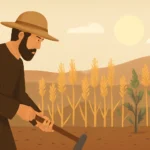
The Weeds Parable invites us to observe a simple garden and listen for a larger voice beneath it. It asks not only what we can pull out today, but what we may miss if we rush to separate, judge, or discard. In its many forms, this parable has traveled across cultures and disciplines, becoming a lens through which we examine growth, patience, and the moment when opportunity reveals itself—sometimes in disguise, sometimes in conflict, always inviting a more nuanced response than quick removal or blanket approval.
At its core, the parable tells of a field where wheat and weeds grow side by side. The workers notice the weeds among the crop and ask the farmer if they should pull them up. The farmer cautions patience: pulling the weeds early may damage the wheat, and the time will come when harvest reveals which plants were true grain and which were not. This story has many flavors—literary, theological, agricultural, and moral—yet the enduring resonance lies in the ambiguity between innocence and harm, risk and reward, and the fraying edge between intervention and restraint.
In modern terms, the parable reframes a common dilemma: how should we handle noisy or disruptive elements within a system—whether a field, a classroom, a company, or a society? If we overreact, we may uproot something valuable or destabilize the system. If we underreact, we may allow harmful patterns to proliferate. The parable does not offer a simplistic formula; it offers a discipline: wait for more information, understand the differences in kind, and recognize that the time of discernment is itself a kind of work.
Several interpretive angles illuminate the same core idea:
Discernment over impulse: assessment requires time, observation, and context.
Protection of the healthy: an overzealous removal can harm the intended crop or community.
Redemption of the marginal: what seems like a weed may be a living thing with a parallel role in the ecosystem, or even a seed of potential.
Complexity of ecosystems: human systems are not neatly separable into good and bad elements; they are dynamic and interconnected.
Variations of the Parable: Stories Across Settings
A gardener in a village plot
In one variation, a humble gardener tends a village plot where weeds creep through rows of cabbages. The gardener remembers stories passed down by elders: some weeds bind soil, some attract pollinators, some simply remind us that nature resists human plans. Rather than pulling everything indiscriminately, the gardener chooses to water, inspect, and observe, noting which plants thrive with the cabbages and which do not. The harvest becomes a mosaic rather than a monoculture, and neighbors begin to see patterns of resilience that emerge from measured restraint.
In a corporate garden: the project portfolio
A project manager describes a portfolio where disruptive ideas appear as weeds among the flagship products. Some weeds distract, consume resources, and derail timelines. Others, however, introduce novel capabilities, open new markets, or reveal hidden customer needs. The leadership learns to separate estranged ideas from essential innovations through staged pilots, feedback loops, and cross-functional collaboration. The parable becomes a guide for managing change without panic, recognizing that disruption can be a catalyst for growth rather than a threat to stability.
In a classroom: ideas as weeds and seeds
Imagine a teacher who invites debate and questions in a crowded classroom. Some questions seem like distractions; others spark unexpected connections. The teacher does not silence every disturbance but creates a culture where questions are labeled, tested, and weighed. The classroom becomes an experimental garden where learning blooms through the careful cultivation of curiosity as well as discipline. In this telling, the parable reframes attention from purity of content to vitality of learning processes.
In a community garden: coexistence and stewardship
A neighborhood community garden faces a seasonal onslaught of weeds that threaten shared plots. The community develops a plan that includes preventive measures, composting, and companion planting. They agree that some weeds will remain because they provide soil health or support biodiversity, while others will be managed through targeted removal. This version foregrounds collective stewardship and invites citizens to practice patient discernment together, acknowledging that a healthy ecosystem depends on both restraint and purposeful action.
Across these variations, three themes maintain their core significance. They interlace with ethical choices, practical decisions, and personal development:
Growth: not all growth is visible at once. Some processes take time to reveal themselves, and the best outcomes often emerge from long horizons rather than instant fixes.
Patience: restraint is a form of stewardship. Patience does not mean passivity; it means choosing the right moment to act and the right method to act with care.
Opportunity: disruption can open doors we did not anticipate. The weeds may signal where the soil needs enrichment, new nutrients, or a different arrangement of the garden’s elements.
Beyond these, several supplementary themes frequently appear in extended readings of the parable:
Discretion versus prejudice: not all unexpected elements are harmful, but not every unexpected element must be welcomed. Discretion requires evidence and context rather than sentiment.
Ethics of removal: pulling out a weed too aggressively can damage the crop, the soil, or the community’s trust. Ethical action weighs consequences to all affected parties.
Time as a revealing factor: the harvest represents a moment when truth becomes visible, not merely when a decision was most convenient.
The Parable in Practice: Lessons for Personal Growth
When we translate a parable into practical behavior, we move from abstraction to action. Here are concrete ideas drawn from the weeds parable that individuals can apply in daily life, whether in a personal project, a workplace, or a social context.
Assess before acting: take time to observe differences between elements that appear similar. Create a simple checklist that helps distinguish seedlings from weeds.
Document patterns: keep a record of what thrives and what struggles. Patterns emerge over time, guiding more informed interventions.
Separate process from person: avoid labeling people as weeds. Treat harmful patterns as issues to address, not as verdicts on character.
Build in feedback loops: pilot small changes, gather feedback, and adjust. This mirrors the parable’s insistence on harvest as the ultimate test of discernment.
Cultivate resilience: a garden is not only about removing threats; it’s about strengthening the space for growth through soil health, water management, and biodiversity.
For many readers, the parable invites a practice: a weekly reflection on a single decision to remove or not remove something that seems disruptive in life or work. The reflection could follow this simple framework:
Describe the element that feels like a weed.
List the potential risks and potential benefits of removing it now.
Identify the stakeholders affected by either action.
Decide on a measured approach, and set a clear time to reassess.
In addition to personal practice, the parable can enrich leadership and organizational culture. Leaders who invite teams to pause before drastic changes create spaces for trust, shared learning, and mutual accountability. The harvest, in such cultures, is not merely a phase of completion but a continual process of adjustment that sustains long-term vitality.
One caveat often raised in critical readings is that waiting can be exploited by systems that tolerate harm under the banner of patience. The parable does not invite passivity in the face of injustice or harm. Rather, it calls for discernment with safeguards—mechanisms that prevent the flourishing of truly destructive patterns while allowing for the growth of beneficial diversity. Some guiding questions include:
Are we delaying action due to fear, or are we delaying action to protect broader integrity?
Who benefits from immediate removal, and who might suffer unintended consequences?
What metrics or signals will we use at harvest time to determine what remains and what goes?
How can we design processes that are adaptive, transparent, and just for all participants?
These questions help translate the parable into a framework for ethical decision-making, especially in contexts where stakes are high and the line between weed and crop is not immediately obvious. In such settings, the parable serves as a reminder that judicious patience is not a passive stance but an active, principled practice.
Cross-Cultural and Cross-Disciplinary Perspectives
Many traditions reflect on weeds and cultivation as metaphors for human experience. In some agrarian societies, a weed is not merely something to remove but a resource to be managed. Intercropping strategies, such as planting legumes among grains to fix nitrogen, reveal a view of ecosystem management in which even unwanted plants contribute to soil health. In Buddhist and Taoist thought, attention to the present moment and harmony with the cyclical nature of life echoes the parable’s call to observe before acting, to honor the process of growth as a path toward wisdom. In these contexts, the parable becomes a shared language: patience in action as a path to effective stewardship.
In secular disciplines—ecology, systems thinking, and organizational science—the parable is used as a case study in resilience and adaptive management. It invites readers to consider how a system’s diversity can be a strength, how redundancy and reductions in the face of disturbances might either protect or erode functionality, and how emergent properties arise when many elements interact over time. The weeds parable thus travels beyond moral instruction and becomes a heuristic for analyzing complex networks.
Weeds in Modern Life: Technology, Business, and Education
Today’s digital era reframes the parable in several compelling ways. Weeds may be misaligned data, noisy signals, or disruptive ideas that threaten short-term plans but seed long-term capabilities. Consider these contemporary reframings:
In technology, a disruptive startup may appear as a weed in an established platform, challenging incumbents to adapt or to be displaced. The harvest becomes an industry-wide transformation, not just a single product launch.
In business strategy, a portfolio must balance exploitation of current competencies with exploration of novel opportunities. The weeds parable supports a governance approach where experimentation is funded and failures are treated as learning, not as a final verdict.
In education, student ideas may at first seem peripheral, yet they can unlock new curricula or teaching methods. Patience with the learning process—recognizing when an idea is a weed to be pruned versus a seed to be nurtured—can influence outcomes for years to come.
These modern readings emphasize a critical point: not all disruptions are harmful, and not all nonconforming voices should be silenced. The parable suggests a disciplined stance in which disruption is analyzed for value, context, and timing, rather than categorized as inherently dangerous.
Practical Exercises and Reflections
To interiorize the parable, try these exercises that blend reflection with small-scale action. They can be done alone, with a partner, or within a team setting.
Garden diary: Keep a two-week garden diary where you note new sprouts, pests, and weather conditions. Mark any element that seems disruptive and evaluate whether it is harming the crop or contributing to a healthier ecosystem.
Weed audit: Create a simple rubric to categorize elements as seeds, weed, or unknown. Revisit every 3–5 days to see if your assessment holds as conditions change.
Harvest rehearsal: Before any major decision, imagine the harvest. What would success look like in six months or a year? What signals would confirm that the decision was wise?
Dialogue protocol: In teams, establish a rule to allow one person to present a disruptive idea without interruption, followed by a structured evaluation phase. This practice embodies the parable’s spirit of measured patience and deliberate discernment.
Ethics check: For every removal decision, ask: Who benefits? Who bears risk? What alternative approach could preserve value while reducing harm?
The Weeds Parable as a Teaching Tool
Educators can use the parable to cultivate critical thinking, empathy, and systems thinking. It invites students to consider multiple perspectives and to practice both moral reasoning and practical problem-solving. A structured lesson might include:
Case studies where teams decide whether to remove a disruptive element in a simulated system, followed by debriefs on the consequences of their choices.
Role-play scenarios in which some participants represent the crops and others represent the weeds, exploring how empathy and context affect decision-making.
Reflection prompts that ask students to connect the parable to their own experiences with growth, patience, and opportunity.
Cross-disciplinary projects that examine the parable from ecological science, ethics, economics, and philosophy to reveal the interconnectedness of the themes.
In keeping with its spirit, a teaching approach should emphasize process over product, encouraging learners to value the journey of discernment as much as the outcome of the harvest.
Weeds as Metaphor: Personal and Collective Transformation
We can also read the parable as a metaphor for transformation—how individuals and communities evolve when they relearn how to see and how to act. The garden evolves as follows:
Awareness: noticing disruptions is the first step toward sustainable solutions.
Inquiry: asking questions about where disruption comes from, what it reveals about underlying conditions, and how it interacts with existing systems.
Adaptation: adjusting plans to accommodate new information rather than rigidly clinging to a single ideal.
Coexistence: acknowledging that a diverse garden is often more resilient than a monoculture, and that even weeds have a place in a functioning ecosystem when managed wisely.
Harvest: the moment of realization when decisions crystallize and the field’s purpose becomes clearer.
When applied to life, the parable supports a stance of humble care—care for the soil of our minds, for the people around us, and for the future that will inherit the fields we tend today.
The tempo of growth matters. In some seasons, weeds proliferate; in others, drought or pests make the field fragile. The parable teaches that seasonal awareness matters: what is a weed in one season might become a resource in another, and vice versa. Understanding this rhythm helps us avoid the trap of binary thinking—good versus bad, right versus wrong—and instead adopt a nuanced calendar of action:
Seasonal observation: track conditions over a cycle (e.g., a planting year or a fiscal quarter) to understand when changes are most prudent.
Temporary containment: use non-destructive measures when possible to manage disruptive elements until a clearer signal emerges.
Longitudinal evaluation: measure outcomes not by fast results but by the strength and resilience of the system over time.
In this light, the harvest is not simply a punitive moment of clearing the field; it is a measurement of the system’s health and its capacity to support growth under evolving conditions.
Final Reflections: A Living Parable
The weeds parable remains a living, adaptable narrative because it does not prescribe a single recipe for every circumstance. Instead, it offers a discipline: cultivate discernment, honor patience, and remain alert to opportunity that may arise from disruption. The parable asks us to consider not only what we remove, but what we preserve, what we nurture, and what we learn by watching the field change with time. It invites us to become gardeners of not just crops, but of character and community.
In the end, the parable can be understood as a call to balance—between action and restraint, between critique and creation, between certainty and curiosity. It is a reminder that meaningful growth rarely happens in a single season, and that the healthiest fields are tended by hands that know when to persevere, when to pause, and when to harvest the wisdom that has quietly grown beneath the surface.
Practical Recap: Core Takeaways
Growth is a layered process—visible outcomes emerge only after time and care.
Patience reduces harm—acting too quickly can damage what truly matters.
Opportunity often hides in disruption—new ideas and understandings can come from challenging elements.
Discernment requires context—make decisions with evidence, relationships, and ethical considerations in view.
Diversity strengthens systems—a garden with varied plants can be more resilient than a uniform field.
As you move through your day, you might carry a small mental image of a field: rows of wheat, interspersed with creeping greens. The image becomes a prompt to ask yourself:
What in my current environment feels like a weed—something that distracts or harms the core mission?
What would be gained by waiting a little longer before deciding to remove it?
What could this weed reveal about the soil—my own assumptions, resources, or the health of the system?
Is there a way to manage this element that preserves opportunity while reducing risk?
Whether you interpret the parable through a religious, philosophical, ecological, or managerial lens, its enduring value lies in the invitation to practice a form of intelligent, compassionate engagement with the world around you. The weeds parable, in all its variations, encourages us to nurture a field that can sustain not just crops, but the growth of wisdom itself.