Overview of the Samuel and Delilah Narrative in the Bible
The canonical story of Samson and Delilah sits within the larger tapestry of the Book of Judges, a period in ancient Israel’s history marked by cycles of disobedience, oppression, cries for deliverance, and imperfect saviors. In this long arc, the story of Samson and Delilah in the bible stands out for its gripping drama, its stark contrast between superstardom and vulnerability, and its persistent questions about power, loyalty, and fate. The biblical narrative in Judges 13–16 presents Samson as a divinely empowered yet tragically flawed figure, whose strength is tied to a sacred covenant known as the Nazarite vow. The tale of Delilah, a Philistine temptress moved by motives shaped by political stakes, functions as the hinge of betrayal that exposes both Samson’s hidden fragilities and the larger moral tensions of the era. In discussing variations of the story of Samson and Delilah in the bible, readers encounter a spectrum of translations, interpretive retellings, and literary echoes—each aiming to illuminate the themes of divine initiative, human choice, and the consequences of breaking trust.
Characters and Motivations in the Samson and Delilah Episode
Three key figures anchor the drama: Samson, Delilah, and the representatives of the Philistine leadership who seek to curb the deliverer of Israel. In this retelling, the hero’s rise and fall are bound up in motives as old as history itself: the lure of personal power, the pressure of collective enemies, and the moral responsibilities that accompany a covenantal calling. The biblical account also highlights the tension between divine empowerment and human weakness.
Samson’s life story begins with a birth foretold by an angel, a birth that marks him as special from the womb. The terms of his life are defined by the Nazarite vow, a consecration that includes abstaining from wine, not cutting the hair, and remaining pure under the laws of the covenant. This vow is the source of Samson’s extraordinary strength, which the chapters describe as the Spirit of the Lord enabling him to perform superhuman feats. Delilah’s role, however, is more complex than a simple seduction; she embodies a clash of loyalties and a strategic calculation to discover the true foundation of Samson’s power. The Philistine powers, intent on cowing the deliverer, offer her payment to extract Samson’s secret, turning a personal relationship into a political trap.
Within the tapestry of the tale, Delilah’s motive appears multifaceted. Some readings emphasize her as a willing instrument of Philistine strategy, while others stress that she is caught in a web of coercion, pressure, and cultural expectations. The narrative thus invites readers to reflect on agency and responsibility: who chooses the path of betrayal, and what are the consequences for both the betrayer and the betrayed? This dimension—where personal relationships become battlegrounds for national interests—gives the story of Samson and Delilah in the bible its enduring power.
Chronology of Key Episodes in the Samson and Delilah Narrative
To appreciate the arc of events, it helps to follow a sequence of pivotal moments. The following chronology highlights the major episodes that culminate in Delilah’s betrayal and Samson’s downfall, while also situating them in the broader frame of Judges and the ongoing struggle of Israel.
The birth and vow: An angel announces the birth of a son to Manoah and his wife, promising that the child will begin to deliver Israel from the Philistines. The boy’s life is to be a Nazarite life devoted to God; he is instructed never to cut his hair. From the outset, the narrative places Samson within a sacred mission and a fragile human condition, since his strength depends on obedience to the covenant and the Spirit’s enabling power.
Samson’s early exploits: The narrative recounts feats that signal God’s empowerment, including killing a lion and later finding honey in its carcass, as well as single-handedly striking down Philistines in various settings. These episodes showcase a paradox: the same strength that enables deliverance can also become a tool for personal risk or mischief when tested by pride, romantic entanglements, or poor discernment. The biblical narrative frames his feats as acts that further Israel’s deliverance in moments of crisis, yet they are tempered by episodes of misjudgment.
Timnah and the riddle: Samson marries a Philistine woman in Timnah and presents a riddle (the famous “out of the eater, something sweet” riddle) to his wedding guests. This episode foreshadows how personal choices intersect with national conflict, and it begins to illuminate the complexity of intertribal tensions. The riddle itself anchors the larger arc of trust and risk: outsiders, manipulation, and the precarious balance between subtlety and force.
Delilah enters the scene: Delilah is depicted as a figure who repeatedly tests Samson’s strength and tries to pry open the secret of his power. In a sequence of visits to Samson, she asks him: “What makes you so strong?” or variations of this question, and he responds with several false theories. Each time, she co-opts Philistine agents to exploit Sampson’s vulnerability. The motif of deception is introduced, turning a personal exchange into a dangerous political negotiation.
Three lies, one truth: In a classic sequence, Samson lies about the source of his strength—first that binding with seven fresh bowstrings would render him unable to break free, then that binding with new ropes would hold him, and finally that his hair alone could unlock the secret of his power. Each time Delilah presses him, and each time she betrays his refusal to reveal the covenant’s sign. The repeated attempts highlight a central theme: the fragility of trust when power and money intersect.
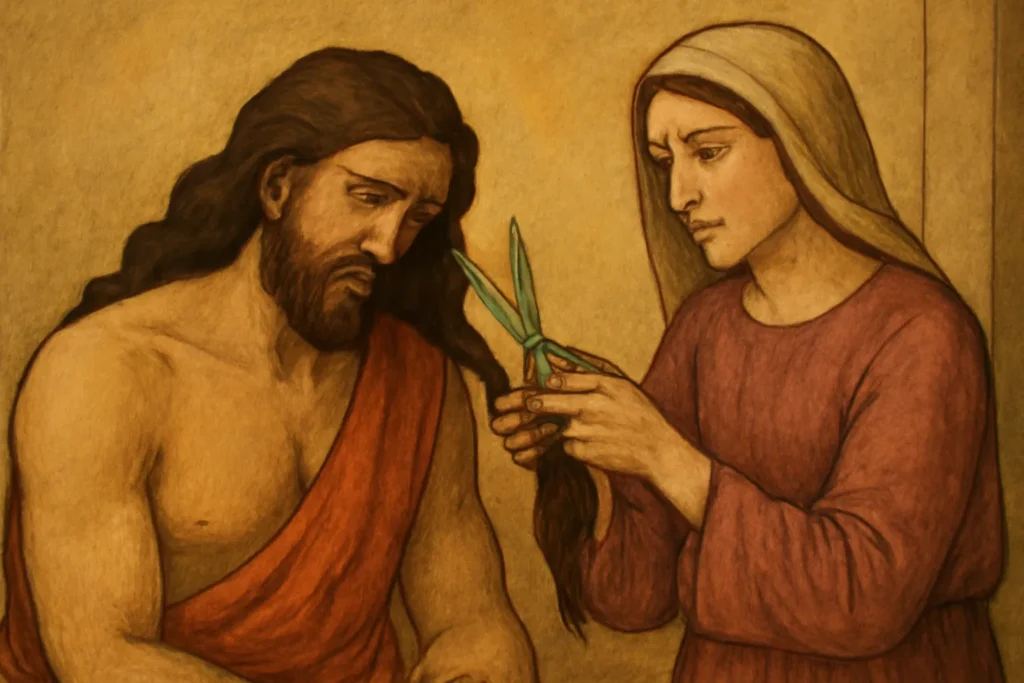
Shaving of Samson’s hair and capture: After Samson reveals the sacred sign, Delilah finally exposes him to the Philistines, who capture him, gouge his eyes, and bind him in bondage. The enemies’ victory is not merely physical; it is symbolic: the destruction of Samson’s sight mirrors a spiritual moment where the people’s prospects for national deliverance seem to dim. The temple of Dagon becomes the stage for the final act of public humiliation and political power.
Imprisonment and humiliation: In prison, Samson’s strength appears to be absent, yet his faith remains a quiet undercurrent. The text presents a paradox: even in weakness, the divine presence can operate in ways that set the stage for a climactic reversal. The narrative thus keeps faith alive in the midst of degradation, a pattern that resonates in many biblical stories of deliverance that emerge from apparent defeat.
Samson’s final act and the temple collapse: In a climactic moment, the hair that symbolized his vow begins to grow again, and the Spirit of the Lord returns to empower him. He prays for strength one last time, and in a final act of prodigious power, he brings down the Philistine temple, killing many of Israel’s enemies and himself in the process. The martyr-like ending of Samson’s life raises complex questions about victory, sacrifice, and the price of human weakness when confronted by idolatrous power.
Betrayal and Its Consequences
The thread of betrayal runs through the entire Delilah episode, casting a long shadow over the characters and their motives. Delilah’s actions illuminate the tension between personal desire and political necessity, while also foregrounding the ethical cost of deception. The Philistines’ decision to use a domestic relationship as a weapon reveals a network of political strategy in which human hearts are collateral in a struggle for power. The consequences of betrayal are not limited to individual misfortune; the narrative emphasizes how betrayal undermines trust, disrupts covenants, and escalates conflict, ultimately altering the course of a nation’s future.
From a literary standpoint, the Delilah incident prompts readers to consider the nature of strength and vulnerability as intertwined forces. Samson’s enormous physical power is real, yet the story insists that his strength is not purely his own; it is granted and sustained by the divine appointment and covenant. When that connection is severed, even the strongest can be turned aside, subdued, or humiliated. The betrayal thus serves as a cautionary lens on the moral hazards of ambition, vanity, and sexual intrigue in times of national crisis. In examining these dynamics, the story of Samson and Delilah in the bible becomes a study of how a people survive, endure, and discern their relation to God under pressure.
Theological and Moral Lessons Drawn from the Narrative
Divine empowerment and human frailty
One of the most persistent themes is the interplay between divine empowerment and human frailty. Samson’s strength is a gift that serves a divine purpose, yet it is exercised within a fragile framework of trust and obedience. The narrative does not sanitize his flaws; rather, it presents them in stark relief and demonstrates how God’s purposes can persevere despite human weakness. This has been a central point in many theological readings: the power of God can work through flawed vessels, and God’s deliverance moves forward even when the agent of deliverance stumbles.
Covenant signs and the symbolism of hair
The Nazarite vow and its visible sign—unshorn hair—become a potent symbol in the tale. The moment Delilah’s treachery cuts that sign, the narrative signals a break in the covenant’s outward sign of consecration. Yet the later restoration of strength, through the revival of Sampson’s hair and the Spirit’s return, underscores a theme: the possibility of renewal even after failure, if repentance and divine mercy are sought. The physical event (hair being cut and then regrown) becomes a metaphor for the possibility of regaining spiritual vitality after a fall.
Wisdom, discernment, and the dangers of manipulation
The Delilah episode is a cautionary tale about manipulation, coercion, and the misuse of intimate trust for political ends. It invites readers to examine how discernment—or the lack thereof—can influence outcomes. The narrative does not present Delilah merely as a one-dimensional temptress; it invites a deeper reflection on the pressures she faces and the moral complexity of choices under duress. The broader moral is that wisdom and faithful discernment matter just as much as strength when a people faces existential threats.
Variations and Interpretations Across Traditions
Across Jewish, Christian, and secular readings, the tale of Samson and Delilah has inspired a wide range of interpretations and retellings. Some traditions emphasize the heroic trajectory of Samson as a judge who embodies a fragile obedience to his covenant with God. Other voices focus on Delilah as a figure of agency caught in geopolitical currents beyond her control, highlighting how women’s voices are heard—and sometimes misread—in ancient texts. Still others approach the episode as a literary examination of power dynamics, gender roles, and the moral ambiguity embedded in a history where deliverance and destruction often travel hand in hand.
In rabbinic and early Christian exegesis, the figure of Delilah has been read with different emphases: as a seductress who tests Samson’s resolve and exposes his vulnerability, or as a woman who navigates a male-centered political landscape with limited tools but ultimately contributes to Israel’s deliverance by participating in a larger divine plan. The borderland between interpretation and re-interpretation is where this story has thrived for centuries, making it a focal point for discussions about the nature of faith, covenant fidelity, and the human capacity to influence rather than merely endure divine plans.
Literary and Cultural Context
Placed within the Book of Judges, the Samson and Delilah story sits in a literary frame that emphasizes cycles: “Israel did evil in the sight of the LORD, and the LORD delivered them into the hands of their enemies.” The narrative of Samson and Delilah thus functions as a case study in how a single life can reflect larger structural tensions—between divine sovereignty and human responsibility, between national survival and personal risk, and between open demonstrations of strength and quiet acts of faith. The text’s artistry lies in its tight pacing, its use of symbolic imagery (covenant signs, hair, chains, and the temple), and its capacity to provoke ongoing conversation about power, virtue, and mortality.
Variations in Retellings and Modern Readings
In contemporary retellings, the episode is often reframed to foreground different ethical questions or to highlight overlooked voices. Some modern versions emphasize the human cost of political manipulation and the ethical complexity of a world in which personal relationships become entangled in national strategies. Other adaptations highlight the interplay between the moral responsibilities of a people and the imperfections of their leaders. The enduring question remains: how should communities respond when entrusted with a lot of power and confronted by relentless adversity?
Readers who explore the story of Samson and Delilah in the bible through different translations or media—ranging from scholarly commentaries to devotional guides and narrative poems—will discover that the core motifs persist: a vow, a sign, a chosen deliverer, seductive risk, a fatal bargain, and a climactic act of deliverance. This interplay between covenanted love and perilous temptation remains a compelling expression of faith, doubt, and hope within the biblical tradition.
What can readers take away from the Samson and Delilah narrative that applies to contemporary life? A few practical reflections emerge from studying this tale in depth:
Powerful gifts require disciplined use: Strength and talent can fulfill noble ends when guided by moral responsibility, not by pride or personal ambition.
Promises and covenants shape identity: The Nazarite vows symbolize the covenantal stakes; respecting commitments matters in both personal and communal life.
Trust matters, and deception costs: Betrayal disrupts relationships and destabilizes communities; safeguarding trust is essential for lasting security.
Divine purposes can unfold through imperfect vessels: Leadership and deliverance often come through flawed people; divine mercy can work alongside human frailty to achieve good.
Discernment is a steady practice: The Delilah episodes remind readers that discernment—especially in intimate or politically charged contexts—is vital for safeguarding against manipulation.
Key Terms and Phrases to Remember
Nazarite vow — a sacred covenant with God involving abstinence and dedication from birth or early life.
Spirit of the Lord — the divine empowerment believed to enable Samson’s feats.
Judges 13–16 — the biblical chapters that recount Samson’s life, his confrontation with the Philistines, and Delilah’s pivotal role.
Delilah — the Philistine intermediary whose questions and schemes push the narrative toward its climactic collision.
Philistines — the regional adversaries whom Samson helps or challenges, depending on the season of the narrative.
Betrayal — a recurring theme that marks the darkest turns of the tale and prompts reflection on loyalty, trust, and consequences.
Academic and Theological Dialogues on the Samson and Delilah Episode
Scholars of biblical literature, theology, and history often approach the Delilah episode from several angles. Some focus on the text’s narrative techniques—its pacing, imagery, and character development. Others examine the social and political dimensions: how the Philistine threat shapes the plot; how intermarriage and cultural contact test the lines of covenant loyalty; and how the deliverer figure navigates a precarious balance between divine calling and human eagerness. Theological discussions may center on sovereignty and human responsibility, the nature of divine presence in moments of weakness, and the possibility of redemption after failure. Across traditions, the questions raised by this episode continue to invite readers to wrestle with the complexities of faith under pressure, the costs of betrayal, and the possibility of hope even at the brink of collapse.
Conclusion-Friendly Notes Without Using the Word “Conclusion”
While this article has not used a formal introductory or concluding label, it has aimed to present a thorough, balanced exploration of the story of Samson and Delilah in the bible as a narrative of power, betrayal, and lasting lessons. By tracing the biblical narrative through its main actors, motifs, and historical setting, readers gain a clearer sense of how this tale operates within the larger story of Israel’s search for deliverance and meaning. The enduring resonance of the Samson and Delilah episode lies not only in its dramatic intensity but also in its ability to raise enduring questions about covenant fidelity, the uses and limits of strength, and the moral complexity inherent in stories about leadership, love, and conflict.
The Nazarite vow marks Samson as a specially dedicated instrument for God’s purposes.
The Spirit of the Lord enabling Samson underscores that ultimate power resides in divine enabling, not merely in personal prowess.
Delilah represents a moment where intimate trust intersects with national danger, illustrating how personal relationships can become arenas of political strategy.
The narrative’s climactic act—Samson’s final prayer and the temple collapse—poses questions about victory, sacrifice, and the cost of human frailty faced with collective threats.
Across traditions, the tale invites ongoing reflection on discernment, covenant fidelity, and the possibility of grace amid brokenness.










Leave a Reply