Story of the Good Samaritan: A Timeless Lesson on Compassion and Mercy sits at a crossroads of moral instruction within the Christian scriptures. This succinct parable, recounted in the Gospel of Luke, uses a roadside incident to probe questions about neighborliness, obligation, and the meaning of being a good person in a fractured social world. The scene unfolds not as a theory, but as a concrete moment where choices reveal character. By tracing the arc from danger to mercy, readers are invited to reconsider who counts as a neighbor, what kindness requires, and how social boundaries can be both acknowledged and transcended.
Setting, characters, and the moral horizon
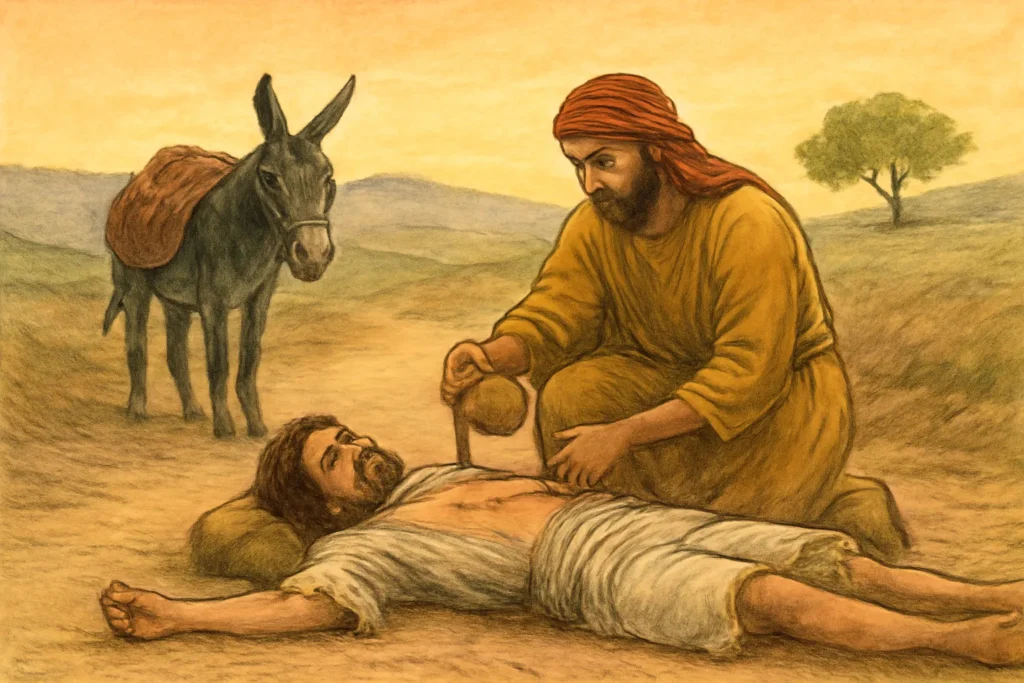
The journey takes place on the perilous road from Jerusalem to Jericho, a route infamous for its rugged terrain and opportunistic violence. A traveler is assaulted by brigands, left half-dead, and passes through a sequence that tests different kinds of moral posture. First comes the priest, then the Levite—two figures associated with religious leadership and ritual purity. Each of them, for reasons left implicit, chooses not to render assistance. A third traveler, identified not by status but by a provocative label in later tradition, arrives: a Samaritan. The term “Samaritan” itself carries historical weight, since Samaritans and Jews traditionally harbored mutual suspicion and enmity. Yet in the moment of crisis, it is the Samaritan who embodies action, care, and practical mercy. This reversal—who is a neighbor and who acts with mercy—forms the crucial hinge of the narrative.
The text offers a rhythm of expectation and disruption. People often expect virtue to come from the religiously or socially approved quarters, but the account subverts that expectation by elevating a stranger, a figure associated with cultural hostility, to the role of savior. In later readings, the Good Samaritan is not merely a tale about helping a battered traveler; it becomes a mirror for readers to examine their own attitudes toward strangers, outsiders, and even adversaries. The narrative’s power lies in how it reframes the problem of ethics: mercy, not mere compliance with ritual or status, becomes the standard.
Compassion in action appears as an explicit contrast to indifference or convenience.
The inn as a metaphor for ongoing care demonstrates that mercy often requires sustained commitment, not a one-time gesture.
The question “Which of these proved to be a neighbor?” challenges the reader to redefine allegiance, loyalty, and obligation.
The Ethical Core: What the Samaritan Did
Actions that define mercy in concrete terms
The merciful traveler embodies a sequence of decisions that illuminate practical ethics. He sees the wounded man, an act that implies recognition of another’s humanity before any moral classification. He responds with immediate aid, applying bandages, pouring oil and wine, and securing the injured person’s safety. Then he takes a step further: he places the stranger on his own animal, ferries him to an inn, and attaches his name and means to the task of healing. Finally, he promises to cover additional expenses and to return to cover any further costs. Each of these actions moves mercy from feeling to responsibility, from sentiment to structured care.
In this narrative, the Good Samaritan can be read as a case study in systems of care rather than a single moment of generosity. The traveler’s conduct demonstrates several enduring principles:
Recognition of another’s suffering, regardless of social or cultural boundaries.
Immediate intervention to alleviate pain and danger.
Stewardship of resources and time to ensure the person’s safety and recovery.
Commitment to follow-through beyond the initial act, even if it requires ongoing obligation.
When we study the parable through the lens of compassionate conduct, we see that the Good Samaritan’s generosity is neither caprice nor sentimentality. It is organized, persistent, and relational. This is why the tale remains a provocation to readers who may want to excuse themselves from helping by pointing to risk, inconvenience, or social suspicion. The narrative quietly asserts that the true measure of character is shown in how we respond to vulnerability, not merely in how loudly we announce our values.
Theological Dimensions and Interpretations
Love of neighbor as a radical ethic
Across Christian traditions, the parable is commonly linked to the command to love one’s neighbor as oneself. Yet the term neighbor in the Luke account carries a challenging universality: the neighbor is anyone in genuine need, not merely those who share the same faith, ethnicity, or allegiance. This expands the circle of responsibility beyond conventional boundaries. In the voice of the text, the Good Samaritan becomes a living embodiment of mercy in action, showing that ethics are not sectional but universal.
Mercy and compassion appear as twin pillars of moral life. Mercy remains practical, not theoretical: bandaging wounds, providing shelter, paying a debt of care. Compassion is the emotional impulse that makes mercy intelligible and urgent. When these two are linked, they yield a form of compassionate justice that refuses to privilege status, identity, or convenience over the basic dignity of a vulnerable person.
Scholars have pointed to the parable’s structure as a method for teaching: a test of perception (seeing the wounded man), a test of motive (deciding to help), and a test of endurance (keeping the promise to return). In this sense, the Good Samaritan is not merely a hero in a story; he is a pedagogical model for forming ethical habits. For communities that prize hospitality, mercy, and service, the parable offers a lived ethic that invites imitation, critique, and renewal.
Practical Applications in Everyday Life
From parable to practice: translating mercy into daily routines
How can the timeless lessons of the Good Samaritan be translated into twenty-first-century life? The answer is not a single blueprint but a flexible mindset: to cultivate habits of attentiveness, courage, and fidelity to one’s promises to aid those in distress. The modern Good Samaritan impulse can take many forms—some outward and visible, others quiet and persistent. Here are several ways to translate the parable into concrete behavior:
Notice and acknowledge—train yourself to notice suffering around you, whether it is a neighbor in need, a friend in emotional pain, or a stranger seeking assistance online.
Act with timeliness—offer help promptly when you are able, even if the situation is not perfectly safe or easy to resolve. Small, timely acts can avert greater harm.
Offer practical support—money, time, or resources may be required, but so can companionship, listening, and problem-solving together.
Follow through—mercy is re-encountered in keeping commitments, such as paying for medical care, arranging transportation, or simply checking in after giving aid.
Respect dignity—assist in ways that honor the person’s autonomy and dignity, avoiding paternalism or judgment.
In our contemporary contexts, the parable can be a guide for civic life, neighborhood dynamics, and the ethics of social support. It challenges individuals to move beyond passive goodwill and cultivate an ordinary, daily readiness to help others. The modern Good Samaritan is not only a single hero but a culture of care that permeates communities through volunteering, neighborly acts, and systems that respond to vulnerability with practical mercy.
Across cultures and faith traditions, the parable of the Good Samaritan has inspired a family of retellings that adapt the core message to local concerns. While the details may shift—such as the setting, the identities of the characters, or the form of aid—the essential claim remains constant: mercy without boundaries is a universal ethic. Some notable variations include:
In some readings, the compassionate traveler is reframed as a member of a minority group who demonstrates solidarity across lines of difference, highlighting how intergroup empathy can bridge historical enmities.
In others, the tale is presented as a social critique of religious authorities who defer to ritual law at the expense of human need, thus reframing piety as service in the living world.
In modern retellings, the traveler’s act is modeled as a coordinated community response—neighbors pooling resources, businesses offering support, and institutions guaranteeing access to care for vulnerable people.
These variants illuminate a broader truth: the narrative invites readers to examine their own biases, to locate mercy in places where it is least expected, and to practice hospitality in a world that often trains people to protect themselves first. The parable of the merciful stranger becomes a lens for assessing social ethics, human rights, and the responsibilities we bear toward those who are different from us.
Stories of Everyday Good Samaritans in Modern Times
Contemporary embodiments of the benevolent traveler
While the term “Good Samaritan” arises from an ancient text, countless modern stories echo its moral core. Some of these are well known and documented, others emerge in quiet, everyday moments. Here are several archetypes and real-world examples that illustrate how the parable translates into contemporary life:
The last-mile helper who stops on a busy street to assist someone with a flat tire or a broken bicycle, then accompanies them to the nearest shop to ensure safety.
Healthcare and caregiving volunteers who dedicate evenings and weekends to visit the elderly, transport patients to appointments, or provide in-home care with empathy and patience.
Digital Good Samaritans who offer emotional support, crisis counseling, or information through online platforms, breaking down barriers of distance and isolation.
Community responders who organize mutual-aid networks after natural disasters, coordinating shelter, food, and medical aid for displaced neighbors.
These stories are not about hero worship; they are about social imagination—the belief that ordinary people can act with extraordinary care. They reveal that the parable’s spirit is not confined to a particular religious tradition but resides in the human capacity to respond with mercy when others are in need. In this sense, modern Good Samaritans—whether they are a nurse in a crowded clinic, a passerby who helps a stranger change a tire, or a neighbor who checks in on an elderly person—embody the parable’s essence: courage paired with compassion, action grounded in dignity, and a promise kept to help another become safe and whole again.
Art, Literature, and Media Influences
Creative retellings that invite fresh reflections
Throughout history, artists, writers, and filmmakers have drawn on the Good Samaritan figure to explore themes of empathy, prejudice, and moral responsibility. Some retellings move the setting to urban scenes, others adapt the cast to reflect present-day social dynamics. A few notable patterns emerge:
Reframing the helper as a true neighbor whose obligations arise not from shared identity but from shared vulnerability.
Presenting the victims and bystanders in ways that illuminate bias, complicity, or awakening conscience.
Exploring the tension between safety and risk, asking how much one should extend aid when personal safety or resources are at stake.
Literary and cinematic treatments of the parable often foreground the ethical questions at its heart: What is the right form of help in a dangerous world? How do we protect dignity while offering aid? How can communities foster a culture of care rather than mere charitable acts? In each generation, these works reframe the ancient narrative so that its moral energy remains current and compelling.
Beyond personal conduct, the parable informs education, religious instruction, and public conversation about social responsibility. In classrooms, the story can seed inquiries about ethics, social psychology, and the limits of obligation. Students might examine questions such as: How do we recognize need when it appears in forms we do not expect? What are the risks and responsibilities involved in helping others? How do we balance compassion with respect for personal autonomy and safety?
In houses of worship, sermons often present the parable as a template for addressing contemporary issues—homelessness, immigration, healthcare access, and the ethics of care in communities. In public life, the tale is invoked to argue for policies that strengthen social safety nets and foster neighborly solidarity across divides. The core message remains the same: to be a true neighbor is to act with mercy, to bear the costs of care, and to commit to the long work of healing and justice.
Practical Guide: How to Be a Modern Good Samaritan
Ten steps to cultivate a mercy-centered mindset
Practice awareness by regularly asking yourself what you notice about the unmet needs around you.
Develop a posture of openness to people different from you, resisting reflexive judgments that delay help.
Move from compassion to action by identifying a concrete first step you can take in any given situation.
Assess risk honestly, but do not let fear devoid you of all courage to assist where you can do so responsibly.
Preserve dignity by asking how the person would like to be helped rather than assuming your method is best.
Offer resources, not just feelings—provide time, money, transportation, or a connection to services as needed.
Follow through on commitments and keep lines of communication open for ongoing support.
Encourage community response—share the responsibility by inviting others to participate in solidarity work.
Protect yourself and others by learning when to seek professional help and how to coordinate with authorities or organizations if necessary.
Reflect regularly on your acts of mercy, learning from them to deepen your future responses.
These steps are not rigid rules but a flexible framework that invites you to act with moral clarity when faced with need. The aim is to embed a habit of mercy into everyday life, so that the Good Samaritan’s example becomes a familiar voice in your conscience and a practical discipline in your routines.
In the end, the enduring appeal of the parable lies in its insistence that compassion and mercy are not optional virtues but essential ways of being in a connected world. Whether encountered on a dusty road in antiquity or on a modern city street, the story repeats its invitation: to see others, to respond with courage, and to commit to acts of care that honor human dignity. The parable of the merciful stranger remains a timeless call to convert intention into action, to transform social suspicion into shared protection, and to hold ourselves accountable to the moral demands of neighborliness.
As a living tradition, the tale continues to evolve through new voices and experiences. The core message—do not let divisions determine your willingness to help; instead, let mercy redefine your relationships—resonates across cultures, faiths, and generations. If we carry this message forward, the Good Samaritan becomes less a figure of ancient lore and more a living standard by which we measure our daily acts of kindness, hospitality, and courage in the face of suffering.










Leave a Reply