Psalm 45: A royal wedding poem and its enduring resonance
Psalm 45 stands out in the Psalter as a royal wedding hymn that weaves together the grandeur of a coronation with intimate imagery of a bride. Its opening frame—"My heart is inditing a good matter: I speak of the things which I have made touching the king"—invites readers into a celebration of sovereign power allied with beauty, fidelity, and ceremonial splendor. The poem’s movement from the king’s splendor to the bride’s radiance is not merely decorative; it is a careful orchestration of symbolism designed to depict a union that embodies political legitimacy, divine favor, and communal blessing. In this sense, the psalmist’s depiction of king and bride becomes a prism through which people understood prophetic expectation, covenant loyalty, and the cosmic order God intends.
In contemporary study, scholars and theologians frequently phrase the central inquiry as the meaning of the king and bride in Psalm 45—how the imagery functions within its own ancient setting and how later readers have transposed those images into new theological landscapes. This article surveys the layers of meaning, from the historical-liturgical background to the rich Messianic interpretations that emerged in Jewish and Christian traditions. We will also consider how the imagery of a royal wedding contributes to a broader narrative about God's rule, justice, and the recurring motif of a people prepared for divine presence.
The king and the bride: core images in the psalm
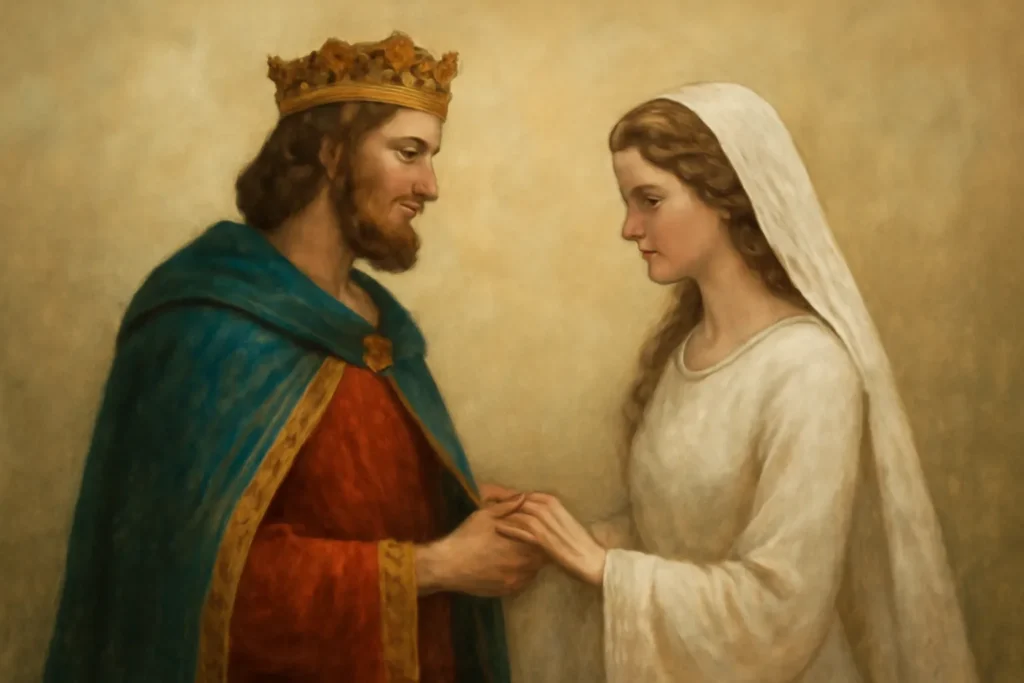
At the heart of Psalm 45 lies a striking dual image: the king who leads with justice, beauty, and authority, and the bride who embodies majesty, fidelity, and ceremonial splendor. The man of the hour is portrayed with language befitting a divine-human grant of kingship:
Regal attire and imagery — the text speaks of richly ornamented garments and the fragrance of precious resins, signaling sacred ceremony and royal wealth.
Righteous rule — the king’s authority is framed as a right scepter, grounded in truth, righteousness, and a cosmology that upholds justice.
Protection and victory — the poem alludes to victory and the security of the realm under the king’s protection.
The bride is presented with equal dignity, her beauty and adornment serving as a counterpart to the king’s majesty. In verses that describe her in gold and fine garments, the reader encounters a figure who stands with honor at the king’s side, symbolizing blessing, prosperity, and the consecration of a new phase in the community’s life. The phrase about the king’s daughter being within the palace in gold apparel is not merely decorative; it signals a transferred allegiance, a joining of two realms—the king’s power and the bride’s virtue—into a single, holy alliance.
A recurring theme in discussions of Psalm 45 is the interplay between public authority and domestic ornament—the public ceremony of kingship and the private radiance of a bride who embodies the covenant people’s ideal. The text suggests that the king’s supremacy is not exercised in isolation; it is bound up with the visible honor of his consort and the reverence of the people who bring gifts and blessings to the royal couple. This dual emphasis helps readers understand why the psalm has resonated in diverse settings: it speaks to the legitimacy of leadership and the beauty of a faithful community under that leadership.
Historical and literary context: Shoshannim and Korahite tradition
Psalm 45 belongs to a distinct category within the Psalter: a royal canticle with a wedding motif, historically linked to the Psalms of the Korahites and set to the musical instruction “upon Shoshannim” (often translated as “lilies”). The exact historical setting remains debated, but most scholars agree that the piece was composed for a ceremonial occasion—likely a coronation or a royal wedding—where a king’s nuptial alliance would symbolize national unity and divine favor.
In the ancient Near Eastern world, such wedding hymns often served political purposes: they celebrated the ruler, legitimized his union, and linked the royal line to a broader divine purpose. The Shoshannim tune points to a musical culture that used floral imagery and seasonal language to convey beauty, fertility, and prosperity. The pairing of a king with his bride, in this frame, is not merely poetic; it is a public proclamation of sovereignty and covenant faithfulness that a community could recite and treasure.
From a literary standpoint, Psalm 45 employs parallelism, chiasmus, and carefully balanced imagery to fuse two scenes—the monarch’s triumphal procession and the bridal chamber—into one cohesive vision. The effect is anticipatory: the reader senses that something cosmic and eternal is unfolding in a human ceremony. The ancient reader would have heard this as both a celebration of a specific king and a symbolic prophecy about a future, more perfect sovereignty.
Messianic interpretations: Jewish and Christian readings of the king and bride
Across religious traditions, Psalm 45 has been read as a Messianic wedding poem—a text that points toward a promised king who will reign with justice and love. Jewish commentators often situate the psalm within the story of the Davidic monarchy or as a coronation hymn for a righteous king in the line of David. Christian theologians, however, frequently interpret the same verses as a foreshadowing of Jesus the Messiah and his relationship with the gathered community, sometimes read as the Church as Bride.
Classic Jewish readings tend to emphasize the human king who embodies divine blessing and national restoration. The imagery of a queen standing at the right hand, in gold, can be read as a portrayal of royal honor accorded to the king’s consort and the people’s loyalty to the Davidic covenant. In this sense, Psalm 45 remains deeply historical and nationalistic, yet it also carries a sense of cosmic destiny—an expectation that the king’s reign will extend beyond political borders to righteousness and peace.
Christian interpretations often press the text into a larger Christological framework. The most discussed lines—such as the assertion that the king’s throne is “forever and ever” and that righteousness guides his rule—are read as indicators of the eternal kingship of Christ. The imagery of the bride has also become central in ecclesial reflection: the church is portrayed as a bride adorned for her husband, the bridegroom Christ. The pairing of king and bride, then, becomes a typology through which Revelation’s language of the marriage supper of the Lamb and the ultimate reconciliation of heaven and earth can be understood.
In brief, the king and bride meaning in Psalm 45 gains depth when read in both tracks: as a historical-royal celebration within Israel’s covenant, and as a symbolic expectation that God’s purposes center on a merciful ruler who unites himself with a faithful community. The tension and harmony between these readings contribute to the poem’s enduring significance for worship, theology, and liturgy.
Key Jewish-to-Christian interpretive bridges
Typology of the Bride — from a national queen to the Bride of Christ, highlighting fidelity, purity, and readiness for a divine union.
Anticipation of the Messianic Kingdom — a future reign of peace where righteousness and justice prevail.
Cosmic imagery — thrones, scepters, perfumes, and garlands point beyond a single historical moment to a universal redemption.
Verse-by-verse motifs: anchors for interpretation
To better understand the messianic wedding poem framing, it helps to note several motifs that recur throughout Psalm 45. While we will not quote every line, the following summaries highlight the central ideas most often cited by scholars and interpreters:
Divine endorsement — the king’s throne is described in terms that foreground God’s blessing and authority. The scepter of the kingdom represents just rule and righteous power.
Inward beauty and outward adornment — the text ties inner virtue (truth, meekness, righteousness) to outward splendor (garments, perfumes, golden adornment).
Covenantal fidelity — the bride’s loyalty to the king mirrors fidelity to God’s covenant, with language that invites a careful reading of how loyalty binds community and leadership.
Hospitality of nations — foreign dignitaries bring gifts and swear fealty, signaling a universal dimension to the king’s reign and the blessings the couple represent.
Transformation of identity — the bride moves from “thy father’s house” to the king’s palace, symbolizing a shift in allegiance that mirrors a transformative call for the people of God.
The bride as symbol: ecclesial and covenantal layers
The image of the bride in Psalm 45 functions at multiple levels. In a historical sense, she is a queen whose presence enshrines the coronation with divine blessing. In a theological sense, she serves as a living symbol of the covenant community—a people chosen to be “ready” for a divine encounter. In Christian readings, the bride becomes a potent symbol for the Church as Bride, a community prepared for the return of the Bridegroom.
This multilayered symbol invites readers to reflect on how communities orient themselves toward leadership that is both authoritative and redemptive. The bride’s presence in gold and fine garments is not mere ornament; it expresses a shared identity, beauty, and grace that belong to a people living under God’s care. When the psalm is read in light of New Testament imagery, the bride is harmonized with the vision of a reconciled cosmos where love, justice, and divine presence converge.
Liturgical and devotional uses: traditions and practices
Across centuries and places, Psalm 45 has found a home in worship, royal liturgy, and spiritual poetry. Its use in ceremonial settings—especially weddings and coronation rites—reflects its primary intention: to celebrate a sacred alliance between ruler and people, and to affirm that such alliance is undergirded by divine blessing.
In a modern devotional setting, Psalm 45 invites readers to contemplate the beauty of virtue and leadership, the sanctity of covenant, and the hope of a future where God’s righteous rule is made manifest among human beings. The poem’s imagery can be adapted for intercessory prayer, liturgical responses, and even meditative study on how communities can live in fidelity to divine purposes.
Translations, textual nuances, and semantic breadth
Translators across English Bible translations—from the King James Version to the English Standard Version and beyond—face choices about tone, cadence, and lexical nuance. The core imagery remains, but the words’ color shifts with translation. For example, terms that convey fragrance, precious metals, or textile richness may be rendered differently, yet the sense of royal splendor and covenantal fidelity remains intact.
These variation opportunities invite readers to explore the semantic breadth of phrases like “throne forever,”“scepter of righteousness,” and “queen in gold of Ophir.” Each rendering emphasizes particular theological weights—divinity in the throne, justice in the rule, or splendor in the bride’s attire—without losing the core, aspirational message of communal blessing under God’s reign.
For students of biblical poetry, comparing translations can illuminate how different interpretive communities understand the king and bride meaning of Psalm 45. Some versions foreground the royal, others foreground the liturgical, and still others highlight the christological shapes that later readers found compelling. This diversity of readings is part of the poem’s lasting power, enabling it to speak to new contexts while preserving its ancient roots.
As readers explore the psalm 45 king and bride meaning, several questions commonly arise:
Is Psalm 45 exclusively about a historical king? or is it primarily a prophetic, messianic text? The answer is nuanced: it belongs to a genre that simultaneously speaks to a contemporary king and to a larger divine plan.
Who is the bride—the king’s wife, or the people, or both? In many readings, the bride represents the community in covenant with God, symbolizing fidelity and worshipful praise.
How does the text relate to Christian doctrine? Many readers see a link to Christology and ecclesiology, yet the text can be appreciated within its own Jewish-historical frame as well.
What is the role of the Shoshannim tune? The musical setting signals a ceremonial, shared celebration, reinforcing the communal dimension of the royal wedding.
Caution is warranted against overly simplistic allegorizing. The beauty of Psalm 45 lies in its ability to be read on multiple planes: as a historical coronation hymn, as an image-laden poem about covenant fidelity, and as a text that nourishes Christian worship through typology and anticipation of the divine
kingdom. Reading with attention to context helps prevent reducing the poem to a single, narrow interpretation.
Variations in phrasing: semantic breadth and interpretive richness
Throughout scholarship and sermon tradition, phrases such as “the king’s glory,”“the right hand of justice,” and “the queen in gold” are treated as flexible anchors rather than rigid propositions. Depending on the translation and the interpretive aim, the emphasis might shift from political legitimacy to moral virtue, from divine favor to celebratory worship, or from national heritage to universal salvation.
A robust approach to psalm 45 king and bride meaning acknowledges these shades of meaning and invites readers to engage with the text as a living conversation. A modern reader might highlight:
The ethical dimension of kingship—justice, truth, and mercy as the scepter’s use.
The liturgical dimension of beauty offered to God through ceremonial adornment and sacred song.
The eschatological dimension of a future fulfillment in which God’s plan for rule and creation is made complete.
Reading Psalm 45 as a king and bride narrative invites believers to consider how leadership, fidelity, beauty, and covenant intersect in their own communities. The poem’s imagery challenges both rulers and citizens to pursue a governance marked by righteousness and generosity, and it invites a community to reflect on the beauty of a faith that is not merely doctrinal but relational—a bond between a people and their God that is celebrated, guarded, and renewed.
In personal devotion, the imagery can inspire belief in a gracious, ruling God who invites his people into a relationship characterized by trust, reverence, and hopeful anticipation of a forthcoming consummation. In communal worship, Psalm 45 provides a template for how to honor leadership that is accountable to divine justice while embracing the beauty and dignity of those who accompany the king.











Leave a Reply