Psalm 19 Commentary: An In-Depth Look at God’s Law and Creation
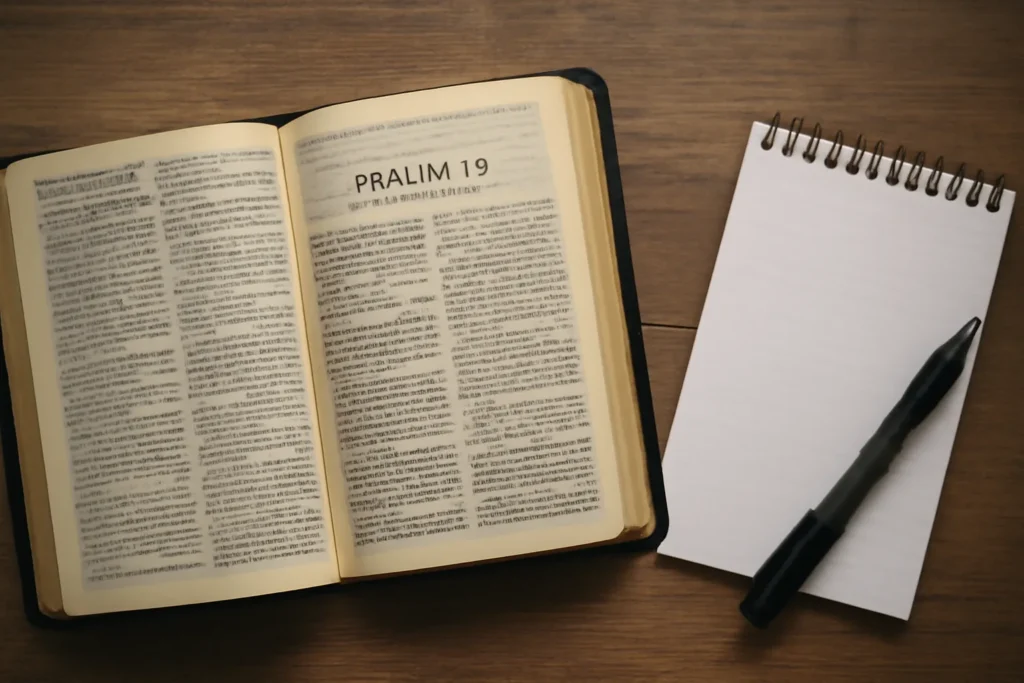
Psalm 19 offers a compact, layered meditation on how God reveals himself through both the created order and the sacred law. This psalm 19 commentary invites readers into a twofold revelation: first, the heavens speak in their regular rhythms, and second, the divine law speaks with clarity and transformative power. In this exploration, we will trace the movement from nature’s testimony to the moral and spiritual instruction that the law provides, then reflect on how these revelations shape prayer, devotion, and ethical living in the modern world.
A Dramatic Dual Revelation: Nature and Sacred Law
One of the central features of a psalm 19 interpretation is its claim that revelation is not confined to a temple or a book; it begins with the natural world and leads toward a moral and spiritual center found in the divine instruction. The text as a whole presents a seamless arc: from universal, accessible knowledge to precise, personal instruction that touches the heart and the tongue.
The heavens declare the glory of God
In The heavens declare the glory of God, the poet insists that the sky is a universal witness. This line functions as a manifesto of natural theology: knowledge of God is accessible even to those who have no scriptures or clergy. The psalm 19 commentary often notes the insistence on universality—creation speaks to all peoples, languages, and cultures. The "firmament" or sky above testifies through beauty, order, and constancy. The rhetorical effect is to invite wonder and orientation toward the divine.
The portion continuing with imagery of the sun’s movement further develops this theme. “In them hath he set a tabernacle for the sun” (a traditional rendering). This phrase suggests intentional design and a stable calendar; the sun’s path becomes a liturgical rhythm—day by day and season by season—under God’s sovereign arrangement. A psalm 19 sermon or psalm 19 study often emphasizes that the sun’s course is not mere astronomy but a poetic parable about order, reliability, and the Creator’s care for his creatures.
Universal accessibility: Nature speaks to everyone, regardless of status or education.
Cosmic order as evidence of design: The sun’s predictable journey narrates intention behind the cosmos.
Immediacy of revelation: The message requires no interpreter—its truth is evident in experience and contemplation.
The sun’s journey as a cosmic calendar
As part of the psalm 19 interpretation, the sun’s daily voyage is described as the ascent and descent of a traveler who travels from one end of heaven to the other. In some translations the imagery emphasizes the sun’s outlet and its “tent” or “tabernacle,” implying that creation is a sanctuary where God’s power is displayed. The sun’s heat and light, its timing and measured speed, all become signs of divine wisdom. Readers of this psalm 19 commentary will often note that the natural revelation set forth here is not a mere report of facts but a summons to reverence and responsibility toward God and neighbor. The natural revelation thus prepares the heart for the next movement—the revelation embedded in the divine law.
The Law of the LORD: Perfection That Converts and Guides
The second major part of a psalm 19 commentary treats the law of the Lord as more than a set of rules. It is described as “perfect, converting the soul”, “sure, making wise the simple”, “right, rejoicing the heart”, “enlightening the eyes”, and “enduring forever”. This cluster of terms—law, testimony, statutes, commandments, fear, and judgments—constitutes a key triad in biblical interpretation: revelation, response, and reform. The psalm 19 commentary highlights how these terms are used in overlapping ways to describe both cognitive understanding and moral formation.
Verse 7 — The law of the LORD is perfect, converting the soul. In this reading, perfection does not imply flawless human obedience but reflects maturity, completeness, and wholeness that the divine instruction provides. The psalm 19 commentary often notes that conversion here points to a turning toward God, a renewal of one’s inner compass, and a reorientation away from self-centeredness toward God-centered living.
Verse 7 — The testimony is sure, making wise the simple. The testimony is reliable, stable, and trustworthy, capable of guiding those who are unlettered or inexperienced in life’s complexities. The psalm 19 study emphasizes that wisdom in this sense is not merely intellectual knowledge but discernment in daily decisions and moral posture.
Verse 8 — The statutes are right, rejoicing the heart. The path the law sets before the reader is not just correct but restorative: it brings joy, trust, and relief from confusion. The psalm’s commentary often notes the inner transformation—the heart’s delight in aligning with divine standards.
Verse 8 — The commandment is pure, enlightening the eyes. Purity here points to integrity and clarity; it removes the fog of moral opacity. The law becomes a light for the mind, enabling clearer vision about God, oneself, and others.
Verse 9 — The fear of the LORD is clean, enduring forever. The psalm 19 commentary links fear not with terror but with reverence and awe, a disposition that underwrites ethical living and faithful worship across generations.
Verse 10 — The judgments are true and righteous altogether. The judgments are not capricious but consistent with God’s character and the created order. The reading highlights that divine judgments are trustworthy guides for justice and mercy in human life.
Verse 11 — More to be desired than gold, yea, than much fine gold. The value of the law dwarfs wealth; the psalm’s language of sweetness and desirability invites readers to prize divine instruction above worldly gain. A psalm 19 commentary repeatedly returns to this theme: spiritual riches surpass financial riches in lasting significance.
Following these verses, the psalmist shifts toward an experiential response: the law not only informs the intellect but also shapes desire, motive, and behavior. The psalm 19 interpretation thus recognizes a synergistic movement where knowledge becomes virtue and virtue becomes worship.
Key Terms and Theological Significance
To deepen a psalm 19 commentary, it helps to map how the various terms function in biblical rhetoric and personal piety:
Law (torah) as revelation that orders life and heart—more than rules, it is guidance toward right relationship with God and neighbor.
Testimony (edut) as witness and memorial—what God has testified to in history and in personal experience invites trust.
Statutes (choq) as binding, fixed, and known structures that shape conduct and collective life.
Commandments (mitzvot) as explicit directives that orient intention and action toward goodness.
Fear (yirah) as reverence—not mere dread but a posture of awe that sustains discipline and humility.
Judgments (mishpat) as verdicts of justice—how God evaluates and orders human behavior within creation.
In the psalm 19 commentary, these terms interact to form a coherent anthropology: human beings are invited to align their inner life with an external order that is both beautiful and just. The law’s perfection is not a cold standard but a compassionate gift intended to heal, guide, and illuminate.
The Psalmist’s Prayer: Purity of Heart and Speech
Another axis of the psalm 19 commentary centers on the closing petition: “Let the words of my mouth, and the meditation of my heart, be acceptable in thy sight, O LORD, my strength, and my redeemer” (paraphrased from traditional translations). This prayer crystallizes the ethical arc of the psalm: knowledge about God, whether from nature or from law, should culminate in a life of worship and integrity. The psalmist acknowledges that even as one receives revelation, there remains hidden fault and weakness, which requires cleansing and renewal. This is a common emphasis in contemporary psalm 19 studies: revelation points one toward confession and transformation as necessary responses.
Two requests shape the final lines of the Psalm: cleansing from secret faults and setting a guard against willful sins. In a modern psalm 19 commentary, these lines are read as a humility before God and a practical commitment to ethical discipline. The text invites believers to trust God not only for cosmic order but also for intimate mercy—the kind of mercy that cleanses the conscience and guards the tongue, so that words and thoughts become instruments of peace rather than sources of harm.
Secret faults acknowledged means moral self-scrutiny and transparency before God.
Preserving or guarding the servant’s steps indicates divine accompaniment in daily decisions and temptations.
Acceptable speech and meditation highlight the aim of a faithful life that honors God in both interior and exterior conduct.
Interpretive Traditions and Modern Readings
Across the history of psalm 19 commentary, interpreters have approached the text from diverse standpoints—exilic, prophetic, wisdom, and devotional perspectives. Each lens offers meaningful insights for contemporary readers while also revealing the text’s enduring complexity.
Jewish and Christian perspectives
In Jewish exegesis, Psalm 19 is often read as a bridge between natural revelation (the heavens) and divine instruction (the Torah). The structure is appreciated as a pedagogy: God reveals himself in creation first, then in the moral and ritual law. In Christian readings, the psalm is frequently treated as a typology of Christ-centered life: creation points toward the Creator, while the Law points toward a higher righteousness fulfilled in Jesus, and the psalm ends with a prayer that echoes the longing for a pure heart that finds its source in God’s grace.
Scholarly and critical voices
Critical psalm 19 commentary often investigates authorship, dating, and the function of poetry in ancient Near Eastern literature. While many scholars affirm Davidic authorship or compossible origins, others emphasize the psalm’s broader ancient Near Eastern context, noting common motifs of cosmology, law codes, and moral instruction. A careful study will recognize both the uniqueness of Israelite faith and the shared cultural milieu that shaped wisdom traditions. Modern readers may engage with questions such as:
How does the juxtaposition of nature and law illuminate a holistic view of revelation?
What is the relationship between divine command and human desire in this psalm?
How does the language of sweetness, gold, and light function in communicating spiritual value?
Poetic Devices and Literary Shape
A strong psalm 19 commentary pays attention to the poetic craft that makes this text memorable and transformative. Several devices are at work:
Parallelism—the Hebrew poetic technique where thought is repeated or reinforced in a balanced partner line. This yields a rhythm of affirmation and intensification: glory of God pairs with handiwork, law is perfect with converting the soul, etc.
Imagery—the sun, the sky, light, sweetness, gold—these images connect sensory experience with spiritual truth, making abstract ideas tangible.
Metaphor and personification—creation speaks, law awakens, and the heart is stirred; personifying abstract realities helps readers feel the moral gravity of the text.
Progression from universal to particular—the psalm moves from cosmic scale to intimate petition, modeling a humane way to approach revelation: wonder leads to instruction, instruction leads to action, action leads to prayer.
Interpreters of a psalm 19 commentary today often translate its ancient insights into personal and communal practice. Here are some actionable takeaways that resonate with contemporary readers:
Cultivate daily attention to the ordinary—the sky, the weather, the changing seasons—as a means to encounter the divine.
Prioritize inner formation—let the law’s perfection not only sharpen moral discernment but also nurture compassion, patience, and humility.
Value clarity and honesty in speech—the psalm’s closing prayer invites a resolute commitment to truth-telling and mindful communication.
Pursue transformation through prayer—the awareness of secret faults calls for confession, repentance, and dependence on God’s mercy.
Integrate worship, wisdom, and justice—the law’s judgments guide not only personal virtue but public equity and mercy in community life.
Beyond exposition, Psalm 19 has inspired artistic and liturgical expressions across centuries. In devotional use, it is a springboard for reflection on creation and conscience. In hymns and liturgy, the rhythm of creation’s voice and the clarity of divine instruction provide a framework for confession, praise, and supplication. A psalm 19 commentary might note that its enduring appeal lies in its balance: it neither dismisses wonder at the natural world nor neglects the imperative to order life by the divine will. This balance offers a durable template for worship that honors God as both Creator and Lawgiver.
In art, the imagery of light, sun, and sight has inspired iconography and landscape painting that seek to embody a sense of divine radiance.
In music, the cadence of the psalm’s verses shapes psalm tunes and choral settings that emphasize the sweetness of divine instruction.
In preaching and teaching, Psalm 19 provides a model for connecting natural theology with moral exhortation and personal prayer.
Further Study and Resources
For readers who want to deepen their engagement with a psalm 19 commentary, here are avenues to broaden understanding:
Compare different Bible translations of verses 1–14 to observe how translators render key terms like testimony, statutes, and judgments.
Consult scholarly commentaries that discuss the psalm’s linguistic features, its place in biblical poetry, and its theological implications.
Explore devotional guides that use Psalm 19 as a framework for daily prayer, confession, and gratitude.
Study parallel passages in wisdom literature and prophetic writings that reflect on revelation, law, and righteousness.
Ultimately, this in-depth look at Psalm 19 commentary reveals a text that speaks across time about how humans come to know God through the interplay of created order and divine instruction. The psalm invites a life that begins in awe, proceeds to discernment, and culminates in a prayer that seeks integrity, mercy, and fidelity before God.
Final Reflections: A Coherent Narrative of Revelation
Viewed through the lens of a comprehensive psalm 19 commentary, the Psalm presents a coherent narrative about revelation that is both universal and intimate. Nature makes the first appeal—an invitation to wonder, humility, and gratitude. The divine law makes the second appeal—a call to right living, wise discernment, and heart conversion. The closing prayer then binds these strands together, asking for inner purification and outward fidelity. In this sense, Psalm 19 remains a vibrant model for readers who seek to integrate awe for creation with devotion to the Creator and a life commited to justice and mercy in daily practice.









Leave a Reply