The King James Version of Psalm 139 is a lyrical meditation on the intimate knowledge and
pervasive presence of God in every moment of a person’s life. The language of the KJV—rich with cadence,
imagery, and a sense of awe before the Creator—invites readers to reflect on divine omniscience, divine
nearness, and the extraordinary artistry of human creation. In this full-text presentation of kjv psalm 139,
you will encounter the complete text of Psalm 139 in the King James Bible, arranged verse by verse for easy
reading and reference.
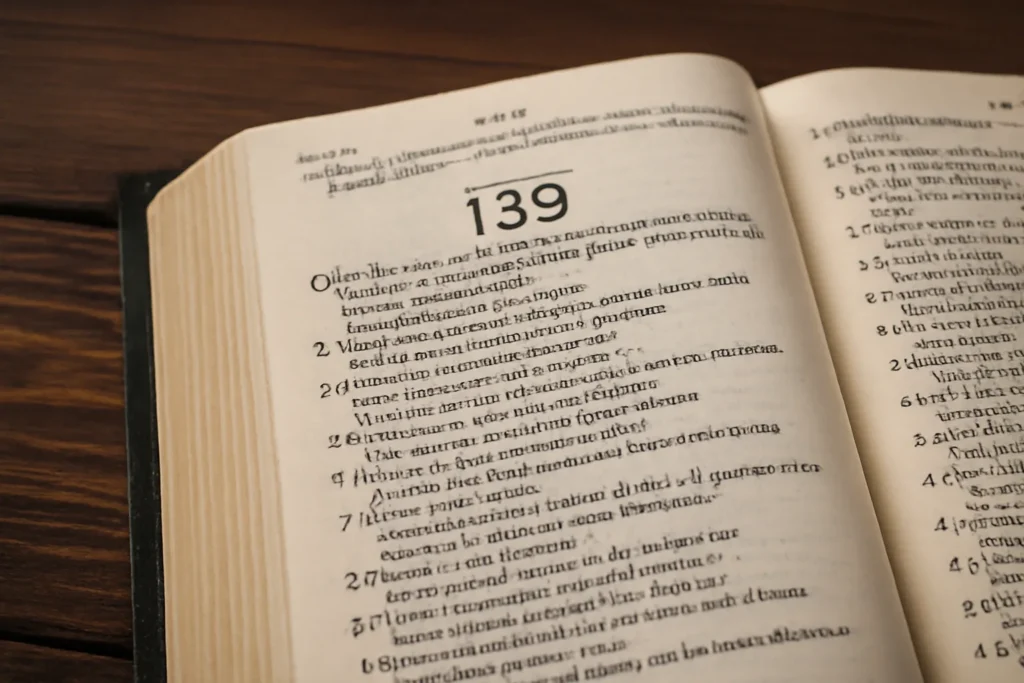
O LORD, thou hast searched me, and known me.
Thou knowest my downsitting and my uprising, thou understandest my thoughts afar off.
Thou compassest my path and my lying down, and art acquainted with all my ways.
For there is not a word in my tongue, but, lo, O LORD, thou knowest it altogether.
Thou hast beset me behind and before, and laid thine hand upon me.
Such knowledge is too wonderful for me; it is high, I cannot attain unto it.
Whither shall I go from thy Spirit? or whither shall I flee from thy presence?
If I ascend up into heaven, thou art there: if I make my bed in hell, behold, thou art there.
If I take the wings of the morning, and dwell in the uttermost parts of the sea;
Even there shall thy hand lead me, and thy right hand shall hold me.
If I say, Surely the darkness shall cover me; even the night shall be light about me.
Yea, the darkness hideth not from thee; but the night shineth as the day: the darkness and the light are both alike to thee.
For thou hast possessed my reins: thou hast covered me in my mother's womb.
I will praise thee; for I am fearfully and wonderfully made: marvellous are thy works; and that my soul knoweth right well.
My substance was not hid from thee, when I was made in secret, and curiously wrought in the lowest parts of the earth.
Thine eyes did see my substance, yet being imperfect; and in thy book all my members were written, which in continuance were fashioned, when as yet there was none of them.
How precious also are thy thoughts unto me, O God! how great is the sum of them!
If I should count them, they are more in number than the sand: when I awake, I am still with thee.
Surely thou wilt slay the wicked, O God: depart from me therefore, ye bloody men.
For they speak against thee wickedly, and lay to waste thy name.
Do not I hate them, O LORD, that hate thee? and am not I grieved with those that rise up against thee?
I hate them with perfect hatred: I count them mine enemies.
Search me, O God, and know my heart: try me, and know my thoughts:
And see if there be any wicked way in me, and lead me in the way everlasting.
The kjv psalm 139 full text invites readers to hear the confidence and humility that emerge when a person
contemplates a God who is both intimately acquainted with every detail of life and sovereign over the boundaries
of creation. This psalm remains a touchstone for conversations about identity, purpose, and the divine presence in
the ordinary and the extraordinary alike. Throughout its lines, the verses point to a God who not only observes but
also sanctifies and sustains—from the earliest moments of life within the womb to the ongoing journey of walking in
truth. In reading the KJV Psalm 139, one can sense an invitation: to acknowledge God’s omniscience, to resist
the urge to hide in darkness, and to bow before the awe-inspiring craftsmanship of human life, crafted by a Creator
who is near at hand and far beyond measure.
Verse-by-Verse Commentary
The verse-by-verse commentary that follows offers a thematic reading of kjv psalm 139 as
it unfolds. Rather than merely summarizing, this section engages with the language of the King James Version to
illuminate theological motifs, moral exhortations, and devotional implications. Each cluster of verses is treated as
a lens through which to ponder God’s attributes—omnipresence, omnipotence, intimate knowledge, and the wonder of creation—while also drawing out practical reflections for
daily faith.
Verses 1–6: The divine knowledge and intimate surveillance
The opening verses establish a paradigm: God is not distant; He has searched and known the speaker. This is not a crude cataloging of facts but a relational knowledge that knows
the inward motions of the heart. In kjv psalm 139, the language of being known touches the deepest
place where intention, thought, and motive reside. The Psalmist uses a cadence of verbs—searched, known, understood—to emphasize that God’s is a knowledge that penetrates. When we read this section, we are reminded
that our inner life is not a mystery to the divine; rather, it is already under His gaze. This should prompt readers
to respond with honesty about areas that need cleansing, confession, and transformation.
Recognition of inner life: The lines invite us to name our thoughts and motives before God, knowing He sees them all.
Security in divine observation: Knowing that God sees us can be a comfort and a warning, depending on
the season; the Psalter invites trust in His just and gracious gaze.
Intimate knowledge as a moral stimulant: When God knows us so completely, it can urge a life of integrity that aligns with His will.
Verses 7–12: The omnipresence of God
The trajectory of kjv psalm 139 continues with a meditation on God’s presence that cannot be escaped.
The questions “Whither shall I go from thy Spirit? or whither shall I flee from thy presence?” present a paradox: human
beings may seek to flee, but the Psalmist discovers that there is nowhere to hide from God. This section uses vivid
imagery—the heavens, the depths, the wings of the morning, the uttermost parts of the sea—to illustrate that God’s
presence pervades every facet of existence.
Divine proximity in every place: If one climbs to the highest heaven or descends into the depths, God is there.
Guidance and protection in transition: “Even there shall thy hand lead me, and thy right hand shall hold me.”
This offers a comforting assurance of divine guidance in journey, decision, and transition.
Light in darkness: The verses affirm that darkness and light alike are present to God; there is no hiding in night
or shadow from the divine gaze.
Verses 13–16: Creation and the wonder of life
The shift in kjv psalm 139 toward creation and formation foregrounds the intimate artistry of God. The speaker
acknowledges being formed by God in the womb and describes human life as a deliberate act of divine craftsmanship.
The language—“fearfully and wonderfully made”—has become one of the most quoted lines for affirming human
dignity and the sacred worth of every person. The sense of reverence grows as the Psalmist notes that substance
and members were written in God’s book before they were seen in the world. This is not merely a biological
claim but a theological statement about God’s sovereign design and intentionality.
Divine craftsmanship: The imagery of secret and intricate construction communicates reverence for human life.
Intrinsic value: Being “fearfully and wonderfully made” positions every person as a creature designed with great care.
Providence in detail: The idea that God’s knowledge precedes actual emergence points to His intentional ordering of life.
Verses 17–24: Thoughts, enemies, and the way of life
The closing stanzas pivot to a meditation on God’s thoughts toward the speaker and the moral implications of living
with such awareness. The Psalmist complains about the vastness of God’s thoughts—“How precious also are thy thoughts unto me.”
The imagery of countless thoughts akin to the sand underscores the immeasurable value God places on life. The text then shifts
to a sobering note about the wicked: the speaker condemns evil and expresses a longing for purity, while also inviting
God to search the heart and reveal any wicked way. The ultimate plea is for guidance—“lead me in the way everlasting.”
Divine thoughts as abundance: The speaker marvels at the sheer number and depth of God’s thoughts, suggesting a
mind that surpasses human reach.
Righteous indignation and desire for justice: The passage voices a protest against those who oppose God and His
name, while maintaining a posture of fidelity to the divine cause.
Heart-searching confession: The closing appeal to God to search and renew is a model for a repentant and surrendered life.
Across kjv psalm 139, the poem moves from intimate knowledge to universal presence, from personal formation to
cosmic contemplation, and from righteous anger toward foes to a humble petition for ongoing guidance. The King James
Version’s distinctive cadence—its elevated diction, parallelism, and imagery—shapes how readers experience both the
awe of creation and the seriousness of moral life. Interpreters commonly see Psalm 139 as a bridge between worship and
ethics: a person worships a God who is intimately aware, then asks for moral alignment with that divine reality.
Devotional
The devotional reading of kjv psalm 139 invites believers to let the ancient words breathe
life into contemporary faith. The Psalm does not merely declare theological propositions; it invites a posture—
a spiritual stance before a God who is both near and transcendent. In this devotional section, we explore how the
themes of Psalm 139 can shape prayer, worship, and daily living.
A faithful response to the KJV version of Psalm 139 begins with gratitude for God’s omnipresence and omniscience.
When you pray through this psalm, you may begin by naming areas of life where God’s presence reassuringly meets you:
The moments of decision and uncertainty, where you can say, “Thou art there.”
Times of loneliness, where God’s constant companionship dispels fear.
Wonder and wonderment at the gift of life, acknowledging God as the divine Artist behind every human story.
Consider turning the lines of kjv psalm 139 into a personal prayer: “O Lord, thou hast searched me, and known
me. Be near me as I face the day; guide my steps, and keep my heart clean before thee.” The devotional aim is not merely
to recite the words but to let them shape a living trust in God’s presence and a growing desire to walk in truth.
The psalm’s insistence that we are fearfully and wonderfully made carries a robust message about identity.
In a culture that often reduces identity to surface traits or temporary roles, Psalm 139 affirms that each person is
known by God in depth and designed with intention. A devotional practice might include:
Writing a brief testimony of how God’s intimate knowledge has formed your self-understanding.
Journaling ways you have sought anonymity or invisibility but are invited into a deeper relationship with God who sees all.
Praying for a renewed sense of purpose that aligns with the Creator’s design for your life.
Confession and surrender: allowing God to search the heart
The request, “Search me, O God, and know my heart: try me, and know my thoughts”, functions as a bold invitation to
surrender. In a devotional setting, this can be taken as a daily rhythm: invite God to examine motives before making plans,
decisions, or judgments. The Psalm’s insistence that there might be a wicked way within me does not imply
fatalism; rather, it invites ongoing repentance and recalibration toward the “way everlasting.”
Variation in reading of this psalm within the broader tradition often emphasizes different facets:
some hear the call to inner cleansing as a personal exercise, while others see a communal or liturgical dimension—where
communal confession and collective worship are shaped by the same divine gaze. In any case, the kjv psalm 139
devotional invites readers to cultivate a life of reverent wonder: a life that recognizes the Creator’s artistry, wisdom, and
justice, and responds with loyalty, humility, and love.
Practical Applications and Lessons from kjv psalm 139
Beyond its poetic beauty, kjv psalm 139 offers practical guidance for a faithful life. The following points draw
from the full text and the verse-by-verse commentary, highlighting how this psalm can inform daily decisions and attitudes.
Trust in God’s omniscience: When you realize God knows your thoughts before you voice them, you can pursue honesty
and transparency in prayer and conversation.
Rest in God’s omnipresence: Knowing there is nowhere to flee from God’s presence can be a source of comfort in trials
and a motivation to integrity in private life.
Awe at creation: Meditating on being “fearfully and wonderfully made” helps cultivate gratitude for life and a sense
of stewardship over one’s body and gifts.
Purity of motive: The call to search and try the heart encourages a discipline of aligning motives with God’s will rather than human approval.
Hope in guidance: Ending with a request for direction in the “way everlasting” provides a framework for decision-making that
honors a divine, eternal purpose beyond earthly outcomes.
If you want to explore further, you can compare how different Bible translations render the same lines in psalm 139, noting how
variations in diction—such as “searchest” versus “hast searched” or “knowest” versus “know”—affect nuance and emphasis.
The kjv psalm 139 remains a rich text for both personal meditation and scholarly reflection, offering a lens through which
to consider the integrity of life lived before a God who is always present.
Additional Variations and linguistic breadth: exploring kjv psalm 139
To broaden the semantic reach of the topic, many readers explore variations of kjv psalm 139 in different
phrasings within the King James tradition and in modern paraphrases. While the core message remains constant, small
lexical shifts can illuminate different theological emphases and devotional tempos. For example, some readers note:
“Searchest me” vs. “hast searched me”: a nuance that highlights the ongoing action of God’s knowledge in the life
of the believer.
“Known me” and “thou knowest my downsitting and my uprising”: a cadence that underscores the rhythm of life under divine
oversight.
“Thine eyes did see my substance” vs. “my substance, yet being imperfect”: invites reflection on divine sight in imperfection.
“Lead me in the way everlasting” as a closing invitation to obedience, a phrase that resonates in corporate worship and personal
devotion alike.
Readers may also consider how the imagery of the psalm translates into contemporary contexts:
Biographical imagination: How does the sense of being known by God shape one’s self-understanding and life story?
Social ethics: The verse that speaks against the wicked can prompt ethical reflection on justice, mercy, and truth-telling in social life.
Court of conscience: The call to search the heart can serve as a heuristic for making difficult decisions with integrity.
The integrity of kjv psalm 139 as a spiritual resource lies in its combination of intimate knowledge, fearless honesty,
and hopeful petition. It invites readers to dwell not in fear of being seen, but in the freedom that comes from being known
by a Creator who loves and sustains. Whether read in private devotion, communal worship, or academic study, the psalm’s
enduring message remains compelling: God is present, God is sovereign, and God invites us into a life shaped by His truth,
craftsmanship, and mercy.








Leave a Reply