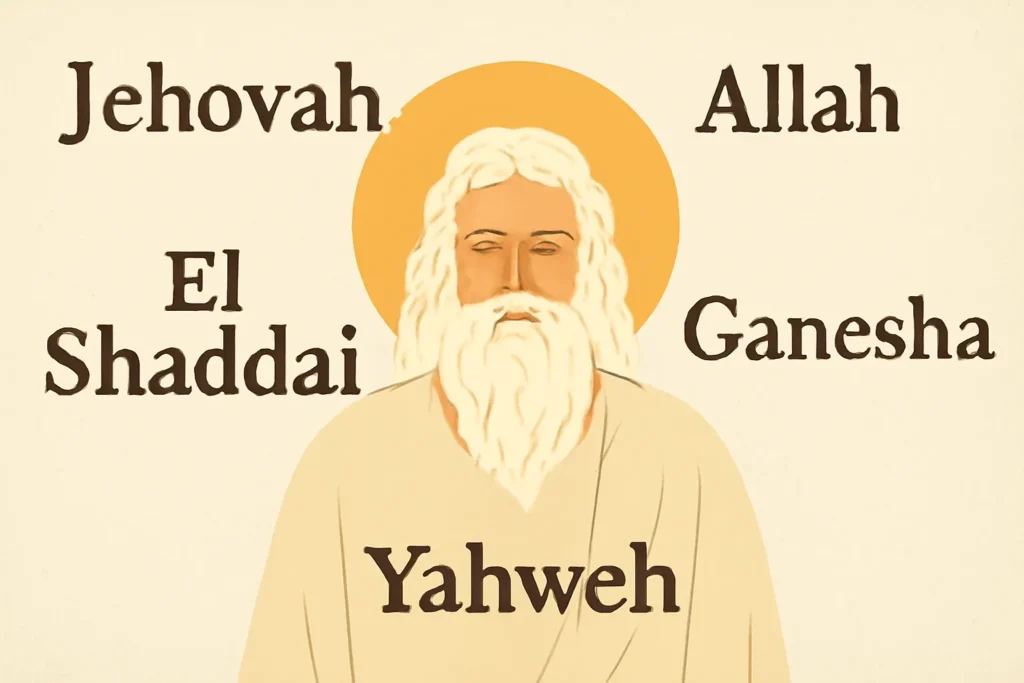
Across the world’s faith traditions, people have given the ultimate reality a multitude of names. These divine epithets—whether titles, descriptive attributes, or personal names—offer windows into how communities imagine, relate to, and address the sacred. This guide surveys a wide spectrum of names for God from different linguistic families and religious contexts. It aims to illuminate how naming shapes worship, theology, liturgy, and daily piety, while showing why names matter beyond mere labels.
Overview: Why Names Matter in Human Theology
Names are never neutral. A divine epithet encodes a relationship, a function, or a moral quality that believers want to emphasize. Some names highlight the sovereign breadth of the divine—omnipotent, eternal, creator and sustainer. Others foreground a personal relation—fatherhood, shepherding, guidance, protection. Still others draw attention to moral and metaphysical attributes like justice, mercy, wisdom, and transcendence.
When we explore other names for God, we encounter a spectrum that spans affections of devotion, doctrinal affirmations, and cultural expressions. The same divine reality may be named differently depending on tradition, language, historical moment, and liturgical setting. This diversity is not a sign of confusion but a record of how human beings, across centuries and continents, have sought to speak to the unspeakable in ways that resonate with memory, practice, and daily life.
In the Judeo-Christian Tradition: Names from Hebrew, Greek, and Latin Traditions
Within Judaism, Christianity, and, to an extent, the Graeco-Roman patristic milieu, God has borne a range of names that reveal different facets of the divine nature. Each name carries a particular theological emphasis, as well as a particular context for invocation or worship.
The Tetragrammaton and Elohim
One of the most central and debated divine names is the Tetragrammaton, the four Hebrew letters YHWH (often vocalized in prayer as Yahweh or Yehovah). In Jewish tradition, this name is treated with utmost reverence, carefully guarded and rarely spoken aloud in everyday speech. In English translations, it is frequently rendered as Yahweh or, less precisely, as The LORD (in small capitals). In some Christian versions, the name appears in quotations or allusions, sometimes almost invisibly, as the Old Testament texts are read in liturgy or studied in seminary work.
Another foundational Hebrew name is Elohim, a term that appears in the opening lines of Genesis and recurs throughout the Hebrew Bible. Although the form is plural in grammar, it is used with singular verbs and is understood in Jewish and Christian thought as a singular, majestic deity who is the Creator and Judge. Believers/Readers often encounter a pairing: the personal, intimate Yahweh and the more cosmic, juridical Elohim, which together convey a robust picture of a God who is both immanent and transcendent.
Adonai, El Elyon, El Olam, and El Shaddai
Several other Hebrew epithets translate into rich theological meanings. Adonai—from a root that means “master” or “lord”—is used as a spoken substitute for the tetragrammaton in Jewish prayer, signaling reverent address to the sovereign God. El Elyon translates to “God Most High,” a title that underscores sovereignty and supreme status above all other powers. El Olam, “Everlasting God,” points to timeless eternity. El Shaddai, often translated as “God Almighty,” suggests power and sufficiency, and in some interpretations also hints at nourishment and divine protection.
In addition to these, terms like El Rabbah (“the Great God”) and Tzevaot or Sabaoth (“Hosts” or “Armies” of heaven) appear in prophetic literature, underscoring the divine command over the celestial and earthly orders. Together, these names outline a God who is mighty, transcendent, covenantal, and intimately involved with creation.
Theos and Kyrios: Greek Reflections on the Divine
In the Hellenistic and later Christian world, Greek terms entered the vocabulary of faith. Theos is the standard Greek word for “God,” used widely in the Septuagint and in the New Testament. Kyrios, meaning “Lord,” became the primary title used for Jesus in early Christian worship, translating reverent address to the divine person in both the Father and the Son roles within Trinitarian theology. As Writings were translated and interpreted across languages, Deus (Latin) and God (English) entered the Christian lexicon as broader, doctrinal labels for the divine.
Over time, biblical and post-biblical Jewish literature adds further layers. Some Jews read names such as Sabaoth in liturgy, and others reference Avinu Malkeinu (“Our Father, Our King”) during the High Holidays and other seasons. While these are not “names” in a strict sense, they function as reverent epithet-like address and liturgical formulae that shape devotion and memory. In Christian usage, many of these terms appear in hymnography and creedal formulations as descriptors of God’s governance and mercy.
In Islam: Names of God and the 99 Names (Asma’ul-Husna)
In Islam, God is understood to be unique, indivisible, and utterly transcendent, yet known through a rich set of divine names that believers recite, contemplate, and invoke. The core Arabic term for God is Allah, often translated simply as “God.” Yet Muslims frequently speak of the Names of God—the Asma'ul-Husna (the “Most Beautiful Names”)—to convey a spectrum of divine attributes that reflect the divine mercy, justice, wisdom, and presence in creation.
Allah and The 99 Names
The concept of the 99 Names is a corpus of divine attributes that God has disclosed or inspired believers to understand. Each name offers a theological lens through which to view reality and a virtue to emulate. Some of the most frequently cited names include:
Ar-Rahman — The Merciful
Ar-Rahim — The Compassionate
Al-Malik — The King, The Sovereign
Al-Quddus — The Holy, The Pure
As-Salam — The Source of Peace
Al-Mu'min — The Giver of Faith, The Protector
Al-Aziz — The Mighty, The Strong
Al-Jabbar — The Compeller, The Restorer
Al-Ghaffar — The Forgiving
Ar-Razzaq — The Provider
Al-Hayy — The Ever-Living
Al-Qayyum — The Self-Existing, The Sustainer
Al-Wahid — The One, The Absolute Unity
Al-Ahad — The One (a Qur’anic expression of absolute oneness)
Al-Latif — The Subtle One, The Gentle
Al-Karim — The Generous
Al-Rafi — The Exalted, The Elevated
In practice, many Muslims learn and invoke a handful of these names in daily prayer, reflections, and supplications. The names are often recited in Arabic because the Qur’an presents them in their original, revealed form. Some devout readers memorize all 99 names as a spiritual itinerary—each name guiding a facet of supplication, gratitude, or moral formation.
Names in Hinduism and Indian Traditions
In Hinduism and related Indian religious traditions, the divine is known through a vast array of epithets and titles, many of them ascribed to specific deities, avatars, or conceptions of the Ultimate Reality. These names reflect the multifaceted nature of the divine in a spiritual ecosystem that includes a panoply of deities, sages, and philosophical schools.
Brahman, Ishvara, and Bhagavan
Brahman is a central concept in Hindu philosophy, often translated as “the Absolute” or “the supreme reality” that permeates all existence. It is not a name in the personal sense but a metaphysical description of reality’s ultimate ground. The related epithet Ishvara denotes “a Lord” or “controller,” a personal aspect of the divine depicted as the organizer and sustainer of the cosmos. When devotion emphasizes personal relationship with the divine, adherents may invoke Bhagavan, a term that translates roughly as “the blessed Lord” or “the fortunate one,” often used for revered forms of God such as Krishna, Rama, or Vishnu.
Names in Vaishnavism, Shaivism, and Shaktism
Within Vaishnavism, the most widely honored forms of God include Vishnu and his avatars, especially Krishna and Narayana. These names carry narratives of preservation, compassion, and cosmic order. In Shaivism, Shiva appears as the supreme being who creates, sustains, destroys, and recreates the universe, with epithets such as Mahadeva (the Great Deity) and Paramashiva (the Absolute Shiva) reflecting his transcendence. In Shaktism, the feminine divine is often described as Devi, Durga, Parvati, or Shakti, emphasizing creative energy and transformative power. This family of names signals a theological emphasis on divine manifestation and dynamic relationships with the cosmos.
Across these streams, the language of Hindu piety often binds names to practices—mantras, bhajans, and ritual recitations—where the sound and resonance of a name itself is believed to awaken particular aspects of the divine presence.
Names in Other Traditions: Sikhism, Zoroastrianism, East Asian Faiths, and African Traditions
Beyond the Abrahamic and Indian worlds, many traditions offer their own luminous epithets for the divine. These names illuminate unique theologies and devotional grammars that have shaped cultures, liturgies, and daily life.
Sikhism: Waheguru and the Names of the One
In Sikhism, the central name is Waheguru, often translated as “Wonderful Teacher” or “Wondrous Lord.” It expresses awe before the divine mystery and a longing for spiritual illumination. Sikh devotional poetry often speaks of Waheguru as the ultimate reality who sustains, guides, and liberates the soul. The term is used in prayer, meditation, and kirtan (devotional singing), and it is cherished for its brevity, profundity, and musical resonance.
In Zoroastrianism, the supreme divine principle is named Ahura Mazda, often translated as “Wise Lord” or “Lord of Wisdom.” The name foregrounds the dual cosmic struggle between truth (Asha) and falsehood (Druj), where Ahura Mazda embodies order, righteousness, and benevolence. The epithets associated with Ahura Mazda in Zoroastrian liturgy emphasize moral intelligence, cosmic justice, and the ongoing work of creation and moral improvement in humanity.
East Asian Traditions: Tian, Shangdi, and Other Concepts
In East Asian religious and philosophical contexts, names for the divine vary in emphasis but often convey order, heaven, and moral authority. In Chinese religious thought, Tian can denote “Heaven” as a broader cellular force or divine principle sustaining the world. In traditional Chinese thought and certain forms of Confucian spirituality, Shangdi (“the Highest Spirit”) is invoked as a supreme deity presiding over moral governance and the blessing of the community. In some East Asian Buddhist and folk-religion practices, epithets such as Five Wisdom Buddhas or Buddha Amitabha function as manifest aspects of ultimate reality, shaping devotion and ethical aspiration rather than a single personified God.
African Traditional Religions: Olodumare, Nyame, and Beyond
Across diverse African traditional religious systems, the divine is often approached through epithets that emphasize sovereignty, benevolence, and the living presence of a creator. Names such as Olodumare (in the Yoruba-speaking world) and Nyame or Nyankopon (in Akan-speaking communities) convey ideas of supreme deity who orders the world, inspires awe, and interacts with humanity through ancestors, oracles, and moral law. In many communities, these names are not merely labels but invitations to remember ethical duties, to participate in ritual life, and to sustain communal harmony.
Theological and Linguistic Distinctions: How Names Shape Belief
People often distinguish among personal names, titles, and attributes when they speak about the divine. A personal name can imply a close, intimate relationship with the divine person—think of Yahweh as addressed in prayer or Waheguru in meditation. A title emphasizes authority, role, or function—such as Lord, Preserver, Creator, or King—and helps worshippers orient themselves within a cosmic order. An attribute (Merciful, Just, Eternal, All-Knowing) points to moral character or ontological quality, guiding ethical reflection and imitation.
Transliteration and pronunciation matter as well. Names migrate across languages with shifts in vowels, consonants, and stresses. For example, Yahweh in Hebrew can appear as Jah in certain English musical traditions or as Jehovah in some medieval Christian debates. The name Allah is the Arabic term for God and is widely used by Muslims across languages; however, in devotional contexts, believers may recite many of the Asma'ul-Husna in Arabic, even when their vernacular language is not Arabic. These translational choices shape understanding and the felt immediacy of the divine presence in worship.
Another linguistic feature is the distinction between universalism (a name that speaks of God’s universal sovereignty) and particularity (a name tied to covenant, tribe, or historical narrative). In the Abrahamic families, citizens of different communities may share certain names (e.g., El or God as a general label) while reserving others for specific theological horizons (e.g., Yahweh as covenantal, Allah as the personal, singular name of God in Islam). In Hindu or East Asian contexts, the same ultimate reality may be approached through multiple epithets that emphasize different ontological dimensions or devotional goals.
Practical Usage: How Epithets Shape Worship, Prayer, and Liturgy
Names for God are not merely doctrinal placeholders; they are activated in practice—during worship, in prayer, and in daily life. Different religious communities cultivate devotional habits that emphasize particular names, either in formal liturgy or in private reflection.
Liturgy and Prayer Practices
Within Judaism and Christianity, certain names appear prominently in liturgical texts. A substantial use of Adonai in prayer replaces the tetragrammaton, while recitations of Elohim may appear in readings of the creation accounts and in doctrinal statements about God’s power and authority. In Christian liturgy, the name Theos or Kyrios appears in the Greek New Testament heritage, and Latin rites speak of Deus in the creeds and hymns. In Islam, daily prayers (the salat) are framed by a reverence for Allah, and many Muslims recite selected Names of God in supplication, hoping to align their hearts with divine attributes such as mercy, justice, and guidance.
In Hindu devotional life, mantras often invoke specific forms of the divine—thus, Krishna or Rama may be named in bhajans, while Brahman and Ishvara might be emphasized in philosophical discourses or meditation on the nature of ultimate reality. Sikh devotional practice places emphasis on Waheguru as the central, unifying name of the divine, used in korahs, kirtan, and meditative repetition (simran).
Ethical and Theological Implications
Names carry ethical weight. When a community emphasizes mercy (mercy-oriented epithets) or justice (justice-oriented attributes), it shapes moral expectations, social action, and communal life. The attribute-focused names invite imitation: a believer who contemplates God’s mercy may cultivate forgiveness in interpersonal relations; a believer who meditates on God’s justice may seek fairness and accountability in society. The practical effect is that divine names are not abstractions; they are living commitments that guide conduct and community norms.
A Glossary of Selected Epithets and Their Meanings
The following glossary offers a compact reference to some widely recognized names and terms. For each entry, a brief description clarifies its significance and typical usage. The aim is to provide semantic breadth while respecting the historical and theological contexts in which these epithets arise.
Yahweh — The personal, covenantal name of God in the Hebrew Bible, often associated with God’s self-disclosure to Israel.
Elohim — A majestic, singular form used for God, stressing power and creation.
Adonai — A reverent substitute for Yahweh in Jewish liturgy, meaning “My Lords” or “Lord.”
El Shaddai — “God Almighty,” emphasizing power and sufficiency; sometimes associated with nourishment and protection.
El Elyon — “God Most High,” highlighting supreme sovereignty.
El Olam — “Everlasting God,” pointing to eternal existence.
Sabaoth or Tzevaot — “Hosts” or “Armies of heaven,” signaling cosmic sovereignty over creation and history.
Avinu — “Our Father,” an intimate relational title used in prayers for guidance and care (especially in liturgical contexts like Avinu Malkeinu).
Jehovah — A historical Latinized rendering of Yahweh used in some Christian traditions; debated among scholars for its representational accuracy.
Theos — The Greek term for God, used in the Septuagint and New Testament contexts.
Kyrios — “Lord” in Greek, a title for the divine and for Jesus in early Christian worship.
Deus — The Latin word for God and the basis for many Western theological formulations.
Allah — The Arabic term for God, used by Muslims across languages and cultures with shared doctrinal fidelity to the oneness of God.
Ar-Rahman — The Merciful, one of the principal attributes of God in Islamic theology.
Ar-Rahim — The Compassionate, emphasizing continued mercy and care.
Al-Malik — The King, The Sovereign, highlighting divine governance over all creation.
As-Salam — The Source of Peace, reflecting the tranquil order God brings into the world.
Waheguru — “Wonderful Lord” in Sikhism, a central devotional name expressing wonder and closeness to the divine.
Ahura Mazda — “Wise Lord” in Zoroastrianism, embodying wisdom, order, and moral law.
Tian — “Heaven” or a principle of cosmic order in certain East Asian religious contexts.
Shangdi — The Supreme God in some traditional Chinese and East Asian religious expressions, especially as the ruler of heaven and moral authority.
Olodumare — The supreme creator in Yoruba cosmology, symbolizing ultimate sovereignty and the life-giving force in creation.
Nyame — The Sky Father and supreme deity in Akan cosmology, associated with kingship, justice, and the order of the world.
Note: This glossary is not exhaustive. Each tradition contains deeper lexical layers, regional variants, and liturgical formulas that reflect its own theological concerns and cultural memory. The names listed here are representative anchors to help readers navigate the broader landscape of divine epithets.
Historical and Theological Reflections on Naming the Divine
Names for God arise in response to questions about origin, revelation, and inspiration. In ancient times, many peoples named the divine in the language of their surrounding culture, often attributing to God a role in creation, governance, and moral order that could be observed in nature and history. Over time, doctrinal formulations—such as the Christian doctrine of the Trinity, or the Islamic emphasis on tawhid (the oneness of God)—influence which names are considered appropriate or orthodox in different communities.
Translational history plays a crucial role in how epithets migrate. A Latinized name, for instance, becomes standard in Christian theology and art across Europe, even as the original Hebrew, Greek, or Aramaic terms survive in scholarly study. In Islam, Arabic remains the canonical vehicle for the Names of God, because the Qur’an and the prophetic tradition (hadith) are anchored in Arabic. In Hinduism, regional languages and temple literatures shape the popularity and devotional texture of epithets for the divine; a name like Krishna might evoke playful sweetness and cosmic love, whereas Brahman invites metaphysical contemplation about the nature of ultimate reality.
As a result, the practice of naming reflects a community’s theological priorities and its imaginative engagement with the mystery of the divine. Names do not exhaust what God is; rather, they orient believers toward certain intuitions about the divine presence—so that prayer, worship, and ethical life can be harmonized with those insights.
Practical Considerations for Readers and Learners
If you are exploring these names for personal study, teaching, or interfaith dialogue, here are some practical guidelines to keep in mind:
Respect context: Understanding a name often requires grasping the tradition’s theology, scriptural exegesis, and liturgical usage. A name may carry heavy reverence and should be engaged with care, especially in interfaith settings.
Recognize semantic range: Many names carry multiple layers—creative, protective, merciful, just, sovereign. A single epithet can highlight more than one attribute of the divine depending on the text or tradition.
Be mindful of transliteration: Different languages render names differently. If you are studying primary texts, be aware that a single name may appear in several spellings, each with historical and theological nuance.
Link form to function: Some epithets emphasize governance (King, Lord), others emphasize mercy (Merciful, Compassionate), and others emphasize transcendence (Eternal, Infinite). Pairing a name with its intended devotional or doctrinal function can deepen understanding and practice.
Avoid essentialism: While names reveal important facets of belief, they do not exhaust a tradition’s entire theology. Interfaith engagement should seek to appreciate both common ground and distinctively different understandings of the divine nature.
To Summarize: The Rich Tapestry of Divine Epithets
The exploration of “other names for God” reveals a cosmopolitan sacred language that spans continents, centuries, and religious communities. Whether one speaks of the Merciful and Creator, or the Waheguru that awakens the soul, these names function as invitations—inviting contemplation, exhortation, and a life oriented toward that which is greater than the self. They serve as memory aids for a people’s story, as calls to moral action, and as a means of drawing near to the divine.
The diversity of divine epithets is not a sign of theological disarray but a testament to the human longing to know and to love what transcends ordinary experience. In that sense, the study of names becomes a journey through faith itself—an invitation to listen to the many voices that speak of the One who is beyond all naming, yet whose presence is sought, cherished, and celebrated in countless ways.
If You Want to Explore Further: Suggested Pathways
For readers who want to deepen their understanding, here are some practical next steps that combine academic study with devotional practice:
Read biblical passages and the accompanying scholarly commentaries that discuss Yahweh, Elohim, and related titles in their historical and literary contexts.
Explore the Asma'ul-Husna in translations and original Arabic to notice how each name frames a particular moral or spiritual virtue.
Listen to recordings of devotional music or recitations in different languages that feature names such as Waheguru, Allah, and Om (which, while not a name of God in the same sense in Hinduism, is a sacred syllable pointing to the cosmic vibration).
Study comparative religion texts that discuss how naming the divine varies across traditions while addressing common themes like sovereignty, mercy, and the moral order of the universe.
Attend interfaith dialogues with a focus on devotional language to appreciate how different communities use naming to nurture virtue, community, and reverence.
In closing, Other Names for God offers more than a taxonomy of titles. It presents a living map of devotion, philosophy, and culture—a map that helps believers articulate their experience of the divine and that invites readers to imagine more deeply how language can accompany awe, prayer, and ethical life. Whether you are a student of theology, a practitioner of a faith tradition, or a curious reader, the language of divine epithets can illuminate both shared ground and beautiful difference.









Leave a Reply