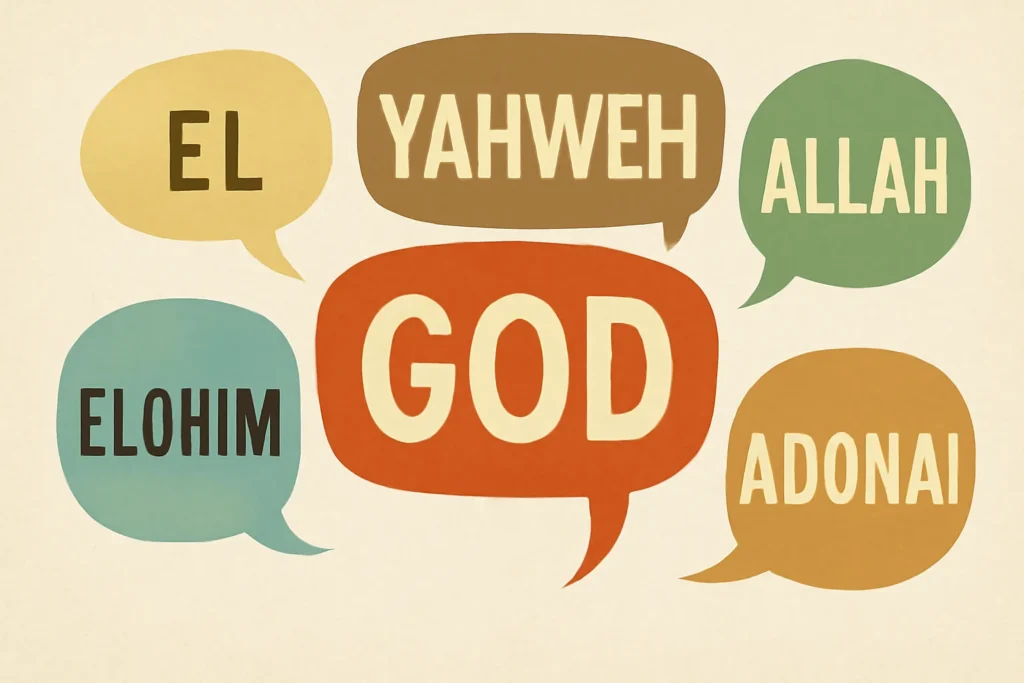
Names for the divine appear in virtually every culture and tradition, and they carry more than
simple labels. They encode theology, history, language, and daily practice. In many faiths,
a single name can reveal a central attribute—such as power, mercy, or transcendence—while in
others a composite set of names or titles conveys a layered understanding of the ultimate reality.
This guide surveys a broad spectrum of names for God and the meanings attached to them,
offering context, etymology, and examples that illuminate how believers relate to the sacred.
The aim here is descriptive and comparative rather than prescriptive: to help readers recognize
patterns, understand why names differ across traditions, and appreciate how these designations shape
worship, liturgy, and moral imagination. We will explore names drawn from major world religions,
while also noting regional variations, historical translations, and the philosophical nuances that
accompany each term. Throughout, important terms will be emphasized to highlight their core
significance.
Categories of divine names and what they signify
Divine names fall into several broad categories, each signaling a different theological or devotional
emphasis. The following list presents common types you will encounter across traditions, with
representative examples.
Names of worship and reverence — terms used in prayer to denote awe, humility, and devotion (e.g., Theos, God).
Names denoting oneness or absolute unity — expressions that foreground monotheism or unity of being (e.g., Tawhid, Ik Onkar).
Names emphasizing attributes — descriptors of mercy, power, justice, wisdom, or compassion (e.g., El Shaddai, Ar-Rahman).
Names tied to creation, sustenance, and sovereignty — terms that highlight role in the cosmos (e.g., Brahman, El Elyon).
Personal or immanent names — language that portrays God in approachable or relational terms (e.g., Adonai, Abba).
Mythic or scriptural titles — names that appear in sacred narratives and liturgy (e.g., Amitābha, Waheguru).
Names in the Abrahamic traditions
Judaism: foundations of the divine name
Jewish texts distinguish several categories of divine names and titles, each carrying unique
reverberations in liturgy, law, and everyday speech. The revelation of the divine name is treated
with special care and is deeply tied to concepts of holiness and covenant.
YHWH (often vocalized as the Tetragrammaton) — the most sacred name revealed to Moses in the biblical narrative. Its exact vocalization is traditionally not spoken aloud in Jewish practice; instead, readers substitute Adonai or Elohim in public reading. The name is associated with the essential, self-existent, eternal nature of God.
Adonai — meaning “my Lord” or “the Lord,” used in liturgy in place of the Tetragrammaton. It signals sovereignty, authority, and personal relation within a covenantal framework.
Elohim — a plural-form term often interpreted as a majestic or plural of majesty, used in the Hebrew Bible to denote God’s creative power and authority. In many passages it functions as a singular, monotheistic name, emphasizing majesty and power.
El Shaddai — commonly rendered as “God Almighty” or “the Almighty.” It foregrounds divine sufficiency, protection, and generative strength.
El Elyon — “the Most High God,” a name underscoring sovereignty, exaltation, and supreme rule over all nations and realms.
Ehyeh Asher Ehyeh — often translated as “I will be what I will be” or “I Am Who I Am,” highlighting God’s self-sufficiency and presence with Israel.
El Olam — “the Everlasting God,” focusing on eternity and enduring presence across generations.
In addition to these, Jewish tradition often uses compound phrases that describe divine acts, such as Rachamim (mercy) or Din (justice), and attributes them to God in prayers and
poetic texts. While these are not “names” in the strict sense, they function as reverent descriptors that
help worshipers articulate their relationship to the divine.
Christianity: names tied to revelation, incarnation, and faith
In Christian practice, names for God appear both in the Old Testament as part of the Hebrew tradition
and in New Testament Greek terminology, where names such as Theos (God) and Kyrios (Lord)
appear frequently. The Christian faith centers on the revelation of God as Father, Son, and Holy Spirit,
with distinct implications for how names are understood, proclaimed, and invoked in worship.
Theos — Greek for “God,” used broadly in Scripture to denote the divine in monotheistic faiths. It functions as a general term for the divine in Christian, Jewish, and pagan contexts historically, but within Christianity it emphasizes the singular God of the Christian witness.
Kyrios — “Lord,” used to acknowledge God’s sovereignty and, in the New Testament, to designate Jesus as Lord, tying name and identity to divine authority and salvific work.
Abba — an Aramaic term meaning “Father,” used by Jesus in intimate prayer and teaching to express a personal, relational aspect of God’s nature. It signals closeness within the divine-human relationship.
Jehovah or Jehovah-Jireh — older Latinized form of YHWH that appears in some traditions; Jehovah has historical usage in some English translations and hymnody, though many scholars prefer “YHWH” or “Yahweh” in academic contexts. Names like Jireh (“provider”) arise from biblical compound forms that emphasize God’s acts in history.
El Shaddai — as in Judaism, used within Christian contexts to speak of God’s sufficiency and nurturing power.
El Elyon — “the Most High,” used in Christian translation to convey supreme sovereignty and exalted status of God.
Father — in Christian theology, the personal and relational designation for God the Father, reflecting the Trinitarian framework and Jesus’ teaching on prayer.
Christian devotion also centers on the Incarnation, in which the Divine Logos becomes human in Jesus Christ.
Names and titles such as Christ, Jesus, and Lord carry salvific meanings as well as
identity claims about God’s self-revelation in history. In liturgy and prayer, Christians frequently invoke
a mix of universal names (like God and Lord) and more relational or salvific ones (like Father and Christ), tailoring the name to the context of worship, confession,
and worship music.
Islam: the divine names and the oneness of God
In Islam, the central creed insists on the unity of God (Tawhid), and God is most commonly referred to by the
Arabic term Allah, which literally means “the God” or “the One God.” Islamic theology emphasizes a
balance between recognizing God’s transcendence and acknowledging His immanence in creation and human life.
Allah — the primary name of God in Islam, signifying the unique, singular, indivisible divinity who creates, sustains, and judges. It is not three, not multiple; it is the One who governs all that exists.
Ar-Rahman — “the Most Merciful,” a name that highlights God’s pervasive mercy toward all beings, often paired with Ar-Rahim (“the Most Compassionate” or “the Most Merciful” in a more specific sense).
Al-Malik — “the King” or “the Sovereign,” underscoring God’s ultimate authority over the universe.
Al-Quddus — “the Holy,” stressing purity and transcendence beyond human limitations.
Al-Wadud — “the Loving,” signaling a benevolent aspect of the divine toward creation.
Al-Alim — “the All-Knowing,” emphasizing divine omniscience.
Al-Hakeem — “the Wise,” pointing to divine wisdom in law, creation, and guidance.
Beyond these, Muslims recite the 99 Names of Allah (Asma’ al-Husna), each name offering a facet of the divine
character. These names are not mere epithets; they function as devotional anchors in prayer, meditation, and
ethical reflection. The names are recited in supplication, memorized for study, and invoked in daily acts of
remembrance (dhikr). The oneness of God in Islam is not a denial of attributes; rather, it is an affirmation that
all attributes belong to the one divine essence, without division or composite form in God’s nature.
Names in Hinduism: many forms of the one principle
Vamana of philosophy: Brahman and the nuance of attributes
Hindu thought contains a rich spectrum of names for the divine, spanning monism, dualism, and pluralistic
devotional paths. A central concept is Brahman, the ultimate, unchanging reality that sustains
and transcends all phenomena. Brahman is sometimes described as without form (Nirguna) and sometimes
as having form and personal characteristics (Saguna), depending on the school or tradition.
Brahman — the supreme, infinite reality that permeates all existence; the source of all energy, matter, and consciousness.
Ishvara — a personal, cartographically navigable form of the divine that presides over creation; often treated as a bridge between impersonal absolutes and personal devotion.
Bhagavan — “the Blessed One” or “the Dear One,” a reverential name used for various deities, especially Vishnu and Krishna, who are revered as supreme manifestations of the divine.
Devas and Devis — plural terms for male and female divine beings in Hinduism, including figures such as Vishnu, Shiva, Shakti, and Lakshmi, among others, each representing distinct aspects or functions of the divine order.
Rama, Krishna, Ganesha, Saraswati — names of particular divine avatars or manifestations of the one supreme reality, each associated with specific virtues, stories, and devotional practices.
Shakti — “divine feminine energy,” a name that captures the active, creative dimension of the divine force in the cosmos.
Harā — a devotional epithet used to praise the remover of obstacles, sometimes associated with path-clearing grace.
The Hindu tradition also emphasizes devotional approaches that treat the divine as personal yet transcendent.
Names such as Rama and Krishna are not only identifiers but also anchors for moral ideals, cosmological narratives, and devotional practices (bhakti). For practitioners, the choice of name often aligns with a theological school (Advaita Vedanta, Vaishnavism, Shaivism, etc.), ethical aims, and the paths of ritual worship, meditation, or service.
Names in Sikhism: Waheguru and beyond
Sikhism presents a distinctive sense of the divine that centers on a single, formless God who is both transcendent
and immanent. The language of the Gurbani and the Guru Granth Sahib emphasizes the unity of God and the intimate
relationship between the divine and human beings.
Waheguru — “Wonderful Teacher” or “Wondrous Lord,” a supremely beloved and central appellation that captures both wonder and guidance.
Ik Onkar — "One, the Creator," a phrase that succinctly expresses monotheism and the inseparability of the divine from creation.
Akaal Purakh — “Timeless Being” or “the Timeless Lord,” underscoring eternity and the divine presence beyond time.
Nam — “the Name,” a devotional shorthand for God understood as the living presence of the divine in the world and in the heart of the seeker.
Guru — while primarily a title for spiritual teachers, in Sikh devotion it also signals the divine truth manifested through the gurus and the Sikh scripture itself.
In Sikh practice, names like Waheguru are invoked in recitation, meditation, and song, forming part of a larger spiritual discipline
that seeks to remember (sarbat) and live in harmony with the divine will. The emphasis on Naam parallelly reflects
an inward experience of God through remembrance and devotion, rather than solely a doctrinal definition.
Names in Buddhism: divine figures and awakened beings
Buddhism offers a different frame for “names of God” because it generally centers on the attainment of
awakening rather than worship of a creator deity. Yet, in many Buddhist traditions, reverence is directed toward
Buddhas, Bodhisattvas, and cosmic beings whose names carry rich meanings and aspirational power.
Buddha — “the Awakened One” or “the Enlightened One,” a title rather than a name, signifying awakened mind and liberation from ignorance.
Amitābha — “Infinite Light,” a primordial Buddha revered in Pure Land traditions; devotion to Amitābha centers on rebirth in a Pure Land.
Amitayus — “Infinite Life,” another important Buddha considered to embody long life and compassion.
Avalokiteshvara (Chenrezig in Tibetan) — the Bodhisattva of Compassion, often invoked for mercy and assistance in times of need.
Manjushri — the Bodhisattva of Wisdom, associated with insight, learning, and the piercing of ignorance.
Padmasambhava — “Lotus-Born,” a revered figure in Tibetan Buddhism associated with turning away obstacles and establishing the Dharma in the land.
Tathāgata — “Thus-Gone One,” a title for the Buddha emphasizing realization and the transcendence of conventional existence.
In Mahayana and Vajrayana traditions, the names of Buddhas and Bodhisattvas function as meditative focal points
and ethical inspirations. Chanting these names or visualizing the corresponding figures can be a method of
cultivating compassion, wisdom, and stability. While not “God” in the monotheistic sense, these names carry
transformative intention and serve as conduits for spiritual practice.
Names in other traditions and indigenous beliefs
Outside the major world religions, a broad spectrum of cultures uses divine names or epithets linked to
the land, ancestors, and cosmology. These names may reference creator deities, nature spirits, or ancestral
powers that govern harvest, weather, or communal life. The following examples illustrate how naming the divine
can reflect specific communities and ecosystems.
Deus (Latin) and Zeus (Greek) — classical names for powerful creator or sky-father figures in ancient polytheistic contexts, often reflected in literature, ritual, and myth.
Odin, Thor, and other names from Norse tradition — names associated with cosmology, fate, war, and wisdom; in modern times they appear in literature and popular media as archetypes rather than as daily devotional speech.
Tao — in Chinese philosophy and religion, the word “Tao” can denote the Way or the ultimate principle underlying reality; it is sometimes treated as a metaphysical principle in Daoist contexts.
Ain Soph, Yah — terms found in Jewish mysticism and the Kabbalistic tradition that describe aspects of the divine as infinitely unknowable and endlessly present.
Inca, Maya, and other Indigenous Names — many indigenous traditions refer to the sacred through names tied to the land, spirits of the hills, rain, sun, and corn. These names may function in ritual chants, offerings, and place-based spirituality rather than as doctrinal, universally standardized names.
Across these diverse contexts, the common thread is that names for the divine encode relationships between
human beings and something greater than themselves. They reveal how communities perceive the sacred, how they
address the mystery of life, and how belief translates into rituals, ethics, and social practice.
Semantic dimensions: how names convey meaning
Names for the divine carry layered meanings. They are not mere labels; they conjure metaphysical attributions,
ethical ideals, and cosmic functions. The following semantic dimensions help explain why names matter in
religious life.
Etymology — the linguistic roots of a name reveal historical contact, migration, and cultural exchange. For example, El in Semitic languages reflects divinity or God, while Om in the Indian subcontinent is a sacred syllable linked to creation and cosmic vibration.
Attribute and function — names like Ar-Rahman (the Merciful) or El Shaddai (God Almighty) foreground the divine’s characteristic action or role in the universe.
Cosmology and sovereignty — titles such as El Elyon or Al-Malik highlight the divine’s supreme position over the cosmos and human history.
Relational/ethnographic context — some names emphasize relationship to the people or to particular communities, such as Abba (Father) in Christian contexts or Waheguru as a relational, devotional call to remembrance.
Transcendence vs. immanence — names can emphasize God’s transcendence (beyond the world) or immanence (the divine present within creation), shaping how the divine is approached in prayer and everyday life.
The interplay of these dimensions explains why a single deity might have many names across languages and traditions.
Each name selects a color from the spectrum of divine reality, enabling believers to approach the sacred from a
particular vantage point—whether through awe, trust, consolation, obedience, or love.
Usage, liturgy, and daily life: how names shape practice
Names for God are not only spoken or sung in worship; they shape ethical norms, liturgical cycles, and
personal piety. Here are some of the ways names function in religious life.
Prayer and invocation — believers recite divine names as acts of remembrance, supplication, and engagement with the sacred. For example, dhikr in Islam involves repeating divine names; Christian prayers may invoke God as Father, Lord, or Theos; Hindu bhakti uses names like Rama or Krishna in devotional songs.
Scriptural reading and liturgy — the names of God appear in sacred texts to anchor doctrinal assertions, narrate divine actions, and guide ethical instruction.
Ritual calendar and feast days — certain names are emphasized during festivals or liturgical seasons that celebrate particular aspects of the divine (e.g., mercy, creation, divine justice).
Ethical imagination — the attributes embedded in divine names (mercy, justice, wisdom, steadfastness) inspire believers to imitate or embody those qualities in daily life.
Art, poetry, and music — poets and musicians often weave the names of God into hymns, meditations, and visual arts, shaping culture and morale.
The practice of transmitting sacred names also involves reverence for how they are spoken. In many traditions,
certain names are treated with special respect, taught in catechesis, or used with particular rituals to honor
their sanctity. In some cases, protective linguistic conventions arise to prevent casual or blasphemous usage.
Translation, transliteration, and linguistic notes
The encounter with divine names across languages almost always involves translation and transliteration.
Each approach carries its own advantages and limitations.
Translation — rendering a name into the recipient language can clarify meaning for new audiences but may obscure nuanced sound or etymology (for example, translating YHWH as “the Lord” helps readability but conceals the original consonantal form and the tradition of vocalization).
Transliteration — preserving the original sounds from the source language (e.g., YHWH, Allah, Amitābha) allows readers to glimpse linguistic heritage, though it may require footnotes or glossaries for readers unfamiliar with the script.
Interpretive glosses — many scholars append brief meanings (e.g., “the Merciful” for Ar-Rahman) to help readers connect the name with its theological implications.
Across traditions, readers encounter the challenge of balancing reverence with accessibility. Some communities
choose to use common translations in everyday language, while preserving the original terms for formal worship and study.
The result is a spectrum of usage that respects tradition while inviting new generations to engage with the divine.
Historical development and cross-cultural exchange
Names for God rarely exist in isolation. They develop through centuries of religious experience, cultural exchange,
and translation. The history of these names reveals:
Translations between languages — as empires, trade routes, and scholarly networks connected diverse communities, names migrated and were adapted (e.g., the Latin Deus into vernacular biblical translations, or Greek Theos and Kyrios shaping early Christian vocabulary).
The rise of monotheistic frameworks — in Judaism, Christianity, and Islam, names shift in emphasis toward unity and singular divine subject, even as the richness of attributes expands within that unity.
Philosophical reinterpretations — as thinkers debated the nature of God and reality, names began to signify abstract principles (like Brahman as ultimate reality) alongside personal relationship (like Ishvara).
Poetic and liturgical innovation — poets, saints, and liturgists created new epithets, often blending older terms with contemporary language to express evolving devotion.
The cross-cultural exchange of names shows how people in different eras and regions perceive the same ultimate questions: Who is God? How does the divine relate to the world? What is our relationship to the sacred? The names listed in this article illustrate how diverse responses to these questions can be—from the intimate and personal to the cosmic and transcendent.
Practical guide: interpreting and using divine names in study and teaching
If you are researching names for God for study, teaching, or personal exploration, here are several practical tips to help
you interpret and present these names clearly.
Context matters — always consider the tradition, scripture, and period in which a name appears. A name can have different connotations in different communities.
Preserve original form where possible — including original script (Hebrew, Greek, Arabic, Sanskrit, etc.) helps learners access etymology and cross-reference resources.
Link name to meaning and function — pair a name with its core meaning (e.g., El Shaddai — “God Almighty”) and a brief note on its theological emphasis (sustenance, power, protection).
Avoid conflating homonyms — different traditions may use similar-sounding words with distinct meanings; clarify distinctions (e.g., El vs. Allah vs. Brahman).
Respect devotional usage — if you are presenting these names in a classroom or publication, acknowledge that some names are treated with reverence and may require careful handling in discussion or translation.
Glossary of selected names and their core meanings
Below is a compact glossary of the names mentioned in this guide, including a quick sense of their primary meaning and the tradition in which they are most often encountered.
YHWH — the sacred, ineffable Tetragrammaton in Jewish tradition; self-existence and covenantal presence.
Adonai — “the Lord,” spoken in Jewish liturgy as a substitute for YHWH.
Elohim — “God” with majesty; used in the Hebrew Bible with singular sense despite the plural form.
El Shaddai — “God Almighty,” conveying power and protection.
El Elyon — “the Most High God” and sovereign ruler over all.
Ehyeh Asher Ehyeh — “I Am Who I Am,” self-sufficient presence and continuity.
Theos — Greek term for God used in early Christian and classical contexts.
Kyrios — “Lord,” signaling divine authority and the Christological confession in Christian faith.
Abba — “Father,” a relational, intimate designation used by Jesus in prayer.
Jehovah — a Latinized form of YHWH used historically in some Christian circles.
Allah — “the God,” the single, universal deity in Islam, emphasizing oneness and sovereignty.
Ar-Rahman / Ar-Rahim — “the Most Merciful” / “the Most Compassionate,” mercy-centered names in Islam.
Al-Malik — “the King” or sovereign ruler in Islamic usage.
Al-Quddus — “the Holy” in Islamic tradition.
Waheguru — “Wonderful Teacher” or “Wondrous Lord,” central in Sikh devotion.
Ik Onkar — “One Creator,” a succinct expression of monotheistic unity in Sikh thought.
Akaal Purakh — “Timeless Being,” emphasizing eternity in Sikh and related traditions.
Brahman — the ultimate, impersonal or transcendent reality in Hindu philosophy.
Ishvara — a personal, approachable form of the divine in some Hindu theologies.
Rama / Krishna / Vishnu — personal manifestations of the divine in Vaishnavism, with particular ethical and cosmological narratives.
Shiva — a primary deity in Shaivism, representing transformative power and cosmic function.
Amitābha / Amitayus — Buddhas revered in Pure Land traditions, symbolizing boundless light and life.
Avalokiteshvara / Chenrezig — Bodhisattva of Compassion, a name invoking boundless mercy.
Conclusion: embracing the diversity of names while honoring their meanings
Names for God and the meanings behind them provide a map to how different communities conceive of
the divine, approach mystery, and orient daily life toward something greater than the self. Whether
through a monotheistic confession, a devotional naming, or a philosophical description of ultimate
reality, these terms offer entry points into sacred horizons. They invite readers to listen to
centuries of tradition, to appreciate linguistic beauty, and to reflect on their own ideas about
the divine. The practice of studying divine names can cultivate humility, curiosity, and a deeper
sense of responsibility to treat the sacred with reverence.






Leave a Reply