The Lost Son Bible is a shorthand way readers often use for the parable known in many churches as the Prodigal Son, or more formally, the parabolic tale in Luke 15. This story sits inside the Gospel of Luke and is one of the most widely discussed passages in the Christian tradition. It is commonly titled the Lost Son Bible narrative because it centers on a younger son who squanders his inheritance, becomes estranged from his family, and then returns home seeking mercy. Yet the broader arc of the story invites readers to explore what it means to be found, forgiven, and welcomed back into a community after failure.
In this article, we will explore the tale behind the Prodigal Son moniker, but we will also expand our lens to consider the deeper meanings, the cultural context, and the practical implications for individuals, families, and faith communities today. We will employ multiple angles—historical, theological, ethical, and literary—to illuminate how the lost son narrative functions not only as a moral fable but as a lens on human longing, divine generosity, and communal reconciliation.
The Luke 15 Setting: Context for the Lost Son Bible Tale
Luke 15 contains three parables that Jesus tells in response to criticism about his association with sinners and tax collectors. The other two parables—the parables of the Lost Sheep and the Parable of the Lost Coin—share a common theme: loss, pursuit, and joyful restoration when what was lost is found. The Prodigal Son narrative closes this trio with a more intimate, character-driven drama that unfolds within a family setting.
Audience and Purpose
The audience for this Lost Son Bible story includes both average listeners and religious authorities who might expect strict adherence to honor codes. In this social world, honor and shame are tangible currencies, shaping how people act toward kin and community. The parable invites readers to rethink what true honor looks like: is it strict adherence to cultural norms, or is it a form of grace that reconciles people across divides?
Historical-Cultural Background
In the ancient Near Eastern and Greco-Roman world, a son's request for his share of the inheritance and then departure would have triggered expectations about familial duty and honor. The way the lost son story unfolds—the departure to a distant country, the eventual famine, and the long-awaited homecoming—mirrors motifs found in other ancient literature. Yet the twist that the father runs to embrace the son, and the celebration that follows, marks a radical redefinition of honor and social belonging in Luke’s Gospel.
The Prodigal Son: An Outline of the Lost Son Bible Tale
To grasp the full meaning of the lost son Bible narrative, it helps to map out the structure, noting how each movement shifts the audience’s attention from loss to reconciliation.
The Departure: The younger son asks for his inheritance and leaves for a distant country. He exchanges the security of family life for independence, then spends everything in reckless living.
The Crisis: A severe famine hits the land, and the younger son finds himself in want. He faces humiliation and hunger, a reversal of the wealth fantasy he previously enjoyed.
The Return: Realizing his mistakes, he returns to his father, planning to present himself as a hired servant, rather than a son.
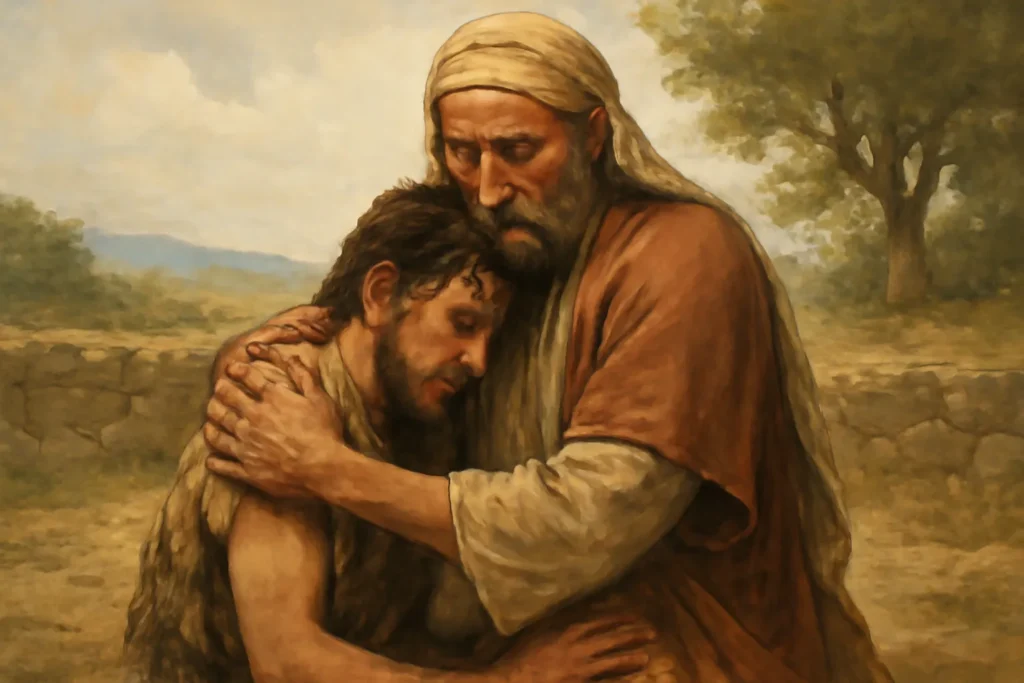
The Reception: The father sees him from a distance, runs to him, embraces him, and orders the best robe, a ring, and sandals to be brought out. A feast follows for the reconciled family.
The Lesson: The elder brother, who stayed home, objects to the celebration. The father explains that mercy and restoration are at the heart of the household—so the party is for the lost being found, not a reward for steadfast obedience alone.
Throughout this progression, the Prodigal Son becomes a focal point for examining how grace operates, how repentance is perceived, and what it means for a community to welcome back someone who has harmed its norms. This arc also invites readers to consider whether the lost son story is merely a tale about personal repentance or a larger invitation to participate in divine hospitality.
Characters and Symbolism in the Lost Son Bible Narrative
The parable is a compact drama with three central characters. Each figure plays a symbolic role that opens up multiple layers of meaning, from interpersonal forgiveness to universal divine mercy.
Younger Son: The Wayward Son
The younger son represents a human impulse toward autonomy, novelty, and self-advancement. He asks for his share of the inheritance, effectively declaring his independence from the family unit. His subsequent spending spree and its consequences illuminate the fragility of human plans when they are uncoupled from responsibility and community.
The father embodies hospitality, mercy, and generous affection. His action of running to meet the son—an act that would have violated social norms for an elder patriarch—signals a radical counter-story to cultural expectations about honor, status, and control. The father’s invitation to celebrate rather than to scold reframes what it means to “be a family.”
Older Son: The Voice of Law and Self-Righteousness
The older son represents a different kind of resistance to grace: concern for fairness, compliance with the letter of the law, and resentment at another’s forgiveness. His objection to the party is less about the younger brother’s sin and more about what he perceives as a violation of norms. The elder son’s response invites readers to consider whether moral behavior without relational mercy can truly fulfill the heart of the law.
Symbolic Layers
Return as renewal of relationship rather than mere apology.
Robe, ring, and sandals as signs of restored status and belonging.
Feast as communal affirmation of reconciliation and restored identity.
Famine as a humbling crisis that illuminates dependence on God and family.
Key Themes and Meanings in the Lost Son Bible Narrative
The Prodigal Son story—often called the lost son Bible tale in casual reading—offers several intertwined themes that have made it enduringly relevant across generations.
Grace and Forgiveness
A central message concerns grace that does not hinge on merit. The father’s mercy toward the returning son reflects a vision of unconditional love that astonishes observers who expect punishment or withdrawal. The parable challenges readers to consider how grace is extended to those who acknowledge their need, even when social norms would demand accountability in ways that feel punitive.
Repentance and Humility
The younger son’s decision to return is not merely a plea for forgiveness; it is a declaration of humility. He acknowledges his misjudgment and chooses to position himself as a servant if necessary. The narrative invites readers to see repentance as a path that leads not only to forgiveness but to a changed status within a community.
Reconciliation and Return
Reconciliation in the Prodigal Son tale is two-sided: God or the divine perspective and human relationships. The father’s welcoming gesture demonstrates that reconciliation involves risk, generosity, and celebration. It’s not a simplistic “you did wrong, so you must pay” model; it is a model of relational return that restores trust and belonging.
Identity, Honor, and Community
The narrative reframes identity from one defined chiefly by achievement and possession to one defined by belonging and acceptance. The party signals a community’s explicit commitment to include the repentant, the wandering, and those who have strayed away. The elder brother’s tension foregrounds a critique of legalism and a reminder that community life must be tempered by mercy.
Economic Realities and Dependence on God
The famine that precipitates the younger son’s crisis is more than a plot device; it highlights the vulnerability of human plans and the dependence on resources, providence, and communal support. The Lost Son Bible narrative invites readers to examine how money, status, and wealth influence decisions, relationships, and the sense of security within families and faith communities.
Some readers emphasize the cultural expectations surrounding family honor, inheritance, and adult autonomy in the ancient world. The parable then reads as a critique of social codes that fail to express mercy, and it frames the divine disposition as more expansive than human norms of fairness.
Theological Lens
The Bible often invites readers to attend to the nature of God as a gracious host who welcomes the estranged. In this light, the lost son tale becomes a theological meditation on God’s grace and mercy, and on the possibility of restoration even after deep estrangement.
Moral and Ethical Lens
Ethical questions abound: What responsibilities accompany freedom? How does a community rightly welcome a person who has harmed its cohesion? What does it mean to show forgiveness without enabling self-destructive behavior? The Prodigal Son narrative provides a framework for discussing these tensions carefully and compassionately.
Literary and Narrative Lens
From a literary perspective, the parable uses character contrast, irony, and a dramatic reversal to carry its message. The narrative structure—departure, crisis, return, reception—serves as a timeless template for stories about rescue, belonging, and transformation.
Translations, Variations, and the Language of the Lost Son
Across translations, the core message of the Prodigal Son remains recognizable, yet the wording can shift nuance. Terms like “prodigal,” “wayward,” “lost,” and “return” carry different shades of meaning in English and other languages, affecting how contemporary readers interpret the tale.
Common Variants in Wording
“Prodigal Son” vs. “Wayward Son” vs. “Lost Son”
“Return” vs. “Coming Home” vs. “Coming Back”
“Father’s mercy” vs. “Father’s compassion” vs. “Father’s forgiveness”
Short Guide to Reading Luke 15 in Different Translations
Pay attention to how the father’s running gesture is translated; some versions emphasize the urgency of mercy, others the tenderness of welcome.
Note how the elder brother’s speech is rendered—the emphasis can shift between grievance, entitlement, or disbelief at grace.
Look for phrases that highlight communal celebration—feast, hospitality, and joy—as signs of restored belonging.
The lost son Bible themes survive translation because they touch foundational human experiences: longing, failure, forgiveness, and the power of home as a place of safety and renewal.
Applying the Prodigal Son Narrative to Modern Life
Personal Growth and Spiritual Formation
For many readers, the Prodigal Son story offers a framework for reflecting on personal growth. It invites honest self-examination: Where have I wandered? Who do I need to ask for forgiveness from? How can I cultivate humility that leads to genuine reconciliation with others?
Family Dynamics and Reconciliation
Within families, the lost son Bible tale can be a constructive guide for handling conflict. It suggests that reconciliation is possible when there is a willingness to forgive, to celebrate the return of one who has caused pain, and to rebuild trust over time.
Church, Community, and Hospitality
In faith communities, the parable challenges leaders and members to practice unconditional hospitality while maintaining healthy boundaries. It raises questions about who is invited to the table, how to respond to those who return after harm, and how to embody mercy in institutional life.
The broader ethical implications include caring for the marginalized, resisting judgmental attitudes, and prioritizing relational healing over punitive justice. The central message—restoration over exclusion—can inform social ethics, charitable work, and restorative justice conversations.
In the cultural context of the time, an elder father would typically be expected to wait for the son to approach. The father’s decision to run toward the son signals an extraordinary emphasis on mercy, initiative, and the value of restoration over ritual propriety. It is often read as a model of divine eagerness to welcome the wayward home.
What about the elder brother’s response?
The elder brother’s protest highlights the tension between justice and mercy. His critique challenges the community to balance accountability with grace, and to avoid turning loyalty into a source of self-righteousness. The narrative invites readers to consider how to celebrate restoration while addressing legitimate concerns about fairness and boundaries.
Is the Lost Son Bible story primarily about individuals or about God?
While the tale centers on a family, many readers interpret it as a mirror of God's character. The father’s actions are seen as a parable of divine mercy, while the younger son’s return showcases repentance and reconciliation. The story invites readers to see their relationship with God as a journey of return, forgiveness, and renewed identity.
The question of universal salvation is debated among scholars and readers. The parable emphasizes God’s willingness to forgive and restore, but it does not explicitly resolve every theological question about salvation. It does, however, strongly advocate for a generous, invitational posture toward those who repent and seek belonging.
How can I apply the Lost Son narrative in counseling or pastoral care?
In pastoral settings, the story can serve as a compassionate framework for helping people navigate forgiveness, reconciliation, and family conflict. It can guide conversations about accountability, mercy, and the healing of broken relationships, while recognizing the need for healthy boundaries and practical support in rebuilding trust.
What does true hospitality look like in a community after someone returns from a destructive season?
How do you balance grace with accountability in your own life or in your church?
In what ways might the elder brother’s perspective reflect legitimate concerns that deserve attention?
How does the imagery of feasting and celebration shape your understanding of mercy and joy?
What personal experiences of loss, redemption, or reconciliation can the Prodigal Son narrative illuminate?
Identify a time you felt distant from a loved one or from a faith community.
Describe how you or others demonstrate mercy in similar circumstances.
Consider what a restorative response would look like in your situation, beyond mere apology.
Conclusion: The Enduring Value of the Lost Son Bible Story
The Lost Son Bible narrative—often celebrated as the Prodigal Son story in Luke 15—remains compelling because it anchors big questions about human failure, divine mercy, and the meaning of home. It invites readers to explore how a family, or a community, can recover from harm not by erasing consequences but by embracing restoration through costly grace. Whether you approach it as a theological meditation, a literary drama, or a practical guide for living with one another, the tale challenges you to consider your own posture toward mercy, forgiveness, and inclusion.
In the end, the Prodigal Son is less about labeling a person as lost and more about recognizing that every life can be found, restored, and welcomed back into the circle of belonging. The wayward son, the father, and the elder brother together become a parable about what it means to be human and to be loved—truly loved—by a generous and welcoming God.









Leave a Reply