The episode commonly summarized as Jesus and the fig tree curse sits at a key crossroads in the Gospels, inviting readers to explore questions about faith, judgment, symbolism, and the relationship between outward religious display and inward fruitfulness. In the narratives found in the Gospel of Matthew and the Gospel of Mark, Jesus engages a fig tree that displays leaves but bears no fruit, and this action becomes a profound teaching moment for his followers. Whether you approach this story as a historical event, a parabolic enactment, or a symbolic prophecy, the core questions remain: What does it mean to be fruitful in faith? How does divine authority interact with human conduct? And what lessons does this episode offer for people who seek to live with integrity before God?
In this article, we will examine the meaning of the episode, its historical and literary context, and the practical lessons for modern faith communities. We will consider the two Gospel accounts side by side, explore the symbolism of the fig tree, and reflect on how this narrative speaks to issues such as hypocrisy, trust, prayer, and judgment. By weaving together theological interpretation with historical awareness and pastoral application, we aim to provide a thorough, accessible understanding of a passage that has shaped Christian reflection for two millennia.
What the text says: a concise itinerary of the episode
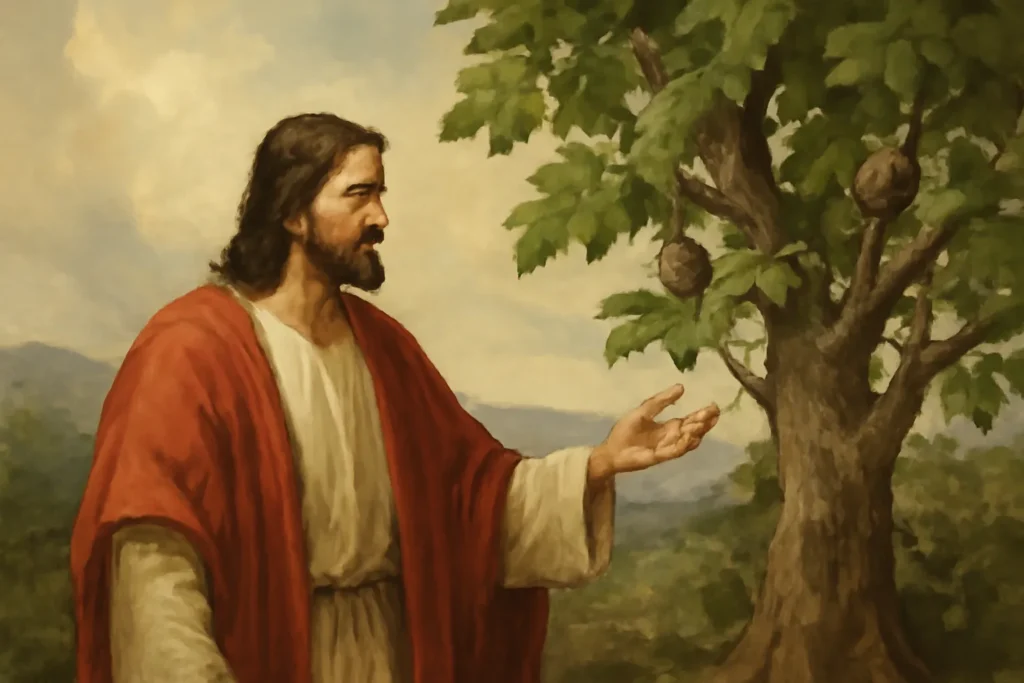
In both Matthew and Mark, Jesus encounters a fig tree on the path as he travels toward Jerusalem. The tree, though “leafy,” yields no fruit when he looks for it. In response, he pronounces a curse, saying that the tree should never bear fruit again. The immediate reaction is stark: the tree withers “from the roots up.” For the disciples, this sequence becomes an occasion to reflect on the power of faith and the seriousness of spiritual fruitfulness.
Two subtle but important differences emerge between the two accounts. In Matthew 21, the cursing follows Jesus’ cleansing of the temple—the dramatic act of disrupting commerce that had turned sacred space into a marketplace. In Mark 11, the cursing falls within a broader sequence of Jesus’ teaching about faith, prayer, and authority that culminates in the call to “have faith in God.” These parallel strands—judgment and mercy, symbol and exhortation—help readers see that the fig tree is not merely about a single act but about a larger pattern of Jesus’ ministry: revealing God’s purposes, challenging complacency, and inviting a deeper form of trust.
Historical and literary context
The setting in first-century Palestine
First-century Israel provided a rich tapestry of symbolic language, agricultural imagery, and temple-centered religion. The fig tree, common in the Mediterranean world, carried layered meanings. On one level, it signified nourishment and provision—figs are a staple crop with early ripening varieties. On another level, the fig tree was often used in biblical literature as a symbol of the nation of Israel, its leaders, and its religious life. In a culture where agricultural cycles and fruitfulness were outward signs of blessing, a tree that appeared healthy on the outside but bore no fruit would be read as a painful indictment of unproductive or hollow faith.
The setting near Jerusalem also matters: this is a moment in Jesus’ ascent to the city’s pivotal events—the triadic sequence of entry, temple activity, and the development of conflict that leads to crucifixion. The fig tree episode is thus part of a larger arc in which Jesus publicly exposes contradictions between appearances and true spiritual life, and it foreshadows the kind of judgment that would accompany Israel’s leadership if genuine repentance did not come.
From a literary perspective, both Gospel writers employ imagery that blends natural judgment with spiritual critique. The moral logic is not primarily meteorological or horticultural; rather, it uses a tangible action—a curse on a tree—to illustrate a deeper principle: fate follows faith, and fruitfulness is the expected outcome of authentic discipleship. The act also signals that Jesus speaks with authority and that his words carry real consequences, inviting readers to consider their own allegiance and trust.
The central meaning: fruitfulness, faith, and judgment
Fruitfulness as the expected outcome of true discipleship
The figure of the fig tree with leaves but no fruit becomes a compelling metaphor for professed spiritual vitality without genuine righteousness. In biblical terms, outward signs like leaves can create a sense of expectation, but they are not sufficient if they are not matched by inner reality. This juxtaposition—appearance versus reality—invites readers to examine their own lives. Are we merely presenting a cultivated exterior of piety while neglecting the deeper work of love, generosity, mercy, and justice that should accompany faith?
Faith, prayer, and the power of speech
In Mark’s account, Jesus connects the act of faith with the power of spoken prayer: Have faith in God. The narrative invites readers to consider the relationship between belief and action. The curse is not a random act of vengeance; it is a dramatic demonstration of faith translated into decisive speech. The underlying claim is that God’s power is available to those who bear genuine trust and who align their requests with God’s purposes. This does not flatten prayer into a guarantee of demand; it anchors prayer in alignment with divine will and a life that bears fruit in love and justice.
Judgment and mercy in tension
The fig tree episode also foregrounds a theme of judgment: trees that fail to fulfill their purpose are subject to consequences. Yet the episode sits within a larger biblical arc that preserves space for mercy, repentance, and restoration. The curse is not framed as a mere act of punitive force; it is a symbolic proclamation that non-fruitfulness—especially when paired with outward religiosity—invites correction. The Christian interpretive tradition often reads this as a call to genuine repentance and to transformation of life, rather than a blanket condemnation of nature or of people who struggle with producing fruit at a given moment.
Matthew’s emphasis on judgment alongside temple action
In Matthew 21, the fig tree episode sits adjacent to the narrative of Jesus driving the money-changers from the temple. The sequence emphasizes that apparent religious life without holy action is incongruent with the kingdom of God. The cursing then serves as a tangible reminder that divine judgment will fall on systems and people who exploit sacred space for personal gain while failing to bear the fruit of justice and compassion. Matthew’s portrayal invites readers to connect personal faith with communal duty—worship that translates into mercy, honesty, and generosity.
Mark’s emphasis on faith, authority, and the timing of fruit
In Mark 11, the narrative foregrounds Jesus’ teaching about faith and prayer, linking the withering of the fig tree to the dynamics of spiritual power. The emphasis is less on the temple-cleansing narrative in this particular moment and more on the way faith, rightly oriented toward God, makes possible extraordinary outcomes. Mark’s audience, often placed in the context of a persecuted or marginal Christian community, might find in this story reassurance that trusting God in the present moment has tangible effects, while also recognizing that divine timing and purposes might differ from human expectations.
Historical questions and interpretive cautions
Was the fig tree cursed for not bearing fruit out of season?
A common interpretive issue concerns whether Jesus cursed the tree because it was not in season for fruit. Some readers find it unfair to condemn a tree for a season in which fruit would not be expected. Scholars note that the imagery should be read symbolically rather than as a horticultural critique. The leaves might signal the possibility of fruit, but the absence of fruit reveals a deeper spiritual deficiency. The takeaway is not horticultural precision but theological significance: outward signs without inner reality are incompatible with God’s purposes.
Is the curse a rejection of Israel or an invitation to reformation?
Across Christian traditions, the fig tree has often been interpreted as a symbol of Israel—its leaders, its religious life, and its relations to God. In this light, the withering of the tree can be read as a prophetic symbol indicating that the nation’s leadership and religious establishment risk divine judgment if they do not bear spiritual fruit—righteousness, justice, and mercy. Yet the broader arc of Scripture also holds space for repentance and restoration. The narratives invite readers to discern a pathway of reform, humility, and renewed dependence on God rather than a blanket condemnation of a people or tradition.
Lessons for faith: what the episode teaches today
Faith that is animated by genuine fruit
Authenticity over appearance: outward religiosity must be matched by inward transformation.
Fruitfulness as a sign of discipleship: love, justice, generosity, and mercy should follow from faith.
Discernment in living: evaluate whether beliefs translate into lived outcomes that benefit others.
Prayer and the humble use of authority
Faith-filled prayer is not a magical formula but a posture of trust in God’s wisdom and timing.
Authority under God: Jesus’ authority is exercised with a purpose—prompting repentance, reform, and faithfulness, not coercive domination.
Prayer that seeks alignment with God’s will, rather than mere personal desire, is the shape of mature faith.
Repentance, hypocrisy, and integrity
Hypocrisy exposed: the story names the danger of living with a hollow spiritual life while presenting a deceptive exterior.
Integrity before God: integrity means aligning what one professes to believe with how one lives in daily realities.
Mercy and correction: correction is offered not to condemn but to invite transformation and renewed faithfulness.
Hope and judgment in a pastoral frame
Judgment with a horizon of hope: even when judgment seems severe, the biblical narrative often points toward opportunities for repentance and renewal.
Pastoral application: churches and faith communities can apply this story by fostering environments where honesty, accountability, and compassionate correction are practiced.
Practical reflections for individuals and communities
For individuals
Examine your fruit: what tangible evidence of love and service accompanies your faith?
Address hypocrisy: where do you present a polished exterior while suppressing inner growth or truth-telling?
Practice faith-filled prayer: cultivate a daily rhythm of prayer that seeks alignment with God’s will and invites transformation.
Seek authentic fruitfulness: identify areas—relationships, work, generosity, justice—where you can bear more fruit for others.
For faith communities
Audits of vitality: regularly assess whether worship and ministry translate into measurable acts of compassion and justice.
Transparency and accountability: create structures that encourage honest self-examination and corrective action when needed.
Teaching and formation: teach the connection between belief and behavior, helping people move from leaves to fruits in their daily lives.
Community prayer: center prayer practices on discernment about God’s will and the shared life of the community.
Theological threads and broader biblical themes
Judgment and grace as two sides of a single story
The fig tree incident sits within the larger biblical arc that depicts God as just and merciful. The immediate act of judgment toward unfruitfulness is counterbalanced by invitations to repentance and new life. This tension is not a contradiction but a dynamic reality of the biblical witness: God’s holiness requires transformation, yet God’s mercy provides a path toward that transformation.
Symbolism that invites moral reflection
The use of a living plant as a vehicle for moral instruction is part of a long tradition in biblical literature. The stories invite readers to look beyond the surface and consider what their lives reveal about their commitment to God’s purposes. The fig tree, with its universal symbolism of provision and promise, becomes a concrete prompt for evaluating whether the life of faith is contributing to the common good.
Expectation and eschatology in light of the episode
For some readers, the episode also intersects with eschatological expectations about judgment and the coming of the kingdom. The decisive nature of Jesus’ actions and words in this moment can be read as a foreshadowing of the climactic judgments described elsewhere in the Gospels. Yet the text also closes with a call to faith and action, signaling that the end goal is a transformed people who live in obedience, hope, and love.
Common misconceptions and clarifications
It is not about cursing nature: the primary aim is symbolic—using a living illustration to teach about spiritual life, trust, and accountability.
It is not a blanket condemnation of trees: in the biblical world, trees often symbolize people or nations; here the focus is on fruitfulness and fidelity.
It is not a punitive whim: the act serves as a prophetic signal that invites repentance rather than a punitive end to life itself.
It is not solely about anger: the episode presents a complex moral and theological message about judgment, mercy, faith, and transformation.
Historical reception: how scholars and theologians have read the story
Patristic and medieval reflections
In early Christian thought, the fig tree tale was often used to discuss the dangers of lipservice without true repentance, as well as the authority of Christ. Some patristic writers connected the symbol to the idle fig trees of spiritual life—fig leaves that hide nakedness rather than revealing obedience to God. Over time, commentators highlighted the pedagogical function of the episode: Jesus teaches by action just as he teaches by parables.
Reformation-era and modern exegesis
During the Reformation and in subsequent modern biblical scholarship, commentators frequently emphasized the contextual nature of the fig tree episode—its place in the sequence of Jesus’ path to Jerusalem, its connection to temple activity, and its role in presenting a critique of hypocritical piety. Modern readers are often urged to read the text in light of both its literary design and its historical setting, balancing the symbolic dimensions with the historical-grammatical method.
Questions for guided reflection
Questions for personal reading
What in your life might resemble a tree with leaves but no fruit, and how can you cultivate legitimate spiritual fruit?
How do you understand the relationship between faith, prayer, and action in your daily routines?
In what ways do you see alignment or misalignment between what you profess and how you live?
Questions for small groups or churches
How can a faith community foster a culture of honesty about spiritual growth without shaming or legalism?
What practical steps can be taken to translate belief into tangible acts of mercy, justice, and care for the vulnerable?
How can leaders teach about judgment and mercy in a way that invites renewal rather than fear?
The fig tree episode stands as a compact, powerful narrative about the life of faith. It challenges believers to examine the evidence of their professed beliefs, to trust in God’s capacity to work through prayer, and to pursue a life that bears consistent, tangible fruit for the good of others. By reading the episode through the lenses of Matthew and Mark, Christians and readers of other traditions can gain a richer understanding of how Jesus, the Messiah, exercises divine authority with mercy, how the gospel invites transformation, and how faith is meant to flourish not in isolation but in love—toward the neighbor, toward justice, and toward the renewal of all creation.
Whether you approach this story as a historical scene, a prophetic symbol, or a moral parable, the enduring message remains clear: true fruit follows true faith, and the path of discipleship is a ongoing process of conversion, prayer, and faithful action in the world.








Leave a Reply