Fallen Angel and Angel: Origins, Symbolism, and Meanings Explained
Fallen Angel and Angel: Origins, Symbolism, and Meanings Explained
The terms fallen angel and angel have echoed through religion, myth, and culture for centuries. They carry layered meanings that shift depending on time, place, and tradition. This article explores the origins, symbolism, and meanings of these celestial beings, tracing how the idea of a divine messenger can become a cautionary tale about pride, rebellion, mercy, and redemption. We will examine how the concepts arise in different faith systems, how artists and writers have reimagined them, and what the language around these beings reveals about human expectations of the heavens.
Origins and Etymology: Where the Word and Idea Begin
Semantic roots: angel as messenger
The word angel derives from ancient languages that describe a celestial messenger. In the Hebrew Bible, the term is mal'akh, often translated as angel or messenger, signaling a function rather than a fixed form. In the Greek Septuagint, mal'akh is rendered as aggelos, which directly becomes the Latin angelus and, in English, angel. In short, an angel is someone sent with a message, a representative of a higher power acting within the world of humans.
Across cultures, this core idea—the transmission of guidance, warning, or decree from the divine—remains central. The emphasis is not only on luminosity or beauty, but on purpose: the messenger arrives to relay a word, a quanta of knowledge, or a directive that matters.
The contrast: light-bringer, messenger, and rebel
Within the broader vocabulary, the term fallen describes a state rather than a nature. An angel that has fallen is one who exists in a different moral or ontological register: their relationship to the divine authority has shifted due to actions like rebellion, disobedience, or a transgression of celestial order. The pairing of fallen with angel creates a complex figure who once stood in service to the divine and who, through choices, enters a story about consequence, judgment, and sometimes repentance.
Ancient and Scriptural Contexts: How Fallen Beings Enter the Narrative
Old Testament glimpses and the language of messengers
In the Hebrew scriptures, angels frequently appear as messengers who deliver announcements, warnings, or guidance. They sometimes take on the appearance of a human, sometimes a more radiant form. Crucially, these beings act under God’s authority, even when their presence seems uncanny to human witnesses. The idea of a fallen state enters more explicitly through later interpretive traditions than through a straightforward canonical text.
Genesis, the Watchers, and extra-biblical insight
The biblical canon is not uniform on the idea of rebellion among celestial beings, but later Jewish and Christian literature expands the scene. In some traditions, a group of heavenly beings called the Watchers or sons of God transgresses by teaching humanity crafts, warfare, and other knowledge they were not meant to impart. This leads to punishment and the emergence of demonic or rebellious figures. The most famous non-canonical book associated with this story is the Book of Enoch, which elaborates on the fall and its consequences. While not accepted in all biblical canons, this material has profoundly shaped Western imagination about fallen angels.
From rebellion to consequence: the mythic arc
The arc of the fall typically follows a pattern: a celestial being or beings rise in pride or disobedience, a heavenly sanction is issued, and the result is a transformed state—often exile, punishment, or an enduring role as tempters or adversaries to humanity. This arc has become a recurring motif in literature, theology, and art, shaping how people understand disobedience, power, and the limits of authority.
Fallen Angels Across Traditions: Variations, Names, and Theologies
Christian tradition: Lucifer, Satan, and the rebellion
In many Christian renderings, the figure associated with the fallen angel is commonly named Lucifer, the “light-bringer” who falls from grace. Although the Bible itself does not present a single, unified narrative of a fall of a singular being named Lucifer, centuries of exegesis, liturgy, and literature fused the term with Isaiah's taunt against a king with heavenly imagery, weaving it into the broader myth of a rebellious celestial being. Over time, Lucifer became a cultural shorthand for the epitome of rebellion against divine order, and by extension for the worst forms of moral rebellion, especially pride.
The figure of Satan—often identified as the adversary or accuser—also grew out of this celestial drama. In some traditions, the fallen archangel is the same entity branded as Satan, while in others, the two are distinct beings with overlapping functions: a celestial rebel versus a prosecuting prosecutor who tempts or tests humanity. The result is a rich, sometimes divergent, spectrum of interpretations in sermons, apocryphal writings, and modern media.
Judaic and Rabbinic perspectives: Watchers, demons, and ethical debates
In Jewish thought, the concept of fallen watchers becomes a lens for exploring how divine decree, human freedom, and moral hazard interact. The Book of Enoch and subsequent midrashim describe a hierarchy of angels, some of whom transgress, and a process of judgment that emphasizes mercy, justice, and the consequences of overreaching. In these traditions, the figure of a fallen being is a vehicle for discussing accountability, corruption, and the boundaries of heavenly knowledge.
Islamic perspective: Iblis, the jinn, and the question of disobedience
In Islamic theology, it is essential to distinguish between angels and jinn. The Qur’an describes Iblis as a being who refused to bow to Adam and was expelled from the heavenly ranks. But Iblis is not an angel in the usual sense: he is a jinn, a created being made of smokeless fire with free will. Because of this distinction, Islam presents a different moral and ontological storyline: even a being endowed with knowledge and proximity to the divine can choose defiance, and the consequences are both cosmic and moral. The outcome emphasizes accountability, the importance of submission to God’s plan, and the possibility of repentance under divine mercy.
Symbolism and Meaning: What Do the Terms Convey?
Light, knowledge, and the risk of arrogance
A central symbolic tension in the stories of fallen angels and angels is the relationship between light and knowledge and the peril that can accompany prowess. Angelic light often stands for revelation, clarity, and truth, while the fall marks a betrayal of that light through hubris and self-regard. The imagery invites readers and viewers to consider how the pursuit of knowledge must be tempered by humility, obedience, and a reverence for limits.
Power, authority, and responsibility
The angelic hierarchy provides a framework in which celestial beings exercise some degree of power and authority. When a fallen angel crosses lines, the narrative invites reflection on how power should be exercised, where accountability lies, and how leadership can degenerate into coercion, manipulation, or tyranny. The mythic fall serves as a cautionary tale about the dangers of unbridled ambition and the moral consequences that follow.
Redemption, mercy, and transformation
Not all retellings end with final ruin. In many traditions, there is room for redemption or a form of mercy extended to beings who have erred. Some stories emphasize that forgiveness does not erase consequences, while others imagine paths by which a being once cast out could regain a measure of harmony with the divine order. This tension—between eternal punishment and possible restoration—speaks to enduring questions about justice, mercy, and the possibility of change.
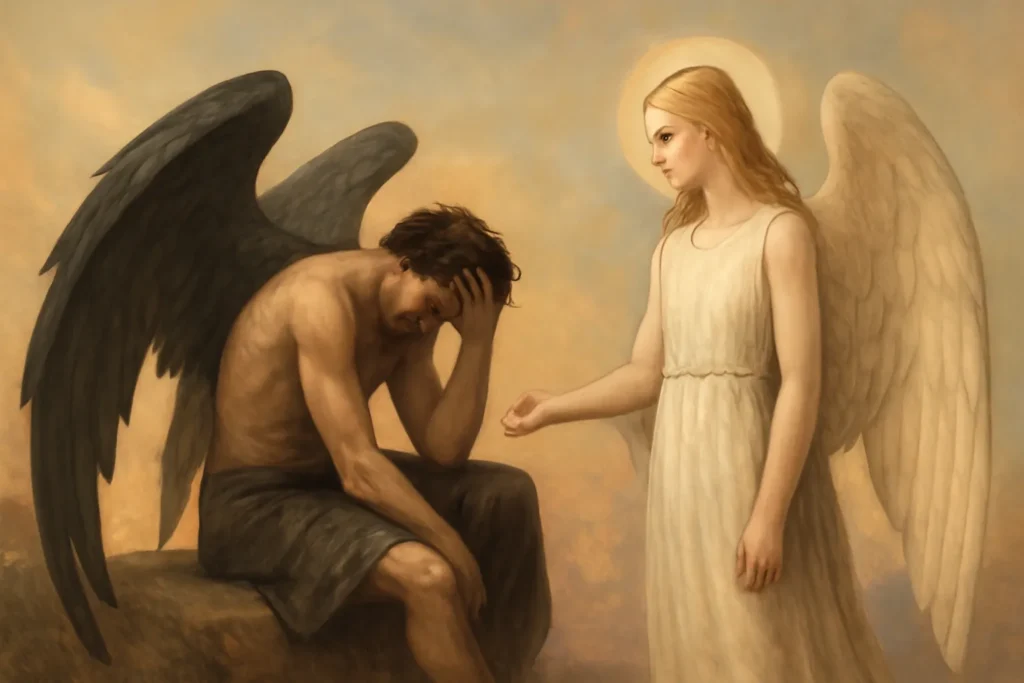
The image of the fallen angel often combines beauty and tragedy: luminous wings, a glorious countenance, and a posture of defiance or sorrow. This visual vocabulary has shaped art, music, cinema, and popular culture. The alternate image of the angel—serene, radiant, and approachable—conveys hope, guidance, and compassion. Together, these palettes form a broad spectrum of symbolic potential, from terror and awe to comfort and trust.
Archetypes and Cultural Representations: From Antiquity to Modernity
Literary archetypes: from epic poetry to contemporary novels
The idea of a fallen angel has inspired countless writers to imagine scenes of celestial rebellion, celestial punishment, and the fragile relationship between heaven and earth. Epics and novels frequently deploy the archetype to explore themes of power, conscience, and alienation. Modern fantasy and science fiction often reinterpret celestial beings as agents of moral investigation, transcendent knowledge, or cautionary warnings about what humanity should not aspire to become.
In painting and sculpture, the contrast between a luminous angel with a sacred aura and a fallen figure marked by sorrow, shattered grace, or fractured wings is a powerful metaphor for moral failure and the brokenness that follows. These images invite viewers to contemplate the complexity of virtue and pride, and to reflect on their own relationship to power and knowledge.
Music, film, and popular culture: reimagining the celestial
In modern media, the fallen messenger trope appears across genres. Some works reframe the rebellion as a tragic miscommunication or a political struggle among divine factions; others cast the rebel as an anti-hero whose motives raise questions about freedom, destiny, and the ethics of divine command. The persistent appeal of the fallen celestial being lies in its capacity to mirror human dilemmas about ambition, conscience, and the search for meaning beyond authority.
Modern Reframing: How Contemporary Thinkers Use Fallen Beings
The psychological dimension: temptation, pride, and self-identity
In psychology-informed readings, the *fallen state* of an angel can be interpreted as a metaphor for inner conflict: the pull of pride, the danger of moral room within authority, and the tension between duty and desire. The figure becomes a mirror for human psychology—an archetype through which we can examine our own tendencies toward hubris, defiance, or the longing for autonomy.
Ethical and theological debates: authority, obedience, and mercy
Debates about obedience to divine command versus personal integrity often hinge on these celestial stories. Some scholars emphasize that the divine order must be respected, while others argue that the possibility of repentance and transformation remains essential to a compassionate theology. The fallen angel motif thus serves as a focal point for discussions about what it means to be faithful, to dissent, or to seek a higher good.
In interfaith contexts, the idea of a celestial rebellion can illuminate differences in how religions understand authority, justice, and the nature of evil. While the details differ, many traditions wrestle with similar questions: What happens when a being of great power chooses to turn away from the good? Can a being defined by disobedience ever be redeemed? These questions continue to resonate in devotional poetry, spiritual essays, and ethical treatises.
Hierarchies, Terminology, and Lexical Variants: How Language Shapes Meaning
Angel as a broad category of heavenly messengers across cultures.
Fallen angel as a subset describing beings who have transgressed or altered their relationship to the divine order.
Names such as Lucifer, Satan, Iblis, and Watcher figures in various traditions.
The difference between angels in canonical texts and the expanded mythic figures in apocrypha and later lore.
The language around celestial beings shapes how people imagine authority, impurity, rebellion, and redemption. By tracing terms and their usage, readers can see how belief systems evolve and how linguistic choices affect moral interpretation.
Frequently Encountered Themes and Frequently Asked Questions
What defines a fallen angel versus a regular angel?
A canonical angel typically acts as a divine courier or agent within a faithful framework. A fallen entity, by contrast, has undergone a transformation—usually involving disobedience, pride, or a transgression against the divine order—leading to exile, punishment, or an adversarial role.
In many traditions, mercy and redemption remain possible, though they may be limited or require extraordinary acts of humility or restitution. The presence of such a possibility keeps the myth alive as a source of hope, not just fear.
Why do these beings appear across so many cultures?
The recurring theme of a celestial entity who wields great power and then faces consequences taps into universal human concerns: the nature of power, the danger of overreaching ambition, the conflict between will and obedience, and the longing for guidance from the heavens.
Glossary of Key Terms and Figures
Angel: a divine messenger or celestial being that acts on behalf of a higher power.
Fallen angel: an angelic being that has fallen from grace due to disobedience or rebellion.
Lucifer: a symbolic name often associated with the archetype of the proud, rebellious light-bringer who falls from heaven; adopted widely in Christian tradition.
Satan: a figure representing opposition or trial, sometimes identified with a fallen angel, other times presented as a distinct adversary.
Iblis: in Islamic theology, the jinn who refused to bow to Adam; not an angel, but a cautionary exemplar of defiance and pride.
Watchers: a group of celestial beings described in apocryphal literature, whose transgression leads to punishment and mythic consequences.
Book of Enoch: an ancient text that expands on the Watchers and their fall, influential in shaping Western imagination about fallen beings.
Conclusion: The Enduring Significance of Angels and Fallen Beings
The story of angels and fallen angels remains a potent cultural and spiritual force because it speaks to timeless questions: How should we wield power? What is the right relationship between humanity and the divine? What happens when light is misused, or when a messenger themselves becomes a teacher of danger? Across eras and traditions, these celestial narratives invite contemplation of virtue, accountability, and the possibility of transformation. Whether approached as theological doctrine, mythological metaphor, or cultural symbol, the figures of the angel and the fallen one offer a language for expressing awe, fear, and hope in the face of the unknown.
Further reading and study suggestions
Explore the etymology of mal'akh and aggelos in scholarly lexicons of Hebrew and Greek.
Compare canonical texts with non-canonical works such as the Book of Enoch to understand how the Watchers narrative expands the concept of rebellion.
Read Islamic theological discussions on Iblis and the distinction between angels and jinn to appreciate cross-cultural nuance.
Study emblematic art depicting the contrast between luminous angels and tragic, fallen figures to see how imagery conveys moral messages.











Leave a Reply