Foundations of Christian Meditation: Entering the Quiet Space with God
Christian meditation is not primarily an escape from life but a cultivated practice of returning
to the presence of God in the midst of daily activity. It invites a rhythm of attentiveness
that turns away from distraction and toward a steady gaze on divine reality. At its heart is
the conviction that God is present and that human beings are invited into a
relationship of listening, love, and obedience. In this sense, meditation is
less about forcing thoughts to disappear and more about cultivating a sacred posture: a body
that rests, a mind that listens, and a heart that trusts.
Across Christian traditions there are several distinct forms that share a common aim: to deepen
prayer by cultivating stillness, attention, and a growing
awareness of the divine reality. This article surveys practical methods, explains how they are
used, and provides actionable steps you can adapt to your own spiritual routine. The emphasis is
on practicality, not a single method, because fruitful prayer often grows from a
willingness to experiment with diverse practices while remaining anchored in the person of Christ.
Key aims and principles of Christian meditation
Before detailing specific practices, it helps to name a few core aims common to legitimate Christian
meditation:
Presence of God as the primary reality into which a person enters.
Scriptural grounding—letting the living word of God shape attention and growth.
Listening as active spiritual work—not merely asking for favors, but learning to hear
what God is saying through Scripture, creeds, and ordinary life.
Humility and discernment—cultivating a teachable heart that seeks God’s will with
clarity and patience.
Community and solitude—recognizing that both silence and shared practice nurture
faith, and that discernment often benefits from wise counsel.
The practical forms presented below are diverse enough to honor different temperaments,
environments, and seasons of life. Some days you may prefer quiet solitude; other days you may
benefit from guided forms that help you anchor your attention. The goal is not to perfect the
method but to cultivate a posture of trust and receptivity.
Central practice: Centering prayer and contemplative silence
Centering prayer is a method designed to open the heart to God through simple, wordless stillness.
It does not demand special hastening of thoughts; rather, it invites the practitioner to rest in
God's presence with silence and gentle attention. The method
emphasizes surrender—letting go of intrusive thoughts and returning to a sacred word as a cue to
refocus.
What it involves
Choose a sacred word or short phrase that expresses your intention to seek God (for example, “Abide,”“Jesus,” or “Come, Holy Spirit.”).
Set a comfortable, quiet space for a fixed period (often 15–20 minutes; longer periods are possible
for seasoned practitioners).
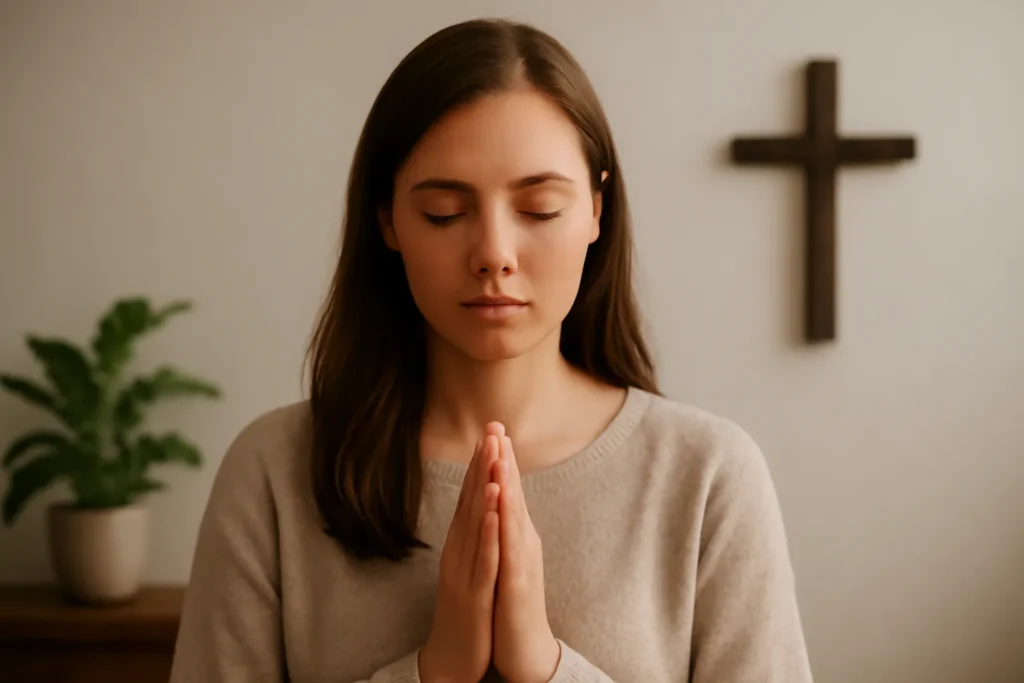
Adopt a relaxed posture—hands resting, shoulders loose, and the gaze soft or closed—while
maintaining a gentle breathing rhythm.
Focus your attention inwardly on the sacred word. When thoughts arise, acknowledge them without
judgment and gently return to the word.
End with a short moment of praise or gratitude, acknowledging God’s nearness in the quiet.
Practical guidelines
Consistency matters more than length: daily practice, even for brief periods, builds
a steady habit.
Release and return: let thoughts come and go; do not cling to them or force a mental
narrative.
Posture should be upright but relaxed to support mindful breathing and spacious
awareness.
Guard your attention from external distractions—turn off notifications and create a
simple environment.
Centering prayer is not a solitary experience alone; many find it spiritually nourishing to share with
a group or to accompany the practice with a brief reading from scripture, a psalm, or a reflective
meditation. The aim remains the same: to cultivate presence and to become
more receptive to the movement of God within.
Scriptural meditation: Lectio Divina in contemporary life
Lectio Divina, Latin for “divine reading,” is a time-honored practice that invites a fourfold sequence:
read, reflect, respond, and rest. It orients the heart toward God through a slow, prayerful engagement
with a text. Although historically rooted in monastic communities, Lectio Divina is adaptable to any
Christian tradition and to varied life contexts.
The four movements
Lectio (reading): A slow, attentive reading of a short biblical passage, perhaps once
aloud and once silently.
Meditatio (reflecting): Pondering questions like, “What is God saying to me through this
text?” or “What truth in this passage addresses my life today?”
Oratio (prayer): Responding to God in words or quiet listening—sharing your thoughts,
gratitude, confusion, or surrender.
Contemplatio (rest): Resting in God’s presence, perhaps noticing a felt sense of God’s
care, and letting any insights settle into daily life.
Text selection and rhythm
Choose a passage with clear imagery or personal resonance, such as a psalm, a gospel narrative, or a
short prophetic text.
Limit the length of the reading to a few verses to keep the pace slow and the intention centered.
Schedule Lectio Divina for moments when you can remain uninterrupted, or adapt to a “mini-lectio” in
a busy day by using a single verse.
Lectio Divina does not aim to extract a single moral rule; rather, it invites you to hear God’s
invitation in the living word of Scripture. You may experience resonance with a promise, a rebuke that
calls for repentance, or a call to redouble your commitment to acts of love. The practice nourishes
discernment by aligning your mind with the truth of God as it is revealed in the biblical narrative.
In a group setting, participants can take turns reading aloud and then pause for silent reflection,
enabling a shared rhythm of contemplation.
With a short reflective reading, you can pair Lectio Divina with journaling, drawing, or a brief
listening exercise to express insights beyond words.
In times of struggle or grief, Lectio Divina can focus on verses of comfort, identity, and faithfulness,
enabling a gentle process of lament, hope, and release into God’s care.
Breath prayers and contemplative invocations
Breath prayer is a simple mechanism to harmonize body, mind, and spirit. By pairing simple phrases with the
breath, believers can maintain awareness of God throughout ordinary activities. The practice is especially
accessible for beginners or anyone seeking a compact, portable form of prayer.
Common forms
“Lord Jesus Christ, have mercy on me” whispered on the inhalation and exhalation, with the phrase spoken
once per cycle or repeated as needed.
Alternating phrases that center on mercy, guidance, or gratitude, for example: “Come, Lord Jesus” on the inhale and “Guide my steps” on the exhale.
Short affirmations tied to daily activities, such as “Bless this work” during morning tasks
or “Be present, O Lord” during a commute.
Tips for effective practice
Keep the phrases brief and meaningful; longer lines can become distracting during movement or busy moments.
Coordinate with natural breath: gentle inhalation and exhalation that feel unforced fosters ease and
steadiness.
Use anchor moments in the day—rising, mealtimes, or transitions—to re-center attention with a breath prayer.
Breath prayer makes the awareness of God portable, suitable for walking, working, or resting. It is a discipline of simplicity that invites a steady attentiveness without
demanding prolonged time blocks. The aim is to carry a sense of God’s presence into ordinary life.
Ignatian contemplation and imaginative prayer
The Ignatian tradition offers a distinct approach: using the imagination to encounter scriptural events as if
present. This form of contemplation invites readers to place themselves in scenes from the
life of Christ or early church events, thus transforming knowledge into intimate encounter.
A practical method: imaginative gospel contemplation
Choose a scene from the gospel narrative, such as the feeding of the five thousand or the anointing of
Jesus at Bethany.
Quietly place yourself into the scene: notice the setting, the people, the sounds, and the emotions.
Attend to the dialogue, actions, and the movements of Jesus. Ask: “What would I hear, see, and feel if I were
there?”
Respond to what you sense: offer a prayer, a lament, gratitude, or a decision to follow more closely the
teaching and example of Christ.
Close with a moment of silent resting in God’s presence, letting any insights take root in daily life.
Variants and cautions
Imaginative prayer is intended to illumine truth and deepen faith, not to replace the factual account of
Scripture. Maintain fidelity to the text and its historical and theological context.
Practitioners often supplement imaginative contemplation with a straightforward reading of the passage to
ground creative exploration.
Ignatian contemplation can be particularly useful when you face decisions or transitions. By placing yourself
within a Gospel narrative, you may discover a movement of the Spirit that informs choices, aligns motives
with love, and clarifies what it means to serve others in light of Christ’s example.
Contemplative walking and nature-based prayer
Walking prayer is a form of meditation that integrates movement with attention. It can be practiced indoors
with a quiet corridor or outdoors in a park, garden, or urban setting. The essential element is the rhythm
of steps paired with gentle awareness of God’s presence in creation and in the body.
Modes of walking prayer
Breath-synced walking: synchronize four steps with a phrase, such as “Be still” on the first step,
“Be present” on the second, “Be loved” on the third, and “Be guided” on the fourth; then repeat.
Scripture-centered stroll: meditate on a verse or a short Psalm while walking, letting the
imagery arise from the landscape as a living backdrop for contemplation.
Silent presence: walk slowly with the intention of becoming less distracted by internal noise,
focusing on the sensation of the feet, the breath, and the awareness of God’s nearness.
Walking prayer can be deeply restorative for those who feel that stillness is hard to achieve in seated
meditation. It invites a body-friendly form of mindfulness that remains rooted in faith,
thanksgiving, and intercession.
Contemplative reading and journaling: sacred study as prayer
Beyond reading and reflection, contemplative reading encourages you to engage with texts in a posture of
prayer. Journaling complements this practice by giving voice to inner movements, questions, and vows.
The combination of thoughtful reading and written reflection can illuminate the ways God is shaping your
heart over time.
Practical steps for contemplative reading
Pick a short passage from Scripture, a spiritual classic, or a creed that fosters depth of insight.
Read slowly, repeatedly, and with a heart open to transformation rather than mere information.
Pause and note any places that resonate, challenge, or provoke questions; write these in your journal.
Offer a brief prayer in response to what you have read—confession, gratitude, petition, or thanksgiving.
Close with a simple breath prayer or a one-sentence resolution for the day.
Journaling is not about producing perfected prose; it is about attuning your heart to God’s ongoing work.
It can become a spiritual record: moments of breakthrough, seasons of dryness, and the ways grace meets you
in ordinary life.
Creative expressions as prayer
Poetry, doodling, or icon-like sketches inspired by Scripture or prayerful reflection.
Musical or chant-style responses that echo the themes of a passage or a personal vow to God.
Simple rituals: lighting a candle, using symbolic objects, or maintaining a small prayer corner as a
tangible reminder of God’s nearness.
Ritual prayer with traditional shapes: Rosary, beads, and benedictory patterns
Some Christian traditions employ repeated sequences as a way to steady the breath and mind while
centering on the person of Christ and the mysteries of faith. While the specifics vary, the underlying aim
remains the same: repetition with intention that anchors attention on God’s saving acts and
character.
The use of rosary-like beads or counting beads can guide rhythmic prayer, with affirmations or short
phrases uttered with each bead turnover.
Short recurring prayers, such as the Jesus Prayer, can be adapted to beadwork or simple finger-counting
rituals to support sustained focus.
One advantage of bead-based practice is that it provides a tactile cue that helps the mind settle into
a contemplative pace, especially for beginners or those with a busy mental life.
Note that bead-based forms are more common in some traditions than in others. If you are drawn to them, approach
them as a tool, not a rule. Allow the rhythm to become a doorway into presence and reverence, rather than a performance metric.
Spiritual disciplines that support sustained practice
No single practice is a guarantee of spiritual depth. A robust routine often includes a combination of
disciplines that reinforce one another. Here are ways to build a sustainable rhythm that honors
God’s invitation to ongoing transformation.
Structure and flexibility
Design a daily rhythm that includes a short morning or evening moment of meditation, a midday pause, and
an extended weekly encounter with silence or a guided session.
Allow room for seasonal adjustments: life phases, stress, health, and travel may require shorter or longer
forms of practice.
Balance solitude with corporate practice: participation in a guided retreat or a faith community can renew
motivation and accountability.
Integration into daily life
Let moments like commuting, cooking, or quiet chores become opportunities to offer a simple breath prayer or
a mindful pause of gratitude.
Transform ordinary routines into acts of devotion by naming your work as service to God—prayerfully performing
tasks with care, honesty, and love.
Use liturgical resources or devotional guides to maintain a broad exposure to Scripture, prayer, and ethical
reflection.
The goal is not to accumulate experiences but to cultivate a consistent and humble
faith that can endure seasons of dryness and joy alike.
Meditation often grows best in the context of Christian community, where experienced voices can guide you in
discernment, accountability, and a shared rhythm of prayer. A mentor, spiritual director, or a small group
can help you reflect on experiences, offer gentle corrections, and celebrate growth with you.
Guided sessions
Structured retreats, whether day-long or weekend, provide focused time for practice, teaching, and
shared reflection.
Online or in-person workshops can introduce new forms of practice, such as contemplative painting, guided
imagery, or prayerful journaling exercises.
Discerning together how a certain practice shapes love for God and neighbor can deepen both faith and
service.
If you are new to Christian meditation, consider starting in a small group or with a trusted guide who can
offer gentle feedback and address questions about doctrine, theological grounding, and safety in spiritual
direction.
Discernment, safety, and healthy boundaries
Discernment is a key fruit of contemplative practices. Scripture, tradition, and reason together shape
a life of prayer that seeks the glory of God and the good of neighbors. It is wise to remember a few
safeguards as you explore these practices.
Guidelines for healthy practice
Keep practices proportionate to your current life situation. If you are overwhelmed by symptoms of
mental health distress, seeking professional support alongside spiritual guidance is prudent.
Avoid isolation as a sole source of spiritual nourishment; balance solitude with healthy relationships and
accountable communities.
Be mindful of doctrinal alignment: if a practice raises questions about faith, seek counsel from a trusted
pastor, mentor, or spiritual director to maintain doctrinal clarity and pastoral care.
The spiritual life invites both freedom and discipline. Healthy practice respects your dignity as a beloved
child of God and is mindful of moral discernment, communal responsibility, and compassionate action in the
world.
Putting it all together: creating a personal practice plan
A practical plan helps you move from ideas to steady life rhythms. Below is a simple framework you can adapt to
your own context, temperament, and schedule.
Choose two or three core practices to begin with (for example, Centering prayer, Lectio Divina on a
weekly Scripture passage, and a daily breath prayer).
Set realistic time blocks (start with 10–15 minutes, then adjust as you grow more comfortable).
Decide on a consistent time and place, and prepare your space with a single object (a candle, a Bible,
a palm cross) to anchor your focus.
Include a brief journaling moment after your practice to record insights, questions, or commitments.
Review weekly: note what practices were most life-giving, what was challenging, and how you observed God’s
presence in daily life.
A durable plan is flexible and forgiving. It recognizes that some days will demand more grace and less work,
while other days may invite you into a longer or more intentional rhythm. The aim is not a flawless record but a
growing ability to say yes to God’s invitation to be present, attentive, and transformed.
A sample weekly schedule
Monday: 15 minutes of Centering prayer in the morning; 10 minutes of Lectio Divina on a Sunday
passage.
Wednesday: 20 minutes of contemplative walking in a quiet park; 5 minutes of breath prayer during the walk.
Friday: a guided Ignatian contemplation session (30–40 minutes) focusing on a Gospel scene; journaling for
15 minutes afterward.
Sunday: longer corporate or guided session with a small group or retreat-like setting.
Common obstacles and how to overcome them
Even seasoned practitioners encounter dry spells, restless minds, or competing obligations. Here are
practical responses to common challenges.
Dry spells and distraction
Return to a familiar, simple practice (for example, a short breath prayer) and extend gently as
interest returns.
Use a brief Scripture verse as an anchor to re-ground attention when wandering thoughts arise.
Time pressures and fatigue
Adapt by shortening sessions temporarily and gradually increasing length as energy allows.
Incorporate micro-practices into routine activities (a 2–3 minute moment of stillness during a break).
Theological tensions and questions
Discuss concerns with a trusted pastor or spiritual director to maintain doctrinal awareness and pastoral care.
Read widely within the Christian tradition to balance different emphases and interpretations of meditation.
Closing reflections on practice and transformation
Christian meditation is not primarily about technique; it is about a transformed relationship with God. The
variety of practices described here reflects the breadth of Christian history—an invitation to enter into
the mystery of God with honesty, courage, and tenderness. The most fruitful path often involves a gentle
integration of different approaches, allowing Scripture, prayer, silence, and movement to speak into the
needs of a particular season.
As you pursue deepening prayer and inner stillness, remember that the goal is
not to achieve a certain mystical state but to cultivate a heart that trusts God with everyday life. When
you encounter God’s presence, you will discover a new way of relating to yourself, to others, and to the
world around you—through acts of love, service, and faithfulness that flow from a rooted, contemplative life.






Leave a Reply