Biblical References to Food: Scripture Lessons on Nourishment
Biblical References to Food: Scripture Lessons on Nourishment
Food in the Bible is more than sustenance. It is a teacher, a symbol, a sign of covenant, hospitality, and hope. From the wilderness manna to the Last Supper, Scripture uses meals, ingredients, and dietary customs to convey truths about God, humanity, and the rhythms of life. This article invites readers to explore biblical references to food as a window into nourishment—physical, spiritual, communal, and eschatological. By surveying both Old Testament and New Testament imagery, readers will see how meals and food-related disciplines shape faith, virtue, and hope across the biblical narrative.
Foundations of Nourishment in the Wilderness: Manna, Quail, and Daily Bread
The journey of Israel from bondage to promise is inseparably linked to daily provision. In the desert, manna appears as bread from heaven, a sign of God’s faithful sustenance for a generation that could not produce its own food. Exodus 16 describes the people gathering for each day’s needs, with a special provision on the sixth day to prepare for the Sabbath. The manna itself is described as “bread” in the true sense, a miracle that reminded the people of their dependence on the Lord. As the text notes, it tasted like wafers with honey, a culinary image that connects sweetness, surprise, and God’s generosity (Exodus 16:31; cf. Psalm 78:24).
Alongside manna, the story of quail arriving in the camp (Numbers 11:31–32) demonstrates the Lord’s ability to provide abundantly in a moment of necessity. Yet the overarching theme is not merely physical supply but daily dependence upon God. In the Lord’s Prayer, Jesus frames nourishment theologically as daily bread, a phrase that anchors prayer in present need and present grace (Matthew 6:11; Luke 11:3). The biblical vision of bread, then, is twofold: bread as daily sustenance and bread as a sign of God’s ongoing care for creation.
For readers and communities today, these passages invite a rhythm of gratitude and trust. They remind us that God’s provision in ordinary meals—the bread we break, the cup we share, the water we drink—are occasions for encounter with the living God. They also prompt ethical reflection: what it means to be faithful stewards of resources and to care for those who lack daily bread in our own time.
Exodus 16 — manna in the wilderness, instruction about gathering and Sabbath rest
Exodus 12 and Leviticus 23 — the prophetic and ritual framing of bread in feasts (Passover and Unleavened Bread)
Matthew 6:11 — “Give us this day our daily bread” as a petition and orientation toward God
In sum, the wilderness episodes set the pattern: nourishment is a gift from God, received with gratitude, guarded by obedience, and celebrated in communal life. The physical sustenance becomes a pointer to a more profound spiritual reality: God’s rule over time and matter, and the invitation to trust in God’s provision daily, in the ordinary and extraordinary moments alike.
Food as Covenant, Ritual, and Worship
Food in biblical religion is rarely merely practical. It is deeply tied to covenant, ritual, and worship. The stories and laws connect meals with identity, memory, and divine presence. Three strands stand out: Passover and unleavened bread, bread offerings before the Lord, and the symbolic use of oil and wine in sacramental contexts.
The Passover, Unleavened Bread, and Covenant Remembering
The Passover event inaugurates a calendar of remembrance and covenant faithfulness. The Israelites eat unleavened bread with the Passover lamb, and this meal becomes a perpetual reminder of deliverance from Egypt. The unleavened bread symbolizes haste in escape, purity, and the people’s dependence on God’s salvation. The Passover ceremony binds future generations to a singular divine act of redemption and marks a turning point in salvation history.
Bread of the Presence: The Sacred Table in Sacred Space
Within the tabernacle and later the temple, the priests safeguarded and shared the bread of the Presence—twelve loaves laid out on the table before the Lord, renewed weekly. This ritual meal signified hospitality before God and communal fellowship among the people of God. The practice is described in Leviticus 24:5–9 and echoed in narrative passages that emphasize the centrality of a shared table in worship and service. Even when the food itself differs across judges, prophets, and psalms, the underlying logic remains: food is a visible sign of God’s nearness and the people’s fidelity to God’s law.
Anointing, Oil, and Sacred Food
Oil, often derived from olives, appears as a symbol of anointing, healing, and purification. Anointing oil is used for priests, kings, and the tabernacle, marking a separation for divine service and blessing. Healing narratives also connect food, oil, and wholeness—for instance, prayers for healing often invoke anointing and shared meals as acts of communal care. In biblical language, oil can signify joy and gladness, as Psalm 104:15 notes that God “causes the grass to grow for the cattle and vegetation for man to cultivate, that he may bring forth food from the earth” and that wine is to “gladden the heart of man.”
Collectively, these motifs show that food is not merely nourishment but a means of revelation and a conduit for spiritual life. The rhythms of eating and drinking are braided with law, worship, and ritual identity, inviting communities to see ordinary meals as moments in which heaven and earth intersect.
Leviticus 24:5–9 — the bread of the Presence and its weekly renewal
Exodus 12 — Passover lamb and unleavened bread as sign and remembrance
Exodus 29, Exodus 30 — oil and anointing as sacred preparation for service
Table Fellowship, Hospitality, and Community Life
Food is often a lens for hospitality, generosity, and community formation in the biblical narrative. From Abraham’s meals with visiting strangers to the early church’s shared table, meals create space for encounter, blessing, and mission.
In Genesis 18, Abraham prepares a generous meal for visitors, who turn out to be divine messengers. The hospitality shown—measures of water, bread, and meat—becomes a doorway to blessing and revelation. The narrative foregrounds the moral and spiritual economy of hospitality: when we feed the hungry and welcome the weary, we participate in God’s redemptive work.
Ruth, Boaz, and the Ethics of Gleaning
In Ruth 2, gleaning in the fields and Boaz’s protective generosity illustrate a social ethic: those with resources extend mercy to the vulnerable. Food becomes a vehicle for social justice, kinship, and restoration. The harvest, sharing, and communal meals bind families and strangers into a larger story of God’s care for the poor and the hopeful.
Meals in the Early Church: Fellowship and Witness
The book of Acts highlights the early Christian practice of sharing meals together. Acts 2:42–47 describes the believers devoting themselves to the apostles’ teaching and to the breaking of bread, with “glad and generous hearts.” This pattern of fellowship meals sustains a community that prays, learns, and bears witness to the crucified and risen Christ. Food functions as both sustenance and a social sign of belonging, unity, and mission.
Genesis 18 — Abraham’s hospitality to visitors
Ruth 2–4 — gleaning, generosity, and kinship
Acts 2:42–47 — the early church’s communal meals and shared life
In these stories, feeding others is not merely an obligation but a sacred activity that shapes identity and destiny. It teaches that generosity creates space for blessing to expand beyond the table and into the streets, into neighborhoods, and into the world.
Vines, Olives, and the Economy of Nourishment: Imagery of Fruitfulness
Scripture frequently uses agricultural imagery to teach moral and spiritual lessons about nourishment, productivity, and reliance on God. Vineyards, olive trees, and livestock appear as signs of how God sustains people and how people should steward creation. Jesus uses vine imagery to describe the indispensable need to remain in him for life and fruitfulness.
The Vineyard as Covenant Faithfulness
The prophetic books frequently compare Israel to a vineyard tended by God. When the vineyard yields bad fruit, judgment follows; when it yields abundance, it signals God’s blessing and human faithful stewardship. In this sense, agricultural success and failure translate into spiritual realities—trust, obedience, repentance, and hope for renewal.
Olive Oil, Athletics of Healing, and Anointing
Olive oil stands at the crossroads of daily life and sacred practice. It anoints priests and kings, signals healing in the prophetic literature, and symbolizes joy and anointing in worship. The biblical economy of nourishment thus intertwines physical sustenance with ceremonial power and spiritual healing.
Wine: Celebration, Wisdom, and Warning
Wine appears as a sign of celebration and blessing—God’s provision that gladdens the heart of man (Psalm 104:15). It also appears in warnings about excess and drunkenness (Proverbs 20:1; Ephesians 5:18). The biblical authors invite discernment: food leads to joy when used with wisdom and restraint, and becomes dangerous when appetite and idolatry take control.
John 15:1–8 — the vine and branches metaphor for abiding in Christ
Psalm 104:14–15 — creation’s provision of wine to gladden the heart
Proverbs 20:1 and Proverbs 23:20–21 — warnings about intoxication and excess
Jesus and the Bread of Life: Miracles, Teachings, and the Lord’s Supper
No collection of biblical food imagery is complete without the central Christ event: the feeding miracles, the Bread of Life discourse, and the institution of the Lord’s Supper. Together, these passages redirect physical nourishment toward a deeper spiritual feast—Jesus himself as the source of true life.
In the Gospels, Jesus feeds thousands through two miracles: the miracle of the loaves and the fishes. Matthew 14:13–21 and Matthew 15:32–39 narrate how Jesus takes a small boy’s offering and multiplies it to satisfy the crowd. These stories highlight God’s abundance, the compassion of Jesus, and the disciples’ learning to trust in divine provision even when resources appear limited. The meals create space for teaching, fellowship, and mission, showing that nourishment becomes a vehicle for the kingdom’s generosity.
The Bread of Life and Eternal Nourishment
In John 6, Jesus proclaims, “I am the bread of life” (John 6:35). He invites listeners to believe in him for eternal life, linking bread not only to physical hunger but to a deeper spiritual hunger for God’s presence and salvation. The discourse emphasizes that true nourishment comes from the Father and that belief in Jesus sustains life beyond the physical body. The expansive imagery culminates in a challenging invitation: to receive spiritual sustenance that endures, even as physical bread satisfies for a time.
The Last Supper and the Sacrament of Communion
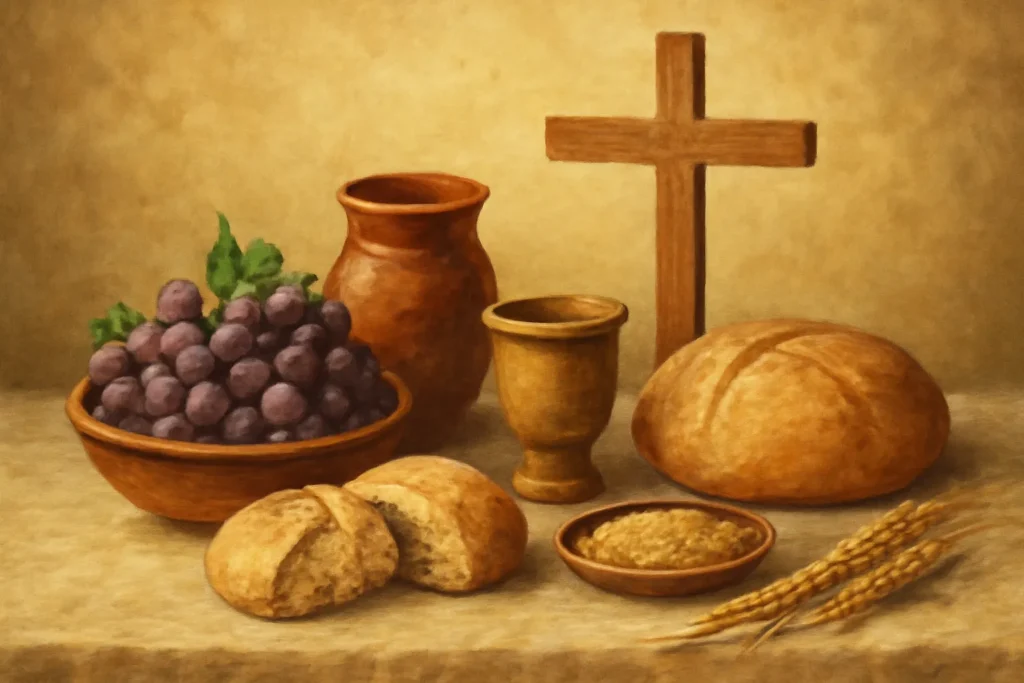
The culmination of Jesus’ food-symbolism is the Passover meal turned into a covenant meal: the Last Supper. Jesus blesses the bread and cup, saying, “This is my body” and “This cup is the new covenant in my blood” (Matthew 26:26–29; Mark 14:22–25; Luke 22:19–20). The Eucharistic reverberations across Christian traditions link memory, gratitude, and a forward-looking hope—the expectation of a feast with Christ at the culmination of history, described in Revelation as the marriage supper of the Lamb (Revelation 19:9). Eating becomes a public confession of faith in the Son and a means by which believers participate in his life, death, and resurrection.
Matthew 14:13–21 — feeding the 5,000
Matthew 26:26–29 — the Last Supper and the institution of the Eucharist
John 6:25–59 — the Bread of Life discourse
Revelation 19:9 — the marriage supper of the Lamb
Yeast, Wheat, and the Parables: Food as a Lens on the Kingdom
Food imagery also colors Jesus’ parabolic teaching. The parable of the yeast (or leaven) shows how something small can transform a larger whole, mirroring the way the kingdom of God expands from a modest beginning. Likewise, bread and grain imagery appear in parables about gathering and transformation, inviting readers to recognize the power of God to bring about growth and renewal from humble beginnings.
Yeast as Parabolic Power
In Matthew 13:33 and Luke 13:20–21, Jesus compares the kingdom to yeast hidden in dough, which works quietly yet profoundly. The image can be read as a positive sign of internal, transformative growth within the human heart and within communities that welcome God’s rule. Yet other biblical uses of leaven warn against hypocrisy and corruption (as in the phrase “the leaven of the Pharisees” in Matthew 16:6), reminding readers that influences within a community can either ferment life or spoil integrity. The nuanced treatment invites discernment: the kingdom often grows through unassuming means, and communities must guard against spiritual disease that compromises the whole loaf.
Wheat, Harvest, and the Holy Spirit’s Maturity
Wheat imagery connects what sustains life with what yields fruit for God’s purposes. In Gospel and epistolary writings, the harvest motif appears as a call to labor in God’s field, to be prepared, and to depend on God for fruitfulness. The practical ethics of work, generosity, and stewardship emerge from these agricultural pictures, guiding believers toward a life that aligns daily action with divine purposes.
Matthew 13:33 — the yeast parable
Luke 13:20–21 — the yeast in dough parable
John 6 (Bread of Life discourse) as a theological center for nourishment and faith
Fasting, Feasting, and Spiritual Appetite
Scripture treats food as not only a source of pleasure or provision but also as an arena for discipline, discernment, and devotion. Fasting and feasting together shape the soul’s appetite for God and align the body with spiritual aims. Prophetic calls for fasting emphasize justice and righteousness, while feasting moments celebrate God’s mercy and blessing. The balance between restraint and gratitude offers a robust ethic for believers navigating modern food culture.
Prophetic Fasting: A Rite of Humility and Justice
Isaiah 58 reframes fasting as not only abstaining from food but pursuing justice, feeding the hungry, and repairing broken lives. The prophet links true fasting with social transformation—sharing bread with the hungry, sheltering the oppressed, and advocating for the vulnerable. In this frame, nourishment becomes a moral action that reshapes communities and honors God.
Joyful Feasting: The Psalms, Proverbs, and Wisdom Literature
However, Scripture also lauds feasting as a blessed practice. Psalm 23 and Psalm 34 celebrate God’s benevolent provision and the blessing of abundant tables in the presence of enemies. Proverbs and Ecclesiastes offer nuanced takes on abundance, labor, and the right use of food to build a life of wisdom and gratitude. The refrain is clear: eating with gratitude, moderation, and generosity fosters wisdom and joy.
Isaiah 58 — fasting coupled with justice and mercy
Matthew 6:16–18 — Jesus’ teaching on authentic fasting
Psalm 34:8 — tasting and seeing that the Lord is good
Dietary Law, Freedom, and Transformation
Dietary rules in the Bible reveal a tension between purity, holiness, and freedom in Christ. The Old Testament contains extensive laws about clean and unclean foods (Leviticus 11) intended to teach holiness and separation for the people of God. The New Testament, however, reinterprets these distinctions in light of the gospel, culminating in a vision of inclusion that challenges barriers between people and foods. This arc is essential for understanding how Scripture dialogues with questions about modern dietary practices, purity codes, and cultural differences.
Leviticus 11–15 contains clear guidelines about what is clean and unclean. The laws function not only as dietary restrictions but also as symbolic thresholds that separate God’s people from surrounding nations and remind them of their dependence on God for life and health. The food laws teach discipline, cultural identity, and the sacred nature of daily life, even as they point forward to a more universal horizon.
New Covenant Re-interpretation and Freedom
In Acts 10–11, Peter’s vision of a sheet containing “all kinds of animals” initiates a reinterpretation of clean and unclean. God declares, “What God has made clean, you must not call common.” This breakthrough points to the gospel’s reach beyond Israel to Gentiles and invites believers to discern how dietary practices relate to faith, love, and unity in Christ. Paul’s letters further echo this principle: the Christian life is not defined by external foods but by faith working through love (Galatians 5:6).
Leviticus 11 — clean and unclean foods
Acts 10–11 — Peter’s vision and the inclusion of Gentiles
Romans 14 and 1 Corinthians 8–10 — liberty in food and sensitivity to weaker consciences
Foods of Hope: Eschatological Banquets and the Kingdom Feast
Many biblical passages cast food as a bridge to future hope. The most explicit eschatological meals are found in the prophetic literature and the New Testament's final redemptive scenes. These passages invite believers to live in light of a promised feast that transcends scarcity and sorrow.
Prophetic Visions: The Heavenly Banquet and the Lord’s Table on the Horizon
Prophets imagine a time when God’s house will be a place of unending abundance—a feast of rich foods and well-aged wines (Isaiah 25:6). This imagery grounds hope in tangible, celebratory meals and signals the end of hunger and oppression. The marriage supper of the Lamb (Revelation 19:9) offers a climactic vision of eternal fellowship with God, where the feast becomes the forever-structure of worship and communal life.
New Creation: A Feast Without End
In the New Testament, the final banquet is not just a meal but a transformative restoration. It anticipates a landscape where justice, peace, and plenty are everywhere, and the church participates in that reality through present acts of compassion, hospitality, and worship. The table, then, is a foretaste of eternity and a current invitation to live as people who taste and see the goodness of God today.
Isaiah 25:6 — a feast of rich foods and well-aged wines
Revelation 19:9 — the marriage supper of the Lamb
Thus, the biblical hunger for nourishment becomes a hunger for God, and the biblical feasting becomes a practice that models the coming kingdom: generous meals, shared tables, and a world transformed by love.
Gratitude and dependence: Across the Bible, nourishment points toward gratitude for God’s daily provision. Practice daily thanksgiving before meals, recognizing the gift of food as a sign of God’s faithfulness.
Hospitality as mission: The biblical pattern of opening homes and tables invites believers to welcome others and build community. Look for practical ways to extend generosity in meals, especially to the marginalized and those in need.
Wisdom in consumption: Scripture invites discernment in what we eat, how we eat, and why we eat. Seek temperance, moderation, and ethical choices in sourcing food, honoring God with our bodies and with creation care.
Spiritual nourishment: Like Jesus’ Bread of Life discourse, nourishment must point beyond the physical to the life God gives in Christ. Read the Bible, pray, and engage in spiritual disciplines that sustain faith as food sustains the body.
Community identity: Meals anchor communities in shared memory and hope. Whether at a family table or church fellowship, meals can reinforce belonging, accountability, and mutual care.
Hopeful eschatology: Let the expectation of future feasts shape present ethics and commitments: care for the hungry now, labor for justice, and live as signposts of the coming kingdom where every mouth is filled with good things.
These practical beliefs are not a checklist but a living framework. They invite us to see the ordinary act of eating as a practice that aligns us with God’s story in the Bible—a story that begins with manna in the wilderness and culminates in an eternal feast with the Lamb.
Throughout Scripture, food is a teacher and a mercy. It teaches dependence on God, reveals God’s generosity, and calls people to live in faithful rhythm with creation, covenant, and community. From the manna in the desert to the Bread of Life discourse in the Gospel of John, and from the scandal of dietary boundaries to the open invitation to a universal feast, biblical references to food illuminate a vibrant, multi-faceted vision of nourishment. They remind us that nourishment is not only about what fills our stomachs but about who fills our lives with meaning, hope, and purpose—the one who gives himself for the life of the world.
May readers respond to these biblical teachings with grateful hearts, generous hands, and a renewed reverence for meals as moments of grace. By honoring the biblical language of bread, wine, oil, and harvest, we participate in a grand story of nourishment that spans the wilderness, the cross, the church, and the promised feast of the ages.








Leave a Reply