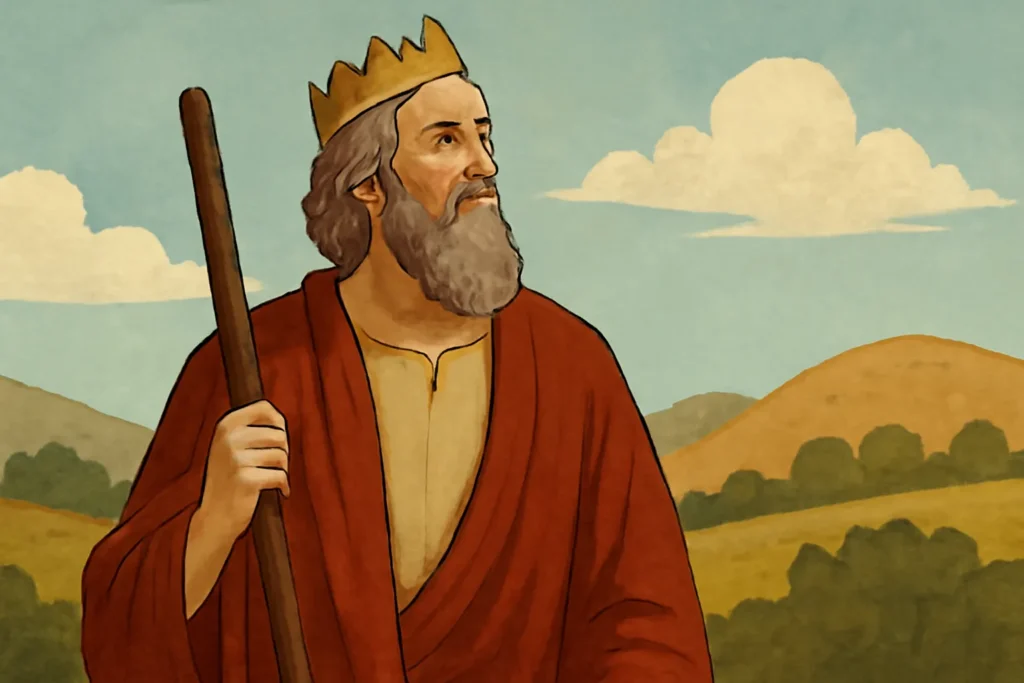
2 Samuel, sometimes called the Second Samuel or the book of Samuel, part II, continues the historical narrative begun in 1 Samuel and concentrates on the reign of David as king over a united Israel. This biblical book, which sits in the Hebrew Bible/Old Testament as part of the Deuteronomistic history, picks up after the dramatic events surrounding Saul’s reign and his demise. It charts the consolidation of David’s rule, the expansion of the royal household, the political and spiritual challenges that accompany leadership, and the complexities of covenantal faithfulness in a rising monarchy. The narrative arc moves from the euphoric beginnings of a centralized capital and a flourishing dynasty to the troubling episodes that test David and his court, ultimately underscoring themes of mercy, justice, and divine faithfulness to a royal line.
For readers seeking a compact explanation, this 2 Samuel overview emphasizes how the text shapes concepts of covenant, kingship, leadership ethics, and communal memory. The book, in its own right, serves as a bridge between the era of the judges and the later, more expansive portrayal of David’s dynasty that culminates in Solomon. If you are exploring the biblical narrative with an eye toward theology and literary craft, this overview of the book of 2 Samuel highlights the ways in which power, responsibility, and divine-human relationship are braided together in the Davidic story.
Key Themes in 2 Samuel
Across the chapters of 2 Samuel, several motifs recur with striking clarity. The following list highlights the core concerns that scholars and readers frequently notice, and a 2 Samuel overview would not be complete without them. The entries below use bold terms to mark the most important ideas you will encounter in the text.
Davidic Covenant and the divine promise to establish a perpetual royal dynasty for Israel, resilient through generations despite human failure.
Unity and centralization of worship and government, especially the move of the ark and capital to Jerusalem, symbolizing a new political center.
Kingship and responsibility as a test of character, choosing mercy over vengeance, and justice over expediency.
Sin, repentance, and consequences as ongoing dynamics—David’s adultery with Bathsheba and the ensuing fallout demonstrate that power does not shield one from accountability.
Prophecy and accountability through figures such as Nathan, who rebukes the king and brings healing through truth-telling and covenantal language.
Violence, war, and peace as repeated conditions of the Davidic era, where military success and political strategy intersect with moral ambiguity.
Divine presence and abandonment—moments when God’s favor appears and when it withdraws, guiding the narrative’s moral and theological trajectory.
Family dynamics and leadership—Absalom’s rebellion and other domestic crises reveal how private loyalties and public power interact within a royal household.
Hospitality and mercy vs. justice—episodes where David demonstrates restraint or mercy, and others where judgment seems unavoidable.
Covenantal faithfulness despite human weakness—the story emphasizes that God remains committed to the chosen line even when the king falters.
In this overview of 2 Samuel, these themes are not isolated notes; they are braided together to present a coherent meditation on leadership, accountability, and the way God works through imperfect people to accomplish divine purposes.
For those studying the book in depth, it can be productive to track how these themes appear in different parts of the text. For example, the Davidic Covenant emerges most fully in a prophetic exchange late in the narrative, while mercy and judgment are visible in David’s response to Nathan’s rebuke and in his measured handling of his son Absalom’s rebellion.
Structure and Literary Design
Structurally, the book of 2 Samuel is typically approached in four broad movements, each focusing on different aspects of David’s reign and the development of the Israelite monarchy. A practical 2 Samuel overview of its architecture helps readers recognize how the author uses narrative sequence, character development, and theological reflection to shape memory and meaning.
Consolidation of David’s rule and the unification of Israel (roughly chapters 1–5). This section includes the transition from Saul’s house to David’s kingship and the capture of Jerusalem as a political and spiritual center.
Expansion of the kingdom and the consolidation of worship (chapters 5–10). The establishment of a central capital, political reforms, and the association of the Ark with the throne illuminate a major shift in royal ideology.
Personal crisis and moral testing (chapters 11–12). The narrative’s hinge moment, featuring the adulterous affair with Bathsheba and the prophetic confrontation by Nathan, reframes the king’s legitimacy and the nation’s future.
Domestic upheaval and political turbulence (chapters 13–20). A sequence of family conflicts, coups, and counter-moves reveals the fragility of royal power and the human costs of ambition.
Final years, wars, and the closing notes (chapters 21–24). The closing material ties up military episodes, public memory, and the census episode, offering a reflective coda on David’s legacy.
Literary devices and theological emphasis
Character development in David, whose strengths and flaws are laid bare, allowing readers to observe how leadership evolves under pressure.
Prophetic intercession as a narrative instrument—Nathan functions as a moral compass whom God uses to call the king to accountability.
Prophetic-royal dialogue that frames the covenantal relationship between God and the king, often in terms of promise, obligation, and consequence.
Historical memory through annals and royal records that the text preserves for communal identity and instruction.
Viewed through this structural lens, the 2 Samuel overview reveals how the author constructs a layered story: the outward success of a centralized monarchy, the inward moral complexity of leadership, and the enduring fidelity of God to the people and to the promised dynasty. The organization of the narrative itself reinforces the central message: kingship is a divinely chosen but humanly tested institution, and the ultimate destiny of the nation hinges on fidelity to covenant and justice.
Timeline and Chronology of Key Events
Readers benefit from a chronological map that follows the sequence of drama in the 2 Samuel narrative. The following timeline captures the primary milestones and turning points, presenting them in a way that supports a practical Second Samuel overview for teaching, study, or thoughtful reading.
David becomes king over Judah (early chapters). This marks the transition from Saul’s dynasty to the house of David and the beginning of a unified political project.
David becomes king over all Israel (late in the early part). The political consolidation completes, with Jerusalem as the capital and symbol of the new era.
Ark of the Covenant moved to Jerusalem and established as a central religious symbol. The integration of worship with governance deepens the sense of divine backing for the throne.
David’s sin with Bathsheba and the confrontation by Nathan. The king’s moral collapse becomes a watershed event that reshapes the narrative’s trajectory.
Death of Uriah and the child’s tragedy, leading to public consequences within David’s house.
Prophetic rebuke and exile of arrogance—Nathan’s warning sets in motion a cycle of accountability and renewal.
Absalom’s rebellion—the capital crisis that tests David’s leadership and highlights the vulnerability of governance to domestic factions.
David’s exile and return—the dynastic stability is threatened, then restored, underscoring the precariousness and resilience of the monarchy.
Final campaigns and governance challenges—ongoing wars, political maneuvering, and the moral consequences of leadership choices shape the late career of the king.
Closing chapters—the genealogies, martial memories, and the census episode that frame David’s legacy and set the stage for the subsequent biblical narrative in 1 Kings.
In a pedagogical 2 Samuel overview, this timeline helps anchor a reader’s understanding of cause and effect—how early victories create opportunities and how later errors generate consequences, all within the overarching framework of God’s purposes for a royal line.
While David anchors the narrative as the central figure, the book of 2 Samuel introduces a cast of important characters whose choices shape the destiny of the nation. Below is a concise guide to the principal actors and their roles in the story.
David—the anointed king whose reign unites Israel, expands the kingdom, and faces profound personal and political challenges.
Bathsheba—a central figure in the moral drama that tests David’s integrity and the consequences that follow.
Uriah—Bathsheba’s husband whose fate highlights the costs of palace intrigue.
Nathan—the prophet who voices God’s rebuke and delivers covenantal insights, guiding public repentance and renewal.
Joab—David’s loyal yet politically shrewd general, whose actions drive many military and strategic outcomes.
Absalom—David’s son whose rebellion and complex motives reveal the fragilities of succession and the pain of family conflict.
Adonijah—a later figure in the dynasty who embodies competing claims to the throne, foreshadowing Solomon’s rise.
Sheba—a rebel leader whose short-lived revolt tests the king’s broader political response.
Readers of the Second Samuel overview can trace how each character’s decisions contribute to the unfolding history, highlighting themes of loyalty, power, justice, and mercy that persist throughout the biblical narrative.
Scholars often approach 2 Samuel as both a theological document and a literary achievement within the biblical corpus. A robust 2 Samuel overview takes into account how the text conveys covenant faithfulness, divine sovereignty, and human responsibility. The following points illuminate several key angles commonly explored by scholars and teachers:
Covenantal fidelity as the undergirding premise of the Davidic dynasty, with God’s promise persisting even as human beings falter.
Prophetic critique as a structural device for moral accountability, especially through the figure of Nathan who exposes David’s missteps and invites repentance.
Royal theology—the way kingship is portrayed as a vocation with spiritual obligations, including a call to justice and mercy toward the people.
Public memory—rituals, chronicles, and genealogies that preserve lessons for future generations about leadership and covenant faithfulness.
Ethical complexity—the text does not sanitize political ambition or mercy; it presents a nuanced picture of how power operates in a fallen world.
In this vein, the 2 Samuel overview emphasizes that the book’s potency lies in its mixture of triumph and tragedy, divine promise and human failure. It invites readers to consider how individuals can respond to divine call with humility and courage, even when personal costs are high.
Understanding the setting of 2 Samuel enriches any overview of the Second Samuel. The book is often dated to a period after the establishment of a centralized monarchy in ancient Israel, a moment when tribal confederacy gives way to a more consolidated political structure. The narrative is frequently linked to the Deuteronomistic history tradition, which interprets events through the lens of covenantal obedience to God. The following contextual notes offer a compact primer for readers who want to situate the book within its broader literary and historical milieu:
Political centralization—the move to Jerusalem as capital reflects a deliberate shift toward centralized governance and a unified national identity.
Administrative reforms—the era introduces professionalized leadership, strategic military planning, and the institutional memory of the monarchy.
Religious reform and worship—the proximity of the Ark to the throne signals a strong link between liturgy, temple-focused worship, and royal legitimacy.
Military culture—wars, sieges, and campaigns shape the geopolitical landscape and reveal the limits of human prudence in the face of divine will.
Social and ethical discourse—the text engages with questions about justice for the vulnerable, accountability for rulers, and communal responsibilities during times of crisis.
This historical frame reinforces the sense that the narrative is not merely a chronicle of events but a deliberate construction intended to convey moral and spiritual lessons to the Israelite community and to readers across generations.
How to Read 2 Samuel: Practical Tips for a Thoughtful Overview
When approaching the book from a study perspective, the following practical notes may help you craft a coherent and engaging 2 Samuel overview for teaching, personal study, or public discourse.
Track causality—note how early decisions lead to later consequences, and how divine pronouncements shape human actions.
Notice parallel structures—the juxtaposition of David’s early victories with later failures mirrors a broader theological message about leadership and accountability.
Balance mercy and justice—observe how mercy is offered and how justice is administered, sometimes through human instruments and sometimes through divine intervention.
Pay attention to characters—each major figure embodies a spectrum of virtues and flaws that illuminate different aspects of leadership and faith.
Consider the covenant theme—the sustained focus on the Davidic line invites readers to reflect on what it means for God to establish a kingdom and for humans to respond to that invitation responsibly.
As you explore this 2 Samuel overview, you will likely notice how the book’s literary craft—its narrative pacing, its use of dialogue, and its prophetic interruptions—contributes to a durable and meaningful portrait of a monarchical era in ancient Israel.







Leave a Reply