The line in Proverbs 31:25 stands as a compact, powerful portrait: strength, dignity, and a posture of hope before the future. In different Bible translations, the same image is rendered with small but meaningful shifts in emphasis, inviting readers to hear the message in slightly different tones. The core idea remains consistent: a person of virtue wears resilience as a garment, finds inner worth in bold character, and anticipates what lies ahead with confidence rather than fear.
Here are several succinct renderings that illustrate the semantic breadth while preserving the essential sense of the verse:
KJV: "She is clothed with strength and honour: and she shall rejoice in time to come."
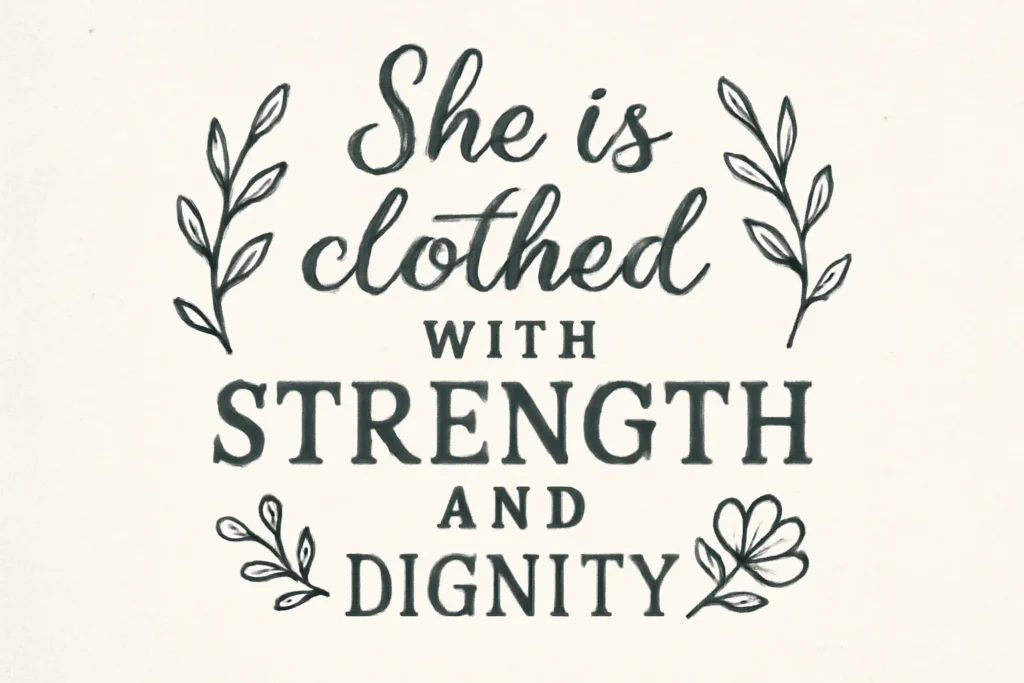
NIV: "She is clothed with strength and dignity; she can laugh at the days to come."
ESV: "Strength and dignity are her clothing, and she laughs at the time to come."
NASB: "Strength and dignity are her clothing, And she smiles at the future."
The Message (paraphrase): "She is clothed in strength and dignity, and she laughs at the days to come."
Beyond these literal lines, the verse is often discussed in terms of imagery—garments as a metaphor for inner character, and time as a test of trust. A few alternative expressions—useful for study, prayer, or sermon writing—offer variations on the same truth. For example:
Garments of power and grace: a woman who wears inner strength with elegance, not arrogance.
Clothing of resilience that shields the heart when uncertainty looms on the horizon.
Dignity as armor that enables a calm, hopeful response to the future’s unknowns.
Hopeful laughter that rises from trust rather than denial of hardship.
Joyful confidence about what is to come, grounded in character rather than circumstance.
In exploring these variations, readers encounter a key range of interpretations: some focus on the ethical ideal of a virtuous woman; others highlight the psychological reality of maintaining dignity under pressure; still others emphasize the theological stance of hope that persists in times of trial. Throughout, the phrases strength, dignity, and hope function as a triad that can be invoked in personal reflection, pastoral teaching, or daily practice.
Cross-cultural and cross-traditional echoes
While the language of the verse is rooted in the Hebrew Bible, the themes translate across cultures and belief systems. The notion of wearing strength and dignity as essential character traits resonates with ethical literature beyond the Christian tradition. In many settings, this triad is cited as a standard for personal conduct, leadership, and service—where one’s outward presentation mirrors an inner posture of trust, kindness, and perseverance. Seeing the future with hope becomes a universally accessible practice that transcends particular doctrinal boundaries.
The word strength in Proverbs 31:25 operates on several levels, each contributing to a holistic sense of empowerment:
Inner resilience: A steadiness that holds through challenges, failures, and changing circumstances.
Moral courage: A commitment to truth, justice, and mercy even when it is costly or unpopular.
Emotional stamina: The capacity to endure hardship without despair, maintaining hope and compassion.
Relational strength: The ability to support others, set healthy boundaries, and nurture communities.
Spiritual anchoring: A steadfast trust that God’s guidance remains present amid uncertainty.
When the text speaks of being clothed with strength, it suggests a daily, continual wearing rather than a one-time achievement. The image invites readers to imagine a life in which strength is not a sprint but a steady thread woven into ordinary acts—work, parenting, service, and leadership. This makes strength both a personal resource and a social signal: it signals that a person can endure, endure well, and extend help to others in need.
In real life, strength is rarely a single attribute. It is a composite of tenacity, humility, resourcefulness, and care. Proverbs 31:25 invites us to consider how these facets come together:
Tenacity to persist in the face of obstacles;
Humility that keeps pride in check and honors others;
Resourcefulness in managing home, work, and community responsibilities;
Compassion that channels strength toward the welfare of others.
The synergy of these qualities produces a life marked by steadfastness and generosity, a combination that many readers find both inspiring and practically instructive.
Dignity as a Virtue
Dignity in this verse is not simply about outward appearance or social status; it is a sustained posture of worth and decency that shapes behavior and judgment. Dignity communicates self-respect and respect for others, even under pressure. It entails choosing words with care, acting with integrity, and maintaining a hopeful orientation toward the future.
Self-respect grounded in values rather than vanity.
Respect for others demonstrated through mercy, fairness, and listening.
Consistent character under stress, showing up with steadiness in family, work, and faith communities.
Grace under pressure that does not collapse into cynicism or despair.
Dignified leadership that invites collaboration, not domination.
In practical terms, dignity becomes evident when a person speaks truth with kindness, acts responsibly when resources are scarce, and models trust in the face of uncertainty. It is both a personal discipline and a social signal—an invitation to others to engage with integrity and hope.
Respecting the limits of dignity
It is important to acknowledge that the portrayal in Proverbs 31:25 is not a template for gender stereotypes or an idealized life without struggle. Rather, it presents a portrait of virtue under pressure that can be learned from by people of all backgrounds. The dignity described here invites reflection on how we treat ourselves and others when time grows tense or the future appears unpredictable.
Hope and the Future
The phrase the days to come or the future anchors this verse in a forward-looking stance. Hope in this context is not a vague optimism; it is a confident expectation rooted in character, trust, and a sense of purpose. The idea that someone can "laugh at the time to come" or "smile at the future" conveys a poised joy that does not ignore difficulty but transcends it.
Hope as steady anticipation: anticipating good outcomes while remaining realistic about present challenges.
Joyful resilience: a posture of cheerfulness that does not dismiss risk but meets it with courage.
Trust-filled confidence: confidence grounded in a relationship with something greater than oneself, whether understood in religious, philosophical, or secular terms.
Future-oriented ethics: choices today that honor the promises of tomorrow, including care for family and community.
Different readers expand the concept of hope in diverse directions. Some anchor it in faith, others in a steadfast commitment to justice, and still others in the simple daily acts of kindness that accumulate into a life of meaning. In all cases, the verse invites a stance that refuses despair and chooses a path of constructive action, generosity, and faithfulness.
Hope as a daily practice
Turning hope into daily practice might involve small rituals:
Starting the day with a moment of gratitude and a view toward possible good.
Setting realistic, values-driven goals for the week or month.
Engaging in helping others, which strengthens both giver and recipient.
Reflection on lessons learned during hardship to fuel future resilience.
Practical Reflections for Everyday Life
The insights from Proverbs 31:25 translate into concrete practices that can shape daily life for individuals, families, and communities. The following ideas offer practical pathways to embody strength, dignity, and hope in ordinary routines.
Physical and emotional health as a foundation for resilience: adequate rest, nutrition, exercise, and healthy boundaries.
Mindful self-talk that reinforces value rather than diminishing it, especially during setbacks.
Spiritual or reflective practices that connect inner strength to a larger sense of purpose.
Relationships and community
Listening with dignity before speaking; creating space for others’ voice and pain.
Mutual support within families and circles of friendship; sharing burdens and joys alike.
Mentorship and leadership that empower others to cultivate their own strength and dignity.
Work, service, and civic life
Ethical decision-making that respects people, resources, and time.
Stewardship of one’s talents and duties, with a view toward the common good.
Encouragement of others to persevere through difficulties, modeling a hopeful outlook.
These practical avenues are not a checklist to perfection but a map for gradual growth. They invite readers to adopt a lifestyle in which strength is active, dignity is practiced in action, and hope remains a trustworthy compass.
Historical and Theological Context
To deepen understanding, it helps to consider the place of Proverbs 31:25 within the book of Proverbs and within the Wisdom tradition more broadly. The closing chapter (Proverbs 31) is a distinct unit that presents both an idealized portrait and a practical guide for virtue. While the famous speech on the "virtuous woman" has often been discussed in gendered terms, many scholars emphasize its universal themes: character, competence, care, and courage under pressure.
Historical setting: Proverbs 31 reflects ancient Near Eastern wisdom literature, in which moral instruction is conveyed through paradox, metaphor, and case-based exhortation. The imagery of clothing is a common figurative device in Semitic poetry and wisdom writing. Clothes function as outward signs of inward reality, signaling readiness for the tasks of life and the moral temperament that enables success in daily duties.
Theological strands: For readers who approach from a faith perspective, the verse intersects with notions of divine support, providence, and the call to faithful living. The idea that strength and dignity are “garments” can be read as a symbol of divine bestowal—God grants or sustains the inner resources that enable virtuous living. Yet the text also challenges believers to cultivate those traits through discipline, wisdom, and love.
Literary purpose
The line is concise, yet its impact reverberates through later wisdom and devotional literature. It invites readers to imagine living in a way that is visibly resilient—with moral integrity and hopeful expectation. It also invites communal reflection: how a community views and supports those who carry such virtues can either magnify or diminish their influence.
Imagery and Literary Devices
The verse employs several striking literary devices that reinforce its message. The most prominent is the garment metaphor: clothing chosen not for fashion but for function—protective, identifying, and expressive.
Garment imagery: Strength and dignity are described as clothing, suggesting preparedness, virtue, and a visible display of inner life.
Personification of hope: The future is not an abstract horizon but a scene in which one can laugh, smile, or rejoice.
Parallelism: The pairing of strength with dignity echoes the wisdom-pattern of balance and complementarity between moral traits.
Optimistic modality: The verse projects confidence about what lies ahead, even in the face of uncertainty.
Reading across translations reveals subtle shades of meaning: the Hebrew concept of strength can encompass both physical vigor and moral power; dignity can imply honor and propriety; the future or the times to come sometimes denotes specific seasons of life or broader epochs. These layers of meaning enrich study and pastoral application alike.
Intersections with Gender, Culture, and Modern Life
The traditional image of the virtuous woman has sparked diverse responses in contemporary culture. Some readers celebrate the verse as a universal standard of character that transcends gender, while others critique it as potentially reinforcing rigid gender roles. In thoughtful engagement, many find a middle path: the core values of strength, dignity, and hope can apply to anyone—men and women alike—while acknowledging unique cultural expressions of virtue.
In communities that value equity and dignity, Proverbs 31:25 can serve as a shared standard for personal growth and communal responsibility. Its emphasis on inner strength combined with outward grace invites ongoing dialogue about character formation, resilience, and the ways in which hope sustains people through hardship.
Closing Reflections
Proverbs 31:25 offers a compressed but rich meditation on how a person can navigate life with strength, dignity, and hope. The verse’s compact phrasing invites readers to unpack its layers, consider its applications, and translate its images into concrete actions. Whether approached as a religious text, a piece of literature, or a guide for ethical living, the verse remains relevant: it calls for character that endures, behaves with decency, and faces the unknown with trust and joy.
By exploring the various translations, interpretations, and practical implications outlined here, readers can cultivate a more integrated understanding. The triple emphasis—strength, dignity, and hope—serves as a threefold compass for personal growth, relational flourishing, and communal well-being. In a world that often tests resolve, this proverb invites us to clothe ourselves not in fear or despair but in a durable, visible virtue that blesses both the wearer and those around them.
Whether you are studying the verse for academic purposes, preparing a talk, or seeking encouragement for daily living, returning to the phrase’s triad—strength, dignity, and hope—can anchor reflection, prayers, or conversations about what it means to live with purpose. The enduring message remains clear: resilience worn with grace can illuminate the path ahead, and a hopeful heart can transform even the most uncertain future into a field of possibility.










Leave a Reply