First Great Awakening: Origins, Impact, and Key Figures in Colonial America
First Great Awakening: Origins, Impact, and Key Figures in Colonial America
The First Great Awakening was a transformative religious movement that swept across British North America in the decade or two before and after the middle of the eighteenth century. It reshaped the way many colonists understood faith, authority, and community, and it helped lay the groundwork for later developments in American society. This article traces the origins of the revival, the key channels through which it spread, the principal figures and factions involved, and the enduring impact on religion, education, and culture in the colonial world.
Several strands came together to produce a broad, transatlantic revival that would soon be recognized as a watershed in North American religious history. The religious life of the colonies was complex and varied by region, but a common pattern persisted: a long-standing reliance on established churches, a strong heritage of Puritan piety in New England, and a Calvinist-tinged evangelical current that allowed for intense, interior religious experiences. Into this mix flowed new ideas from Europe and from pietistic movements in the English and German-speaking world, which emphasized personal conversion, spiritual renewal, and revival preaching.
The philosophical milieu of the period also mattered. The Enlightenment introduced appeals to reason, natural law, and inquiry that some observers perceived as challenging traditional authority, church hierarchy, and the seriousness of sin. In the American setting, the tension between rational inquiry and evangelical passion helped create space for a revival that argued faith did not merely rest on inherited status or formal creeds but required a living, transforming encounter with grace.
Several practical and social conditions contributed to the climate of revival. Rural settlements and frontier communities often faced hardships—distance from established parishes, rapid population movements, and the vulnerability of life on the edge of colonial frontiers. In such places, churches were sometimes weak or divided, and itinerant preachers could reach people who had little exposure to formal religious instruction. The presence of strong community identity and the desire for meaning beyond routine parish life created a receptive audience for exhortation, moral reform, and emotional religious expression. In addition, a robust print culture spread sermons, pamphlets, and letters that could ignite and sustain spiritual fervor across large geographic areas.
In short, the dawn of this awakening in the colonies arose from a combination of deep religious longing, theological stimuli rooted in Calvinist and Reformed traditions, and changing social and cultural conditions that made new forms of religious experience both imaginable and appealing.
Theological and Intellectual Currents
At the heart of the movement was a renewed emphasis on conversion experience as a decisive moment in a believer’s life. Traditional doctrine often described salvation in terms of a covenant relationship with God maintained by grace; the revival amplified the immediacy of that encounter, framing it as a personal, transformative experience that could be witnessed and shared with others. The role of preaching—evangelical, intense, and emotionally charged—became central. Sermons designed to move listeners toward repentance and renewal appealed not only to intellect but also to the heart, a hallmark of the New Lights tradition that challenged what many called the Old Lights approach to ministry.
Important terms to know include:
- New Lights and Old Lights: denoting factions within Congregationalist and Presbyterian circles regarding the value of revival emotion versus more traditional forms of worship and education.
- Revival preaching: itinerant and sermon-centered ministry aimed at sparking spiritual renewal across diverse communities.
- Conversion narratives: personal stories of turning toward faith that circulated widely in sermons, journals, and pamphlets.
Jonathan Edwards, a leading Puritan theologian in New England, helped anchor many of these ideas in a distinctly congregational, cognitively rigorous, yet emotionally resonant form of preaching. His famous sermon Sinners in the Hands of an Angry God (though often cited as a stark illustration of Puritan fear rhetoric) also braided a sober assessment of human sin with a hopeful invitation to divine mercy, illustrating how intellectual depth and urgent exhortation could coexist in revival theology.
Across the Atlantic, the ongoing exchange between British evangelical leaders and colonial pastors shaped the message as well. The rise of revival religion did not transplant one rigid formula; rather, it produced a family of practices that included camp meetings, emotional testimonies, and a broader sense of religious excitement that cut across denominational lines.
Social and Demographic Forces
The revival’s appeal extended beyond major cities and established parishes. Frontier areas, settlement districts, and less-structured churches stood to benefit from a revival that emphasized equal access to grace and to religious leadership, regardless of social status. Women, for example, found opportunities to participate in worship, testify to personal experiences of grace, and influence family and community religious life in ways that could be discouraged or restricted in more formal settings. This democratization, even if limited, helped shift norms about who could speak, lead, and shape religious practice in the colonial world.
Importantly, the movement did not erase regional differences. New England Congregationalism, Presbyterian communities in the Middle Colonies, and Baptist and Anglican groups in the South and borderlands experienced revival in characteristic yet distinct ways. The revival’s ability to reach diverse audiences across a wide geographic area—while still adapting to local customs and institutional structures—was one of its most remarkable features.
Spread Across the Colonies
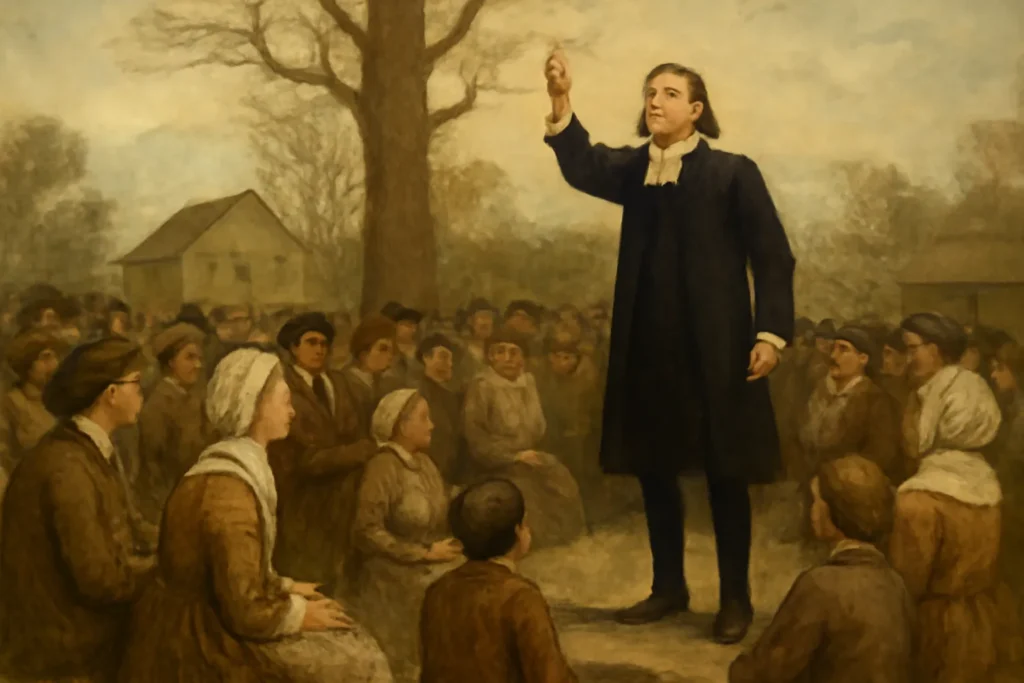
As the revival cycle intensified, preachers traveled from colony to colony, creating a network of shared themes, symbols, and practices. The movement’s reach was astonishing in its breadth, and its methods—series of sermons, emotional appeals, outdoor meetings, and communal decision-making—left a lasting imprint on religious culture.
New England became a central theater for revival energy, with Congregational churches and their ministers embracing renewed zeal. The Northampton awakenings associated with Edwards and others demonstrated how doctrinal reform and compassionate preaching could converge to mobilize lay believers and reorient congregational life.
Mid-Atlantic region saw a blend of Presbyterian, Dutch Reformed, and Anglican communities cultivate revivalist impulses. Gilbert Tennent, a Presbyterian minister, helped articulate a New Light critique of complacent ministerial life in the frontier colleges and churches, urging a return to experiential faith and vigorous preaching.
Southern backcountry and frontier zones experienced revival in ways that complemented the rise of Baptist and Methodist currents. The frontier’s rough landscapes and community-centered living shaped forms of worship—often in outdoor spaces—that emphasized personal conversion, communal testimony, and social ties strengthened through shared religious experiences.
The movement’s geographic pattern was not uniform, but the common elements—emotional preaching, calls to conversion, and renewed congregational life—were widely felt. The revivals helped shift religious authority away from distant denominational elites toward local preachers, lay leaders, and ordinary members who could articulate personal religious experience in compelling ways.
Key Figures and Movements
Although the revival drew support and leadership from various quarters, a few individuals and campaigns stood out for shaping its direction and afterlife. The collision and conversation among these figures and groups produced a dynamic dynamic that would redefine American Protestantism in the colonial era.
Jonathan Edwards and the Northampton Revival
Jonathan Edwards anchored a movement in New England with a theology that combined rigorous Calvinism, an insistence on sovereign grace, and a powerful sense of divine visitation. His preaching emphasized the perilous condition of the unconverted and the irresistible call to repentance. But Edwards also insisted on sophisticated doctrinal reasoning, cultivating a kind of revivalism that could withstand intellectual scrutiny. His work and leadership in the Connecticut Valley during the 1730s, culminating in sustained awakenings, demonstrated that religious reform could be both emotionally compelling and theologically coherent.
George Whitefield and the Atlantic Circuit
George Whitefield, an English Anglican evangelist, became one of the most influential public voices of the Great Awakening. His itinerant preaching across coastal towns and inland settlements created a dramatic surge of religious enthusiasm. Whitefield’s eloquent, expansive rhetoric appealed to listeners of diverse backgrounds and challenged local clergy to compete in seriousness and style. He popularized the idea that spiritual renewal could cross regional and denominational lines, linking congregations with a broader evangelical network that extended into the Atlantic world.
Gilbert Tennent and the Presbyterian Awakening
Gilbert Tennent, a Presbyterian pastor and theological thinker in the Middle Colonies, sharpened the revival’s message within a Reformed framework. He argued that genuine religious life required an experiential dimension—what some would later describe as evangelical awakening—and he criticized complacency among ministers who relied primarily on routine preaching without addressing the inner spiritual crisis of individuals. Tennent’s leadership helped consolidate a New Light Presbyterian tradition that valued revival preaching, doctrinal clarity, and public accountability.
Samuel Davies, a key figure in Virginia and Maryland, extended revival energy into the southern frontiers and colonial universities. He demonstrated that the awakening’s fervor could reach more rural populations and help create a network of evangelical congregations that would later feed into broader denominational life. Davies’s ability to connect pulpit theology with practical ministry illustrated the movement’s capacity to address both doctrinal disputes and practical concerns of colonial society.
In addition to these leading figures, the movement fed a broader culture of revival preaching, testimonies, and camp-style gatherings that became a familiar feature of religious life. The appearance of new religious identities—especially among Presbyterians, Congregationalists, and Baptists—helped loosen longstanding restrictions and created space for lay leadership and collaborative ministry within and across denominations.
Theological Core: Conversion, Revival, and Democratic Spirit
Several core themes repeatedly emerged across sermons, journals, and devotional writings. These themes helped the awakening translate into social and cultural changes beyond the church walls.
Conversion as a turning point: the moment when an individual recognized sin, felt repentance, and received grace. This personal conversion was not merely a private experience but often produced public testimony and social reinforcement within the community.
Emotional engagement: revival preaching sought to move listeners by appealing to conscience and emotion as much as to reason, encouraging a direct encounter with divine mercy.
Religious egalitarianism in practice: while not erasing hierarchies, revival culture offered opportunities for lay members to contribute, speak, and lead in new ways. This contributed to shifting norms about who could exercise influence in religious life.
Denominational growth and consolidation: the spread of revivalist energy helped fuel the expansion of already existing denominations and contributed to the formation of new ones, particularly among Baptists and evangelicals who embraced revival rhetoric and ongoing missionary activity.
Educational impulse: a renewed interest in training clergy who could preach with conviction and pastoral sensitivity led to the expansion and reform of colonial colleges and schools. Higher education institutions would become crucial vehicles for evangelization and cultural formation.
The First Great Awakening thus combined a disciplined theological framework with an experiential, accessible form of religion. It offered a message that was at once rigorous and emotionally compelling, and it enabled religion to become a more participatory and widely shared aspect of colonial life.
Institutions, Education, and Cultural Shifts
Education and institutions played a central role in the revival’s trajectory. The very formation of new colleges in the colonial period was shaped by revivalist concerns about training ministers who could articulate gospel truth with clarity and passion. Several institutions emerged or grew out of the revival milieu, including some that would later become major American universities.
Princeton University (originally the College of New Jersey, founded 1746) housed a generation of ministers and lay leaders who reflected New Light theology and preaching style. The school’s early curriculum and faculty were shaped by revivalist energies—emphasizing piety, classical education, and a robust preaching tradition.
Brown University (founded 1764) and Rutgers University (1766) likewise trace their roots to religious communities seeking to prepare ministers and educated lay leaders who could engage in public life with moral seriousness.
Dartmouth College (1769) and other colonial colleges were encouraged by revivalist networks that valued religious reform and the training of pastors who would be capable of shaping conscience and civic life.
Beyond the colleges, revival networks helped standardize certain catechetical practices, improve literacy for reading the Bible and devotional literature, and foster the creation of organized associations of ministers and laypeople who could coordinate missionary efforts, missionary societies, and philanthropic initiatives. The revival’s emphasis on evangelistic preaching and public testimony contributed to a broader culture of voluntary associations, charitable work, and lay leadership that persisted long after the initial blaze of revival energy.
Print Culture, Sermons, and Public Dialogue
One of the movement’s distinctive strengths was its ability to translate spiritual fervor into a durable public discourse. Sermons, sermons collections, diaries, and pamphlets circulated with remarkable speed in the colonial press, enabling people across vast distances to participate in a shared theological conversation. The revival’s rhetoric, once published, could be reread, debated, and used to persuade neighbors and kin. This printed material often emphasized a direct appeal to conscience, a sense of urgency about salvation, and a call to reform personal conduct, family life, and community institutions.
Key features of this public discourse included:
Accessible language that could be understood by lay readers, not just clergy, thereby expanding the audience for religious instruction.
Testimonies and narratives about conversion experiences, often written in the first person to establish authenticity and to encourage reciprocal sharing within communities.
Pamphlet warfare and polemics that clarified theological differences, especially between New Lights and Old Lights, and between evangelicals and defenders of traditional parish life.
Cross-Atlantic connections as English and American evangelists shared sermons, reports, and letters, reinforcing a sense of a transatlantic revival movement.
In this sense, the revival contributed to a media environment in which religious discourse could be both intimate and public—a hallmark of Protestant modernization in the colonial era.
Impact on Religion, Society, and Denominational Life
The consequences of the Great Awakening were broad and lasting. The movement reshaped religious practice, church organization, education, and even political sensibilities in the colonies. Several of these changes took root during the eighteenth century and continued to influence American religious life well into the nineteenth century and beyond.
Denominational growth and schisms: The revival helped many congregations grow rapidly, particularly among Presbyterians, Congregationalists, Baptists, and Anglicans, and it also created lasting tensions between New Light evangelicals and the Old Light traditionalists. These tensions could lead to reforms within churches and, in some cases, to the creation of new denominations or the expansion of existing ones.
Increased lay leadership: A generation of lay preachers, female participants, and ordinary members took on roles in church life that had previously been more restricted to ordained ministers, contributing to a more participatory religious culture.
Educational expansion: The revival’s energy translated into the founding and growth of colleges and seminaries, forging a pipeline for clergy, missionaries, and educated lay leadership who would influence public life beyond the pews.
Social challenges and reform: Revivalist preaching often linked moral reform with social improvement, addressing issues such as alcohol abuse, debt, and family discipline, and encouraging communities to pursue collective improvements in behavior and civic life.
Religious pluralism: The movement’s breadth helped dilute monolithic religious authority by underscoring the legitimacy of multiple expressions of Christian faith across the colonies. This pluralism would later contribute to the religious freedom culture central to American political thought.
Transatlantic religious networks: The revival strengthened ties between colonial churches and British evangelical movements, adding an international dimension to early American religious life and facilitating cross-cultural exchange in theology and practice.
In political and civic terms, the strong emphasis on individual experience, personal decision, and public accountability may be seen as contributing to a broader sense of agency among colonists. While the Awakening itself did not articulate a program for independence, it helped cultivate a climate in which religious and civic life could be debated in ways that later fed into broader debates about rights, authority, and community life in the young Atlantic world.
Legacy, Continuities, and the Long Arc
The memory of the Great Awakening persisted in American religious and cultural life even as the specific revival events faded. Its legacy can be observed in several durable threads that continued into the nineteenth century and beyond.
Contemporary evangelical identity: The revival helped establish patterns of preaching, revival campaigns, and a bold confidence in personal religious conversion that would reappear in the Second Great Awakening and in subsequent evangelical movements.
Educational and institutional reform: The college-building impulse initiated during the Great Awakening laid groundwork for ongoing educational efforts designed to train religious leaders and to equip laypeople for public life.
Church polity and denominational life: Debates between New Light evangelicals and traditionalist ministers contributed to the emergence of more democratic church governance and to the expansion of many denominations, including Presbyterians, Congregationalists, Baptists, and methodists as they crystallized in the late colonial period and the early republic.
Rhetorical and literary traditions: The revival’s style—vivid, personal, and morally urgent—produced a lasting literary and rhetorical heritage that influenced sermons, diaries, and devotional literature for generations.
Cross-cultural and cross-regional exchange: The movement linked urban and rural religious life, New England and the South, and the Atlantic world, demonstrating that religious fervor could be a connecting force across diverse communities.
Today’s readers and scholars distinguish the First Great Awakening as a multifaceted phenomenon, not a single program or a uniform movement. Its strength lay in its ability to adapt to local contexts while binding disparate communities through shared themes of conversion, grace, and renewal. It also highlighted enduring questions about the relationship between emotion and doctrine, between lay agency and clerical authority, and between religious revival and social change—the kinds of questions that would continue to shape American religious history for centuries.
Comparative Reflections: The Awakening and What Came After
In historical memory, the First Great Awakening is often treated as a prelude to later religious transformations in the United States. The Second Great Awakening, which began in the early nineteenth century, intensified many of the same motifs—emotional revival, itinerant preaching, and mass mobilization—yet occurred within a different social and political climate. Together, these movements illustrate how American Protestantism evolved through cycles of revival, reform, and institutional development. They also reveal the central role of religious life in shaping questions of liberty, community, and education in American life.
It is important to appreciate the differences as well as the continuities. The first wave emphasized the personal conversion and experiential dimension of faith and often operated within existing denominational structures, pushing clergy and congregations toward renewal. The later wave broadened the scope to include new revival forms, the expansion of evangelical networks, and the transformation of many religious identities within the rapidly growing nation. Taken together, these waves show how religious energy can spark social and cultural change over long periods, especially when it encounters new generations of believers, institutions, and ideas.
Primary Sources and Suggested Readings
For readers who want to engage more deeply with the history of the First Great Awakening, a variety of primary sources and scholarly analyses illuminate the movement from multiple angles. Notable materials include:
The sermons and diaries of Jonathan Edwards, including his Northampton revivals and his wider theological writings on grace, sovereignty, and human responsibility.
The public preaching and itinerant campaigns of George Whitefield, as reflected in contemporary letters, diary entries, and published sermons.
Congregational and Presbyterian records documenting the debates between New Light and Old Light factions, especially in the Middle and Southern colonies.
Missionary correspondence and church meeting minutes that reveal how revival preaching translated into organizational reforms and the founding of colleges.
Histories of colonial American religion that compare the Awakening with later revival movements, analyzing the social, political, and cultural consequences across regions.
Scholars often point to a broader set of sources, including pamphlets that captured contested theological positions, letters describing revival experiences, and regionally focused church histories. By examining these sources, readers can trace the evolution of religious practice and public life in a colonial society that faced complex challenges and opportunities as it moved toward nationhood.
In sum, the First Great Awakening stands as a pivotal moment in colonial America. It forged new patterns of religious experience, influenced the development of educational institutions, encouraged lay leadership and denominational growth, and expanded the reach of evangelical culture. Its impact resonated not only within churches but also in the social and cultural life of the colonists who lived through it, helping to shape a religious landscape that would continue to evolve as the United States took shape in the centuries that followed.









Leave a Reply