Ezra is a post-exilic book in the Hebrew Bible that centers on the return of some of the Judean exiles from Babylon and the renewal of the community around the worship of Yahweh. The book is often read as having two interconnected parts: the first describes the return and the laying of a new foundation for worship through the rebuilding of the Temple in Jerusalem, while the second concentrates on a reform movement led by Ezra the scribe, who emphasizes the revival of Torah observance and covenant fidelity. Taken together, these episodes illuminate how a people rebuild not just a physical structure, but a distinct religious and communal identity after a period of upheaval, assimilation pressures, and political dominance by a foreign empire. When readers encounter the phrase Ezra book summary, they are usually seeking to understand how this text articulates the relationship between divine providence, human leadership, and the obligations of a community under covenant law.
One of the distinctive features of the Ezra narrative is its dependence on imperial authorization. The initial return is driven by the decree of Cyrus the Great, the Persian king who allows Judean exiles to return to Zion and to resume temple activities. The second movement involves Ezra the priest and scribe traveling from Babylon to Jerusalem with authority granted by King Artaxerxes I to teach the law and reform the people. The book thus models a particular dynamic: political permission enables religious reform, and reformal leadership then shapes the social and spiritual life of the community. The careful blend of historical memory, legal instruction, and communal ritual makes Ezra a foundational text for understanding how a people remembers its origins, interprets its laws, and reorganizes its life around worship and covenant fidelity.
For modern readers, the Ezra story provides a template for thinking about how a community negotiates change. It foregrounds two kinds of renewal: a rebuilding project—a temple and a liturgical system—and a reform project—a reorganization of social life according to holy law. The two projects are not separate acts but complementary expressions of a shared aim: to honor God in a community that has learned the fragility of its own fidelity. This broad aim is echoed in the way Ezra treats questions of purity, intermarriage, sacred space, and the authority of scripture, all of which are treated with a seriousness that invites careful reflection about the balance between tradition, law, and pastoral leadership.
Historical Context and Setting
To appreciate Ezra’s message, it helps to situate it in its historical milieu. The events unfold in the aftermath of the Babylonian exile, during the Persian Empire, when Judea enjoyed a measure of autonomy under imperial oversight. The temple in Jerusalem—originally destroyed during the exile—becomes the central symbol of the community’s identity and its relationship with Yahweh. The narrative links the return to the temple with the rebuilding efforts sponsored by the Persian authorities, who permit and oversee the restoration process. This linkage underscores a broader theme: faithfulness to covenant expectations is closely tied to proper worship within a sanctified space, and the state’s permission can either hinder or enable religious reform depending on the alignment of royal decrees with divine purposes.
Two key Persian-era figures structure Ezra’s plot: Cyrus, who initiates the return and permits the temple’s reconstruction, and Artaxerxes, who entrusts Ezra with the task of enforcing the Law and guiding the community’s religious life. The shift from Cyrus’s temple-centered project to Ezra’s law-centered reform reflects a transition from a focus on ritual space to a focus on communal identity as it is defined by obedience to Torah. The narrative’s emphasis on the temple’s reconstruction and on Ezra’s legislative efforts helps readers understand how a community seeks stability and legitimacy after upheaval: by re-centering worship, re-educating the people in written law, and reconstituting the boundaries of who belongs and who does not.
In addition to the temple and the law, Ezra engages with questions of leadership, authority, and communal memory. The chronicler is careful to note genealogies, official decrees, and public assemblies, presenting a model in which political legitimacy and religious authority reinforce one another. The book also interacts with Nehemiah’s later account—often read alongside Ezra—to describe how a broader project of rebuilding includes both the temple and the city walls. The Ezra–Nehemiah arc, though not contained within Ezra alone, offers a fuller portrait of post-exilic renewal: a people who restore worship, renew social norms, and rebuild communal infrastructure to sustain a renewed covenant life.
Major Themes in Ezra
Return, Restoration, and Covenant Faithfulness
At its core, Ezra is a narrative about return and restoration under the umbrella of a renewed covenant. The initial return under Cyrus is presented as a permissive act of God’s providence, enabling a people to reconstitute their worship in Jerusalem. Yet restoration goes beyond geography; it involves aligning the community’s life with the covenant’s demands. The author repeatedly frames restoration as a fidelity task: rebuilding the temple, reinstating proper sacrifice, and aligning daily life with the Torah’s prescriptions. This is why restoration is described not merely as physical reconstruction but as spiritual and covenantal realignment with Yahweh.
The temple stands as the most visible symbol of God’s presence among Israel. Rebuilding the sanctuary is not only about rituals; it is about reconstituting a people’s identity around worship that is centered on the right place, right priesthood, and right offerings. The narrative treats temple worship as the framework within which memory, confession, and covenant renewal occur. Ezra’s reforms emphasize that devotion must be properly ordered—rituals, dietary laws, sabbath observance, and festivals all function to sustain the community as a holy people set apart for God’s purposes.
Law, Covenant, and Spiritual Reform
Ezra’s focus in the latter half of the book—especially Ezra 7–10—is a sustained effort to re-embed the people in the Torah. The text presents Law as the instrument of spiritual and social cohesion, guiding matters as diverse as intermarriage, ritual purity, marriage norms, Sabbath observance, and temple offerings. Ezra’s insistence on separating from foreign wives and foreign influences is presented as a necessary step to protect the community’s covenant faithfulness. This theme engages ongoing debates about how a people should maintain their religious distinctiveness while navigating complex social and political realities in a multi-ethnic empire.
Leadership, Authority, and Community Agency
The book repeatedly centers its characters as models of leadership and accountability. Cyrus is admired as a king who sees a broader political rationality—sustaining loyalty while allowing for religious freedom. Ezra embodies the ideal of a reforming priest-scribe who translates written law into everyday life, asserts moral agency, and leads communal repentance. The theme of leadership also raises questions about the proper scope of authority—when to permit diverse practices and when to call the community back to a shared center of worship and obedience. The narrative suggests that true leadership in this context is inseparable from fidelity to the covenant and willingness to confront wrongdoing in order to restore communal integrity.
Purity, Community Boundaries, and Intermarriage
A central and often debated topic in Ezra is the issue of intermarriage with foreign nations. The text presents the problem as a threat to covenant identity and warns against practices that might compromise the people’s exclusive worship of Yahweh. Ezra 9–10 foregrounds confession, repentance, and public reform as a remedy. The discussion invites readers to reflect on how communities negotiate boundaries, how they balance hospitality with fidelity, and how they interpret purity in light of historical circumstances. The emphasis is not merely on exclusion but on the aim of preserving a communal sacred space where the law governs life.
Key Characters and Their Roles
Ezra the Scribe
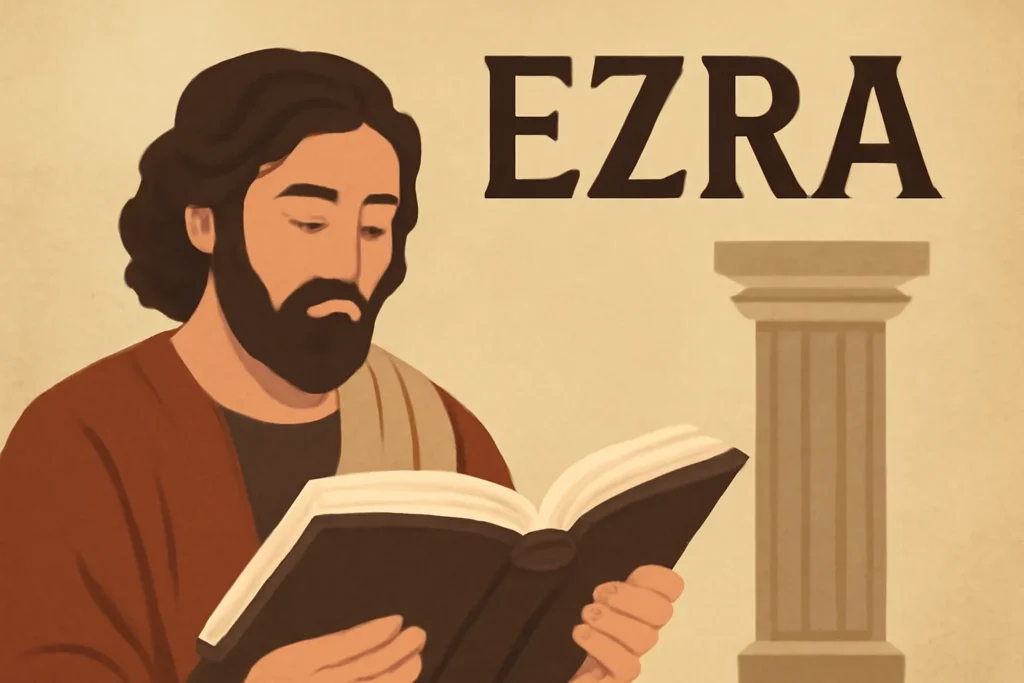
Ezra is the book’s central figure in its second half. Described as a priestly scribe and a devoted student of the Law, Ezra arrives in Jerusalem with authority to teach God’s statutes and to instruct the people in Yahweh’s commands. His mission is explicitly reform-oriented: to implement covenant renewal, to re-educate the populace in the Torah, and to restore a sense of holy living. Ezra’s leadership illustrates the power of religious education as a tool for transformation. He is not primarily a political leader but a reformer who seeks to reorient the community around Scripture and prayer.
Zerubbabel and Jeshua
In the first phase of Ezra, Zerubbabel—the political governor, and Jeshua the high priest—play crucial roles in guiding the return and the initial temple reconstruction. Their leadership embodies the fusion of civic authority and liturgical stewardship necessary to reestablish an ordered community in exile’s aftermath. Their work helps lay the physical and institutional groundwork that Ezra later reinforces through law and reform.
Cyrus’s decree to rebuild the temple inaugurates the post-exilic project, signaling divine blessing through a foreign ruler’s policy. Later, Artaxerxes grants Ezra the legal permission to appoint teachers, appoint judges, and enforce the law, showing how imperial politics can intersect with religious life. These figures remind readers that God’s purposes can work through secular authorities to advance spiritual restoration.
The Community and the Assembly
Behind the named leaders stands a broader community whose actions—collective repentance, public confession, corporate vow renewals, and communal reforms—shape the book’s arc. The assemblies that gather to hear the law, publicly acknowledge sins, and separate from practices that threaten covenant faithfulness demonstrate the social dimension of renewal. The community is not a passive receiver of decrees but an active participant in the reformation process.
Narrative Structure, Style, and Literary Features
Twofold Narrative Design
Ezra’s structure can be read as a two-part drama: the restoration of the temple (Chs. 1–6) and the restoration of the people through Torah obedience (Chs. 7–10). This configuration highlights how physical restoration and spiritual reform reinforce each other. The temple’s reestablishment provides the stage for a renewed covenant life, while Ezra’s law-centered reforms ensure that the community remains anchored to divine instruction as it carries out worship and daily living.
The book uses a formal, decree-driven style in several places. Chronicles of edicts from kings and the precise ordering of rebuild efforts give the narrative a documentary, almost archival feel. This approach underscores the reliability and legitimacy of the processes described, while also illustrating how public policy and sacred law intersect in shaping communal life.
Prayer, Confession, and Covenant Renewal
Ezra includes a significant moment of prayer and confession—Ezra’s own prayer in Ezra 9–10—where the community confesses sins committed by their ancestors and by some in the present generation. This liturgical moment dramatizes the cognitive and emotional components of renewal: recognizing past failures, seeking God’s mercy, and recommitting to the covenant. It also models a pattern for communities today: acknowledge wrongdoing, confess honestly, and pursue corrective steps through repentance and reform.
Takeaways and Practical Implications
Renewal Requires Both Space and Scripture
The Ezra narrative teaches that true renewal requires a restored sacred space (the temple) and a returned fidelity to sacred literature (the Torah). For readers today, the dual emphasis suggests that any sustained renewal effort should address both institutional infrastructure and doctrinal formation. Space without substance can become rote ritual; doctrine without worship can become abstract. The book argues for a balanced approach where worship, law, and community life align.
Leadership Matters: Vision, Courage, and Accountability
Ezra models leadership that is deeply committed to truth, reform, and communal well-being. The scribe’s courage to confront troubling practices, to teach the laws, and to call the people back to covenant faithfulness demonstrates how moral leadership can catalyze change. Readers can draw a practical lesson: leaders who articulate a compelling vision grounded in Scripture, who confront wrongdoing with humility but firmness, and who steward resources and processes with care can guide communities through difficult transitions.
Ezra’s stance on intermarriage within the post-exilic context raises enduring questions about how communities balance hospitality and fidelity to shared convictions. The text invites readers to reflect on how to maintain an open, welcoming community while preserving core commitments that define its identity. The takeaways here are not only about prohibition but about the intentional cultivation of a shared life that honors commitments, fosters accountability, and cultivates unity in diversity without compromising essential beliefs.
The Dynamic Between Empires and Religious Life
The narrative illustrates how religious communities navigate imperial politics. The permissive decrees of Persian rulers demonstrate how foreign authority can enable religious projects, while the subsequent reforms show how a community can also exercise agency to align practices with its covenantal integrity. This tension—between dependence on state permission and the imperative of spiritual fidelity—offers a nuanced lens for readers to think about church-state interactions in contemporary settings.
Ezra emphasizes the power of memory—genealogies, decrees, lists, and rituals—to ground identity. Preserving memory about who the people are, where they came from, and what they promised to God provides the continuity necessary for a community to endure through upheaval. The practical corollary is that institutions—schools, liturgies, archives, and public ceremonies—that foster memory can reinforce ongoing faithfulness and cohesion.
Questions, Reflections, and Interpretive Points
How does Ezra relate to Nehemiah? Ezra and Nehemiah together provide a more complete portrait of post-exilic renewal, with Ezra focusing on temple-related reforms and Nehemiah on rebuilding the city walls and social reforms. Together, they show that renewal involves both worship and civic life.
What is the significance of the intermarriage issue? The emphasis on separating from certain marriages is framed as a covenant problem—one that touches on worship, loyalty, and national identity. Modern readers might explore how boundaries and inclusion are navigated in communities facing assimilation pressures.
What is the role of law in Ezra? The Law functions as both a guide for worship and a social charter, shaping everyday decisions and communal norms. Ezra treats the law not merely as a set of rules but as the means by which a people lives in fidelity to God.
How does prayer function in renewal? Ezra’s prayer and the community’s confession reveal a dynamic relationship between repentance, divine mercy, and reform. Prayer is both personal and corporate, serving as a catalyst for structural changes.
What does Ezra reveal about leadership under foreign rule? It shows that leaders can leverage foreign authority to promote spiritual renewal while also needing courage to challenge practices that threaten covenant fidelity.
Variations of “Ezra Book Summary” and Semantic Breadth
When exploring the topic across different courses, articles, and study guides, you will encounter a number of phrasings that acknowledge the book’s dual focus and its lasting impact. You might come across phrases such as Ezra’s reform movement, Ezra the scribe and the covenant renewal, post-exilic temple rebuilding and Torah restoration, or the Ezra narrative on leadership, law, and worship. Each variation highlights a facet of the same core message: the post-exilic community seeks to realign itself with divine instruction while rebuilding its shared life around sacred space and scripture. Understanding these variations can help readers connect Ezra with broader biblical themes such as the significance of memory, the relationship between law and worship, and the dynamics of community reform in changing political contexts.
Takeaways for Readers in Contemporary Contexts
Community renewal is multi-dimensional: physical restoration (buildings, infrastructure) must be accompanied by spiritual renewal (law, ethics, worship, and communal norms) to sustain long-term transformation.
Public leadership interacts with sacred authority: Ezra demonstrates how religious reform can be catalyzed by state action, yet it requires moral courage, pastoral discernment, and communal participation to be faithful and effective.
Identity formation relies on shared practices: rituals, dietary laws, holy days, and public confessions help a community articulate who they are and why they exist, especially in the face of external pressures.
Repentance is a communal and ongoing process: confession and amendment are not one-off events but recurring commitments that sustain a people’s covenantal life across generations.
Summary Takeaways: What Ezra Teaches Us About Renewal
In sum, the Book of Ezra presents a nuanced, practical blueprint for how a code of worship, a system of governance, and a sense of shared memory can converge to renew a community after crisis. It underscores that restoration is not a single action but a sustained project that involves: recognizing divine providence in the return, restoring sacred space, re-educating in the law, reforming social practices, and renewing a people’s covenant identity. The enduring value of Ezra lies in its insistence that faithfulness to God requires both fidelity to the written word and a willingness to organize life around the worship of the one God who guides and sustains the community through times of challenge.
Closing Reflections: Connecting Ezra to Broader Biblical Narrative
For readers who are traversing multiple books of the Bible, Ezra serves as a bridge between the return from exile described in Chronicles and the city-building narrative of Nehemiah. It demonstrates how the exilic experience reshapes a community’s sense of vocation: not only to survive but to flourish by aligning social life with divine instruction. The story invites ongoing reflection on how a contemporary faith community can translate ancient covenants into present-day practices—how to balance tradition with inclusion, how to pursue justice and holiness, and how to pursue renewal with humility and hope. The broader takeaway is that renewal is a deliberate, communal effort anchored in worship, law, and shared memory, and it remains a relevant model for churches, schools, and communities seeking a principled path forward.










Leave a Reply