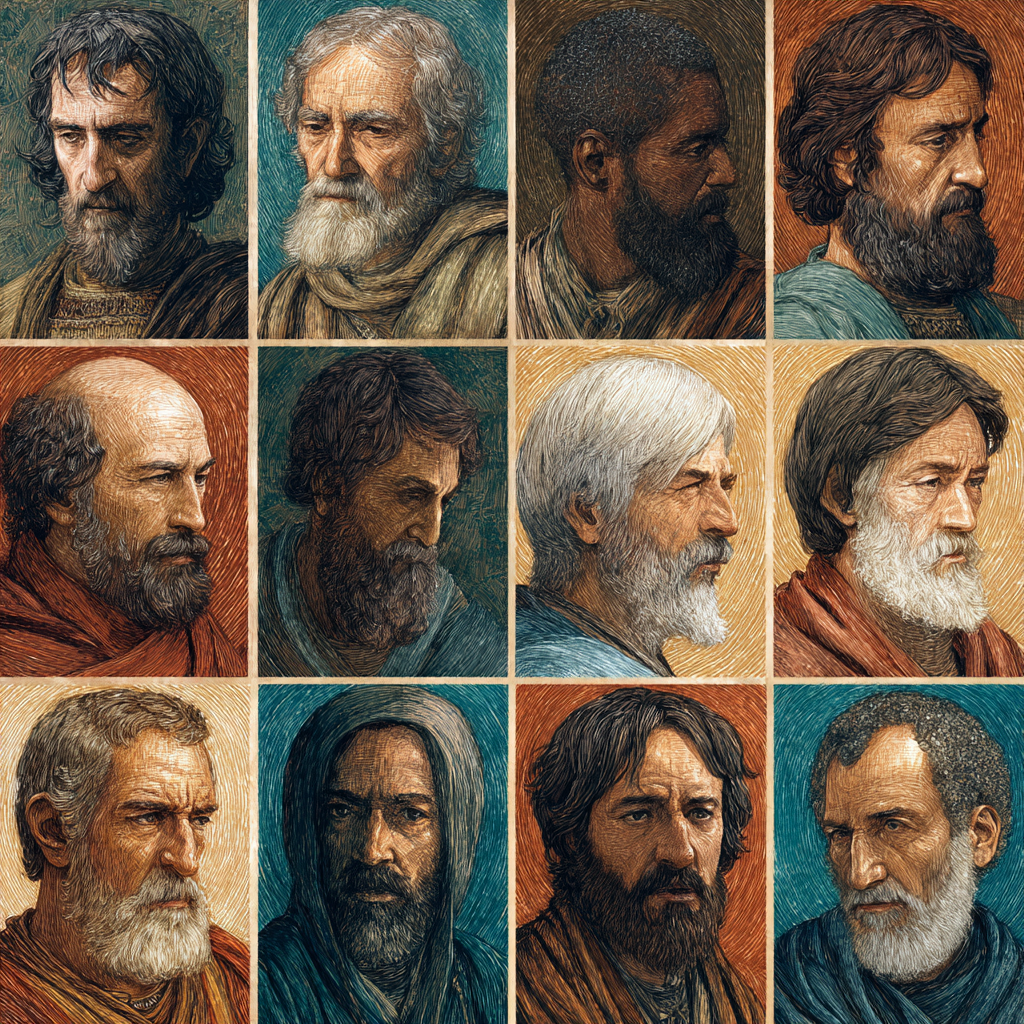
Across biblical narratives and centuries of Christian tradition, the twelve apostles stand as a foundational group for understanding early Christian leadership, mission, and community. These men—sometimes referred to as disciples in the Gospels and later as apostles in Acts—were chosen by Jesus to accompany him, learn from his teaching, and then carry a shared commission to proclaim the gospel, heal, cast out demons, and establish churches. The story of the 12 disciples is not only a list of personal names; it is a map of callings, backgrounds, personalities, and roles that together helped shape the spread of early Christianity.
Names vary in the biblical text and in later tradition. Some figures appear under multiple forms—Peter is also known as Simon Peter or Cephas; James and John are brothers, each with distinctive contributions; Thomas is often called Didymus, meaning “the twin”; Bartholomew is sometimes linked to Nathanael; and Judas Iscariot is the infamous betrayer who was eventually replaced by Matthias after the betrayal. This article uses variations of the names to reflect the semantic breadth found in scripture and tradition, while presenting a cohesive guide to who these twelve were and what they did.
The purpose here is twofold: to present the complete list of the apostles as most scholars understand it, and to give a concise portrait of each disciple’s role, calling, and impact on the early church. We will also acknowledge the textual distinctions among the lists in Matthew, Mark, Luke, and Acts, and explain how Matthias came to join the ranks after the departure of Judas Iscariot. By exploring the names and roles in a structured, accessible way, readers can gain a richer understanding of the collective mission these men carried and how their varied backgrounds contributed to a shared purpose.
The Complete List of the Apostles and Their Roles
The canonical New Testament presents the Twelve in several lists, with the most widely cited set including: Peter (also called Simon Peter or Cephas), James (the son of Zebedee), John (the son of Zebedee), Andrew, Philip, Bartholomew (also identified as Nathanael in some traditions), Matthew (also known as Levi), Thomas (also called Didymus), James the Less (son of Alphaeus), Simon the Zealot (also called Cananaean or Canaanite), and Judas Iscariot, who would betray Jesus. After Judas’s betrayal, the apostolic circle was expanded by the selection of Matthias, who joined the ranks to become part of the Twelve once again.
To help readers navigate the variations, this section presents two complementary lists: the Original Twelve Apostles before the betrayal, and the Twelve Apostles after Matthias’s selection in Acts 1. Each entry includes commonly used name forms and a note on the role that disciple played in the Gospels and early church history.
Original Twelve Apostles (pre-Betrayal): Names and Common Variants
Peter (also Simon Peter, Cephas) — the acknowledged leader among the apostles; a primary witness to Jesus’ ministry who later plays a pivotal role in the formation of the early church.
James (son of Zebedee) — often referred to as James the Greater; part of Jesus’ inner circle with John, and an early martyr in the Acts narrative.
John (son of Zebedee) — the beloved disciple; traditionally credited with the Gospel of John, three epistles, and Revelation; associated with deep experiential teaching and pastoral care in the early church.
Andrew — the brother of Peter; known for introducing others to Jesus and for his role in spreading the early message to new regions.
Philip — a key interlocutor in Jesus’ dialogues; associated with bringing Nathanael to Jesus and with questions about seeing the Father.
Bartholomew (often identified with Nathanael) — sometimes called by different regional or cultural variants; traditionally linked with missionary activity in various places.
Matthew (also Levi) — the tax collector who answered Jesus’ invitation; traditionally credited with authoring the Gospel that bears his name.
Thomas (also Didymus) — famous for doubts and subsequent confession of faith; later tradition places him in missions in India and beyond.
James (son of Alphaeus) — known as James the Less in some lists; less is recorded about his life in the New Testament, but he is counted among the core group.
Simon the Zealot (also called Simon the Cananaean) — named for his possible political leanings or zeal for the Law; a distinct voice among the apostles.
Judas Iscariot — the disciple who would betray Jesus; his role ends tragically, and he is replaced in the apostolic circle after the resurrection and ascension events.
Twelve Apostles after Matthias’s Selection (post-Betrayal)
Peter — remains the central figure among the Twelve after the replacement; a pillar of the early church in Acts and an instrument of key decisions and preaching.
James (son of Zebedee) — continues as a prominent apostle in the Acts narrative and early leadership circles, especially among the Jerusalem church.
John (son of Zebedee) — carries forward the Johannine tradition; his later writings and leadership contribute to shaping early Christian theology and church life.
Andrew — persists as a missionary figure in various regions; seen as a model of humble service and recruitment of new followers.
Philip — continues to engage with Jesus’ teaching questions and helps extend the reach of the message to broader audiences.
Bartholomew (Nathanael) — maintains a presence in the apostolic network, carrying forward the witness to Jesus as Messiah.
Matthew (Levi) — contributes to the spread of the gospel narrative and the establishment of early Christian communities among diverse audiences.
Thomas (Didymus) — persists in missionary effort and in the proclamation of faith across regions where the early church sought to take root.
James (the son of Alphaeus) — remains a quieter but operative voice in church leadership, with emphasis on community organization and fidelity to the gospel.
Simon the Zealot — continues to be a voice for zeal for God’s purposes, often associated with mission efforts in challenging contexts.
Matthias — chosen by the other apostles to replace Judas Iscariot; his inclusion enables the Twelve to maintain a complete circle for the mission ahead.
Profiles of Each Apostle: Roles, Callings, and Legacy
In this section, we look at each member of the Twelve, focusing on their call to follow Jesus, the gifts they brought to the apostolic fellowship, and the ways they contributed to the spread of the early Christian movement. The portraits below blend textual evidence from the Gospels with the rich tapestry of Christian tradition that has grown around these figures. Bolded terms highlight their core roles and distinctive contributions.
Peter: The Rock, The Leader, and The Peter-figure of the Early Church
Peter, sometimes styled as Simon Peter or Cephas, stands as the most prominent among the Twelve in many gospel narratives. His call is one of the clearest examples of Jesus inviting a fisherman to become a fisher of people, a metaphor that underscores the mission-oriented nature of discipleship. Peter’s leadership emerges early—he is the first to confess Jesus as the Messiah and later takes on the role of shepherding and guiding the apostolic community after Jesus’ ascension.
Role: Primary leader among the apostles; spearheading mission strategy and teaching; a shaping voice for church governance in early Christian communities.
Key moments: Confession of Jesus as the Christ; commissioning to feed and tend Jesus’ sheep; restoration after denial; central figure in Acts’ early expansion.
Legacy: Considered a foundational pillar of the church in Christian tradition; his name in various forms—Peter, Simon, Cephas—reflects his evolving identity in the narrative.
Variations of his name reflect the interplay of Hebrew, Aramaic, and Greek linguistic traditions across the biblical text: Simon Peter, Peter, Cephas. These variants echo how his leadership was perceived across communities and languages, highlighting how a single figure could become a unifying emblem for the movement.
Alternate Names and Identity
Simon Peter — the full form used in Luke and Acts to emphasize his given name alongside his chosen role.
Cephas — the Aramaic nickname used by Jesus and echoed in the Gospel of John; often understood as meaning “rock,” a symbolic title for stability and leadership.
Petro or Petros — the Greek transliteration that appears in the New Testament; forms of this name appear in Epistles as well.
James (son of Zebedee): The Inner Circle Member and Early Martyr
James the son of Zebedee is frequently called James the Greater to distinguish him from James the son of Alphaeus. Along with his brother John, he is part of Jesus’ intimate inner circle, a trio that witnesses some of Jesus’ most meaningful moments (transfiguration, key teachings). James’s life in the Gospels and early church history underscores a profile of bold witness and early sacrifice.
Role: Member of Jesus’ intimate circle; a leader who helps shape early apostolic decisions and the Jerusalem church’s early growth.
Key moments: His martyrdom is noted in the Acts narrative, marking him as one of the first apostles to die for the faith after Jesus’ resurrection.
Legacy: His martyrdom is often held as a symbol of steadfast witness; his partnership with John in the inner circle is a recurring theme in the Gospel accounts.
John: The Beloved Disciple, The Theologian, And The Apostle of Love
John, the son of Zebedee, is traditionally regarded as the beloved disciple whose close relationship with Jesus is depicted in the Gospel of John. Beyond the Gospel, John’s later writings—the three Johannine epistles and the Apocalypse—contributed richly to early Christian theology about love, truth, and the sovereignty of Christ.
Role: Theological witness, pastoral care, and the agent of spiritual revelation through his writings.
Key moments: Witness to Jesus’ signs; prolonged mentoring of early Christian communities; post-resurrection appearances; authoritative voice in early church teaching.
Legacy: His writings shaped the understanding of Jesus as the incarnate Word, the Spirit, and the Lamb who is worthy of worship in Revelation.
Andrew is notable for his role in introducing people to Jesus—most famously bringing his brother Peter to Jesus after an encounter with the Messiah. As a member of the broader apostolic ensemble, Andrew represents the theme of invitation and outreach: he helps widen the circle of those who follow Jesus and hear the good news.
Role: Early missionary zeal; connector who introduces friends and family to Jesus; acts as a bridge-builder for the early church.
Key moments: Following Jesus’ invitation, he immediately seeks out and introduces others, reflecting an active evangelistic impulse within the apostolic group.
Legacy: Viewed as a model of simple, faithful evangelism—an example that impact can begin with one invitation that multiplies later.
Philip: The Interlocutor who Questions and Clarifies
Philip is often portrayed as a practical thinker who asks Jesus thoughtful questions and seeks clearer understanding of Jesus’ mission. In the narrative where he asks to see the Father, he models the importance of seeking clarity in faith and the willingness to take steps toward deeper understanding.
Role: Communicator who helps theologize and translate Jesus’ teachings for broader audiences; a facilitator in conversations that reveal revelation about God’s presence.
Key moments: Interactions with Jesus that highlight genuine curiosity and the pedagogy of faith; contributions to the spread of the gospel through teaching and proclamation.
Legacy: Philip’s approach demonstrates that discipleship often involves patient teaching, practical questions, and relational outreach.
Bartholomew: Nathanael and the Witness to Jesus as Messiah
Bartholomew, who is often identified with Nathanael, brings a tradition of blessing and faithful witness. The Bartholomew/Nathanael linkage emphasizes the continuity of prompt recognition of Jesus as the Son of God and the King of Israel, a crucial confession that helps anchor faith in Jesus’ identity.
Role: Witness who affirms Jesus’ messianic identity; part of the apostolic network that expands the reach of the early church.
Key moments: Recognition of Jesus as the Son of God upon meeting him; consistent presence in the apostolic circle throughout early ministry.
Legacy: Bartholomew’s place in tradition underscores the importance of truthful recognition of who Jesus is and of bearing testimony in diverse communities.
Matthew: Levi the Tax Collector Turned Evangelist
Matthew—also known as Levi the tax collector—embodies a powerful narrative of transformation. Leaving behind a life of tax collection, he joins Jesus’ following and becomes a bridge between Jewish and Gentile audiences through his Gospel account and his role within the apostolic family.
Role: Scribe of the gospel story; a witness who documents Jesus’ ministry and teachings for a wide audience; a bridge-builder between communities.
Key moments: Leaving behind the tax booth to follow Jesus; hosting a feast that brings together various kinds of people to encounter Jesus’ message.
Legacy: The Gospel of Matthew is a foundational text for understanding Jesus as the fulfillment of the Hebrew scriptures plus the opening of a broader, mission-minded church.
Thomas: The Twin Who Names Faith in Confession
Thomas—often called Didymus—is renowned for a moment of doubt that leads to a bold confession of faith: “My Lord and my God.” This exemplary paradox reveals a disciple who wrestles with truth and ultimately embraces a profound confession of faith.
Role: Courageous witness who embodies the tension between doubt and faith, and who propels the spread of the gospel in the face of uncertainty.
Key moments: The famous doubt turning into resolute worship; a missionary trajectory that tradition associates with preaching the gospel in distant lands.
Legacy: Thomas is often invoked as a model of honest inquiry that matures into earnest devotion and bold proclamation.
James (the Son of Alphaeus): The Quiet Architect of Early Community
James the son of Alphaeus—sometimes called James the Less—appears less prominently in the Gospel action but remains a constructive part of the apostolic ecclesial network. His role exemplifies how a diverse group of disciples (with varying profiles) contributed to a cohesive mission.
Role: Stabilizing presence within the early church; governance and pastoral care through communal leadership.
Key moments: Participation in the spread of the gospel and support for the community’s organizational life.
Legacy: Demonstrates that the mission thrived not only by dynamic leaders but also by steady, faithful service from all participants in the apostolic circle.
Simon the Zealot: The Zealous Advocate for God’s Mission
Simon the Zealot—often called Simon the Cananaean in some traditions—embodies a zeal for God’s purposes that may reflect a prior political or devotional disposition. In the apostolic assembly, Simon represents the thread of fervent faith that sustains a mission to proclaim the kingdom of God in diverse contexts.
Role: A zealous advocate who helps carry the gospel into new cultural and geographic settings; a model of steadfastness in mission.
Key moments: Participation in the spread of the early church across regions; teamwork with the other apostles despite diverse backgrounds.
Legacy: Simon the Zealot testifies to the gospel’s ability to transform even those with intense prior commitments into faithful witnesses for Christ.
Judas Iscariot: The Betrayer and The Lessons He Teaches
Judas Iscariot stands as a cautionary figure in the gospel narratives. His betrayal of Jesus represents a dramatic turn in the timeline of salvation history and becomes a testing ground for the fidelity and integrity of the apostolic band. Judas’s actions lead to profound reflections about temptation, free will, and the need for repentance and reconciliation in the wake of betrayal.
Role: One of the Twelve who is entrusted with a place in the inner circle and with the ministry of proclamation; his fall prompts critical questions about integrity and responsibility.
Key moments: The betrayal in the garden and the ensuing events that lead to Jesus’ crucifixion; his departure from the apostolic fellowship is a turning point in the early narrative.
Legacy: Judas Iscariot’s life serves as a stark reminder of human frailty and the urgent need for accountability within leadership circles.
Matthias: The Replacement and The Reconstitution of the Twelve
Matthias appears in Acts 1 as the apostle chosen by casting lots to replace Judas Iscariot. His selection completes the Twelve as the number that carries the apostolic witness into the post-resurrection era. Matthias’s inclusion marks continuity and renewal in the mission—the continuity of Jesus’ commission carried by witnesses who have learned from him personally.
Role: Participant in the apostolic circle who immediately joins in the shared mission of testifying to Jesus’ resurrection and teaching.
Key moments: The moment of selection by the early disciples and the subsequent involvement in the early church’s life and mission.
Legacy: Matthias embodies the principle that missionary work benefits from deliberate renewal—an intentional reconstitution of the Twelve to maintain a complete, credible witness to Jesus’ life and teaching.
Why The Names Matter: Variations as Windows into Meaning
The numerous name variants for these twelve figures are not mere linguistic trivia. They offer a window into how early communities encountered Jesus and his followers across different languages, cultures, and social settings. For example:
Peter appears as Simon Peter and Cephas in different strands of tradition, signaling both his human identity and his role as “rock” in the church’s life.
John is repeatedly associated with the title the beloved disciple, highlighting a relational aspect of discipleship and a unique theological voice in the Johannine tradition.
Nathanael (identified with Bartholomew) serves as a reminder that the same follower may be named differently in various settings, reflecting cultural and linguistic adaptation.
Didymus (Thomas) points to the idea that a twin identity can accompany a distinctive faith journey—one that moves from doubt to faithful worship.
Kanaanaios or Cananaean (Simon the Zealot) hints at possible social or political identities that intersect with spiritual calling, illustrating the diverse backgrounds within the apostolic community.
The ability of the early church to integrate these varied identities into a single mission demonstrates a powerful principle: unity does not require uniformity of background, but it does require a shared commitment to the message and to the mission given by Jesus.
How the 12 Disciples Have Shaped Christian Thought and Practice
The twelve apostles are more than historical figures; they are the founding witnesses upon which Christian preaching, missionary activity, and ecclesial leadership have repeatedly drawn. Their stories inform:
Ecclesial authority: The sense in which leadership is entrusted to leaders who shepherd, teach, and guide communities in faith and practice.
Mission and outreach: A model for spreading the faith across geographic and cultural boundaries with discernment, courage, and humility.
Teaching and doctrine: The apostles’ testimonies become a primary platform for theological reflection on the person and work of Jesus, the identity of the Church, and the meaning of discipleship.
Repentance and restoration: The arc of Judas’s betrayal followed by Matthias’s replacement highlights the possibilities for renewal and continuation even after failures.
Variations in the List: A Friendly Guide to Different Biblical Translations
Different biblical translations, historical traditions, and church communities sometimes present small variations in the names or the ordering of the apostles. This is natural given:
The use of Hebrew, Aramaic, and Greek forms of names, leading to variants like Cephas vs. Peter, or Levi vs. Matthew.
Different identifications of certain figures (for example, Nathanael being linked with Bartholomew) across Gospel accounts and apocryphal traditions.
The transition from Judas Iscariot to Matthias as the official Twelve in Acts 1, which can be presented as either a replacement or a restoration of the number twelve to its complete form.
By recognizing these variations, readers can appreciate the breadth of early Christian tradition and understand how diverse communities identified with different apostles. The essential theme remains: these twelve were entrusted with a shared mission and shared authority to witness to Jesus’ life, death, and resurrection.
Conclusion: The 12 Disciples as a Model for Contemporary Discipleship
The 12 Disciples Names and their accompanying roles offer a timeless model for congregational life, mission, and church leadership. Their variety—ranging from bold leadership to quiet service, from questions that spark understanding to courageous proclamation—demonstrates that a healthy Christian community is built from multiple gifts harmonized around a common calling. Whether you read these accounts as historical narrative, theological reflection, or a blueprint for church practice, the core message remains clear: following Jesus requires both personal transformation and communal commitment to sharing that transformative message with the world.
In studying the complete list of the apostles and their roles, readers can gain practical insights for personal faith, for how communities organize themselves, and for how leadership is exercised in ways that are faithful, humble, and effective. The names—whether we speak of Simon Peter, John, Thomas, Matthias, or any of the other members—point to a shared history and a common purpose: to bear witness to Jesus and to carry forward the mission with courage and grace.