Genealogy of Mary, Mother of Jesus: Her Lineage, Heritage, and Spiritual Legacy
Genealogy of Mary, Mother of Jesus: Her Lineage, Heritage, and Spiritual Legacy
The genealogy of Mary, Mother of Jesus stands at the crossroads of Scripture, tradition, and theology, revealing how God wove His divine plan of salvation through generations of faithful men and women. More than a list of names, Mary’s lineage expresses the mystery of the Word made flesh —the eternal Son of God born of a humble virgin from Nazareth.
The New Testament provides two genealogical records of Jesus: one in the Gospel of Matthew (1:1–17) and the other in Luke (3:23–38). Both trace His ancestry to King David, but with distinct purposes.
Matthew begins with Abraham, emphasizing Jesus’s legal and royal right to the throne of David. This genealogy moves forward from Abraham to Joseph and underlines Jesus as the fulfillment of God’s covenant with Israel (cf. Matthew 1:1; 2 Samuel 7:12–13).
Luke, conversely, traces the line backward from Jesus to Adam, highlighting His role as the universal Savior and new Adam (cf. Luke 3:23–38; Romans 5:18–19).
While both lines list Joseph, early Christian scholars such as John of Damascus (An Exact Exposition of the Orthodox Faith, Book 4) and Julius Africanus proposed that Luke recorded Mary’s genealogy. They explained that Heli, listed as Joseph’s father, was actually Mary’s father, making Joseph Heli’s son by marriage. This interpretation preserves both the Davidic lineage and virginal conception, uniting Mary’s heritage with the Messianic promise.
2. A Possible Reconstruction of Mary’s Genealogy
To visualize the lineage of Mary, Mother of Jesus, ancient and modern tradition harmonize the data of Matthew and Luke with extra-biblical sources like the Protoevangelium of James. A simplified genealogical outline may look as follows:
                  Abraham
                      │
                 King David ─── Bathsheba
                      │
                   Nathan (son of David)
                      │
                [Several generations]
                      │
                   Matthan
                      │
             ┌────────┴────────┐
          Jacob             Joachim ─── Anne
             │                     │
           Joseph           **Mary (Miriam)** ─── Holy Spirit
                                    │
                             **Jesus Christ**
This scheme highlights both royal descent through David (by Nathan rather than Solomon) and priestly ancestry through Anne, alleged to descend from Aaron, the brother of Moses. These dual lines —royal and priestly— converge perfectly in Christ, who is both King and High Priest (cf. Hebrews 7:24–27).
3. Biblical and Prophetic Context
Mary’s role cannot be separated from the prophetic framework of the Old Testament. Her ancestry echoes prophecies that foretold the coming of the Messiah through David’s line.
Isaiah 11:1: “A shoot shall come out from the stump of Jesse, and a branch shall grow out of his roots.”
Jeremiah 23:5–6: “The days are coming,” declares the Lord, “when I will raise up for David a righteous Branch, a King who will reign wisely.”
Psalm 132:11: “The Lord swore an oath to David… One of your own descendants I will place on your throne.”
These verses show that Mary’s lineage fulfilled divine promises —her womb became the meeting point of prophecy and incarnation. Through her, God transformed centuries of expectation into a living reality.
4. The Protoevangelium of James and Early Traditions
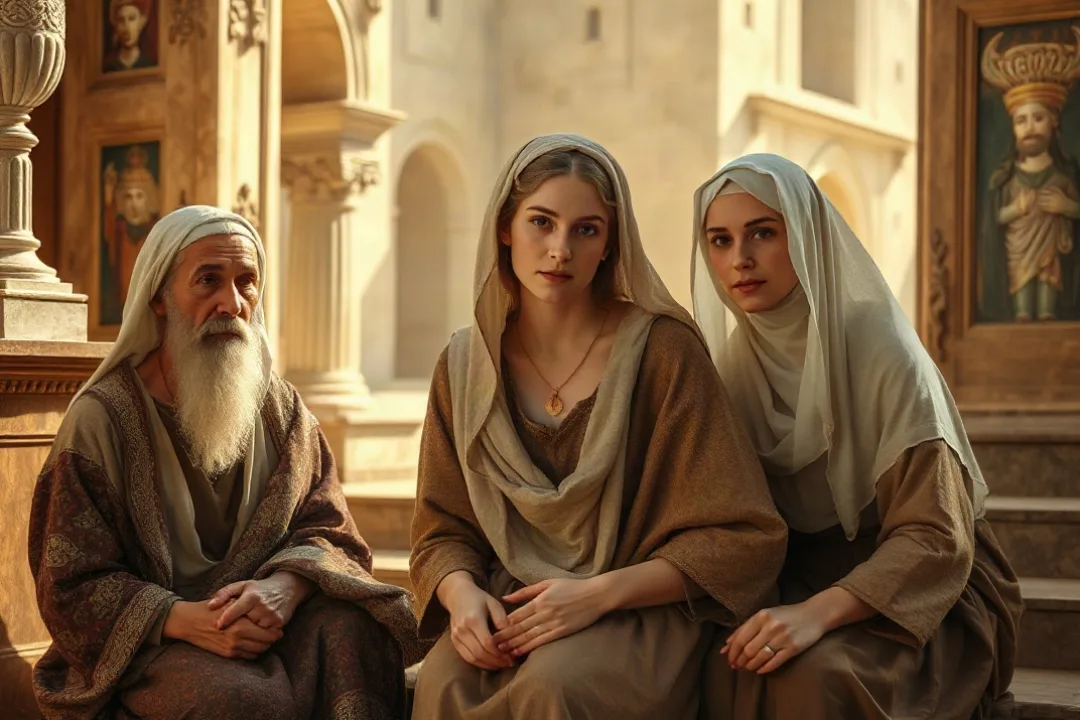
The Protoevangelium of James, an ancient Christian text written around the 2nd century, provides insight into Mary’s background. It names her parents as Joachim and Anne, describing them as a devout couple who dedicated Mary to the service of God at the Temple.
Though non-canonical, this text heavily influenced Christian piety and liturgy —especially the Feast of Saint Anne and Joachim. It also supports the belief that Anne belonged to the priestly family of Aaron, placing Mary at the intersection of royal and priestly lines, something profoundly symbolic in Christian theology.
5. Mentions in the Talmud and Historical Commentary
Fragments of the Babylonian Talmud (Shabbat 104b; Sanhedrin 67a) are sometimes interpreted as obscure references to Jesus and possibly to His mother. However, these texts are polemical, written centuries later, and therefore not reliable genealogical evidence. They do, however, indirectly confirm the historical impact that Mary and her lineage had on early religious debates.
6. Mary’s Extended Family in Scripture
The Gospels hint at Mary’s wider kinship network, especially through her relative Elizabeth, the mother of John the Baptist (Luke 1:36). Elizabeth is called “of the daughters of Aaron”, and her husband Zechariah served as a priest in the Temple (Luke 1:5). This means Mary’s family bridged both the tribe of Judah (royal) and the tribe of Levi (priestly).
This dual heritage aligns with Jesus’s mission: He is King in David’s line and High Priest forever (cf. Hebrews 7:17). The encounter between Mary and Elizabeth (Luke 1:39–45) beautifully symbolizes the meeting of Old Covenant and New, with both women carrying children destined to renew the world.
7. Was Mary Truly of Davidic Descent?
While the Gospels do not explicitly declare Mary’s Davidic lineage, theological logic and early Church consensus affirm that she was. Otherwise, it would be difficult to reconcile Jesus’s legitimate claim to David’s throne with the virgin birth.
Under Jewish law, lineage was legally transmitted through the father; hence Matthew and Luke both highlight Joseph’s genealogy to establish this right. Yet spiritually and biologically, it is Mary who provides the human nature of Christ —the “flesh” of the Word (cf. John 1:14). Through her, the promises made to David and Abraham find their perfect fulfillment.
8. The Spiritual Meaning of Mary’s Lineage
The lineage of Mary, Mother of Jesus, bears immense theological depth. It demonstrates that history, law, and faith converge in a single purpose: the redemption of mankind through Christ.
Messianic Fulfillment Mary’s ancestry unites the moral strength of the prophets and kings of Israel. In her, the promises to Abraham (Genesis 22:18) and David (2 Samuel 7:16) reach their fulfillment.
Universal Salvation By connecting Jesus not only to Israel but to all humanity through Adam (Luke 3:38), Luke’s genealogy portrays Him as the Redeemer for every nation, echoing Paul’s words in Galatians 3:28.
The Mystery of Divine Election God’s choice of a humble maiden from Nazareth illustrates that true nobility lies not in status but in grace. As Luke 1:28 declares, “Hail, full of grace, the Lord is with you.” Mary’s faith, more than her ancestry, crowns her as blessed among women (Luke 1:42).
9. The Descendants and Legacy of Mary, Mother of Jesus
Although Mary mother of Jesus descendants does not refer to biological offspring beyond Jesus —since Scripture testifies to her perpetual virginity (cf. Luke 1:34; Matthew 1:25)— her spiritual legacy extends through the Church itself.
Jesus, from the Cross, entrusted His mother to humanity through John: “Woman, behold your son… Behold, your mother” (John 19:26–27). From that moment, Mary became Mother of all believers, the heart of a vast spiritual family spanning generations. Every Christian, by faith, becomes part of this spiritual genealogy, inheriting the blessings promised to her Son.
When we study the genealogy of Mary, Mother of Jesus, we perceive the hand of Providence guiding human history. Her ancestry binds together prophecy, royalty, priesthood, and grace. The royal promise given to David, the priestly sanctity inherited from Aaron, and the obedient heart of a young woman of Nazareth all converge in the mystery of the Incarnation.
Mary’s genealogy is therefore not a mere ancestral record, but a symbol of God’s preparation —the patient unfolding of salvation through generations until the fullness of time arrived (cf. Galatians 4:4).
Conclusion: Mary’s Lineage as a Bridge Between Heaven and Earth
The genealogy of Mary mother of Jesus weaves together human and divine threads. Through the lineage of Mary mother of Jesus, Kings and prophets give way to the Virgin who would say, “Let it be done to me according to your word” (Luke 1:38). And through her obedience, the Word became flesh —the Son of the Most High born into the world.
Thus, the history of salvation turns a humble family tree into a cosmic genealogy, where each name reflects a promise fulfilled and each generation prepares the way for Christ, the fruit of Mary’s faith.
In her, human ancestry meets divine eternity. Through her, the story of grace, kingship, and redemption finds its perfect center.
Frequently Asked Questions on the Genealogy of Mary, Mother of Jesus
1. What is the lineage of Mary, Mother of Jesus?
The Bible does not explicitly provide Mary's genealogy. However, Luke 3:23–38 lists a genealogy traditionally thought by many scholars to represent Mary’s lineage through her husband Joseph as a legal heir, with Joseph being called the “son of Heli.” Some early Christian traditions suggest that Heli was Mary's father, making this possibly a maternal line.
2. How far back can we trace Mary's family tree?
If we accept Luke's genealogy as reflecting Mary's lineage, it traces back to Adam, making it universal in scope. However, this is theological in nature. In terms of historical documentation, Mary's lineage cannot be confirmed beyond a few generations due to the lack of records.
3. Are there any historical records or documents that support Mary's lineage?
There are no known contemporary historical records outside the Bible that document Mary's ancestry. Most claims about her lineage come from Church tradition and early Christian writings, like the Protoevangelium of James, a 2nd-century apocryphal text.
4. Did Mary have any siblings or cousins mentioned in the Bible?
The Bible does not mention any siblings of Mary. However, Elizabeth, the mother of John the Baptist, is referred to as Mary's "relative" (Greek: syngenis) in Luke 1:36. This term is broad and can mean cousin or another form of kinship.
5. Is there any evidence that Mary was a descendant of King David?
While no direct biblical statement says Mary descended from David, her connection to Joseph, who is from the house of David (Matthew 1:1–16; Luke 1:27), links Jesus legally to David’s line. Some traditions and interpretations of Luke's genealogy argue that Mary also descended from David, through Nathan, David's son.
6. What is the relationship between Mary and Elizabeth, the mother of John the Baptist?
As mentioned in Luke 1:36, Mary and Elizabeth were relatives. Elizabeth is described as a descendant of Aaron, the priestly line, suggesting a mix of Davidic and priestly heritage within their extended family.
7. What are the different traditions and beliefs about Mary's early life and family?
Tradition (not the Bible) holds that Mary’s parents were Saints Joachim and Anne. This comes primarily from the Protoevangelium of James. According to this account, Mary was born to elderly, devout parents and dedicated to God from an early age.
8. How does Mary's genealogy connect her to the broader history of Israel?
Mary’s connection to the house of David (directly or through Joseph) ties her to Messianic prophecies, as the Messiah was expected to come from David's lineage (2 Samuel 7:12–16). Her relationship to Elizabeth also connects her to the priestly heritage of Israel.
9. What can we learn about Mary's character and mission from her lineage?
Mary’s lineage—especially if seen as connected to both kingly (Davidic) and priestly (Levitical) lines—underscores her unique role in salvation history. Her humble background and obedience reflect God’s choice of the lowly to fulfill His purposes, aligning with themes in Luke’s Gospel.
10. How has the understanding of Mary's genealogy evolved over time?
Over time, interpretations of Mary’s lineage have varied. Early Church Fathers debated whether Luke or Matthew represented her line. Traditions about her parents and ancestry developed outside Scripture, especially in Eastern Christianity and Catholicism, enriching theological reflection but lacking firm historical evidence.
11. Who were the parents of Mary, Mother of Jesus?
According to early Christian tradition, especially the Protoevangelium of James, Mary’s parents were Joachim and Anne. This tradition is widely accepted in Catholic, Orthodox, and some Anglican churches, though not mentioned in the canonical Bible.